Carlo Scarpa’s Brion-Vega Cemetery

scarpa.jpg

“I would like to explain the Tomba Brion…I consider this work, if you permit me, to be rather good and which will get better over time. I have tried to put some poetic imagination into it, though not in order to create poetic architecture but to make a certain kind of architecture that could emanate a sense of formal poetry….The place for the dead is a garden….I wanted to show some ways in which you could approach death in a social and civic way; and further what meaning there was in death, in the ephemerality of life—other than these shoe-boxes.” Carlo Scarpa

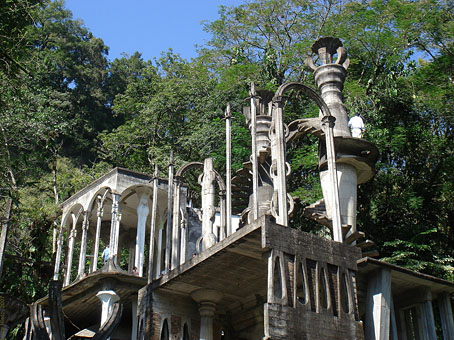
Dan Hill at City of Sound reminds us (okay, reminds me…) of Carlo Scarpa’s incredible private cemetery via a link to a Wallpaper* photo feature about the place. Scarpa’s final work (he’s buried in the grounds) was built for the Brion family at San Vito d’Altivole, Italy, and completed in 1978.

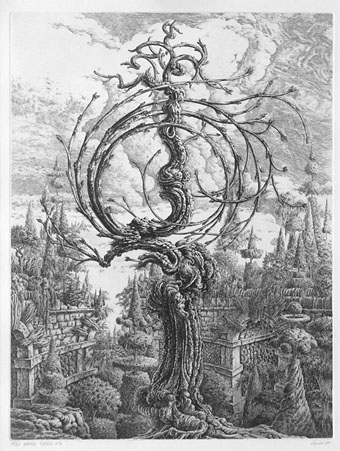
This construction and other Scarpa buildings often come to mind after encountering some disastrous use of concrete in architecture. Scarpa, like Frank Lloyd Wright, shows how well that meanest of building materials could be used with the application of care and imagination. And Scarpa, like Wright, also favoured attention to detail, with the cemetery providing copious examples of this, notably the motif of a pair of interlaced circles which feature as a prominent window design and recur in tiny elements elsewhere. Those paired circles and the garden itself remind me of the Jantar Mantar at Jaipur. I’m sure I read that one of Scarpa’s influences for the cemetery was Arnold Böcklin’s The Isle of the Dead but I’m unable to find any online reference. For more about that painting, there’s my earlier post on the subject.

• Flickr has a wealth of photographs of the cemetery
A black & white photo set by Gerald Zugmann

Previously on { feuilleton }
Hugh Ferriss and The Metropolis of Tomorrow
The Jantar Mantar
Arnold Böcklin and The Isle of the Dead
Frank Lloyd Wright’s future city

Roger Hiorns’ crystal world

hiorns.jpg

A visitor examining Seizure. Photograph by Sarah Lee.

I’d love to see this installation work which opened on Wednesday at 157 Harper Road, Southwark, London. British artist Roger Hiorns has transformed a flat awaiting demolition by growing thick mats of copper sulphate crystals on all the interior surfaces, a work he calls Seizure. Copper sulphate always brings back memories of chemistry lessons at school and childhood chemistry sets. I recall growing the crystals in a test tube but such meagre attempts at efflorescence give little indication of how beautiful these things are at a larger scale. Happily Flickr has further documentation of Hiorns’ work while Adrian Searle reviews it for The Guardian, fittingly referencing JG Ballard’s The Crystal World. “Seizure is a sort of sci-fi nightmare in Southwark, and that this happens in a council flat makes it all the more uncanny and disturbing,” he says. A shame, then, that it wasn’t situated in an empty high-rise block for maximum Ballard overload.

Seizure runs until 2 November, 2008. Artangel has location details and opening times.

Previously on { feuilleton }
JG Ballard book covers

Hadrian: Empire and Conflict

antinous.jpg

The sculpture known as Antinous Mondragone (c.130 AD).

The planned British Museum exhibition I mentioned in January, a major examination of the Emperor Hadrian’s life and influence, opens today and runs to 26 October, 2008. Hadrian means more to Britons than most Roman Emperors on account of the still-extant wall which bears his name, built to divide England from the untameable wilds of Scotland, or Caledonia as it was then known. On a personal level he fascinates for his obsession with his dead lover Antinous and the mausoleum (later the Castel Sant’Angelo) and villa he left in Rome.

Hadrian was a man of great contradiction in both his personality and reign: a military man and homosexual, he combined ruthless suppression of dissent with cultural tolerance. He reacted with great ferocity against the Jewish Revolt in 132 AD (examples of poignant objects belonging to Jewish rebels hiding in caves near Jerusalem will be included in the exhibition), but he was also a dedicated philhellene, passionate about Greek culture. He took a young Greek male lover, Antinous, who accompanied him on his travels around the empire. In AD 130, Antinous drowned in mysterious circumstances in Egypt. Consumed by grief, Hadrian founded a new city, Antinoupolis, close to the spot where he died and had Antinous declared a god, linked to the Egyptian deity Osiris. A cult of Antinous-Osiris sprang up resulting in statues, busts and silverware featuring the image of the newly deified youth.

And proving that this is a subject whose time has come, John Boorman has a film in production based on Marguerite Yourcenar’s Memoirs of Hadrian. Given Boorman’s uneven output that could be either a good or bad thing; we’ll no doubt find out soon enough.

A very modern emperor | Mary Beard on Hadrian
Hadrian’s Wall World Heritage site
Virtual Museum: Antinous Portraits

Previously on { feuilleton }
Hadrian and Greek love
Vedute di Roma
The Cult of Antinous