Rerberg and Tarkovsky: The Reverse Side Of “Stalker”

stalker.jpg

Stalker (1979).

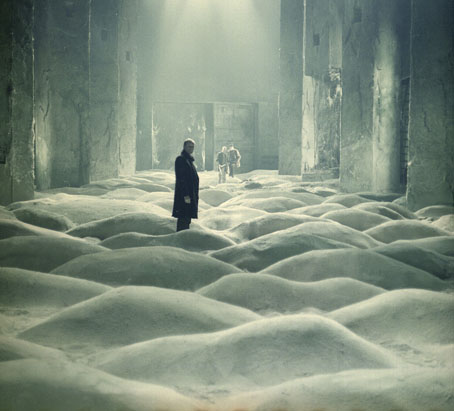
Among the new documentary films being shown at the Sheffield (UK) Doc/Fest is Igor Mayboroda’s Rerberg and Tarkovsky: The Reverse Side Of “Stalker”.  Behind the unwieldy title there lies an exploration of the troubled genesis of one of my cult artefacts, Andrei Tarkovsky‘s 1979 science fiction film, Stalker, a personal adaptation by the director of a Russian sf novel, Roadside Picnic, by Arkadi & Boris Strugatsky. Tarkovsky’s production suffered from technical calamities, illness, artistic disagreements and, worst of all, location work in a polluted area which (allegedly) caused the early deaths of a number of the people involved, including the director and leading actor, Anatoli Solonitsyn. All of which makes the completed film seem both miraculous and chilling for reasons beyond its uniquely sinister atmosphere.

When the British Film Institute launched a survey on “the film you would like to share with future generations”, behind Blade Runner in first place was a surprise second place entry: Andrei Tarkovsky’s science fiction film Stalker, in which a guide leads two clients to a site known as “the Zone”, which has the supposed potential to fulfill a person’s innermost desires. This creative documentary tells the remarkable story behind the making of Stalker, including the series of conflicts which led to crew members, most notably celebrated director of photography Georgi Rerberg, being left off the credits, leaving careers in tatters. Far from your standard making of doc, Director Igor Mayboroda has woven an engrossing “documentary cinema novel” which not only stands as a tribute to Rerberg’s career but also as a delight for cinephiles interested in how the creative process can flourish even under the most difficult and ultimately devastating of circumstances.

Stalker as it currently exists on DVD has a couple of interviews about the making of the film but nothing as substantial as Mayboroda’s documentary which sounds like essential viewing. Those in the Sheffield area can see a repeat showing on November 8.

Also at the Doc/Fest is a new film for the BBC’s long-running arts series, Arena, which will no doubt be screened on TV in due course. Eno is directed by Nicola Roberts and—needless to say—its subject is musician, producer, artist, etc, Brian Eno. Arena has always used Eno’s short piece, Another Green World, for its theme music but I believe this is the first time he’s been profiled in the series. Roberts also directed the excellent 1994 Arena doc, Philip K Dick: A Day in the Afterlife, so I’ll be looking forward to seeing this one as well.

Danger! High-radiation arthouse! | Geoff Dyer on his own Stalker obsession.

Previously on { feuilleton }
Brian Eno: Imaginary Landscapes
The slow death of modernism
Thursday Afternoon by Brian Eno
The Stalker meme

Drowned worlds

rockman1.jpg

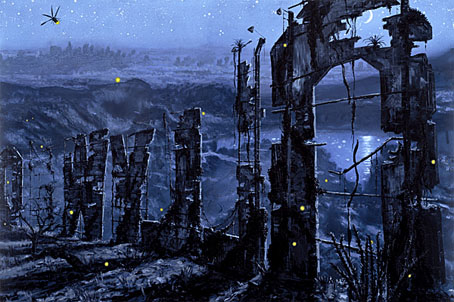
Hollywood at Night (2006).

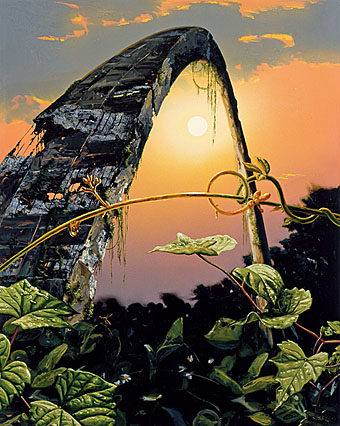
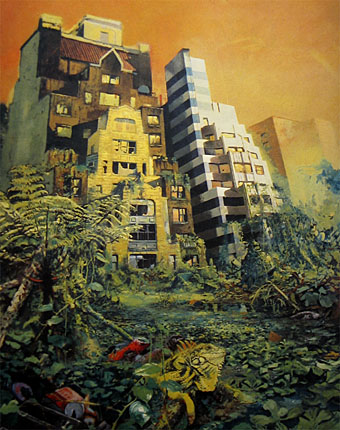
Alexis Rockman‘s paintings of swamped or ruined American landmarks present views which are a novelty in contemporary art galleries whilst being very familiar to science fiction readers. Many of these could well be illustrations for JG Ballard’s 1981 novel, Hello America, which imagined a depopulated United States reclaimed by flora and fauna. Others would suit The Drowned World, of course, and they bear favourable comparison with Dick French’s illustrated edition (below) which was also published in 1981.

rockman2.jpg

Gateway Arch (2005).

Rockman’s hothouse atmospheres remind me of earlier paintings of Brazilian wildlife by another American artist, Martin Johnson Heade (1819–1904), many of whose tropical landscapes only require a distant ruin or two to match Rockman’s work. (Tip via Design Observer.)

french.jpg

The Drowned World by Dick French (1981).

While we’re on the subject, Ballardian has posted the first of three features about my colleagues at Savoy Books, beginning with a Michael Butterworth interview which discusses some of Ballard’s connections with Savoy. One of the subsequent posts should see yours truly discussing the visual dimension of the Savoy world. More about that later.

Previously on { feuilleton }
The coming of the dust
Ballard and the painters

Virtual Alice

alice.jpg

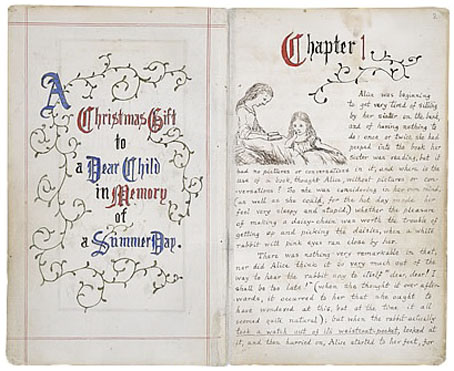
No, I didn’t go searching for this, I had my fill of Alice’s Adventures in Wonderland last month. The British Library website is a lot more amenable than it used to be for the casual browser, and one of its newer sections is a small collection of what they call virtual books which enable you to leaf through some of their exclusive volumes. The pages above are from the original handwritten manuscript, Alice’s Adventures Under Ground, from which the printed book was later adapted. I have this in a small facsimile edition so I don’t need a web version, and the illustrations are often reprinted, but this web copy allows you to see the work in its entirety. They also reproduce the text and have an audio facility. I went through my copy a couple of times whilst working on the calendar in order to see how Dodgson depicted some of his scenes. A few of his conceptions differ from the famous Tenniel illustrations, not least his drawing of Alice herself who closely resembles the real Alice Liddell.

Previously on { feuilleton }
Psychedelic Wonderland: the 2010 calendar
Charles Robinson’s Alice’s Adventures in Wonderland
Humpty Dumpty variations
Alice in Wonderland by Jonathan Miller
The Illustrators of Alice

Salomé scored

nazimova.jpg

Alla Nazimova as Salomé (1923).

I wrote a while ago about Alla Nazimova’s luscious silent film production of Oscar Wilde’s Salomé, a suitably Decadent affair with an allegedly all-gay cast, and costume and stage design based on Aubrey Beardsley’s celebrated illustrations. The film is currently touring England and Wales with a new score for four musicians by composer Charlie Barber, an extract of which can be heard here. I like the Middle Eastern sound of this, a shame the film isn’t coming to Manchester.

salome1.jpg

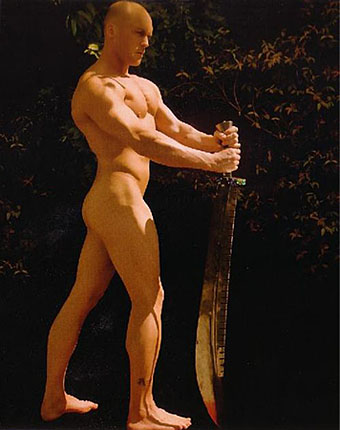
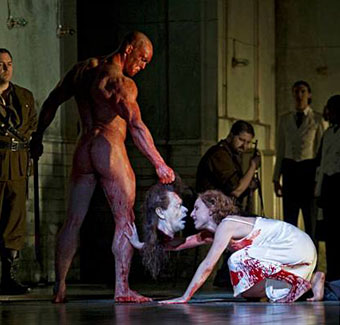
By coincidence, artist Clive Hicks-Jenkins sent these photos of an impressive Duncan Meadows and his equally impressive sword as additions to the burgeoning Men with swords archive. Meadows is shown as the executioner in a Royal Opera House production of the Strauss opera, appearing at the end of the drama bearing the head of John the Baptist. Given the way that Salomé’s body has always been the focus of attention in this story, Meadows’ appearance makes a striking change, one which Wilde himself might have appreciated.

salome2.jpg

Elsewhere on { feuilleton }
The men with swords archive
The Salomé archive

Previously on { feuilleton }
Equus and the Executionist

Heart of dance

rnc.jpg

One of a series of stunning ads by Y&R of Chicago for the River North Chicago Dance Company which give the old “body as machine” a contemporary and rather erotic twist. (I would have credited the photographer but the ad agency site is the usual Flash interface which refuses to work in any of my browsers.) The picture below is an older version of the meme by Fritz Kahn from 1926.

kahn.jpg

Via Homotography.

Previously on { feuilleton }
Tiger Lily
Chris Nash
Peter Reed and Salomé After Dark
Felix D’Eon
Dancers by John Andresen
Youssef Nabil
Images of Nijinsky
The art of Hubert Stowitts, 1892–1953