Dalí in Wonderland

dali1.jpg

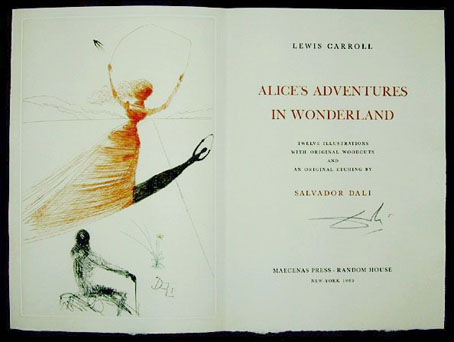
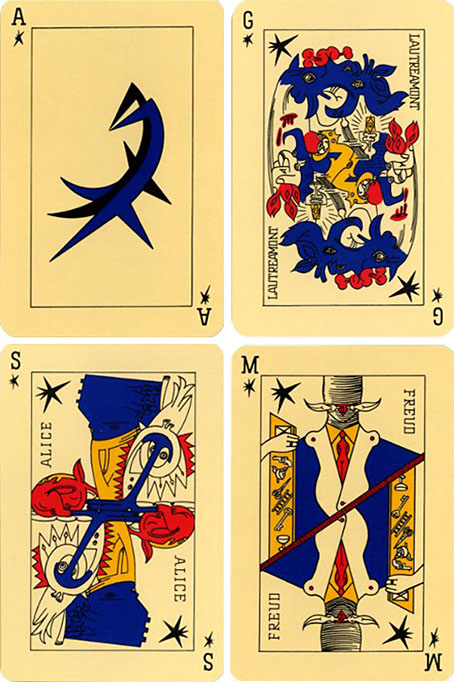
I’d only seen one or two of Salvador Dalí’s illustrations for Alice’s Adventures in Wonderland before but you can see the complete (?) set here. These date from 1969 when Dalí was well past his prime as an artist but they’re still worth a look to see how he tackled each chapter, using the skipping girl motif from earlier paintings as his Alice figure. The attraction of the Alice books for the Surrealists is no surprise; Max Ernst produced a rather enigmatic series of Alice-themed lithographs while André Breton had earlier made Alice the “Siren of Stars” in the set of Surrealist playing cards he designed in the 1940 (below). I’d imagine there are other connections I’ve missed; leave a comment if you know of any. (Thanks to Charity for the tip!)

For more Dalí, here’s something I neglected to link to a while ago, the legendary Dalí meets Disney short, Destino.
stars.jpg

Elsewhere on { feuilleton }
The illustrators archive

Previously on { feuilleton }
Virtual Alice
Psychedelic Wonderland: the 2010 calendar
Charles Robinson’s Alice’s Adventures in Wonderland
Humpty Dumpty variations
Alice in Wonderland by Jonathan Miller
Dalí and Film
The Illustrators of Alice
Surrealist cartomancy

Beardsley at the V&A

abva.jpg

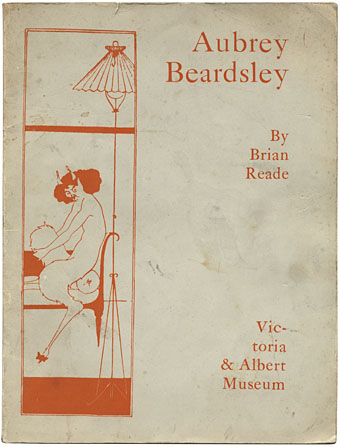
This battered item is my copy of the V&A guide to the landmark Aubrey Beardsley exhibition held at the museum from May to September 1966. That exhibition introduced Beardsley to a new public and made his work very trendy for a while, helped by the Beardsley-styled sleeve of the Beatles’ Revolver album which was released the same year, and a general resurgence of interest in fin de siècle style. Aside from a rare unfinished drawing, there isn’t anything in the booklet which hasn’t been reprinted many times elsewhere but it does contain an excellent overview of the artist’s career by Beardsley scholar Brian Reade.

abva2.jpg

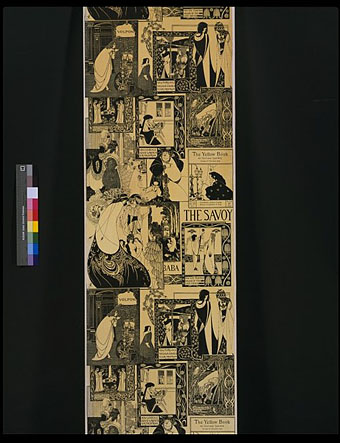
The V&A website has gained a new feature recently which allows you to search their collections with either a specific search or a random browse. The results don’t give the kind of high-resolution results which I’d like (unlike the British Museum) but the Beardsley works can now be seen in something like their actual condition, edge of the paper and all. Also present is the above piece of Beardsley trivia, a yellowed sheet of wallpaper manufactured by Arthur Sanderson & Sons Ltd in 1967. The Deansgate office of Savoy Books was once covered in this stuff but had unfortunately been papered over by the time I arrived on the scene.

Elsewhere on { feuilleton }
The Aubrey Beardsley archive

Finch posters

finch.jpg

I won’t say this is by popular demand but after persistent requests for posters of my cover art for Jeff VanderMeer’s latest novel, Finch, I’ve opened a new CafePress shop selling exactly that. The largest of these is 58.38cm x 82.55 (22.984″ x 32.5″) which should be big enough for most appetites. There’s also a smaller size 35.03cm x 49.53 (13.7904″ x 19.5″) and I’ve added some cards and postcards.

In Finch, mysterious underground inhabitants known as the gray caps have reconquered the failed fantasy state Ambergris and put it under martial law. They have disbanded House Hoegbotton and are controlling the human inhabitants with strange addictive drugs, internment in camps, and random acts of terror. The rebel resistance is scattered, and the gray caps are using human labor to build two strange towers. Against this backdrop, John Finch, who lives alone with a cat and a lizard, must solve an impossible double murder for his gray cap masters while trying to make contact with the rebels. Nothing is as it seems as Finch and his disintegrating partner Wyte negotiate their way through a landscape of spies, rebels, and deception. Trapped by his job and the city, Finch is about to come face to face with a series of mysteries that will change him and Ambergris forever.

Jeff is currently promoting Finch on his latest book tour, details of which can be found here.

Previously on { feuilleton }
Finch