Tadanori Yokoo animations

yokoo13.jpg

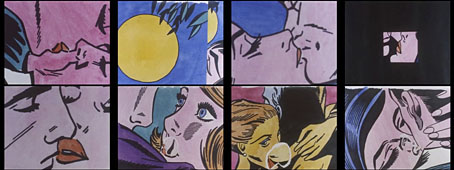
Kiss Kiss Kiss (1964).

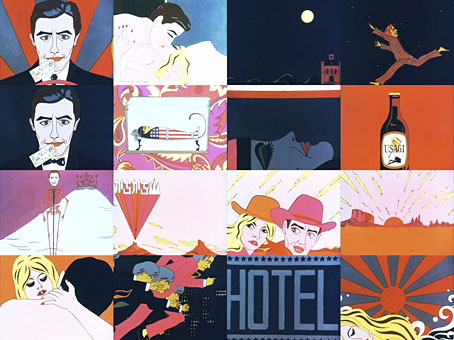
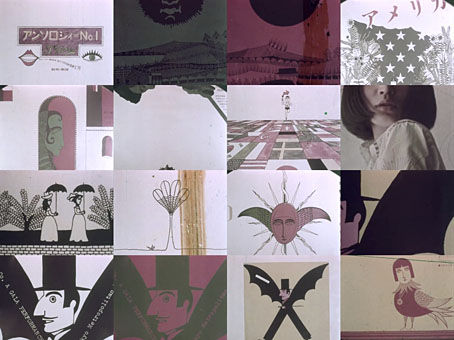
A follow-up to yesterday’s post, and three short films by the artist from the 1960s. As animations go these are fairly crude but they do have the benefit of showing Yokoo’s sense of humour, something which isn’t necessarily so obvious in his poster art. Kiss Kiss Kiss is a short sequence of juxtaposed couples from the same American romance comics that Roy Lichtenstein spent much of his time plundering. Kachi Kachi Yama, the longest of the three, opens with the unlikely claim that it features Alain Delon, Elizabeth Taylor, Richard Burton, Marilyn Monroe and The Beatles, then makes good by showing drawings of all of these in a witty melodrama which is like Yokoo’s poster art brought to life. Tokuten Eizou Anthology No. 1 is a lot less explicable being a display of the artist’s drawings together with the occasional photograph. All three films can be seen together at Ubuweb.

yokoo14.jpg

Kachi Kachi Yama (1965).

yokoo15.jpg

Tokuten Eizou Anthology No. 1 (1964).

Previously on { feuilleton }
Tadanori Yokoo album covers

Tadanori Yokoo album covers

yokoo01.jpg

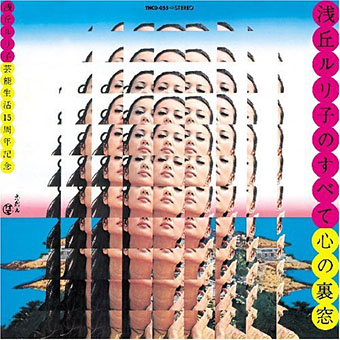
Kokoro No Uramado (1969) by Asaoka Ruriko.

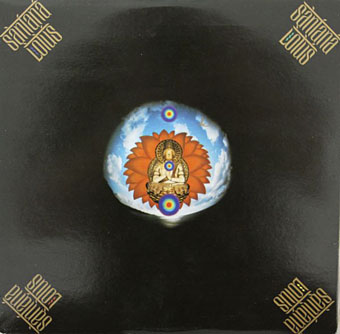
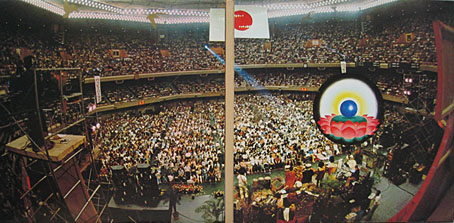
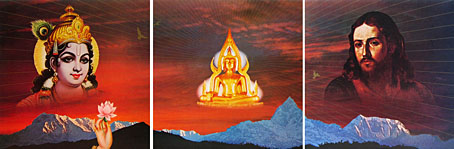
A few examples of Tadanori Yokoo’s earlier cover designs which are the ones I prefer. Although he’s continued to produce collage art for music releases, the CD format does his work few favours. I lose interest musically in Santana after about 1970 so I’d not looked properly at their triple-live set Lotus before, an album which is one of those worth having for the cover alone. Worth having for the cover and the music is Miles Davis’s thundering jazz-rock monolith Agharta which for some reason was given a different cover by Elena Pavlov on its US and European release. For Yokoo’s more recent cover art see his Discogs page.

yokoo02.jpg

Lotus (1974) by Santana.

yokoo03.jpg

Lotus (1974) by Santana.

yokoo04.jpg

Lotus (1974) by Santana.

Continue reading “Tadanori Yokoo album covers”

William E. Jones on Fred Halsted

halsted1.jpg

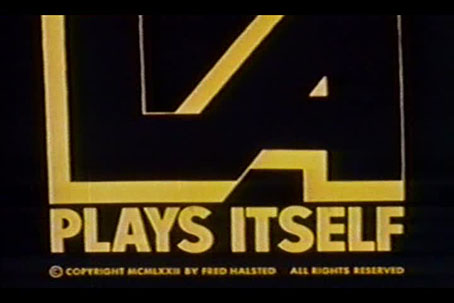
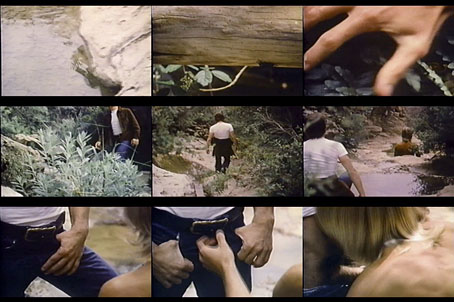
Presenting an interview by John Wisniewski with William E. Jones, author of Halsted Plays Himself (2011). The subject is gay filmmaker and performer Fred Halsted (1941–1989) whose 1972 film LA Plays Itself was a pioneering piece of low-budget cinema which combined a fragmented view of Los Angeles with explicit liaisons between several men, one of them portrayed by Halsted himself. Halsted took advantage of the period between 1970 and 1975 when porn in the US was no longer illegal but hadn’t yet been industrialised. As with Genet’s Un Chant d’Amour, what you get on the screen isn’t a product, it’s the representation of an obsession. It’s this that makes LA Plays Itself a still surprising and provocative piece of work.

I arrived at this film and Halsted somewhat belatedly, in fact I don’t think I’d read anything about him at all until William E. Jones was interviewed when his book was published. (Matters haven’t been helped in this country by the way hardcore porn of any kind was still illegal into the 1990s.) LA Plays Itself fascinates for the view it gives of the LA cruising scene which John Rechy described in considerable detail in The Sexual Outlaw. It’s a curiously hybrid film, neither straightforward porn—many of the sex scenes are fragmented—nor is it narrative fiction or outright documentary. Together with the recently reissued films of Peter de Rome, it’s the kind of thing that few people would be likely to make today, despite the easier access to film technology and the relaxing of censorship. And like all porn films of this era, it now has a unique look simply because it’s been shot on film.
halsted2.jpg

None of Halsted’s films appear to be on DVD at the moment, and as William Jones notes below, Sextool (1975), the film Halsted regarded as his major work, may only exist as a single fading print.

Here’s John and William.

* * *

John Wisniewski: Why did you choose to write your book on filmmaker Fred Halsted?

William E. Jones: For several years I made money in the adult video industry, producing budget DVD compilations (4 hours for $10) sold in adult video stores. Before technological innovation rendered my job redundant, I watched over 700 hours of gay adult film and video produced between 1969 and 1999. In such vast quantities, the material, especially from the second half of the period, began to seem nightmarish in its ugliness. I would relish the opportunity to see any earlier title, produced before 1985, directed more or less like a movie, shot on location, and sometimes even acted fairly well. I can say without hesitation that Fred Halsted’s films were my favorites of all the videos I saw during those years in the porn industry.

Fred Halsted’s films have many fans but few advocates, and I thought my book could intervene in a decisive way before his legacy – the films and the memories of those who knew him personally – disappears completely. I also chose him as my subject because of his connection to Los Angeles. He lived and worked in neighborhoods I pass through nearly every day. But there was something else that drew me to his films, the uncanny power of work by a novice, and a self-taught one at that. His films are crude, idiosyncratic, and at their best have the force of a revelation.

Continue reading “William E. Jones on Fred Halsted”
La femme qui se poudre

bokanowski1.jpg

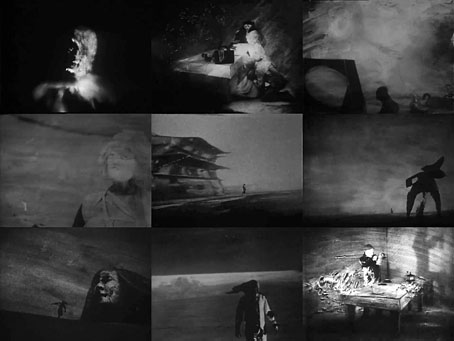
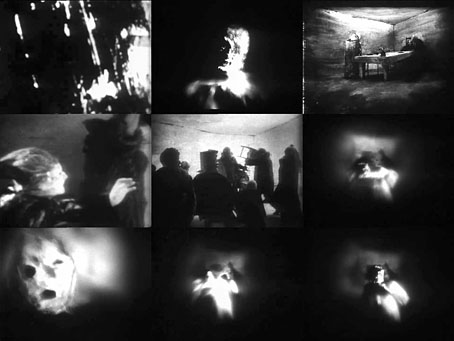
The DVD collection of films by Piotr Kamler turned up last week so I’ve been alternating viewing of that with shorts by Patrick Bokanowski. The latter is less an animator than a filmmaker who uses animation or film effects to achieve his aims, together with masks and very stylised performances. Bokanowski’s early film La femme qui se poudre (The Woman Who Powders Herself, 1972) runs for 15 minutes, and is as remarkable in its own way as his feature-length L’Ange (1982). La femme qui se poudre has the same masked figures engaged in activities which often lack easy interpretation; in both films the atmosphere can shift from absurdity to the edge of horror and back again. For me what’s most remarkable about this particular short is the way it anticipates both Eraserhead and the early films of the Brothers Quay yet still seems little known. The Quays are on record as admiring L’Ange but I’ve yet to see any sign that David Lynch knew of this film in the 1970s. I’d be wary of assuming that Lynch was imitating Bokanowski, artists are quite capable of finding themselves working in similar areas independently.

bokanowski2.jpg

Films of this nature always benefit from well-matched soundtracks: Piotr Kamler uses recordings by different electronic composers; Eraserhead had Fats Waller and the rumblings and hissings of Alan Splet; the Quays have unique compositions by Lech Jankowski. La femme qui se poudre and L’Ange have outstanding soundtracks by Michèle Bokanowski, the director’s wife and an accomplished avant-garde composer. Her work is as deserving of further attention as that of her husband. DVDs of L’Ange and a collection of Patrick Bokanowski’s short films may be purchased here.

Previously on { feuilleton }
Le labyrinthe and Coeur de secours
Chronopolis by Piotr Kamler
Brothers Quay scarcities
Patrick Bokanowski again
L’Ange by Patrick Bokanowski

Weekend links 159

francov2.jpg

El Banquete Magnético (2011) by Cristina Francov.

Did Vertigo Introduce Computer Graphics to Cinema? asks Tom McCormack. He means Saul Bass’s title sequence which mostly uses still harmonographs but also features some animated moments by John Whitney.

•  Temple of the Vanities by Thomas Jorion. “Pictured here are political monuments and munitions depots, hulking concrete forms that marked the edges of empires.” Related: Paintings by Minoru Nomata.

• Musical reminiscences: Matt Domino on the Small Faces’ psychedelic magnum opus Ogden’s Nut Gone Flake, and Richard Metzger on the sombre splendours of Tuxedomoon.

Harrison is best known as one of the restless fathers of modern SF, but to my mind he is among the most brilliant novelists writing today, with regard to whom the question of genre is an irrelevance. To read his work is to encounter fiction doing what fiction must: carrying out the kinds of thinking and expression that would be possible in no other form. I pass through his novels feeling a mixture of wonder, calmness and disturbance; I end them brain-jarred and unsettled. Metaphysical echoes persist for days afterwards. It feels as if I have had a strabismus induced, causing illusions that slowly resolve into insights.

Robert Macfarlane on M. John Harrison and the reissue of Climbers.

• Divine Machinery: An Interview with Paul Jebanasam. Arvo Pärt, Cormac McCarthy and Algernon Blackwood are folded into his new album, Rites.

Autostraddle shows the evolution of twelve queer book cover designs. As is often the case in cover design, latest isn’t always best.

• “My Definition Of Hell? It’s Other People, At The Cinema!” Anne Billson on the very thing that finished me as a cinema-goer.

• “London in the 1830s was a truly weird and terrifying place.” Spring-Heeled Jack, The Terror of London.

• At Scientific American: The Reading Brain in the Digital Age: The Science of Paper versus Screens.

Van Dyke Parks: “I was victimised by Brian Wilson’s buffoonery.”

Colour film of London in 1927.

Abandonedography

Social Dead Zone

• Tuxedomoon: Tritone (Musica Diablo) (1980) | Desire (1981) | Incubus (Blue Suit) (1981)