Seward/Howard

burroughssphinx.jpg

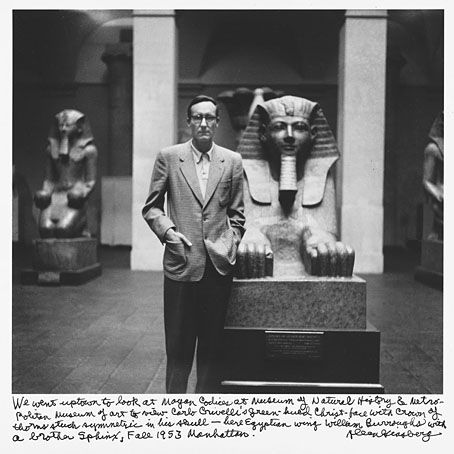
William Burroughs, New York, 1953. Photo by Allen Ginsberg.

Lonely lemur calls whispered in the walls of silent obsidian temples in a land of black lagoons, the ancient rotting kingdom of Jupiter – smelling the black berry smoke drifting through huge spiderwebs in ruined courtyards under eternal moonlight – ghost hands at the paneless windows weaving memories of blood and war in stone shapes – A host of dead warriors stand at petrified statues in vast charred black plains – Silent ebony eyes turned toward a horizon of always, waiting with a patience born of a million years, for the dawn that never rises – Thousands of voices muttered the beating of his heart – gurgling sounds from soaring lungs trailing the neon ghost writing – Lykin lay gasping in the embrace can only be reached through channels running to naked photographic process – molded by absent memory, by vibrating focus scalpel of the fishboy gently in a series of positions running delicious cold fingers “Stand here – Turn around – Bend”

The Ticket that Exploded (1962)

William Burroughs always talked favourably of Ernest Hemingway, and the famously spare style of Hemingway’s prose is evidently a style he sought himself, especially in the later works where there’s less of an emphasis on linguistic pyrotechnics. Something that always strikes me when I return to Burroughs’s earlier novels is the quality of passages like the one above which is a long way from the Hemingway style. What’s even more noticeable—and this is something which attracted me to Burroughs’s work from the outset—is the degree to which some of these passages are reminiscent of HP Lovecraft. In the case of the example above, taken from The Black Meat chapter of The Ticket that Exploded, some of this may be the work of Michael Portman who Burroughs credits as co-writer. What Portman contributed to The Black Meat and another chapter of that novel I’ve never discovered but there are plenty of other examples by Burroughs alone to show that he wasn’t incapable of this himself. The Ticket that Exploded was the first Burroughs book I read, and part of the shock and fascination came from encountering a recognisable Weird Tales-style atmosphere wrenched into inexplicable and thoroughly alien territory.
hpl.jpg

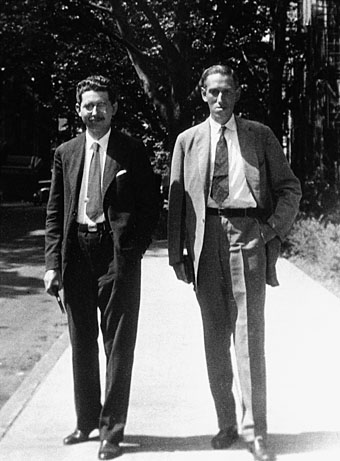
Frank Belknap Long and HP Lovecraft, New York, 1931. Photo by WB Talman.

There are others connections beyond literary style. When the Simon Necronomicon was published in 1977 Burroughs was asked to provide a blurb for the book. He wasn’t as effusive as the publishers might have hoped but the dubious volume was still advertised with his recommendation:

Let the secrets of the ages be revealed. The publication of the Necronomicon may well be a landmark in the liberation of the human spirit.

If it wasn’t for this then the extraordinary Invocation which opens Cities of the Red Night (1981) would have been diminished. Among the other “gods of dispersal and emptiness” whose names are called, Burroughs mentions “Kutulu, the Sleeping Serpent who cannot be summoned”, and “the Great Old One”, among a number of the usual Mayan gods, and several Sumerian deities whose descriptions (as with Kutulu) are taken from the pages of the Simon Necronomicon. It’s impossible to imagine Saul Bellow or John Updike opening a novel this way, just as it’s impossible to imagine many genre writers wandering into the areas that Burroughs explores elsewhere in that novel. This is one reason why Burroughs (and JG Ballard) were included in DM Mitchell’s The Starry Wisdom anthology in 1994, an attempt to expand the acceptable boundaries of Lovecraftian fiction, and also wilfully trample the fences that separate the genre and literary camps. I campaigned at the time for The Black Meat chapter to be included but Dave was set on Wind Die, You Die, We Die from Exterminator! (1973), a lesser piece although in the end it didn’t seem out of place in the book as a whole.

Elsewhere on { feuilleton }
The Lovecraft archive
The William Burroughs archive

Thot-Fal’N, a film by Stan Brakhage

brakhage1.jpg

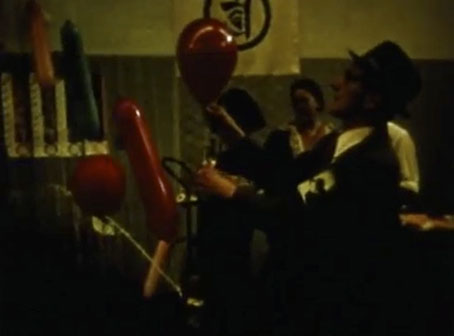
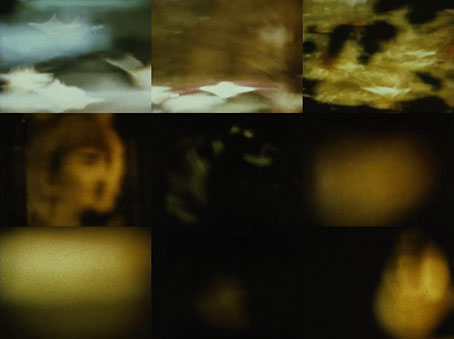
A final film for this week of Burroughs-related posts. Thot-Fal’N (1978) is a typical piece of Stan Brakhage montage: 9 minutes of completely silent close-ups, shots blurred to incoherence, plus occasional clips of American streets or people. Among the identifiable humans there’s a brief sequence with William Burroughs and a balloon, also shots of Allen Ginsberg and Peter Orlovsky. Brakhage enjoyed creating cinema that was deliberately abstract and without narrative so there’s no need to go looking for a meaning.

brakhage2.jpg

Elsewhere on { feuilleton }
The William Burroughs archive

Mr Bradly Mr Martin Hear Us Through The Hole In Thin Air

bradly1.jpg

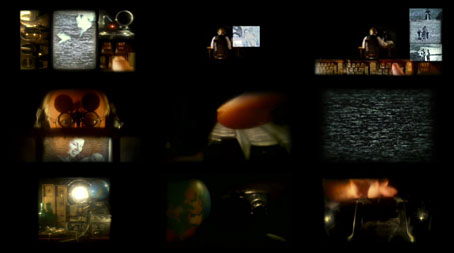
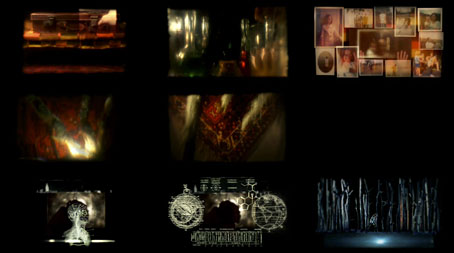
Vimeo swarms with Burroughs-related films, many of which might not have been made had it not been for the profusion of recordings of the author reading his work. This short from 2010 is one of the better examples, a combination of live-action film and animation by Greig Johnson that crams a considerable amount of invention into five minutes. The text is from the mulch of cut-ups that formed Nova Express, the recording being one of the tracks on Burroughs’s first album of readings, Call Me Burroughs (1965). Given the film’s style and short running time it makes a good double-bill with Philip Hunt’s Ah Pook Is Here (1994).

bradly2.jpg

Elsewhere on { feuilleton }
The William Burroughs archive

The Last Words of Dutch Schultz, a film by Gerrit van Dijk

lastwords.jpg

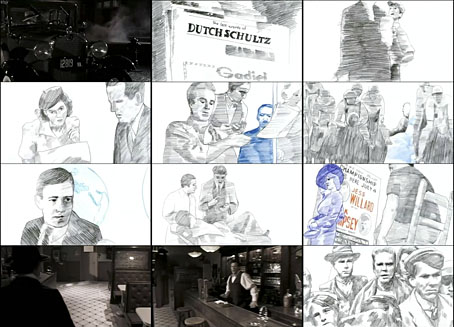
Gerrit van Dijk’s combination of live-action sequences and rotoscoped animation is tangentially related to William Burroughs, it being Burroughs who popularised the deathbed ramblings of New York gangster Arthur “Dutch Schulz” Flegenheimer with a “fiction in the form of a film script” also entitled The Last Words of Dutch Schultz (1970).

Flegenheimer was gunned down in the toilet of the Palace Chop House in Newark, New Jersey, in October 1935. Three of his associates had also been shot but he survived, and he spent two days muttering in his hospital bed while a police stenographer took notes. Burroughs was fascinated by the dissociated stream-of-conscious nature of the transcript which revealed little about his assailants but drifted feverishly through memories and hallucinations. The shooting and the deathbed ramblings were further popularised in 1975 by the publication of the Illuminatus! trilogy by Robert Shea and Robert Anton Wilson in which some of Flegenheimer’s more surreal pronouncements—”A boy has never wept nor dashed a thousand kim”—acquire occult significance. Flegenheimer and his last words also turn up in Exterminator! (1973), and Burroughs further fragmented the transcript in at least one of his own recordings where he reads out the equally strange phrases from transcripts of so-called electronic voice phenomena over an earlier reading of Flegenheimer’s words; the voices of the (supposed) dead wiping out the voice of the dying.

Burroughs’ Last Words of Dutch Schultz is nicely presented in its original form, the pages being laid out like a screenplay interposed with crime-scene photos from the period, Flegenheimer’s mug-shots and Art Deco graphics. The scene descriptions range through Flegenheimer’s life and mob history; whether they would make a good film or not would no doubt depend on the director. A film based on the script would be feature-length, and the narrative is a very fragmented one. Gerrit van Dijk’s film runs for 23 minutes and takes a similar approach, dramatising the shooting from different angles while juxtaposing the live action with animated sequences that are often anachronistic. Rutger Hauer supplies Flegenheimer’s dying voice. The anachronistic moments don’t contribute much unless we’re meant to regard Flegenheimer’s fever as being some kind of precognitive vision. Given the nature of the material—Depression-era gangsters, hallucinations, the Burroughs connection—I’m sure this won’t be the last film we see on the subject.

Elsewhere on { feuilleton }
The William Burroughs archive

Burroughs at 100

wsb.jpg

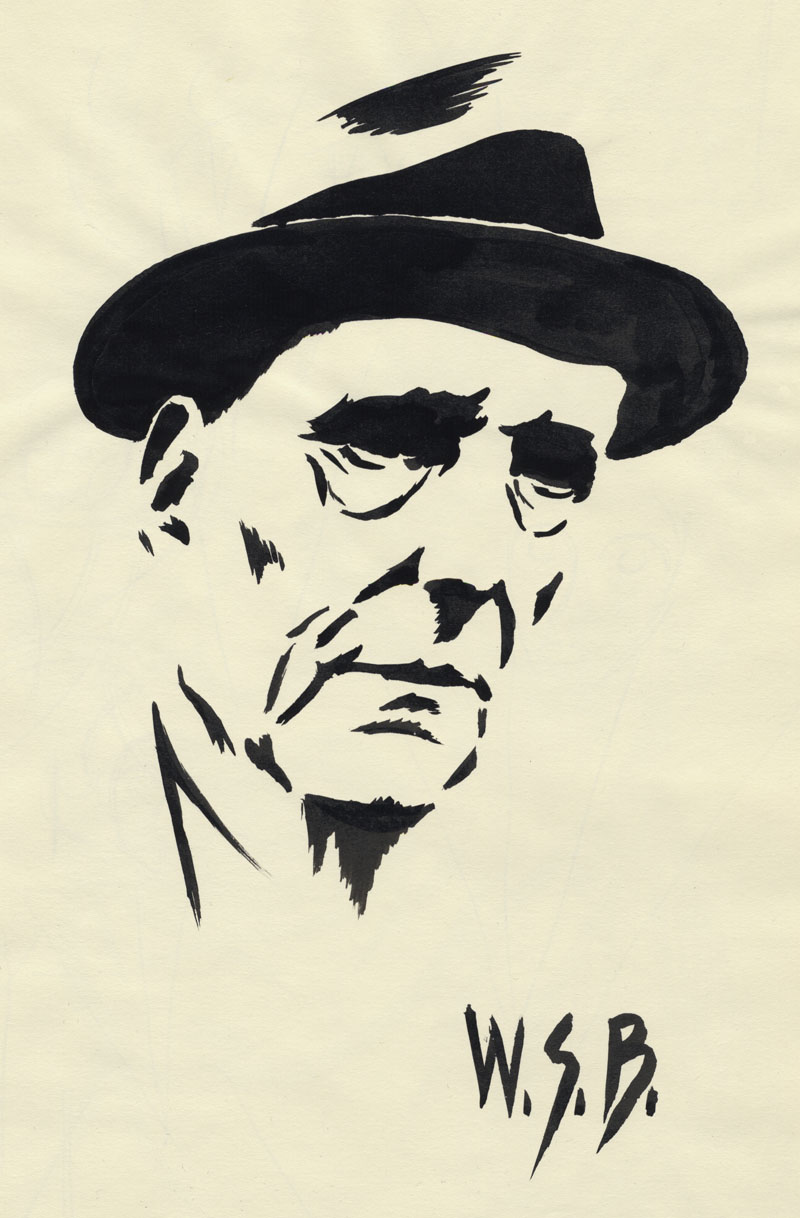
Something from 1994 I found in an old sketchbook. Ink on paper.

Happy birthday, Bill. To celebrate the Burroughs centenary I could have put together several very different mixes of Burroughs-related music—there’s been a lot of it, and he was blessed with some excellent collaborators—but in the end decided on a version of something I’ve been messing with on and off for about twenty years.

Seven Souls Resouled by Feuilleton on Mixcloud

Bill Laswell’s associations with William Burroughs go back to Laurie Anderson’s Mister Heartbreak (1984) album which Laswell played bass on and co-produced. Burroughs had a guest spot on the last track, Sharkey’s Night, and that session may have led to the 1989 album by Laswell’s Material project, Seven Souls, a seven-track album based around Burroughs’s readings of passages from The Western Lands. This has always been my favourite of all the albums which set Burroughs texts to music, not least because Laswell has always surrounded himself with exceptional musicians. I liked this album so much I used to try padding it out on cassette tape with other Laswell productions, many of which feature the same musicians, and even similar riffs and instrument sounds. I could never settle on a definitive mix, however, and even the one presented here doesn’t feel absolutely right although it works far better than all previous versions. Matters aren’t helped by there being much extraneous material (so to speak): Seven Souls was reissued in 1997 with remix tracks, and there’s also a related EP, The Road To The Western Lands, with further remixes. Then there are the many tracks which match the Seven Souls sound, not least on the 1994 Material album, Hallucination Engine, which also features a Burroughs reading. Laswell’s solo albums, and much of his Axiom label, is infected by Burroughs-like titles; for a while Axiom even promoted its world- and genre-spanning ethos with the slogan “Nothing is true; everything is permitted”. The Beatles may have put Burroughs’s face on the cover of the Sgt Pepper album but Bill Laswell has done far more to spread the virus of the man’s work. Below there’s a guide to the tracks followed by another visit to the Wild Boys.

William S. Burroughs – Word Falling, Photo Falling (1960s)
One of the numerous tape recordings from the 1960s which are like audio equivalents of the books Burroughs was writing at the time. This one is from Nothing Here Now But The Recordings (1981).

Material – Ineffect (1989)
The first track from Seven Souls.

Ginger Baker – Dust to Dust (1986)
Bill Laswell produced two Ginger Baker solo albums, Horses and Trees (1986), from which this track is taken, and Middle Passage (1990). Both feature Laswell’s core group of Material musicians including Nicky Skopelitis, Bernie Worrell and Aiyb Dieng. Baker was a member of a later incarnation of Material, and appears on the Live In Japan (1993) album.

Material – Seven Souls (1989)
The second track from Seven Souls.

Material – Ruins (Submutation Dub by Bill Laswell) (1994)
From Material’s other masterwork, the mighty Hallucination Engine.

Material – Soul Killer (1989)
The third track from Seven Souls.

Ginger Baker – Under Black Skies (1990)
From Baker’s Middle Passage album.

Material – The Western Lands (1989)
The fourth track from Seven Souls.

Mandingo – Lanmbasy Dub (Kora in Hell Mix by Bill Laswell) (1993)
A slight deviation from the Seven Souls tracklist. The first four Burroughs tracks were followed by two very different pieces: Deliver, featuring the voice of Gambian musician and kora player Foday Musa Suso, and Equation which combined a rock riff with Rammellzee’s vocals. Foday Musa Suso is another floating member of Material who also released an album, New World Power (1990) on Laswell’s Axiom label under the name Mandingo. This track is an extended remix of the first track from New World Power.

Bill Laswell (with William S. Burroughs, Techno Animal, Iggy Pop) – The Western Lands (1999)
Hashisheen : The End Of Law is one of many one-off Laswell projects, this one featuring a collection of readings about Hassan i Sabbah set to music. Burroughs appears briefly two years after his death reading what may have been a Seven Souls outtake. Iggy Pop then reads a piece from The Western Lands.

Material feat. Rammellzee & phonosycographDISK – No Guts No Galaxy (1999)
In place of Equation from Seven Souls there’s this rap number from Material’s Intonarumori album.

Bill Laswell – Flash Of Panic [Pipes Of Pan / Up Above The World / Under Black Skies / Out Of The Ether] (1994)
Part of a track from the Axiom Ambient album which blends some of Laswell’s recording of the pan pipes at Jajouka with strings from a Jonas Hellborg album, and Omar Faruk Tekbilek’s ney from Under Black Skies.

Material – Soul Killer (Remote Control Mix by Terre Thaemlitz) (1997)
The reissue of Seven Souls featured three remixes of which this has always been my favourite. Terre Thaemlitz subjects Burroughs’s voice to some granular distortion then cuts-up his words.

Material – The End of Words (1989)
The seventh and final track from Seven Souls.

Continue reading “Burroughs at 100”