
Main aesthetics

main01.jpg

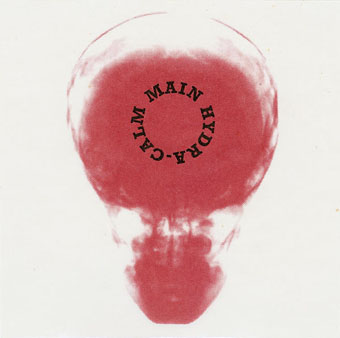
Hydra-Calm (1992).

It’s always good to find a group of musicians who not only make the kind of sounds you like but also package their work effectively. Having read the Quietus interview with Robert Hampson last week I was going back through the catalogue of Hampson’s 90s group Main and thinking again how well the design of their digipak singles and albums complemented their music. Main evolved out of an earlier rock outfit, Loop, and the earliest Main productions still bear some trace of the trancey Loop approach to rock structures. The first Main album, Hydra-Calm, was released on Situation Two, and comes packaged like the first album from Faust, with an X-ray of a skull on a transparent sheet replacing the X-ray fist of the German group.
main02.jpg

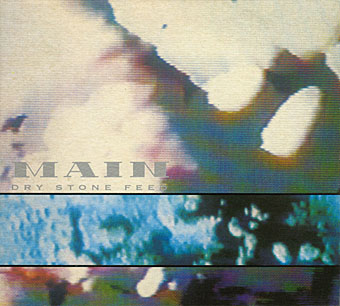
Dry Stone Feed (1993).

With a move to the Beggars Banquet label a year later, a different design approach was adopted which set the template for nearly all the Main releases during the 1990s. An outfit (or person) named Avida is credited with Main’s design, with the name being adjusted on various releases to Avida Design, Avida Formations, Avida Hydroforms and Avida Iceforms. The decision to dwell on varieties of texture matches the evolution of the group’s music from arrangements of guitar, bass and drums to abstract and increasingly minimal fields of sound; in this respect, Deliquescence was a perfect title. Hampson and co. created their sound fields by subjecting guitar noise to unspecified sampling and effects processes. When Simon Reynolds invented the term “Post-rock” to describe some of the musical developments happening in the 1990s, Main always seemed to be exemplars of the term, they really did go from being a bona fide rock band to a group pushing sound far beyond anything to do with rock music at all.
main03.jpg

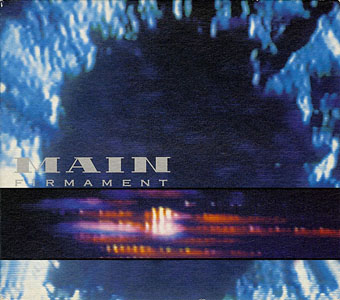
Firmament (1993).

The photos used by Avida Design start out as shots of TV screens or computer monitors then range through the natural world with close-ups of rock formations, lichen, wood grain and underwater ice. The typography is nearly always Copperplate Gothic (or a sans serif variation) printed in metallic silver ink. The most satisfying release for me was the Hz set of six CD-singles released from mid-1995 to 1996, the last of which came with a box to place the singles in and a booklet containing symbols which relate to each disc. Hz is the peak of their output, and although it was later released as a double-disc set I prefer the box.

Anyone looking for these releases today can find copies for sale at Discogs.com. Robert Hampson is still active, his site is here. A few more Main covers follow.
Continue reading “Main aesthetics”

Everything old is new again

negovan.jpg

Thomas Negovan.

Music journalist Simon Reynolds has been garnering attention over the past couple of weeks with his new book Retromania, an exploration of the thriving revivals and resurrections in the musical world and an examination of what this may mean for the future. There’s an astute discussion along these lines between Reynolds and Colin McKean over at The Quietus (and it is a discussion for once, rather than the more usual Q&A). The debate is a pertinent one but seems a little insular in its focus on music alone, and pop music in particular. Other creative disciplines have been dealing with questions of influence and originality for some time, they only seem pressing concerns in the musical world because so much music from all nations and eras is now available, and pop as a form is still relatively young.

In addition to the rear-view mirror approach to musical creation, there’s another side to retromania in the present fascination with antique musical instruments and recording equipment. The Cramps once declared that they preferred valve amplifiers because valves “turned the music to fire”; amps containing silicon chips, on the other hand, deadened the music by routing it through pieces of stone. There’s a lot of this attitude around at the moment (organic analogue versus inorganic digital), not least the persistent fetish for analogue synthesizers which dates back as far as 1995 and the Node project. That said, you’ll have to work hard to find anyone pursuing a retro aesthetic with greater determination than Thomas Negovan, a Chicago musician intent on releasing a 4-track EP which has been recorded directly onto wax cylinder using an 1894 Edison recording machine. Negovan and co. plan to release the recording on vinyl (with no digital technology used in the transfer), and also release a single on wax cylinder, a medium which they say hasn’t been used in this way since 1924. They still need some funding so there’s a Kickstarter page for the project here, and more details about Mr Negovan’s music over at his MySpace page.

Lastly, and quite by coincidence, The Wire‘s website has been running Antique Phonograph Portal links this week, including mention of a wax cylinder preservation project at the University of Santa Barbara. Go here, here and here for further details.

Update: Jay reminds me that he wrote a piece for the LA Weekly back in 2003 about the ongoing interest in music of the past.

Previously on { feuilleton }
Obsolete formats continued
Old music and old technology

Weekend links 11

orazi4.jpg

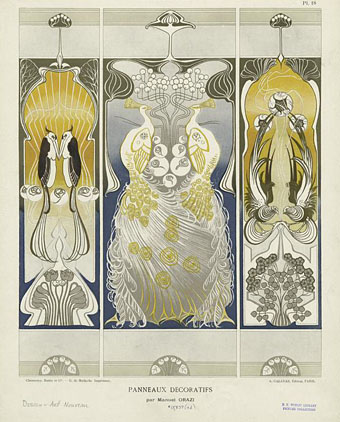
Panneaux decoratifs (1900) by Manuel Orazi at NYPL.

Ghostsigns: “a collaborative national effort to photograph, research and archive the remaining examples of hand painted wall advertising in the UK and Ireland.”

• Golden Age Comic Book Stories posts some Alphonse Mucha.

Voyage Fantastique – An illustrated guide to the body and mind at A Journey Round My Skull.

The gallery of the International Exhibition of Calligraphy.

Trevor Wayne Pin-Up Show, a new photo collection of the tattooed Mr Wayne which includes photos and a foreword by Clive Barker.

Phallophonies, a gallery exploring the penis in religious art. Related: “Churchgoers are outraged over a crucifix in a Catholic church that they say shows an image of genitalia on Jesus.”

Hollingsville: “Expect live and unscripted wanderings around voodoo science parks, examinations of cities as battle suits and thoughts on pods, capsules and world expos.”

Phantom Circuit #33 is a Ghost Box special featuring an interview with Jim Jupp (Belbury Poly) and Julian House (The Focus Group). Related: Ghost Box films at YouTube.

Eldritchtronica and Wyrd Bliss, a mixtape by Simon Reynolds.

• Avant garde music and cinema meet at The Sound of Eye.

• Make your own newspaper with Newspaper Club.

Drawdio: A pencil that lets you draw music.

Yoko Ono collects rare books.

KittehRoulette.

• Song of the week: The Four Horsemen (1972) by Aphrodite’s Child.

Wyatting

These are people after my own heart as this is something I’ve been doing for years with jukeboxes. Usually the challenge was to find the weirdest thing in the whole selection of records which would often be a B-side of some sort. “Wyatting” seems a rather unfair name for something that’s annoying people (although if it’s going to be named something it may as well be after the wonderful Robert). If it’s irritation you want then “Merzbowing” (see below) would seem more apt, not least because of its relation to the Dada works of Kurt Schwitters.

* * *

Wyatting (vb): when jukeboxes go mad by Ned Beauman

Just as the best way to judge an adult is by his or her record collection, the best way to judge a pub is by the albums on its jukebox. Or it was, until the 21st-century caught up with the noisy machine in the corner. There are now nearly 2,000 internet-connected jukeboxes in the UK, each of which can access as many as 2m tracks – and with them has come Wyatting, which is either a fearless act of situationist cultural warfare or a nauseatingly snobbish prank, depending on who you ask.

The phenomenon was first identified in the New York Times by Wendy McClure. She was in a grimy rock bar when someone pulled up Brian Eno’s Thursday Afternoon, which consists of a single distant piano phrase repeated for more than an hour, and found herself too mesmerised to leave. “Imagine replacing the brass cylinder in a music box with a Möbius strip made from nerve endings,” she wrote. The rest of the bar’s patrons , however, were soon in revolt.

This wasn’t to be an isolated incident. After music critic Simon Reynolds linked to McClure’s article on his weblog, several of his readers wrote in to confess that this is a game they regularly play. Carl Neville, a 36-year-old English teacher from London, coined the term “Wyatting” because sticking on Dondestan, the 1991 avant-garde jazz-rock LP by ex-Soft Machine singer Robert Wyatt, is the perfect way to disrupt a busy Friday night in a high street pub. Other favourites are free-jazz clarinetist Evan Parker and surrealist Japanese noise producer Merzbow. In theoretical terms, Wyatting has been explained as enacting the theories of Adorno, who believed that subverting pop music would help to bring down capitalism. Alternatively, if you listen to Neville, it’s simply “childish, futile, but finally hilarious”. (More.)