Directed by Saul Bass

bass1.jpg

Phase IV (1974).

It’s been a thrill recently poring over the Saul Bass monograph, Saul Bass: A Life in Film & Design by Jennifer Bass & Pat Kirkham, a large volume that weighs a ton and is as revelatory about the career of a great designer (and his wife and frequent collaborator, Elaine Bass) as you’d hope. One pleasure was getting to read about Bass’s film work from his own viewpoint for once. The curious science-fiction film he made in 1974, Phase IV, is well-known enough to have a cult reputation but too often his long involvement with Hollywood is passed over as a footnote to the careers of the directors for whom he worked. In addition to his celebrated title sequences, Bass was also a visual consultant responsible for the planning and filming of what used to be called “special sequences” within films, the most notorious of which is the endlessly argued-over shower scene in Hitchcock’s Psycho (1960). (See this authoritative post by Pat Kirkham on Bass’s special sequences, and the disputed history of those few seconds of black-and-white film.)

bass3.jpg

Phase IV (1974).

All of which sent me to YouTube looking for some of the shorter films that Bass directed from the mid-60s on. The monograph explores these and Phase IV in some detail, for the latter showing pages of sketches for unfilmed sequences. I’m not sure these would have improved a film which I find flawed and occasionally ludicrous but it’s good to see what the director had in mind. The film on DVD has no extras at all but a trailer can be found on YouTube that shows off some of the startling imagery, and also includes a few shots that were cut by distributors foolishly eager to try and sell it as a horror film. It’s ironic that a man who gained world recognition for his poster designs wasn’t allowed to design the poster for his own film.
bass2.jpg

Quest (1984).

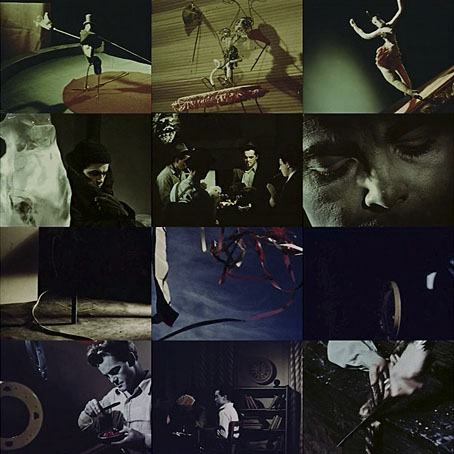
Of the short works there’s Why Man Creates (1968) here and here, an examination of the creative impulse that’s been so popular with art teachers over the years that it’s probably been seen by a lot more people than his marauding ants. Both this and The Solar Film (1980), a documentary about solar energy, utilise Bass’s hand-drawn animation. The latter is also of note for its final shot of a baby walking into a sunset, a still of which was turned by Bass into an album cover for Stomu Yamashta in 1984. Also that year, Saul and Elaine produced their strangest work, Quest, a half-hour piece of science fiction based on a Ray Bradbury short story whose quest theme is overly-familiar from a dramatic point-of-view but which typically yields a wealth of memorable visuals. In Phase IV there was a nod to Dalí with the dead man’s hand filled with burrowing ants; in Quest we find imagery borrowed from Magritte (a floating castle-topped mountain) and MC Escher (his Cubic Space Division). The copy on YouTube is rough quality but it’s certainly worth a watch. I’m amused to discover how much Saul & Elaine were prog-rock heads (not that there’s anything wrong with that…): Phase IV has Stomu Yamash’ta and David Vorhaus from White Noise on its soundtrack, The Solar Film features a dubious cover version of Tubular Bells, while the score for Quest is mostly original music (with some borrowings from Holst) that sounds much of the time like Tangerine Dream when they were leaning on their Mellotrons.

Previously on { feuilleton }
Saul Bass album covers
Pablo Ferro on YouTube

Dreams That Money Can Buy

dreams1.jpg

Max Ernst.

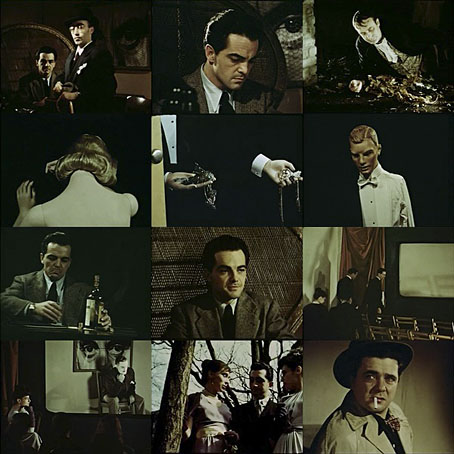
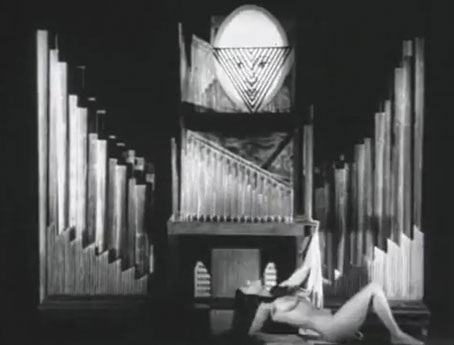
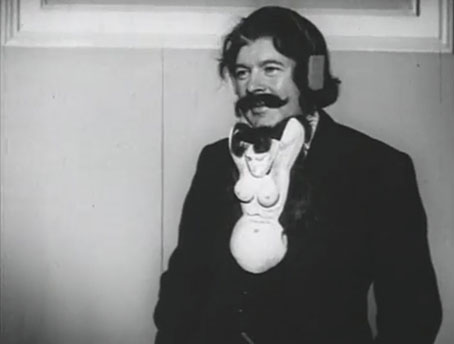
The posts this week have all followed a Surrealist theme so I feel compelled to draw attention to the DVD-quality copy of Hans Richter’s Dreams That Money Can Buy (1947) at the Internet Archive. As mentioned before, Richter’s film is one of the key works of Surrealist cinema, made at the time when the art movement had been overwhelmed by the war in Europe but was finding a brief resurgence of interest in the United States. Hitchcock had drafted Salvador Dalí to design the dream sequences in Spellbound two years earlier which may have helped Richter to raise the funds for a colour feature film. The budget was low but the production values are a lot higher than other experimental films of the time, and Richter was able to find in New York a roster of world-class collaborators including Max Ernst, Paul Bowles, Fernand Léger, Man Ray, Marcel Duchamp, John Cage and Alexander Calder.

dreams2.jpg

The seven artists provide (and in Ernst’s case, perform in) the dreams that lead character Joe is selling to cover his rent. Fernand Léger’s contribution is a song sequence, The Girl with the Prefabricated Heart, about love among the showroom dummies, while Marcel Duchamp’s spinning discs are given another outing accompanied by music from John Cage. Dreams That Money Can Buy is a fascinating film that’s essential viewing for anyone interested in the art of this period. It’s also a film to which Kenneth Anger owes a small debt: the sleeping woman in Ernst’s Desire sequence is seen at one point swallowing a golden ball that hovers above her mouth, a trick that Anger later borrowed for Inauguration of the Pleasure Dome.

dreams3.jpg

Also at the Internet Archive are three further Richter films: two short works, Rhythmus 21 (1921) and Filmstudie (1925), and also Ghosts Before Breakfast (1927), an inventive experimental piece using cut-up imagery, simple animation and trick photography.

Previously on { feuilleton }
La femme 100 têtes by Eric Duvivier
Entr’acte by René Clair

Magritte’s Maldoror

maldoror2.jpg

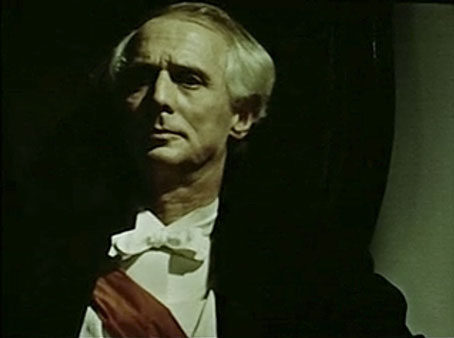
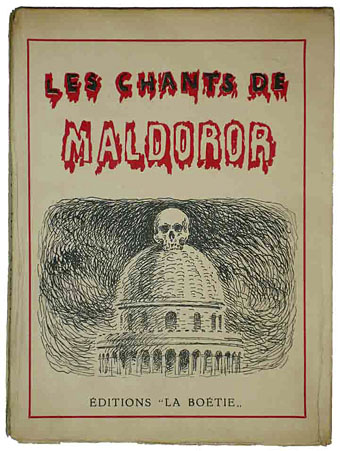
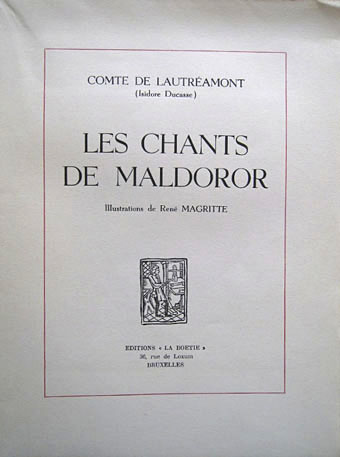
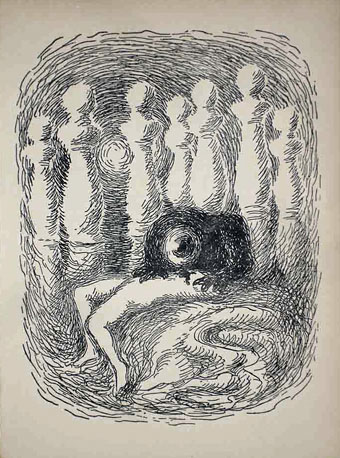
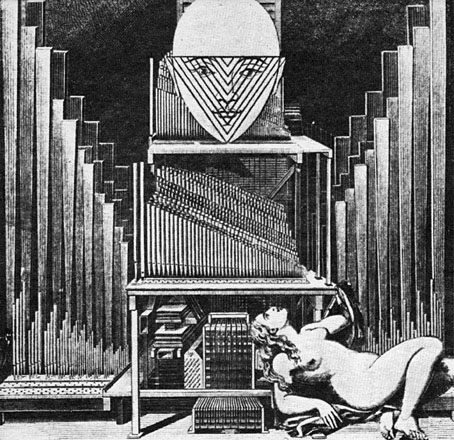
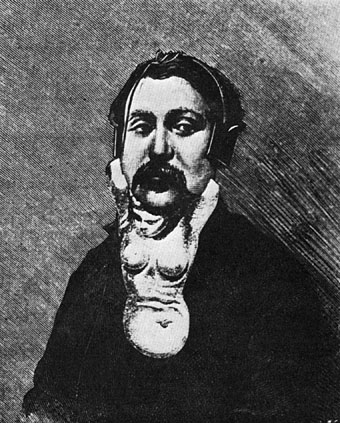
Seen briefly in yesterday’s film about René Magritte were some of the artist’s 77 illustrations created for a 1948 edition of Lautréamont’s Les Chants de Maldoror published by Éditions “La Boetie”, Brussels. The examples here are from various auction sites, and they can’t be counted among Magritte’s best work which probably explains why they’re not reproduced very often. Salvador Dalí’s set of engravings for a 1934 edition were appended last year to a new English translation by RJ Dent for Solar Books. And from French publisher La Baconniere there’s this recent edition with a set of fresh illustrations by TagliaMani (also here).

maldoror4.jpg

maldoror1.jpg

Continue reading “Magritte’s Maldoror”

La femme 100 têtes by Eric Duvivier

femme1.jpg

La femme 100 têtes: L’immaculée conception (1929).

Salvador Dalí never lacked for attention from filmmakers, as has been noted here on several occasions. Max Ernst, on the other hand, received far less attention despite being an actor and collaborator in two of the most significant Surrealist films, L’Age D’Or (1930) and Dreams That Money Can Buy (1947).

femme2.jpg

La femme 100 têtes: Alors je vous présenterai l’oncle (1929).

One of the key works in the Ernst filmography is La femme 100 têtes, a 19-minute film from 1967 based on the series of collages Ernst created under that title in 1929, precursors to his collage masterwork Une semaine de bonté (1934). Eric Duvivier was the director, nephew of the celebrated French director Julien Duvivier, and a director of many educational films, none of which seem to be listed on IMDB. Duvivier’s film may be short but he had the resources to go to some extraordinary lengths in replicating cinematically so many of Ernst’s collages. Some of the scenes merely require a room or a street, in others bizarre or elaborate sets have had to be built then populated with actors for shots that last less than half a minute.

femme3.jpg

La femme 100 têtes (1967).

Why go to all this effort in 1967? The clue is in the name and logo of the producer—Sandoz—the pharmaceutical company that invented and manufactured LSD. Sandoz had a film division which they used to create promotional films for their products. Among the ones related to LSD are Images du monde visionnaire (1964), directed by Henri Michaux and Eric Duvivier, and (possibly) La femme 100 têtes. I say “possibly” only because I haven’t seen this confirmed but why else would a pharmaceutical company that just happened to make the world’s most famous hallucinogenic drug make a Surrealist film? Whatever the reason it’s a remarkable piece of work. See it on YouTube here.

femme4.jpg

La femme 100 têtes (1967).

Previously on { feuilleton }
Scenes from a carriage
Surrealist echoes
Max (The Birdman) Ernst
The Robing of the Birds

Flamboyant excess: the art of Steven Arnold

arnold1.jpg

Invitation to Yin and Yang by Steven Arnold.

“Less is NOT more, MORE is more, less is less.”

Steven Arnold

Thanks to Monsieur Thombeau for pointing the way to The Steven Arnold Archive, a respository of biographical and career detail about Steven Arnold (1943–1994):

…a California-based multi-media artist, spiritualist, gender bender, and protégée of Salvador Dalí. His work consisted of drawings, paintings, rock and film posters, makeup design, costume design, set design, photography, and film.

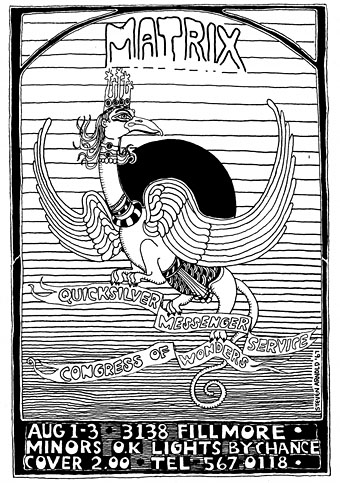
Arnold’s work with outrageous performance troupe The Cockettes seems to receive more attention today than his other creations so it’s good to see the balance being redressed. It was a surprise, for instance, to find he’d drawn a poster in 1967 for The Matrix club, San Francisco. Similar works are mentioned but the site doesn’t have any examples and I’ve yet to see any elsewhere.

arnold2.jpg

arnold3.jpg

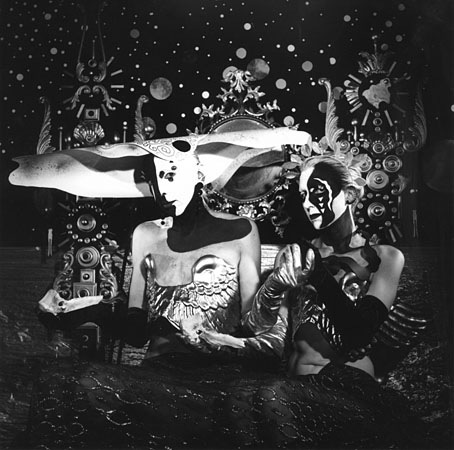
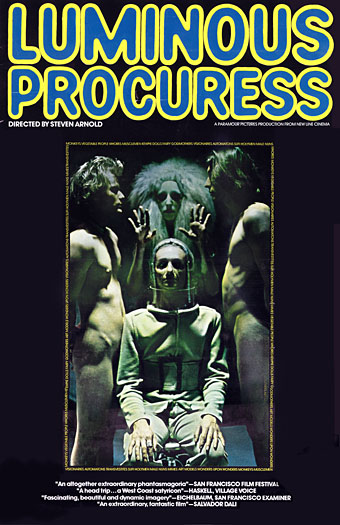
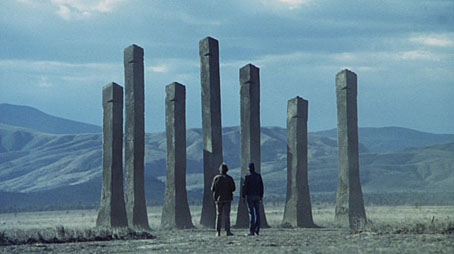
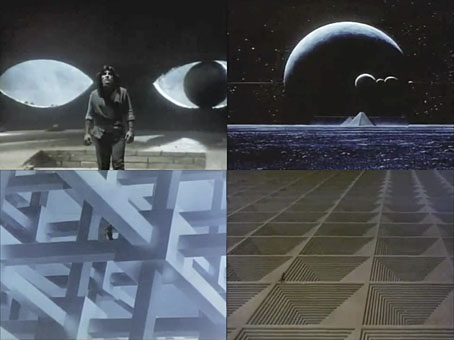
And I haven’t seen the Cockettes film, Luminous Procuress (1971) either. Salvador Dalí unsurprisingly responded with enthusiasm to its atmosphere of androgynous weirdness:

Luminous Procuress is an altogether extraordinary, individualistic phantasmagoria. It was filmed entirely in San Francisco over a two-year period, and describes the adventures of two wandering youths in San Francisco who visit the home of a mysterious woman, the Procuress. She is an elegant emblem of sorcery, her vivid features glowing under bizarre, striking maquillage, and one is not certain who she is or where she intends to lead the protagonists. Although the language she speaks is vaguely Russian, it appears that the Procuress has psychic powers. She discerns a sympathetic response to her on the part of the youths, and by magical means, conducts them through fantastic rooms, on a psychic journey… (more)

Definitely one for the future viewing list. Meanwhile, one of Arnold’s tableaux photos, The Advantages of Modern Marriage, is currently on display in Cruising the Archive: Queer Art and Culture in Los Angeles, 1945–1980 at the ONE National Gay & Lesbian Archives, Los Angeles. The exhibition runs to April 1st, 2012.

Previously on { feuilleton }
James Bidgood