Elliott Dold’s Night

dold01.jpg

Looking for artwork by Elliott Dold turned up this remarkable set of illustrations for an unremarkable collection of poetry, Night, by a friend of the artist, Harold Hersey. Elliott Dold (1889–1957) was an American illustrator during the early days of the pulp magazines, best known today for drawings of huge machines which are a match for those by his more prolific contemporary, Frank R. Paul. The pulp magazines are so often filled with mediocre illustration that it’s a pleasure to find another talent lurking in their pages. But Dold was more than an illustrator of big science, as these illustrations for Hersey’s dubious poetry demonstrate.

dold02.jpg

Night is a collection of vaguely erotic poems, all of which Hersey labels “Nocturnes”. The collection was published in 1923 in a privately-printed subscriber-only edition, and every description I’ve read of it agrees that the illustrations are the best thing about it. The drawings are also radically different to Dold’s science-fiction art, to a degree that they could easily be taken for the work of a different illustrator. “What a pity the artist has to waste his time grinding out art for the pulps,” said HP Lovecraft, in a letter to Clark Ashton Smith. A pity, indeed. Dold’s illustrations are on a par with those that Wallace Smith was producing in the same year, and are close enough to Smith’s style that’s it’s tempting to accuse him of imitation. Smith’s style wasn’t unique, however; Ray Frederick Coyle was another American artist at work in the 1920s who favoured the same combination of strict black-and-white, careful linework and stylised figures. It’s curious that three books with somewhat controversial contents should have been published in the USA in 1922/23, all of them illustrated in a very similar manner: Ben Hecht’s Fantazius Malare (illustrated by Wallace Smith), James Branch Cabell’s new edition of Jurgen (illustrated by Ray Frederick Coyle), and Hersey’s Night. Rather than look for spurious influence I’d guess that this was a combination of coincidence and American literature acquiring a belated taste for Decadence which required suitably Beardsleyesque illustration. Similar trends were evident in cinema, especially in Alla Nazimova’s 1923 film adaptation of Oscar Wilde’s Salomé, where the costumes and settings were all based on Beardsley’s illustrations.

dold03.jpg

The images here are from a copy of the book at HathiTrust that’s another poor Google scan. The Hathi website isn’t as convenient for reading as the Internet Archive so I’ve downloaded all of the illustrations and, when necessary, cleaned the grey tone left by the scanner’s camera.

dold04.jpg

dold05.jpg

Continue reading “Elliott Dold’s Night”

Art on film: Crimes of Passion

cop11.jpg

Continuing an occasional series about artworks in feature films. I’ve been spending the past couple of weeks working my way through the Ken Russell filmography, rewatching familiar documentaries and feature films while acquainting myself with the portions of the Russell oeuvre that I’d missed in the past. Crimes of Passion (1984) was a film that I did see when it turned up on video in the late 1980s but I didn’t remember much about it apart from its overheated erotic atmosphere and a red/blue lighting scheme. It’s not one of Russell’s best—the script lurches uncomfortably between mundane domestic drama and lurid, sex-crazed delirium; Rick Wakeman’s synthesizer score is persistently annoying—but it does feature spirited performances by the lead actors, Kathleen Turner and Anthony Perkins.

cop03.jpg

Turner is Joanna Crane, a swimwear designer who deals with the vacuity of her life by moonlighting as an in-demand prostitute named China Blue. (The polite term “sex worker” didn’t exist in the 1980s.) Russell delivers the art references early on, with unexpected cuts to erotic figures from Aubrey Beardsley’s Lysistrata (above), various Japanese shunga prints, and a flash of The Rape by René Magritte. Since the real woman behind the China Blue persona isn’t revealed until later in the film we don’t know at first that Joanna Crane’s apartment contains reproductions of some of the same pictures. She eventually admits to thinking of them during stressful moments.

cop01.jpg

cop02.jpg

Despite this admission, there’s nothing in the script of Crimes of Passion that warrants the references, Crane’s apartment could easily have been furnished in a blandly expensive manner suited to a successful designer. The only other character who seems remotely interested in art is Anthony Perkins’ Reverend Shayne, a splenetic, sex-obsessed preacher who has a hotel room next door to China Blue. In one of several references to Psycho, Shayne watches his neighbour’s erotic encounters through a spyhole. The walls of his own room are covered in a collage of religious and pornographic imagery but little is made of this.

cop04.jpg

The Lovers by René Magritte.

cop05.jpg

Joanna Crane and Bobby Grady (John Laughlin) in Joanna’s apartment. Among the pictures on the walls are Romeo and Juliet by Marc Chagall, The Embrace by Gustav Klimt, and The Kiss by Gustav Klimt.

Continue reading “Art on film: Crimes of Passion”

Weekend links 661

rubin.jpg

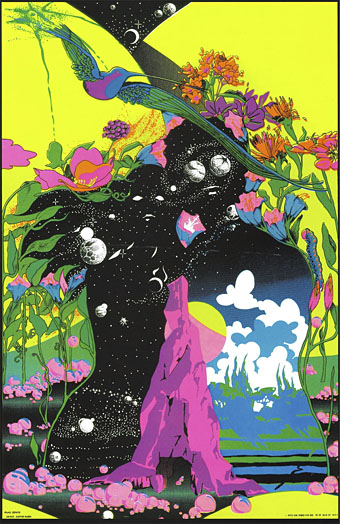
Zephyr (1970), a blacklight poster by Jupiter Rubin. Via.

• I wouldn’t usually expect Clark Ashton Smith’s Zothique to be mentioned at Literary Hub for any reason, but there it is. Emily Temple recommends some of the best stories from a century of Weird Tales that you can read online.

• Mixes of the week: A mix for The Wire by Gamut Inc, and The Last of Us, “a non-stop mix of ambient soundscapes, experimental electronics and modern classical music”.

• “…Yaggy believed that wonder was the helpmate of learning.” Sasha Archibald on Levi Walter Yaggy’s Geographical Maps and Charts (1887/93).

Stylistically, Beardsley’s pictures for Salome are among his most derivative and original. In the sharpness of their lines and great swaths of black and white, we see the well-documented influences of Japanese woodcuts and Ancient Greek vase-painting. And yet, Beardsley’s work bridges these grand traditions of East and West with such fresh dynamism and taboo as to be undeniably, and ultimately definitionally, Nouveau.

Mirror and Window Both: The Brief Superabundance of Aubrey Beardsley by A. Natasha Joukovsky

• New music: Rhinog Fawr by Somatic Responses, and Sargo/Posidonia by Sleep Research Facility/Llyn Y Cwn.

• “Why is there such a voracious consumer appetite for miniature things?” asks Steven Heller.

• At Dennis Cooper’s: Spotlight on…Julio Cortázar Blow Up and other Stories (1967).

• At Unquiet Things: The Prolific Pioneering Pulp Art Of Ed Emshwiller.

Random images from DJ Food’s desktop.

Miniature Sun (1989) by XTC | Adventures In A Miniature Landscape (2009) by Belbury Poly | Miniature Magic (2020) by Plone

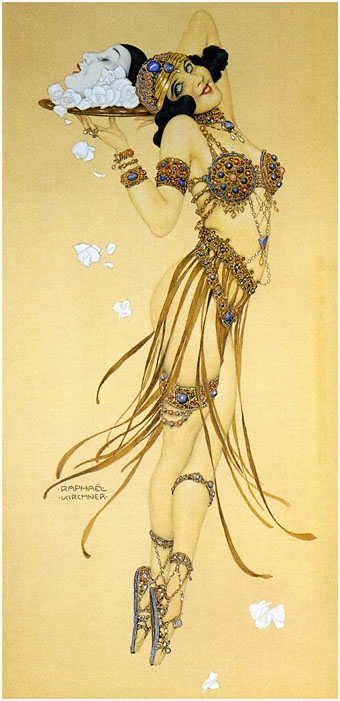
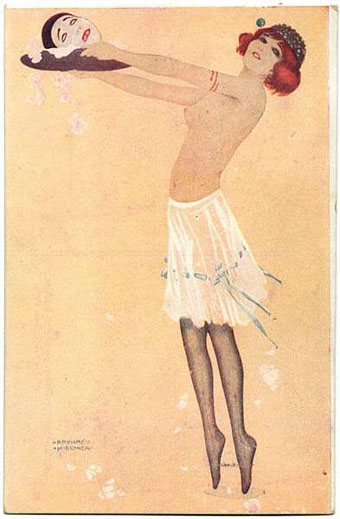
Raphael Kirchner’s Salomés

kirchner1.jpg

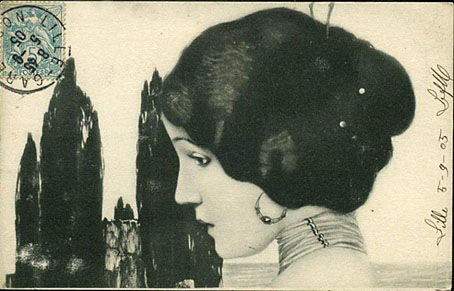
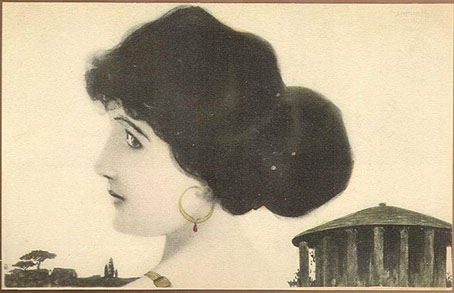
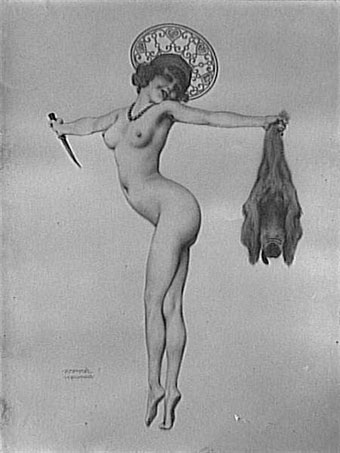
This drawing by Austrian artist Raphael Kirchner (1876–1917) caught my attention for its apparent combination of the Salomé theme with an arrangement of stones and cypresses that bring to mind Arnold Böcklin’s Isle of the Dead. All supposition on my part since I can’t find any definite confirmation that the picture is meant to depict Salomé, while a stand of cypresses is often just a stand of cypresses. But the Salomé theme and Böcklin’s island were popular enough fin de siècle subjects to be gestured towards in this manner, even on a piece of postcard art. In one of Kirchner’s other alleged Salomé cards he has a building that resembles the Temple of Cybele in Rome so the cypresses may simply be there to signify Ancient-World-plus-Mediterranean-setting (which in itself contradicts the Judean setting of the Salomé story). Kirchner’s speciality as an artist was attractive young women, often in states of undress, so the Ancient World here and elsewhere is providing the same excuse for a straight audience as “Greek” themes provided for homoerotica in the 19th and 20th century. There’s a lot more of Kirchner’s tasteful cheesecake at Wikiart.

kirchner2.jpg

kirchner3.jpg

kirchner4.jpg

kirchner5.jpg

Elsewhere on { feuilleton }
The Salomé archive

Oscar (1985)

oscar1.jpg

I’ve mentioned John Hawkesworth’s three-hour television biography of Oscar Wilde in previous Wilde-related posts, but was never able to point to a viewable copy until now. Oscar was broadcast by the BBC in three parts in 1985, and if it was ever shown again I don’t recall it; I certainly missed capturing it on tape. This was frustrating because I always remembered Michael Gambon’s portrayal of Wilde as being the best I’d seen, but the only reissues for home viewing were long-deleted tapes and discs produced for other countries. Having watched the drama again I’m pleased to find it as good as I remembered, possibly more so since I’ve read a several Wilde biographies in the interim so I’m better able to judge its accuracy.
oscar2.jpg

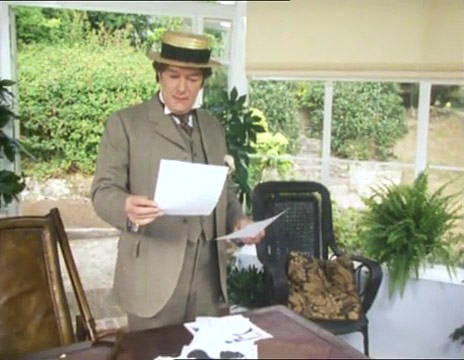
Oscar examining Aubrey Beardsley’s Salomé illustrations.

As a writer and TV producer John Hawkesworth specialised in period drama, creating and writing episodes for The Duchess of Duke Street, Danger UXB (about wartime bomb disposal), and the celebrated Granada TV Sherlock Holmes series featuring Jeremy Brett’s definitive portrayal of the detective. Oscar was based on biographical books by H. Montgomery Hyde, an MP who lost his seat for his campaigns in the late 1950s and 1960s against the British laws forbidding homosexual acts. Knowing this it’s significant that Hawkesworth’s opening scene in the first episode is a brief parliamentary discussion about the notorious Labouchere Amendment of 1885 (“The Blackmailer’s Charter”) which the narrator informs us would send Oscar Wilde to prison ten years later. Hawkesworth divides his drama into three distinct phases: Gilded Youth (concerning Wilde’s relationship with Alfred Douglas, his artistic success and the ire of the Marquess of Queensberry); Trials (the personal as well as legal variety); and De Profundis (imprisonment and its aftermath).
oscar3.jpg

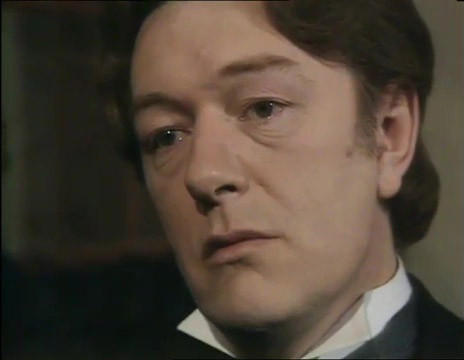
In the dock at the Old Bailey.

The arc of tragedy is a familiar one, of course, but other dramatisations are seldom as well-balanced as here. Feature films about Oscar Wilde generally have shorter running times so devote their larger budgets to a recreation of the glamorous fin-de-siècle rise and the terrible downfall. Oscar is a typical BBC production of the period, mostly recorded on video in studio sets with occasional film work for exteriors. What we see of Victorian London appears sparse compared to the Sherlock Holmes episodes which were being filmed at this time. Hawkesworth may have been restricted by budget but three hours allows him to pay greater attention to the later episodes, especially the courtroom scenes. Oscar was the first screen biography to include the discussion of sexual details during the trial, as well as to show Wilde alone with a naked boy. This was a considerable advance at a time when gay sex of any kind was a rare sight on British television, and when even the straight variety could cause problems, as it did for Gambon and co. a year later when Dennis Potter’s The Singing Detective inspired the contemptible Mary Whitehouse to complain to the BBC. Hawkesworth also runs through the later years to the very end, a period of decline usually avoided or, as in Brian Gilbert’s Wilde (1997), disingenuously truncated so as to provide a “happy” resolution. Given this, I would have preferred some of the earlier scenes to be longer and to offer a sense of Wilde’s status as a serious thinker about art and aesthetics. Wilde’s flamboyant persona made him famous but he was influential not for his dandyish manner but for his ideas and their articulation in essays, lectures and the plays; his aesthetic theories were the foundation of all his writing. The most famous line from his final poem is a statement of philosophic principle: “Yet each man kills the thing he loves”.
oscar4.jpg

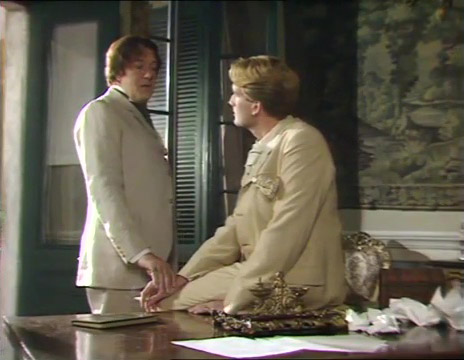
Oscar and Bosie.

Aesthetics aside, the public perception of Oscar Wilde presents a hurdle for dramatisations which risk resurrecting the caricatures that flourished while Wilde was alive. Michael Gambon’s performance shows Wilde as a human being, not merely a charming dispenser of witty aphorisms. This has always seemed to me crucial for any actor; it’s not enough to merely look like Wilde—as Robert Morley and Stephen Fry did—but you have to be able to convey the horrors, the indignity (and, with regard to his wife, the culpability) of his later years. Stephen Fry is a good comic actor but he never could have played the Singing Detective. Gambon’s seductively purring voice is another plus, and he even allows a hint Irish brogue to slip through now and then. Of the other actors, Robin Lermitte looks more like Alfred Douglas than does Jude Law in Brian Gilbert’s film, but Law is better at conveying Bosie’s mercurial and tempestuous character; likewise Tom Wilkinson made the Marquess of Queensbury seem a little more human in Gilbert’s version, at least in the beginning, whereas Norman Rodway presents the man from the outset as a perpetually furious goblin. Missing from Hawkesworth’s drama are Wilde’s good friend Ada Leverson, and his mother, Speranza, whose urging him to stand tall and remain in England when the police were coming for him was one of the factors that sealed his fate.

Oscar may be seen here: Part One | Part Two | Part Three

For now, and possibly the foreseeable future, this is the only way to see this drama so I’d suggest downloading it if you can. It’s a rare work that could easily vanish once again.

Elsewhere on { feuilleton }
The Oscar Wilde archive

Previously on { feuilleton }
The Importance of Being Oscar