Matthew Bourne’s Dorian Gray

bourne_dorian.jpg

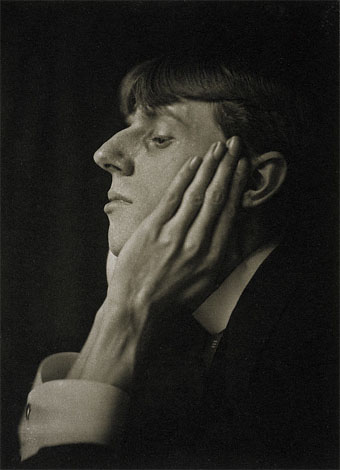
Dorian (Richard Winsor) photographed by Bill Cooper.

Matthew Bourne‘s new dance version of Dorian Gray opens today at the Sadler’s Wells Theatre, London, and I’d have been interested in this production even without visions like the ones above and below; the eye candy merely adds an additional frisson and, let’s face it, there’s always been an erotic component to dance and ballet however high-minded the intention. Bourne famously gave the world the a Swan Lake with male swans and in Dorian Gray updates Wilde in a very contemporary manner (following Will Self’s Dorian: An Imitation and Duncan Roy’s recent film adaptation) with the gay subtext made an overt text.

Set in the image-obsessed world of contemporary art and politics, Matthew Bourne’s ‘black fairy tale’ tells the story of an exceptionally alluring young man who makes a pact with the devil. Amongst London’s beautiful people, Dorian Gray is the ‘It Boy’ – an icon of beauty and truth in an increasingly ugly world.

The destructive power of beauty, the blind pursuit of pleasure and the darkness and corruption that lie beneath the charming façade; the themes behind Oscar Wilde’s cautionary tale have never been more timely.
bourne_dorian2.jpg

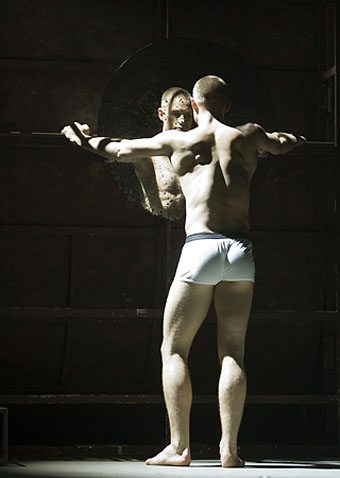
Richard Winsor again, photographed by Murdo Macleod.

Dorian Gray continues the gender-reversals with Lord Henry becoming Lady H, while Sybil Vane is transmuted to Cyril. I like the stage design detail where the customary nightclub glitterball becomes a version of Damien Hirst’s diamond-encrusted human skull, the expensive artworld bauble finding its own level at last as a piece of decoration. Updating stories in this way often provokes a feeling of ambivalence—removing the subtext can have the effect of diluting the tension which lies at the heart of the work—but the continual refashioning of Wilde’s fable has confirmed its status as a contemporary myth, something I’m sure he’d be very pleased about. In that respect, it gives the creator the immortality through art which his creation, in the closing pages of the story, is denied.

Because Wilde’s worth it | Matthew Bourne discusses the production
Review in The Independent
Bill Cooper’s production photos
Wilde at heart: Matthew Bourne’s Dorian Gray | Another photo gallery

Elsewhere on { feuilleton }
The Oscar Wilde archive

Arthur Zaidenberg’s À Rebours

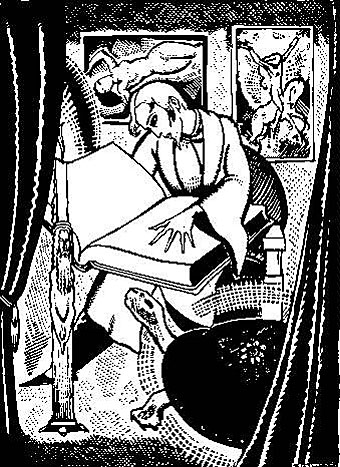
arebours1.jpg

“It had not been able to support the dazzling splendour imposed on it…”

It was a novel without a plot and with only one character, being, indeed, simply a psychological study of a certain young Parisian who spent his life trying to realize in the nineteenth century all the passions and modes of thought that belonged to every century except his own, and to sum up, as it were, in himself the various moods through which the world-spirit had ever passed, loving for their mere artificiality those renunciations that men have unwisely called virtue, as much as those natural rebellions that wise men still call sin. The style in which it was written was that curious jewelled style, vivid and obscure at once, full of argot and of archaisms, of technical expressions and of elaborate paraphrases, that characterizes the work of some of the finest artists of the French school of Symbolistes. There were in it metaphors as monstrous as orchids and as subtle in colour. The life of the senses was described in the terms of mystical philosophy. One hardly knew at times whether one was reading the spiritual ecstasies of some mediaeval saint or the morbid confessions of a modern sinner. It was a poisonous book.

The corrupting French novel which Lord Henry Wotton gives to Dorian Gray is never named by Oscar Wilde but its identity is no secret. À Rebours (Against Nature) by Joris-Karl Huysmans was published in 1884 and Wilde, Whistler and others were immediately impressed by what amounts to a manual for the lifestyle of a Decadent Aesthete. Wilde fell sufficiently under its spell to have Dorian Gray in the later chapters of his own novel indulge his senses much like Huysmans’ protagonist, Des Esseintes; where Des Esseintes grows poisonous blooms and fills his room with exotic perfumes, Dorian Gray luxuriates over a hoard of precious stones.

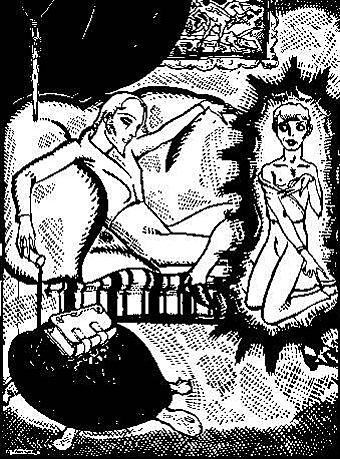
À Rebours features lengthy descriptions of Symbolist art, with particular attention given to Gustave Moreau and Odilon Redon. Yet despite the visual description Arthur Zaidenberg’s illustrations are the only ones I’ve come across to date. The book may be influential but it seems too obscure to have attracted illustrators. Zaidenberg’s drawings from a 1931 edition are executed in a woodcut style not far removed from Frans Masereel’s earlier work in books such as Die Stadt (1925), and as such the style is fashionably spare, not necessarily the right choice for a work concerned with sensory delirium. (This Zaidenberg street scene from 1937 shows a definite Masereel influence.) I’d much rather have seen Harry Clarke illustrate Huysmans. Zaidenberg’s drawings are also curious for their foregrounding of the sexual content which makes me think this edition may have been sold on the basis of a salacious reputation. The scene below, for example, doesn’t occur in the novel but can be implied from the description of Des Esseintes meeting a schoolboy in the Avenue de Latour-Maubourg.

arebours2.jpg

“Never had he experienced a more alluring relationship.”

The complete (?) set of Zaidenberg’s illustrations can be seen here. Pages from a later artists’ manual, Anyone Can Draw, are at VTS.

Elsewhere on { feuilleton }
The illustrators archive

Previously on { feuilleton }
John Osborne’s Dorian Gray
Because Wilde’s worth it
Whistler’s Peacock Room
Dorian Gray revisited
Frans Masereel’s city
The Poet and the Pope
The Picture of Dorian Gray I & II

John Osborne’s Dorian Gray

dg1.jpg

I wrote recently about John Selwyn Gilbert’s television play, Aubrey, an hour-long drama concerning the artist Aubrey Beardsley. The play was only screened once in 1982 and, like most one-off studio works of the period, is unavailable on DVD. John Osborne’s 1976 adaptation of The Picture of Dorian Gray is a welcome exception to this neglect and can be acquired in a box set along with three BBC productions of Wilde’s plays and a more recent Wilde documentary.

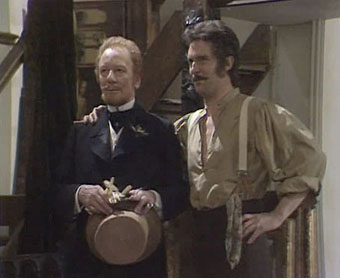
The stage plays are decent enough although the cast in the 1952 film version of The Importance of Being Earnest takes some beating. Dorian Gray is for me the essential work in the collection, even if its 100-minute running time cuts the story to the bone. The principal attraction in an entirely studio-bound work with few actors is the leads, and for this we have two great performances from John Gielgud as Lord Henry and Jeremy Brett as artist Basil Hallward. The tragic Dorian is played by Peter Firth who has difficulty keeping up with these heavyweights, especially in the later scenes when the story concentrates more fully on his predicament. Matters aren’t helped by his Yorkshire accent which frequently rises to the surface in a manner that would surely raise eyebrows in Mayfair drawing rooms.

dg2.jpg

Lord Henry & Basil Hallward admire the portrait.

Continue reading “John Osborne’s Dorian Gray”

Aubrey by John Selwyn Gilbert

aubrey00.jpg

Aubrey Beardsley photographed by Frederick Evans (1894).

I’ve been going through the Coulthart VHS library recently, transferring to DVD recordings which can’t be purchased or found online. Among these is a drama from the BBC’s Playhouse strand, Aubrey by John Selwyn Gilbert, which was broadcast in 1982. This drama follows the life of artist Aubrey Beardsley from the time of Oscar Wilde’s arrest in April 1895—which event resulted in Beardsley losing his position at The Yellow Book—through the foundation of The Savoy magazine, to his tubercular death in March 1898.

aubrey01.jpg

John Dicks as Aubrey.

Playhouse was a BBC 2 equivalent of Play for Today (which usually ran on BBC 1) and Aubrey, like many other dramas of the period, was shot on video in the studio. This was done for convenience as well as being cheaper than shooting on film, since scenes could be filmed using several cameras simultaneously. The drawback is that the image looks very harsh, and historical works such as this often seem unreal and artificial as a result. If you can forgive this deficiency, Aubrey was an excellent production with some great performances, especially Ronald Lacey as Leonard Smithers and Rula Lenska as Aubrey’s sister, Mabel. The details of Beardsley’s life are very accurate, down to his beloved Mantegna prints on the walls, and many of the scenes are arranged to correspond with his drawings, the production design being largely monochrome.

Continue reading “Aubrey by John Selwyn Gilbert”