The Thief of Bagdad

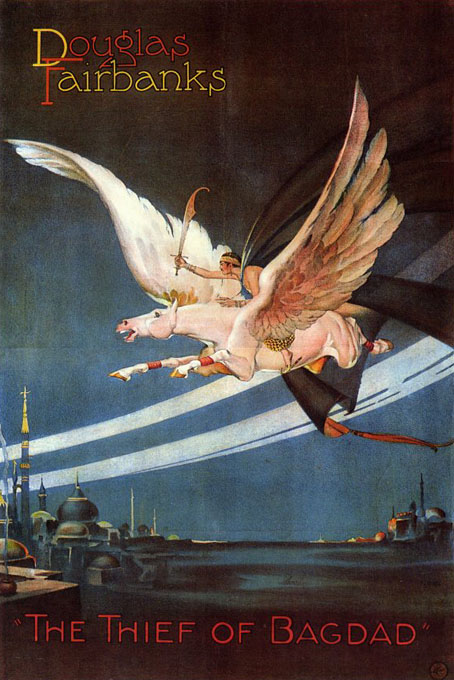
thief2.jpg

It’s the poster for the 1924 film version we’re concerning ourselves with here, not the more popular 1940 adaptation directed by Michael Powell. Both films are great but I have a special affection for Raoul Walsh’s silent version and this poster design has long been a favourite for the way it manages to condense the film’s blend of storybook graphics and Art Deco exotica. I’d wondered for years who was responsible for this design; according to various poster sites it’s the work of the film’s art director Anton Grot (1884–1974). This is one of several variations (there another here and one here) and there’s also a less interesting design which is far more typical of the period.

I often recommend the 1924 Thief of Bagdad as an introduction to silent cinema, especially if you can find a decent print. Fairbanks’ production had William Cameron Menzies as production designer and his sets are enormous Arabian Nights confections replete with minarets, onion domes and filigree screens like something from an Edmund Dulac illustration. Fairbanks gives a tremendously athletic performance and the marvellous Anna May Wong plays a Mongolian slave girl. There’s a lengthy description of the film’s production here while you can find a copy of the entire film at the Internet Archive although it really ought to be seen in a version which isn’t blighted by a company logo throughout.

Previously on { feuilleton }
More Arabian Nights
Edward William Lane’s Arabian Nights Entertainments
Alla Nazimova’s Salomé
Metropolis posters

Jack Cardiff, 1914–2009

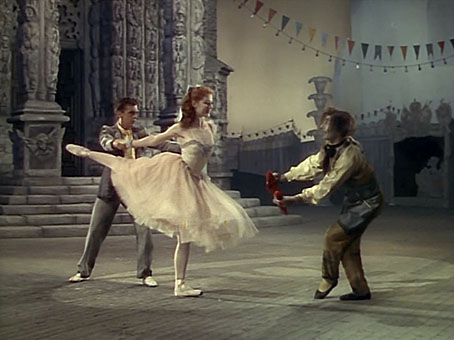
red_shoes.jpg

Robert Helpmann, Moira Shearer and Léonide Massine; The Red Shoes (1948).

Jack Cardiff, who died this week, was one of the great cinematographers from the postwar era, a period when British cinema was raised for a time to world-class level. His three films for the Archers, aka Michael Powell & Emeric Pressburger, are masterpieces of Technicolor photography. He won an Oscar for one of these, Black Narcissus, while his photography in The Red Shoes includes Moira Shearer’s 18-minute ballet performance, one of the most strikingly surreal sequences in the whole of British film.

Cardiff taught himself about lighting from scrutinising the Old Masters and the Impressionists, and teaching himself to observe colour, shade and reflection in everyday things. “As they say, ‘Love comes by looking’, and I was looking all the time. That’s how you learn.” He picks up one of the dozens of books on Rembrandt that he owns and draws my attention to the exquisitely painted shadow of a nose in one of his favourite portraits. We look at the interiors of other Dutch masters – Pieter De Hooch, Vermeer. It was to the work of Vermeer that the starkly beautiful images of nuns he created for his Oscar-winning movie Black Narcissus (1947) were likened.

Elizabeth Lowenthal, The Independent, 1994.

Previously on { feuilleton }
Deborah Kerr, 1921–2007
Freddie Francis, 1917–2007

Deborah Kerr, 1921–2007

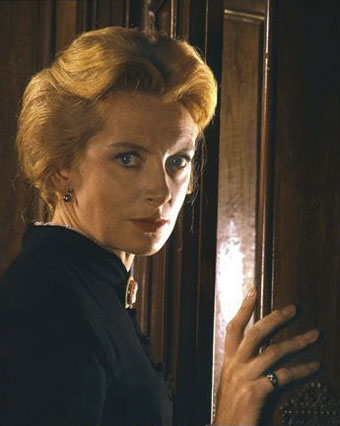
innocents.jpg

The Innocents.

A great British actress died this week. She was also something of a movie star in the Fifties, rolling in the surf with Burt Lancaster in From Here to Eternity (1953) and standing up to Yul Brynner in The King and I (1956). Prior to that she starred in two films for Michael Powell and Emeric Pressburger, The Life and Death of Colonel Blimp (1943) (where she played three roles) and Black Narcissus (1947). But for me she’ll always be the (literally) haunted Miss Giddens in The Innocents (1961), Jack Clayton’s superb adaptation of The Turn of the Screw. Still one of the most effective screen ghost stories; try and see it this Halloween.

Previously on { feuilleton }
Freddie Francis, 1917–2007