The Hand, a film by Jiří Trnka

hand1.jpg

Regular readers may have noticed that Jiří Trnka’s name has been written here with all the Czech accents intact, something that hadn’t been possible until a few days ago thanks to a database coding fault. This had long been the case with accents like those used in Czech, Polish, Turkish, Japanese, and other languages, to my endless frustration. I’ll spare you the technical details but the solution, which I resolved at the weekend, turned out to be easier than I expected, as a result of which I’ve been going back through posts adding accents to names which until now had been incomplete.

hand2.jpg

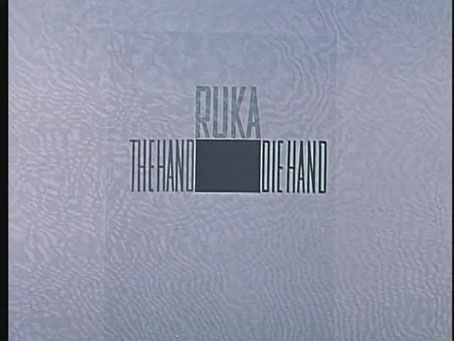
Jiří Trnka (1912–1969) came to mind while I was restoring the accents for Jiří Barta; both men are Czech animators, with Barta having been mentioned here on many occasions. Trnka was one of the founders of the Czech animation industry whose puppet films aren’t always to my taste but I thought I might have mentioned The Hand (1965) before now. This was Trnka’s final film, and one of his most celebrated for its wordless presentation of a universal theme: the freedom of the artist in the face of authoritarian demands. Many of Trnka’s previous films had been stop-motion puppet adaptations of fairy tales which lends The Hand a subversive quality when the scenario seems at first to be pitched in a similar direction. The artist character is a typical Trnka puppet with a persistently smiling face who spends his time in a single room making flowerpots with a potter’s wheel. “The hand” in this context refers both to the manual nature of the potter’s craft as well as to the huge gloved appendage that forces its way into the room demanding that the pots be abandoned in favour of hand-shaped sculptures. The resulting battle of wills shows the strengths of animation in delivering a potent visual metaphor.

hand3.jpg

Trnka’s message at the time of the film’s release was especially pertinent for the Soviet satellite nations where the promise of post-war Communism had been corrupted by decades of repressive governments, a situation that Jan Švankmajer bitterly addressed in The Death of Stalinism in Bohemia. Trnka isn’t as savage as Švankmajer but his message is still an ironic one, and may have been fuelled by an equivalent bitterness. Trnka’s career was bookended by films showing the struggle of assertive individuals against authoritarian oppression, but in the first of these, The Springman and the SS (1946), the contest is between a Czech chimney-sweep and the Nazi occupiers. The Hand could only be taken by Czech viewers as being aimed at their own oppressive government, and as such may be seen as Trnka’s contribution to the Czech New Wave, especially those films (Daisies, The Cremator) that the same government regarded as politically subversive or otherwise harmful. The Hand, like The Cremator, was withdrawn from distribution a few years after its release. Jiří Barta is a very different director to Trnka but Barta’s The Vanished World of Gloves (1982) features a dystopian sequence showing a fascist world of marching hands which looks like a homage to Trnka’s film. Watch The Hand here.

Previously on { feuilleton }
Jiří Barta: Labyrinth of Darkness
Jiří Barta’s Pied Piper

Weekend links 776

hoffmeister.jpg

Illustration by Adolf Hoffmeister for a Czech edition of The First Men in the Moon by HG Wells.

• It’s good to hear that Czech animator Jiří Barta is back at work on his long-gestating feature film based on the Golem legend. The new iteration looks like a reimagining of the entire project.

• Among the new titles at Standard Ebooks, the home of free, high-quality, public-domain texts: The First Men in the Moon by HG Wells.

• This week in the Bumper Book of Magic: Ben Wickey breaks down more of his Great Enchanters pages.

• At Colossal: Charles Brooks photographs the interiors of musical and scientific instruments.

• At Igloomag: Philippe Blache on neo-noir, doom jazz and related atmospheric music.

• At The Daily Heller: The book-brick that is the 1,264-page Emigre Specimen Encyclopedia.

• New music: Changing States by Matmos, and Of Shadow Landscapes by Skotógen.

• At the BFI: Josh Slater-Williams selects 10 great Japanese time-travel films.

• Lawrence English remembers the sound-art pioneer Alan Lamb.

Tunde Adebimpe’s favourite albums.

Time Machine (1967) by Satori | Time Machine (1968) by Lemon Tree | Turn Back Time (1971) by Time Machine

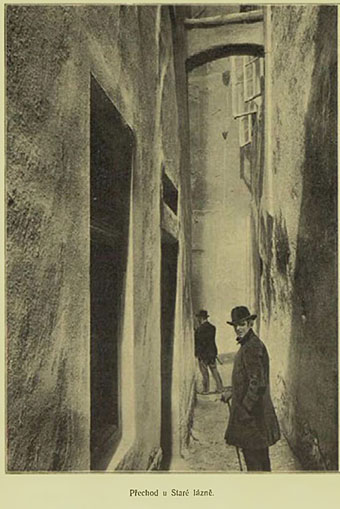
Gustav Meyrink’s Prague

prague.jpg

The Prague Ghetto, 1902, by A. Kaspara.

I looked away from him, and gazed instead at the discoloured buildings, standing there side by side in the rain like a herd of derelict, dripping animals. How uncanny and depraved they all seemed. Risen out of the ground, from the look of them, as fortuitously as so many weeds. Two of them were huddled up together against an old yellow stone wall, the last remaining vestige of an earlier building of considerable size. There they had stood for two centuries now, or it might be three, detached from the buildings around them; one of them slanting obliquely, with a roof like a retreating forehead; the one next to it jutting out like an eye-tooth.

Beneath this dreary sky they seemed to be standing in their sleep, without a trace revealed of that something hostile, something malicious, that at times seemed to permeate the very bricks of which they were composed, when the street was fllled with mists of autumn evenings that laid a veil upon their features.

In this age I now inhabit, a persistent feeling clings to me, as though at certain hours of the night and early morning grey these houses took mysterious counsel together, one with another. The walls would be subject to faint, inexplicable tremors; strange sounds would creep along the roofs and down the gutters—sounds that our human ears might register, maybe, but whose origin remained beyond our power to fathom, even had we cared to try.

(Translation by Mike Mitchell)

Watching Jiří Barta’s films again, and thinking about his unfinished adaptation of The Golem, prompted me to return to the source.

Previously on { feuilleton }
Stone Glory, a film by Jirí Lehovec
The Face of Prague
Josef Sudek
Das Haus zur letzten Latern
Hugo Steiner-Prag’s Golem
Karel Plicka’s views of Prague
Barta’s Golem

Jiří Barta: Labyrinth of Darkness

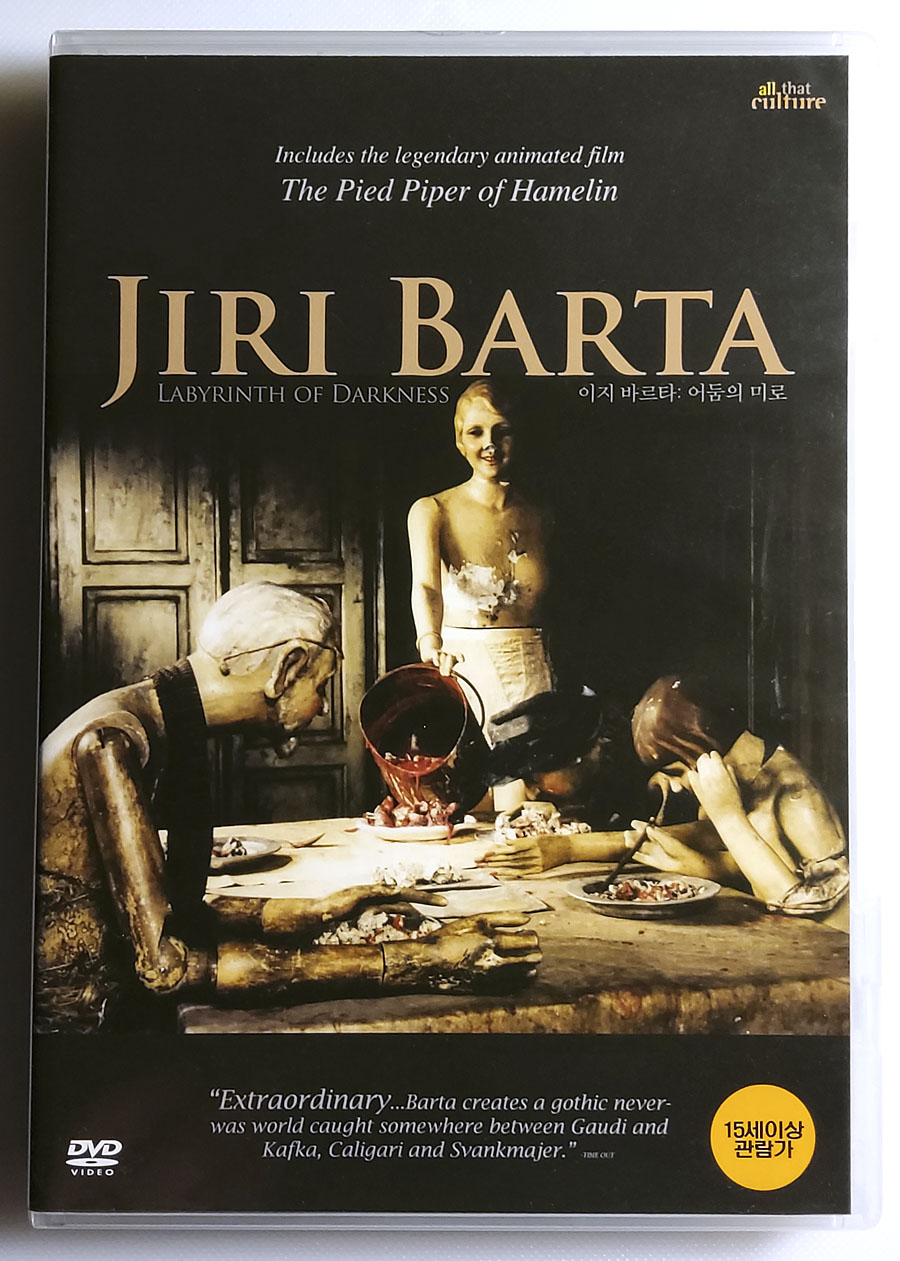
barta1.jpg

A new purchase. It’s excessive and wasteful to order DVDs from South Korea but when this is the only available option you have no choice. Jiří Barta: Labyrinth of Darkness is a Korean clone of a deleted disc that was originally released in the US by Kino, and which I’d managed to miss when it was still easy to find. The collection gathers all of the Czech animator’s short films from 1978–89 plus his 53-minute masterwork, The Pied Piper (1986), a film whose Expressionist puppets and decor steal the familiar folk tale away from picture-book cuteness and return it to its darker roots. The subtitle “Labyrinth of Darkness” suggests that all the films tend towards horror which isn’t really the case, although anyone disturbed by animated shop mannequins may be unnerved by Club of the Discarded (1989). Barta’s films can be dark but they’re also wry or quirky: The Design (1981) is a wordless fable about the imposition of social uniformity by contemporary architecture, while The Extinct World of Gloves (1982) cleverly uses anthropomorphism to pastiche a range of cinematic genres. Barta is still active today but most of his recent films have been advertising commissions and a child-friendly feature, Toys in the Attic, the marketplace being resistant to animation that’s too strange or personal. I still hope we might one day see his feature-length film of The Golem but there’s been no news about this since a preview was released in 2002:

“Everyone is expecting a fairytale about that legend. Our interpretation is a little bit different, because we start from another point of view, which is Gustav Meyrink’s Golem…It is much more interesting, but I think that this is the reason why we have not moved forward, why the whole project has stopped, why some producers have disappeared, appeared and disappeared again.” (via)

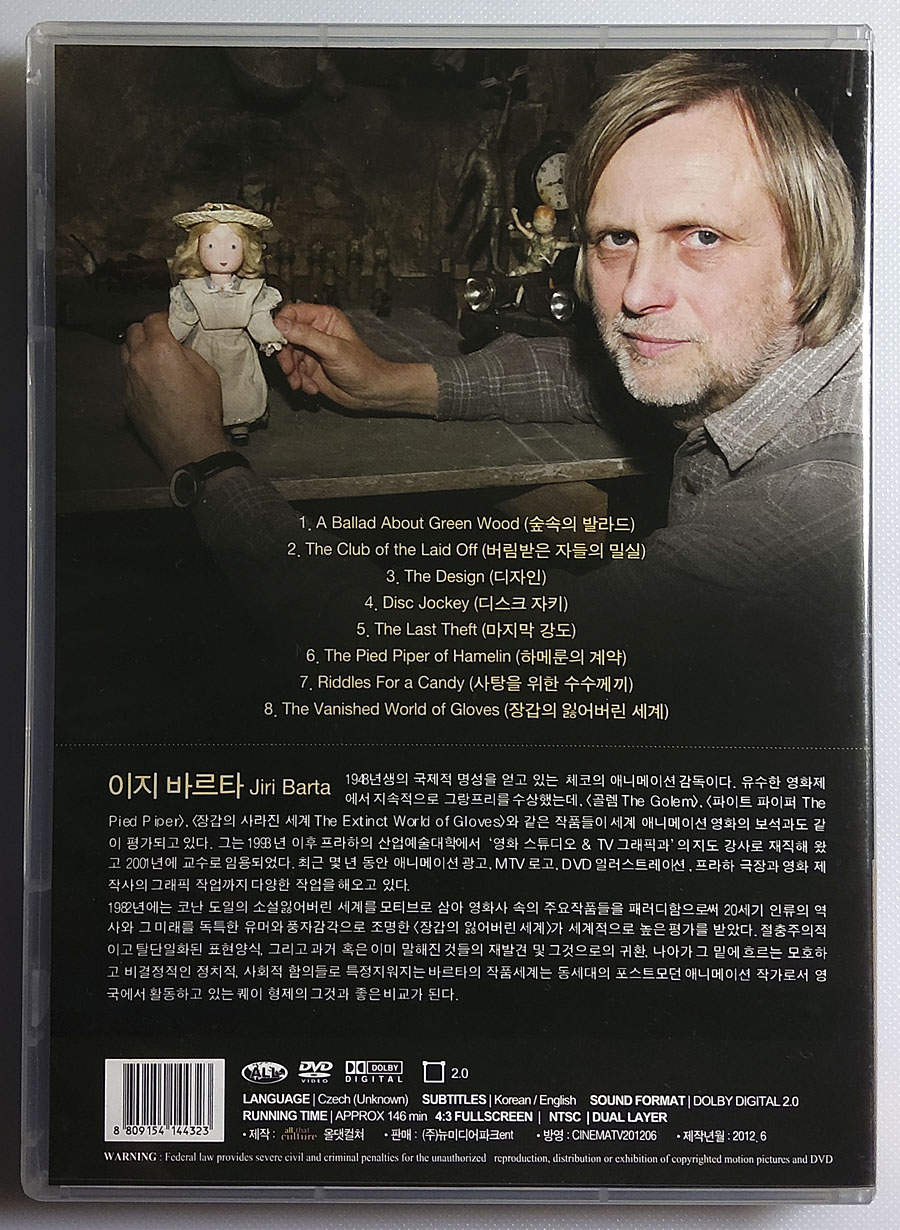
barta2.jpg

The unavailability of the Kino disc of Barta’s films is part of a worrying trend for those of us who like to own physical copies of scarce films. Many DVDs released ten or more years ago are now deleted and—in the case of my precious Piotr Kamler collection—impossible to find, while the films they contain are of such minority interest there’s little hope of seeing them on blu-ray any time soon. In the hierarchy of cinematic value, feature-length dramas always receive the most attention while documentaries, shorts, animations and experimental films are subject to the greatest neglect. Yes, “everything is now on YouTube” (except when it isn’t), but invariably compromised by low resolution, a lack of subtitles, or blighted by TV watermarks. And everything on YouTube is only there for as long as the uploader maintains their channel or until someone files a copyright complaint; previous posts here are filled with links to videos that are now deleted, so the Koreans are doing everyone a service by keeping Barta’s films in circulation. The same goes for the great René Laloux whose science-fiction features, Time Masters (1982) and Gandahar (1987), are currently available with English subs only from South Korea. The quality of this Jiří Barta disc leaves much to be desired but it’s still better than YouTube.

Previously on { feuilleton }
Jiří Barta’s Pied Piper
Gloves
More Golems
Barta’s Golem

Animated Self-Portraits

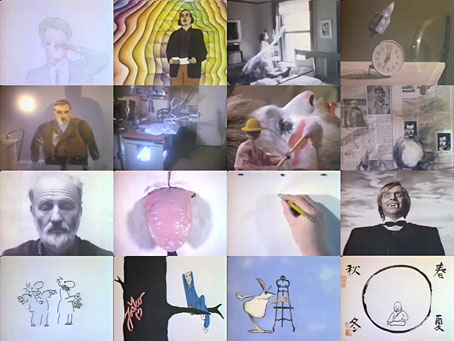
portraits.jpg

Another animated anthology, this one being a brief collection of self-portraits of around 10 to 20 seconds each. Like yesterday’s short film, Animated Self-Portraits (1989) was produced by David Ehrlich who contributes a portrait of his own. I’m not enough of an aficionado to recognise all the names involved but the contingent from Czechoslovakia (as it was then) includes Jan Švankmajer and Jiří Barta. More of an entertaining piece than Academy Leader Variations even if you aren’t familiar with the animators.

Previously on { feuilleton }
Academy Leader Variations
42 One Dream Rush