Albrecht Dürer’s Apocalypse

durer01.jpg

Revelation of St. John.

In Robert Shea and Robert Anton Wilson’s Illuminatus! trilogy, John of Patmos, the author of the Book of Revelation, is referred to as “Saint John the Mushroom-head”, the suggestion being that the bizarre and grotesque scenes listed at the end of the Bible were the result of hallucinogenic frenzy. Mushroom-derived or not, John’s apocalyptic visions have fuelled the imagination of artists for a very long time, and in a wide variety of media. The earlier chapters of the New Testament are the more popular ones when it comes to adaptations but only the Book of Revelation has inspired two monuments of progressive rock: the 666 album by Aphrodite’s Child, and Supper’s Ready by Genesis.

durer02.jpg

Martyrdom of Saint John the Evangelist.

Die Offenbarung St. Johannis (1900) is a recent upload at the Internet Archive which presents Albrecht Dürer’s magnificent set of Apocalypse woodcuts in a single volume. Multiple copies of the same prints may be found at Wikimedia Commons but sets of pictures there are always divided into separate pages; where possible, I prefer to have a book to leaf through. I love to pore over Dürer’s prints, they’re always crowded with tiny details rendered with great precision. The fifth plate in this series, showing the arrival of the Four Horsemen, is the one you see reproduced most often, and it’s a typically cramped composition; Dürer was an artist who often seemed to want to cram as much as possible into the available space. Some of the later plates in the series have the same powerful sense of occult strangeness that you find in the best alchemical engravings, especially plate eleven which shows John being instructed by an angel with a blazing face to eat a book. The Biblical text describes the angel as appearing suspended over columns of fire, but Dürer shows the columns as a pair of architectural limbs that happen to be burning at their terminations. It’s an example of proto-Surrealist imagery that makes me wonder what a set of Albrecht Dürer Tarot cards might have looked like.

durer03.jpg

Vision of the Seven Candlesticks.

durer04.jpg

Saint John Before God and the Elders.

durer05.jpg

Four Horsemen of the Apocalypse.
Continue reading “Albrecht Dürer’s Apocalypse”

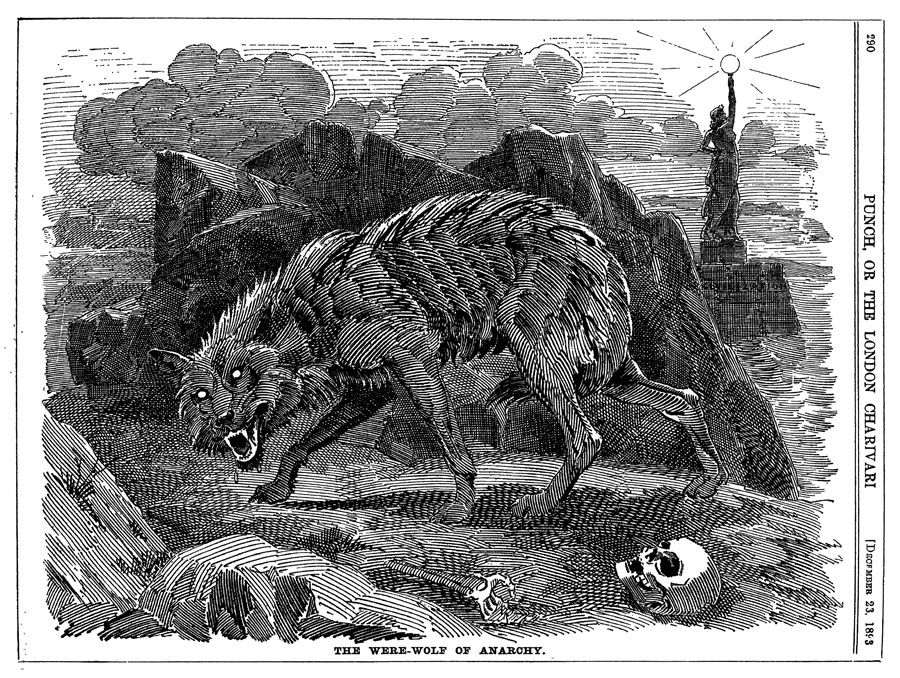
The Werewolf of Anarchy

werewolf.jpg

Synchronicity is as universal as gravity. When you start looking you find it everywhere.

Thus Discordian anarchist Stella Maris, making her first appearance in my re-reading of Illuminatus! (previously) in a week when more synchronicities related to the novel have been imposing themselves. “The Werewolf of Anarchy” (published on the 23rd of the month, of course) was a picture that turned up a couple of days ago when I was searching through the back issues of Punch magazine. Punch did a lot of this kind of thing, dropping the humour now and then for some heavy-handed pictorial comment about international affairs. Given my current reading the word “anarchy” was bound to catch my attention but the werewolf image is unusual—why not a regular wolf?—while being further bound to the novel via Robert Anton Wilson’s fondness for Lon Chaney Jr’s lycanthrope. I often wondered why Wilson used to refer to this as much as he did. Illuminatus! mentions the werewolf legend from the first Universal film in its grab-bag of cultural weirdness, and I seem to recall there being more references in Wilson’s later novels. In the 1980s Wilson was living in Ireland where he wrote a werewolf-themed song with a local band, The Golden Horde, one of the few (only?) Irish groups who can be counted as part of the fleeting psychedelic revival that took place in the middle of the decade. The Golden Horde’s first album, The Chocolate Biscuit Conspiracy, appeared in 1985, and ends with Lawrence Talbot Suite, a number which is “explained” with the following words: “Lon Chaney Jr, The Easter Bunny, The primeval sleeve note, red curtain, the stings, a crush-can dominates a scowling buddha”. Whatever that means.

hillage.jpg

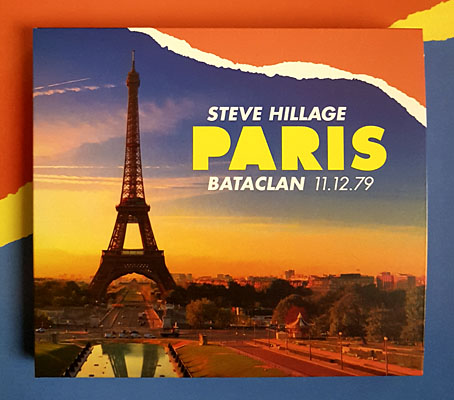
Meanwhile, my RSS feed informs me that Pentagrams Of Discordia have just released a new album whose final number bears the title Planetary Radiation (RAW); Robert Anton Wilson turns up again at the end of the track to talk about Chaos Theory in relation to Discordian history. And the above item arrived in the mail this week, a two-disc CD release of a newly-discovered live recording of Steve Hillage and band performing at the Bataclan in 1979. I own a lot of live Hillage albums, along with all his studio recordings, and this is one of the very best. The concert is pertinent for including an early rendition of New Age Synthesis (Unzipping The Zype), a song that made its first appearance in 1979 on the studio side of Live Herald, and which contains what may be the first reference to Illuminatus! in song form (the album sleeve includes thanks “to Robert Anton Wilson for his intriguing books”). Hillage offered an explanation of the studio songs’ lyrics in his own mysterious sleeve note:

For those who find the lingo a bit strange—“unzipping the zype” can be defined as (rising organ music please!):—the spontaneous inner exorcism by which a person can neutralise the harmful, consciousness-distorting effects of the artificial elemental spirits (zypes) formed around each word of everyday language.

The zypes are built up by the identification process by which we manufacture “reality.” Occultists refer to them as “astral glamour,” yogis as “the web of Maya”—but no word is zype-proof, not even zype. Cherish this phrase—it’s a royal flush!

Hmm, okay… No indication there or in the lyrics as to how you go about “unzipping the zype”. New Age Synthesis is a call-and-response between Hillage and partner Miquette Giraudy in which Hillage recounts his experience with the zypes. In the first verse he mentions “word spirits” to which Giraudy replies “Egregores!”, an occult concept which—quelle surprise—has connections to Chaos Magic. In the next verse Hillage blames the existence of the word spirits on the Illuminati—”Paranoia!” responds Giraudy—only to discard this claim in the lines that follow: “It isn’t really them at all, but you and me”. Hillage’s albums of the 1970s are filled with all manner of New Age business—flying saucers, ley lines, mysticism of various kinds—but he isn’t a David Icke. Why werewolves? What zypes? Mysteries abound. This is a great album, anyway, in or out of the Synchronicity Zone.

Previously on { feuilleton }
Ewige Blumenkraft
Twinkle, twinkle little stars

Ewige Blumenkraft

dollar.jpg

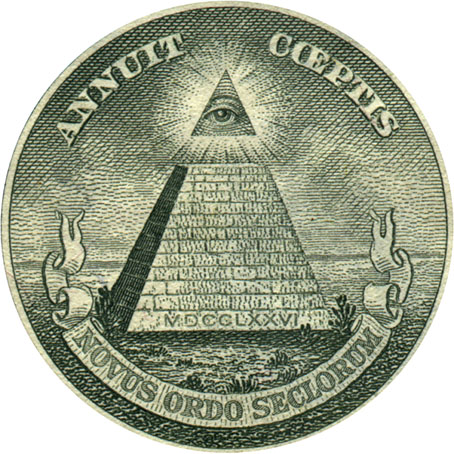
It’s that occult symbol again…

And it was suddenly all weird and super-freaky, like Godard shooting a Kafka scene: two dead Russians debating with each other, long after they were dead and buried, out of the mouths of a pair of Chicago Irish radicals. The young frontal-lobe-type anarchists in the city were in their first surrealist revival just then and I had been reading some of their stuff and it clicked.

“You’re both wrong,” I said. “Freedom won’t come through Love, and it won’t come through Force. It will come through the Imagination.” I put in all the capital letters and I was so stoned that they got contact-high and heard them, too. Their mouths dropped open and I felt like William Blake telling Tom Paine where it was really at. A Knight of Magic waving my wand and dispersing the shadows of Maya.

Adding to my suspicion that my footsteps are being dogged just now by the Chicago Surrealist Group, that there is a quote from the second chapter of Robert Shea and Robert Anton Wilson’s Illuminatus! trilogy. The passage occurs in a lengthy reminiscence by hippy-anarchist Simon Moon in which he remembers the continual arguments of his Chicago-anarchist parents. Having mentioned Illuminatus! in a couple of recent posts I decided to read it again, in part to see what might be thrown up by the very long hiatus since my last encounter. I read the novel rather obsessively from the age of 15 to 17—three times in all, I think—then set it aside while I followed Robert Anton Wilson into his other novels and non-fiction books. Simon Moon doesn’t mention the Chicago group by name—and the Rosemonts and their friends were more Marxists than anarchists—but, ya know… RAW enjoyed his coincidences (or synchronicities, or whatever) so I’ll take this as acausally significant. Will there be more? It’s a big novel so I don’t doubt it.

Previously on { feuilleton }
Eco calls on Cthulhu
Going beyond the zero
23 Skidoo

Moon and Serpent Rising

masbbom1.jpg

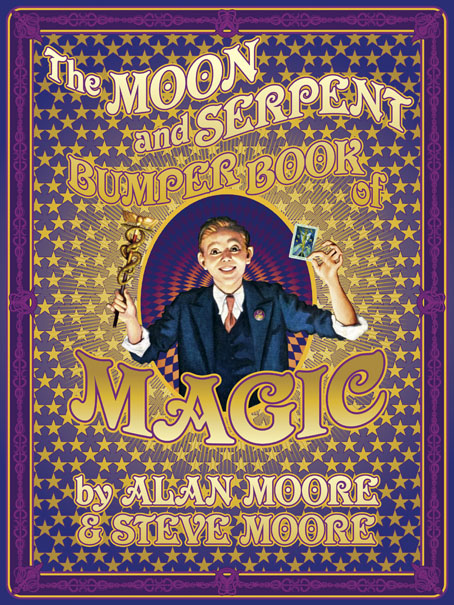
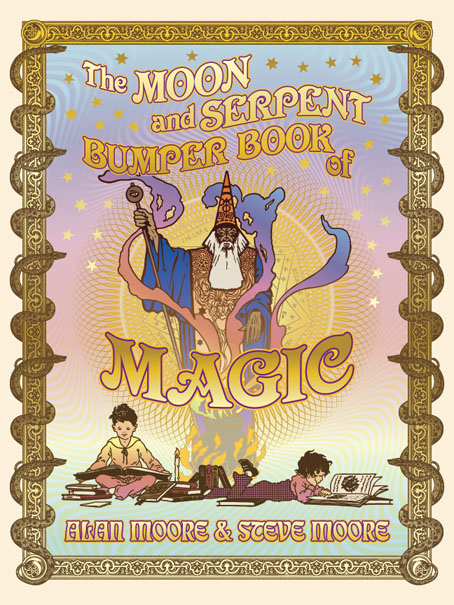
Top Shelf announced this one on Friday so I can break my silence about the book I’ve been working on since May 2021. The Moon and Serpent Bumper Book of Magic by Alan Moore and Steve Moore was first announced in February 2007. I’d created the cover design which was used for promotional purposes after which the project went into hibernation for several years. In 2014 Alan and Steve were back at work again, and were co-writing the final essay when Steve died suddenly in March of that year, whereupon the book retreated to limbo once more. Since 2007 my cover has been floating around the internet like the lid for an empty toybox, but the book really is finished at last, and will be published by Knockabout (UK) and Top Shelf (US) in October.

masbbom2.jpg

In addition to the cover design I was also slated to be working on two of the book’s internal features: The Soul, a six-part illustrated serial set in the 1920s which evolved out of the occult-detective strip that Alan and I were planning circa 1999; also a series of twenty full-page illustrations for a feature titled Magical Landscapes. When Tony at Knockabout informed me at the beginning of 2021 that the book was being revived I made the audacious suggestion to him and to Alan that I could, if need be, design the whole thing as well as illustrate my own sections. Alan readily agreed, saying he trusted me implicitly, which was good to hear; his sole brief was that the book should be “beautiful and psychedelic”. One reason for his trust is that we’d already made excursions into the Moon & Serpent zone together. I designed three of the Moon & Serpent CDs in the 2000s, and made the video that accompanied the William Blake-themed reading/performance by Alan and co. at the Purcell Room, London, in 2001. Consequently, I’ve often felt like a floating member of the Moon & Serpent cabal.

masbbom3.jpg

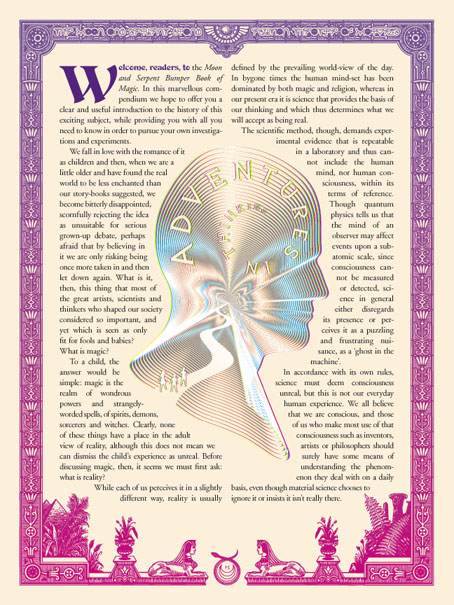
A couple of things are worth noting now that the book is about to enter the world. The first is that the contents are a little different to the press release from 2007 which announced a book of 320 pages, with 78 of those pages being brand new Tarot card designs. The authors subsequently realised that creating an entirely new Tarot deck is a huge task in itself, especially if, as was the intention, you wanted it to be as wide-ranging and authoritative as the Crowley/Harris Thoth deck. There is a chapter about the Tarot in the finished book but readers will now have to choose decks of their own. I can imagine disappointment being expressed about this, and about some of the other changes but the book as it now stands is actually bigger than the original proposal, with an additional 32 extra pages. The expansion is partly a result of my page design which put fancy borders on all of the text pages. I ended up doing a lot more work for the book than I expected, adding new pages here and there, creating a lot of extra graphics and illustrations, and breaking up the long final essay into sections which are illustrated throughout with small pictures.

Continue reading “Moon and Serpent Rising”

Eco calls on Cthulhu

eco2.jpg

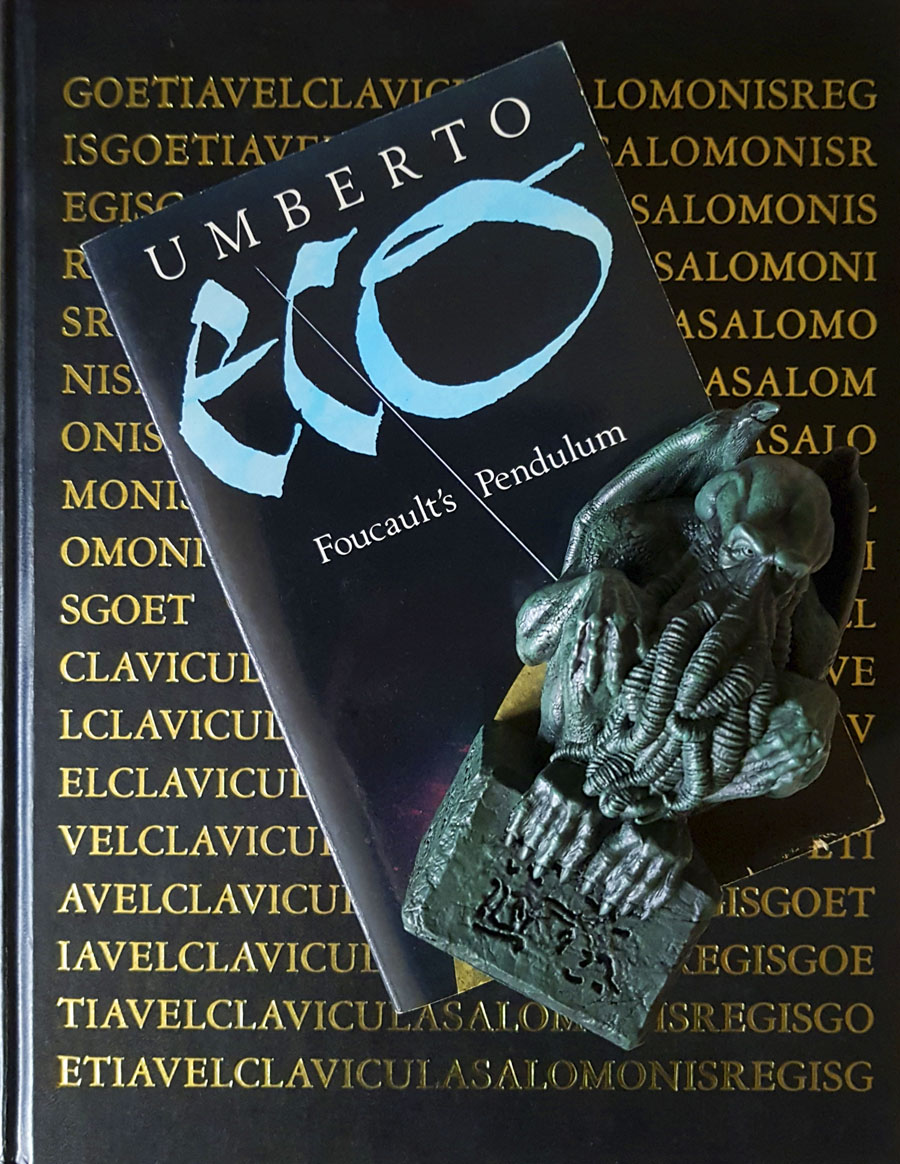
In which Umberto Eco nods fleetingly to the Cthulhu Mythos near the end of his second novel, Foucault’s Pendulum. I’d show you more of the relevant passage (below) but it’s rather spoilerish if you haven’t read the book. This turned up during a re-reading, my first since the novel appeared in paperback in 1990. A reference like this doesn’t stand out as much as it might elsewhere, not when the text that precedes it is stuffed to the gills with esoterica. Several hundred pages of occult history made me forget that Eco had hauled Lovecraft into his compendious fabulation along with everything else.

eco1.jpg

Ishmael Reed was responsible for returning me to Eco’s novel as a result of an earlier re-read of Mumbo Jumbo, Reed’s fictional account of voodoo, jazz, politics and many other things in the America of the 1920s. Eco was already in mind prior to this since I’d been working my way through his essays and lectures. (As I still am. He wrote a lot of the things.) Mumbo Jumbo‘s exploration of occult knowledge and occult conspiracy summoned vague memories of Foucault’s Pendulum, which made me realise that I didn’t remember very much at all about Eco’s novel even though both books share an interest in the tangled history of the Knights Templar. To the top of the pile it went.

It’s been interesting reading Eco’s novel again. For a start, it was funnier than I remembered, although this may be a result of my being much more familiar with the publishing business than I was in 1990. The story concerns a trio of men who work for a small publishing house in Milan, a division of which is devoted to the works of self-financing authors or “SFAs”. A vanity press in other words. A potential SFA turns up with a crank book rather similar to The Holy Blood and the Holy Grail, then abruptly disappears without collecting his manuscript. Curiosity, idleness and invention inspire the trio to improve upon the manuscript’s occult conspiracy in a manner that knits together just about every aspect of Western mysticism there is, and even some of the Eastern ones: Rosicrucianism, alchemy, the Kabbalah, Atlantis, the Illuminati, ley lines, the Hollow Earth, Stonehenge, etc, etc; it’s all in there. This is the thing they eventually call “the Plan”, a kind of Unified Field Theory of esoteric knowledge, and a contrivance whose fabrication is assisted by further SFA manuscripts arriving as candidates for a new line of “Hermetic” books. Problems arise for the publishers when their elaborate intellectual game ends up being taken for a serious revelation by a group of fanatical mystics. Eco’s novel demonstrates the pleasures of creative apophenia—the trio are continually challenging each other to fit a new piece of historical data into their scheme—while also acting as a warning that any halfway plausible Plan has the potential to be taken seriously by credulous cranks. As Lia, the novel’s voice of reason, says:

People are starved for plans. If you offer them one, they fall on it like a pack of wolves. You invent, and they’ll believe. It’s wrong to add to the inventings that already exist.

Eco explored this phenomenon more seriously in a later novel, The Prague Cemetery, which invents an author for the notorious Protocols of the Elders of Zion, a Plan whose conspiratorial claims continue to fuel anti-Semitism the world over. The internet has only accelerated Plan-construction, and I imagine Eco would have been simultaneously fascinated and appalled by the feeble imaginings of that ex-football player with the lizard obsession, and the shambling, frothing Q-mob with their Very Important jpegs. (What is it the latter are always saying? “Trust the Plan”… And having mentioned Mr Icke, I just put his name into Google only to find that the latest extract from his Twitter feed has him talking about the Holy Grail. Welcome to the Crank Zone.)

Continue reading “Eco calls on Cthulhu”