Illustrating Hyperborea

hyperborea00.jpg

The Book of Hyperborea (1996). Cover art by Robert H. Knox.

“My Hyperborean tales, it seems to me, with their primordial, prehuman and sometimes premundane background and figures, are the closest to the Cthulhu Mythos, but most of them are written in a vein of grotesque humor that differentiates them vastly.” — Clark Ashton Smith

Since re-reading Clark Ashton Smith’s The Tale of Satampra Zeiros I’ve been revisiting more of Smith’s stories set in the lost world of Hyperborea. And having put together a post some years ago that gathered all the original illustrations for Smith’s Zothique cycle, I thought I’d try and do the same for another of his story series. As I noted in the earlier post, we’re fortunate today that it’s so easy to see illustrations that in the past would have been impossible to find unless you owned (or had access to) a huge collection of pulp magazines. Pulp illustrations aren’t always very good—in the case of the early issues of Weird Tales, they’re frequently amateurish—but those that illustrate new fiction for the first time are historically important if nothing else.
pennington1.jpg

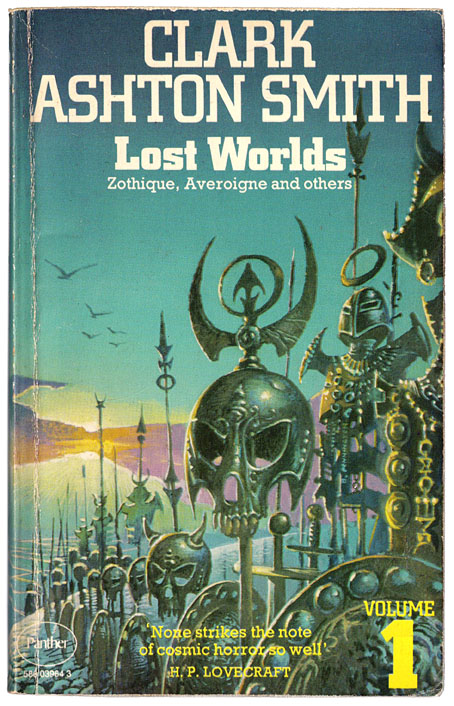
Lost Worlds: Volume 1 (1974). Cover art by Bruce Pennington. Lost Worlds was a single-volume collection published by Arkham House (USA) and Neville Spearman (UK). The Panther paperback covers by Bruce Pennington could easily be used on other books but these were the first Smith volumes I owned.  

The first Hyperborea stories were among Smith’s earliest prose fantasies, owing something to Lord Dunsany on the one hand (HP Lovecraft detected a Dunsanian quality), and the writers of antiquity on the other, the name “Hyperborea” (“Behind the North Wind”) being borrowed from the Greeks. The northern location is about the only feature of the continent that the Greek writers would recognise, Smith’s world being a temperate pre-Ice Age realm of mountains and verdant jungles. Dinosaurs and megafauna share the lands with human inhabitants for whom sorcery is a common practice. As with Zothique, the cycle was an influential one. Lin Carter in the introduction to his Ballantine collection, Hyperborea (1971), suggests that the name of the continent might have prompted Robert E. Howard to set his Conan stories in “the Hyborean Age”. This could be the case: Howard and Smith were writing for the same publications, and the first Conan story was published in Weird Tales shortly after The Tale of Satampra Zeiros; but Howard was also reading the Greeks as well. A more substantial influence may be found in Fritz Leiber’s Nehwon, a world in which aspects of Hyperborea and Zothique are combined. Sword and sorcery begins “behind the North Wind”, in other words, although there’s very little sword-play in Smith’s fiction, that was Leiber and Howard’s department.
pennington2.jpg

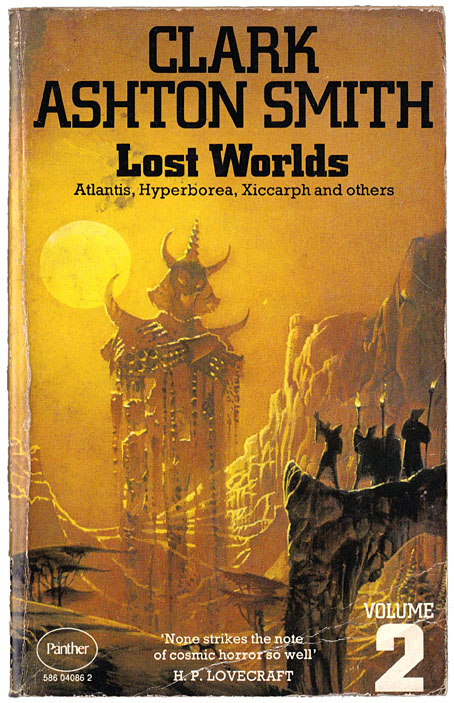
Lost Worlds: Volume 2 (1974). Cover art by Bruce Pennington.

The original Hyperborea illustrations are fewer than those for Zothique. As with the later cycle, several of the stories are unillustrated, while others were given lacklustre artwork. In the earlier post I followed the story order chosen by Lin Carter which attempted to contrive an internal chronology for the cycle. Carter did the same with his Hyperborea collection so I’ve followed his example once again. Later collections, like Will Murray’s Book of Hyperborea, tend to order the stories by publication date.
hyperborea01.jpg

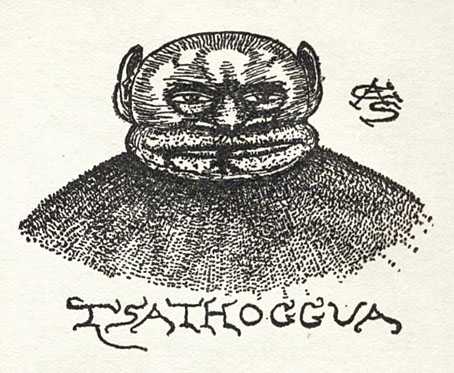
The Seven Geases, Weird Tales, October 1934.

An illustration of Tsathoggua by Smith himself. The toad-god turns up in person in this story.
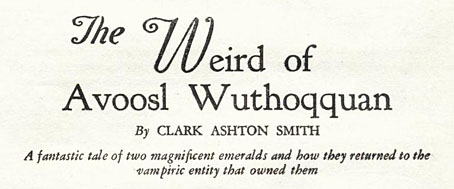
hyperborea02.jpg

The Weird of Avoosl Wuthoqquan, Weird Tales, June 1932.

Continue reading “Illustrating Hyperborea”

The art of Hannes Bok, 1914–1964

bok01.jpg

Altars of Patagonia (1946)

Like the huge cache of Virgil Finlay art that turned up at the Internet Archive a couple of years ago, the pictures here are from a two-volume collection made by an enthusiast gathering together yet more illustrations from the pulp magazines of the 1940s and 50s. Hannes Bok (real name Wayne Francis Woodard) wasn’t as prolific as Virgil Finlay, but the careers of the two men intersected in the pages of Weird Tales where they both used stipple shading to compensate for the poor reproduction of pulp paper. Bok’s work tended to be more stylised than Finlay’s, with a quirkiness that makes his art easy to spot once you’ve seen a few examples.

bok02.jpg

Boomerang (1947)

The two volumes contain a total of over 300 illustrations so any selection will only be a small sampling. Many of the drawings were new to me. The first volume is mostly work from magazines such as Weird Tales and the minor SF mags; the second includes book covers, calendar illustrations and other work. As with the Finlay collections, both volumes are available in a range of file formats which include cbz files, a format I prefer to pdf for browsing image-heavy documents. For more about cbr/cbz files, see the end of this post.

bok03.jpg

Cross of Mercrux (1942)

bok04.jpg

Daughter of Darkness (1941)

bok05.jpg

Dimensional Doors (1944)

Continue reading “The art of Hannes Bok, 1914–1964”

The Cthulhu Mythos in the pulps

mythos01.jpg

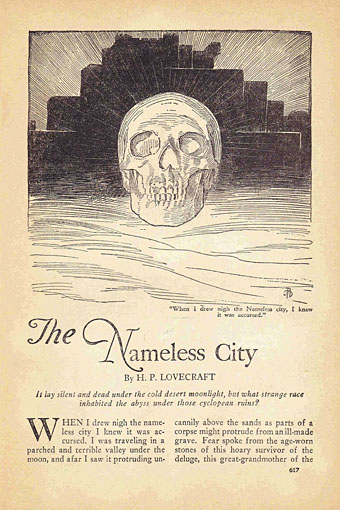
The Nameless City: First published in The Wolverine, November 1921. Reprinted in Weird Tales, November 1928. Illustration by Joseph Doolin.

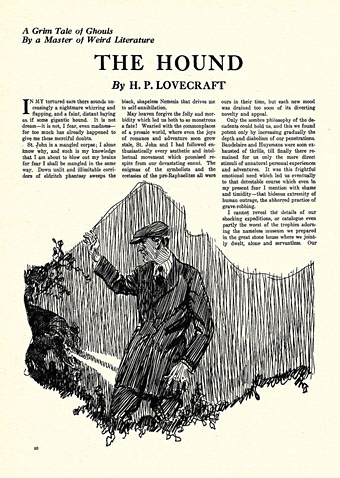
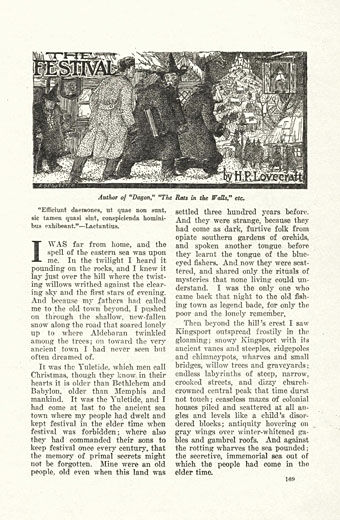
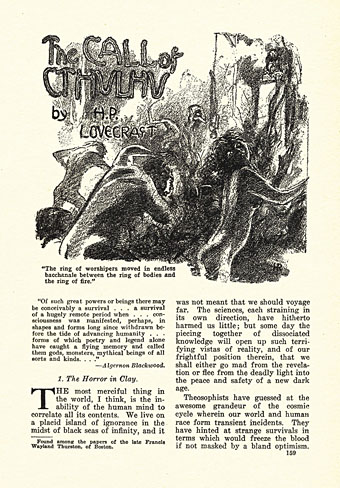
This would have been “The Cthulhu Mythos in Weird Tales” if some of HP Lovecraft’s more substantial stories hadn’t been published elsewhere. To prevent sprawl I’ve limited the list to Lovecraft’s own stories even though the Mythos takes in the work of contemporaries such as Clark Ashton Smith, Robert E. Howard, Frank Belknap Long, Zealia Bishop, August Derleth and others. I like seeing the first appearance in print of familiar tales, and I like seeing their accompanying illustrations even if the drawings are inferior pieces, which they often were for the first decade of Weird Tales. These are the short-story equivalent of first editions, and in the case of The Call of Cthulhu you get to see the first printing anywhere of that mysterious name.

mythos02.jpg

The Hound: Weird Tales, February 1924. Illustration by William Fred Heitman.

This issue is also notable for a story by Burton Peter Thom which shares a title with a Mythos-derived song by Metallica, The Thing That Should Not Be.

mythos03.jpg

The Festival: Weird Tales, January 1925. Illustration by Andrew Brosnatch.

mythos22.jpg

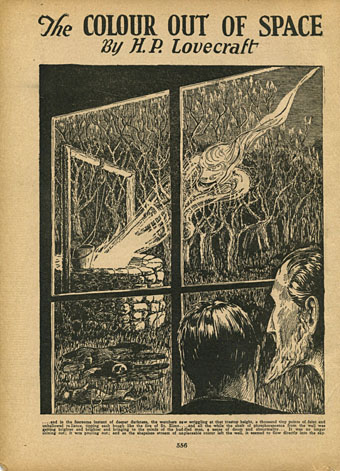
The Colour Out of Space: Amazing Stories, September 1927. Illustration by JM de Aragon.

Lovecraft didn’t think that Weird Tales would appreciate this one even though it’s more horror than science fiction so he sent it to Amazing Stories instead.

mythos04.jpg

mythos26.jpg

The Call of Cthulhu: Weird Tales, February 1928. Illustration by Hugh Rankin.

It’s doubtful that Rankin, Senf and co. would have been up to the task of depicting Great Cthulhu or the non-Euclidean nightmare of R’lyeh, but this hardly excuses editor Farnsworth Wright’s decision to give the cover to Elliott O’Donnell’s ridiculous ghost table.

Continue reading “The Cthulhu Mythos in the pulps”

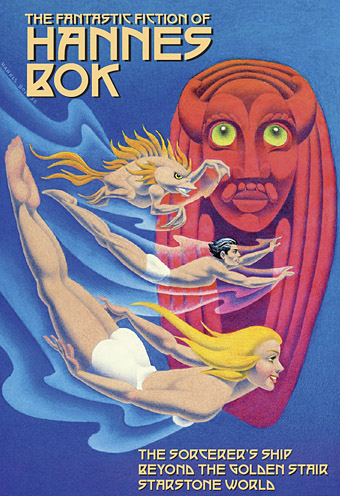
The Fantastic Fiction of Hannes Bok

bok1.jpg

A belated note of thanks to Robert T. Garcia who sent me a PDF of this book a few weeks ago. The Fantastic Fiction of Hannes Bok is a hardcover collection of three fantasy novels by artist Hannes Bok, all of which have been out of print for decades (75 years in the case of Starstone World). Bok has a lasting reputation as an illustrator of fantasy, science fiction and horror during the pulp era but he also wrote fiction and poetry for the pulps, in addition to essays for Mystic Magazine that included a short-lived astrology column. Two of Bok’s novels were published posthumously by Lin Carter in the Ballantine Adult Fantasy series, the existence of which intrigued me for many years, not least because the Ballantine paperbacks weren’t easy to find in UK bookshops. Bok’s fantasy isn’t quite to my taste (I prefer things to be generally darker and more grotesque) but I’m pleased to see these stories back in the world.

bok2.jpg

Contents:
The Fantastic Fiction of Hannes Bok‘s cover art is by Bok (published previously in Hannes Bok: A Life in Illustration in a poor image, scanned here for the first time from the original).
• Original Introduction by Charles de Lint!
• Ballantine Adult Fantasy editor Lin Carter’s introductions to The Sorcerer’s Ship and Beyond the Golden Stair, plus an all-new afterword detailing the publishing history of The Sorcerer’s Ship by Bok collector and college professor William Lorenzo. Publisher, Bob Garcia provided an introduction to Starstone World.
• A number of unpublished photos of Bok.
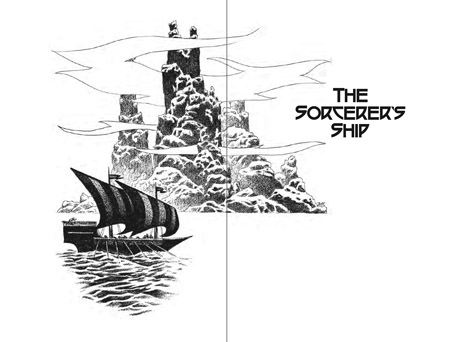
• Bok’s pulp art for The Sorcerer’s Ship is included, plus two paintings specified by the artist as illustrating that novel: a color reprise of an interior illustration and a color portrait of the creature Yanuk done for a fan.
• Since the other two novels did not have artwork by the artist, Jim Pitts provides us a wonderful original frontispiece for each.
• Bok sketches from The Hannes Bok Sketchbook Folio, and A Hannes Bok Sketchbook plus unpublished sketches.

bok3.jpg

Previously on { feuilleton }
Ballantine Adult Fantasy covers

Things

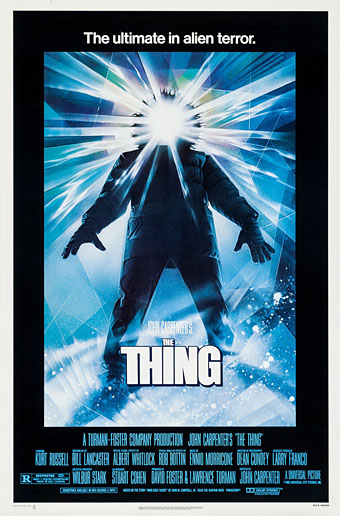
thing01.jpg

Art by Drew Struzan.

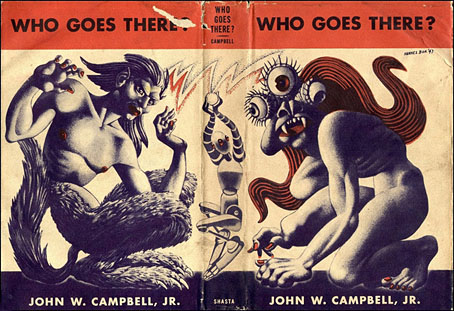
One of my current commissions is a piece of art for a book based on John Carpenter’s The Thing, due to be published next year. This was a request I agreed to immediately, having been astonished by the film when it appeared in 1982 (I saw it three times), and having rated it ever since as Carpenter’s best, as well as one of my all-time favourite horror films. I haven’t started on the planned piece just yet but the commission encouraged me to upgrade my DVD copy of the film to the Blu-ray version, and to also read for the first time John W. Campbell’s “Who Goes There?”, the short story that was the origin of both Carpenter’s film and The Thing From Another World (1951) directed by Christian Nyby. Reading the story set me hunting around for other interpretations of Campbell’s alien.

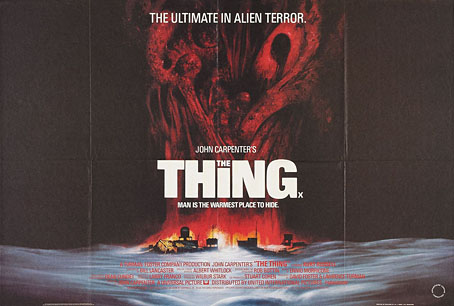
thing02.jpg

UK poster. Art by Les Edwards.

The story was instructive in several ways, the first being how closely Bill Lancaster’s script for the Carpenter film follows the story’s outline. The paperback collection I was reading has an introduction by James Blish which complains about the Howard Hawks/Christian Nyby production turning the polymorphous alien into another clone of Frankenstein’s monster. That’s true but the Nyby film still scared me to death when I first saw it aged 11 or so, and it has its merits. Lancaster not only stayed closer to the original shape-shifting premise but also kept many of the character names, plus details such as the blood test and the Thing’s attempt at the end to build a machine to escape from the encampment. The unforgettable opening, however, with the lone helicopter pursuing the dog, is all Lancaster’s.

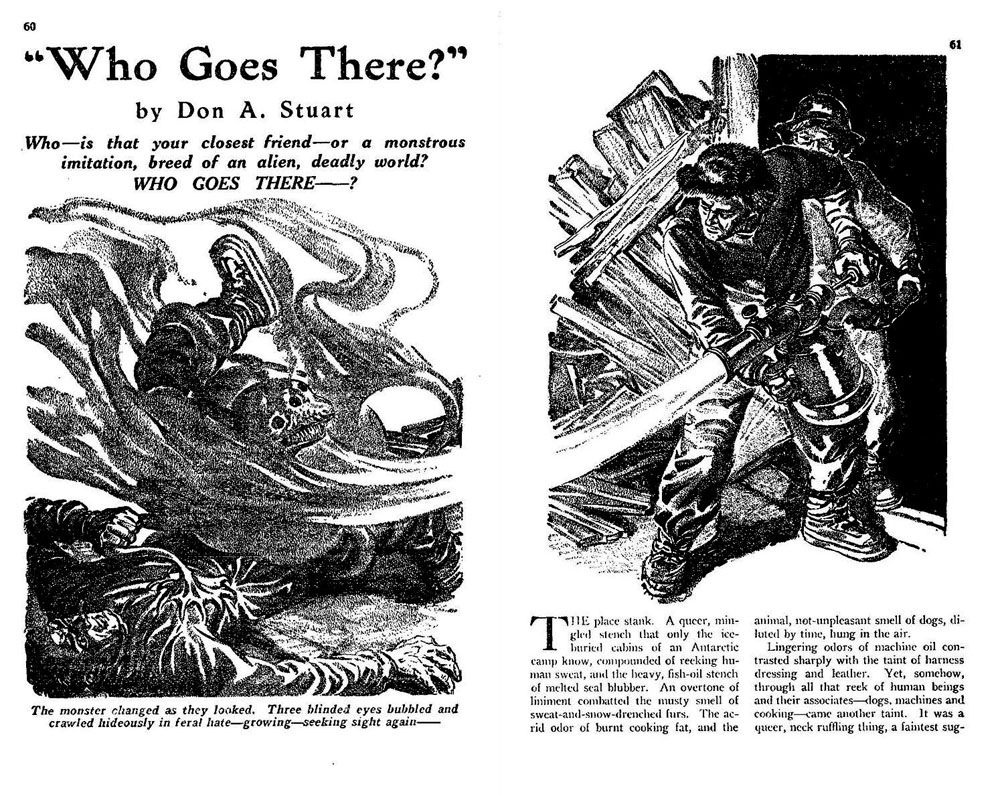
thing03.jpg

Astounding Science-Fiction, August 1938; artist unknown. “Don A. Stuart” was a pseudonym for John W. Campbell, at that time the newly appointed editor of Astounding. Campbell’s editorship changed the name of the magazine from Astounding Stories to Astounding Science-Fiction.

It was face up there on the plain, greasy planks of the table. The broken haft of the bronze ice-axe was still buried in the queer skull. Three mad, hate-filled eyes blazed up with a living fire, bright as fresh-spilled blood, from a face ringed with a writhing, loathsome nest of worms, blue, mobile worms that crawled where hair should grow—

Campbell’s description of the ice-bound alien is better than some of his writing elsewhere. I’m used to tempering my judgement when visiting stories written for the pulps but Campbell’s writing is really awful, and a reminder of why I never got very far with the early SF writers. Weird Tales magazine had its share of ham-fisted journeymen (and women), but Campbell’s contemporaries such as Clark Ashton Smith and HP Lovecraft read like the most finessed and mandarin prose stylists in comparison. Well, The Thing isn’t the first great film to be based on a poor-quality story so we can at least thank Campbell for his scenario, although how much of it was his own has never been clear. The idea of ancient aliens in Antarctica (some of which are amorphous shape-shifters) had already been explored by HP Lovecraft in At the Mountains of Madness; Lovecraft’s story was published in 1936 by Astounding Stories, the same magazine that published “Who Goes There?” two years later. This lineage, and the possible influence, makes The Thing one of the foremost Lovecraftian films even without all of its tentacled abominations.

thing04.jpg

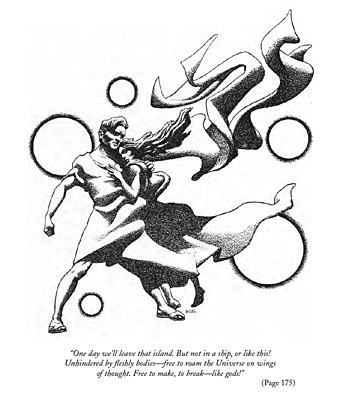
Art by Hannes Bok.

The story provided the title of Campbell’s debut collection of short fiction in 1948. I’ve known the Hannes Bok cover art for many years but hadn’t realised until recently that the three-eyed monster on the front was a Bokian rendering of Campbell’s alien. The figure on the back is presumably a human/husky hybrid, while I’d guess the robot relates to one of the author’s other stories.

Continue reading “Things”