It’s become a tradition here to post a playlist for Halloween so here’s the one for this year, a collection of favourite “voodoo” music. Most are these pieces have as much to do with real voodoo as Bewitched does with real witchcraft but I like the atmospheres of Voodoo Exotica they evoke.
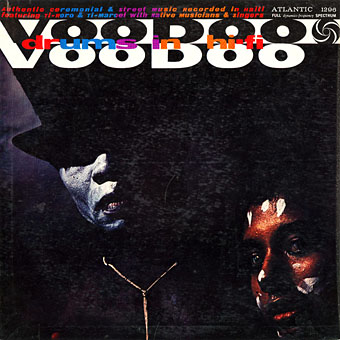
Voodoo Drums in Hi-Fi (1958).
Beginning with some ethnographic authenticity, this is one of many recordings of genuine (so they claim) voodoo drummers from Haiti, and was probably released to cash-in on the Exotica boom of the late Fifties. For the genuine article, the drums here sound less dramatic than the pounding rhythms familiar from Hollywood rituals, but that’s still a great cover. Voodoo Drums in Hi-Fi has been deleted for years but a worn copy of the vinyl release can be found on various mp3 blogs. For a more recent recording of voodoo rhythms, there’s Spirits Of Life: Haitian Vodou on the Soul Jazz label.
Voodoo Dreams (1959) by Martin Denny.
This, meanwhile, is the genuine kitsch from Denny’s Hypnotique album, a slow arrangement of a syrupy Les Baxter tune. More drums and bongos than usual for a Denny piece, and a suitably spectral chorus.
Voodoo (1959) by Robert Drasnin.
When composer Drasnin was asked by the Tops company to get hip to the Exotica craze the result was an album entitled Voodoo (with unconvincingly exotic white people on the cover), from which they released a single, Chant of the Moon, and this track as the B-side, one of the best pieces on the album.
I Walk on Gilded Splinters (1968) by Dr John.
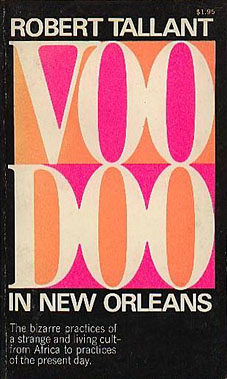
Mac Rebennack was working as a session musician in Los Angeles when he recorded his debut album in an atmosphere far removed from the swampy New Orleans miasma which the music conjures. Gris-Gris owes a great deal to Robert Tallant’s book, Voodoo in New Orleans (1946), a popular recounting of the city’s occult legends from which Rebennack borrowed not only his new persona (chapter 5 concerns the history of the real Dr John, a 19th century voodoo practitioner) but also many of the transcribed chants which he set to music. In chapter 3 we read this:
A song given to a reporter of the New Orleans Times-Picayune was printed in that newspaper on March 16, 1924. Probably a very old one, it reflects the dominance of the queens in New Orleans Voodoo and boasts of their tremendous power. Originally sung in the patois known as Creole, it is given here in English:
They think they frighten me,
Those people must be crazy.
They don’t see their misfortune
Or else they must be drunk.I—the Voodoo Queen,
With my lovely headkerchief
Am not afraid of tomcat shrieks,
I drink serpent venom!I walk on pins
I walk on needles,
I walk on gilded splinters,
I want to see what they can do!They think they have pride
With their big malice,
But when they see a coffin
They’re as frightened as prairie birds.I’m going to put gris-gris
All over their front steps
And make them shake
Until they stutter!
Anyone familiar with Gris-Gris will recognise the lyrics of I Walk on Gilded Splinters (misspelled “Guilded” on the sleeve) which Dr John did a great job of fashioning into a classic voodoo song. The entire album might be ersatz, then, but it remains one of my favourites by anyone, and for me it’s still the best Dr John album.
Mama Loi, Papa Loi (1970) by Exuma.
Gris-Gris was too weird to be a success when it first appeared but Dr John’s music and extravagant stage presence were very distinctive and helped Blues Magoos manager Bob Wyld recast singer Tony McKay as “Obeah man” Exuma for Mercury Records. Exuma’s self-titled debut album is ersatz stuff again but manages to sound even more deliriously swampy and sorcerous than Gris-Gris, with jungle sounds, zombie gurgles and a clutch of enthusiastic voodoo-inflected songs. “Mama Loi, Papa Loi / I see fire in the dead man’s eye” he sings here, and for the duration of the album Tony McKay is Exuma.
Zu Zu Mamou (1971) by Dr. John.
After Gris-Gris Dr John gradually pared away the voodoo songs but saved one of the best until his final occult outing, The Sun, Moon & Herbs, which includes contributions from Eric Clapton and, somewhere in the bayou distance, Mick Jagger and PP Arnold on backing vocals. Zu Zu Mamou is the spooky highlight which made a fleeting appearance in Alan Parker’s 1987 Satanic noir, Angel Heart.
Voo Doo (1989) by the Neville Brothers.
Of all the songs I’ve heard which equate falling in love with a voodoo spell, this one from New Orleans’ Neville Brothers is the most evocative, a track from their marvellous Yellow Moon album.
Invocation To Papa Legba (1989) by Deborah Harry.
Yes, it’s Blondie’s Debbie Harry singing a very authentic-sounding voodoo chant, arranged by Chris Stein. This was a one-off which appeared on a Giorno Poetry Systems collection, Like A Girl, I Want You To Keep Coming, along with a William Burroughs reading (a staple of GPS albums), New Order playing Sister Ray live, and other pieces.
Litanie Des Saints (1992) by Dr. John.
Goin’ Back to New Orleans, like Gumbo before it, saw Dr John revisiting the musical history of his native city. Most of the songs are old jazz and blues covers with the notable exception of this opening number, another voodoo invocation. A great string arrangement and vocals from the Neville Brothers; I’d love to hear a whole album like this.
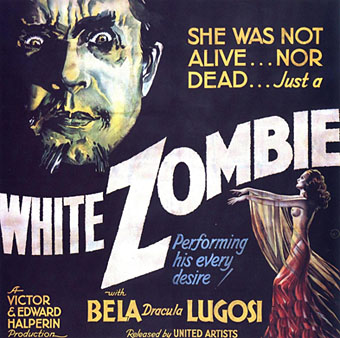
Zombie’ites (1993) by Transglobal Underground.
Zombies are a voodoo staple despite their current degraded status as the cuddly monster du jour, a development which has made me tire of seeing the word “zombie” in almost any context. A shame because I used to have a lot of time for films such as White Zombie (1932), I Walked With a Zombie (1943), and the later George Romero movies. White Zombie was the first zombie film and stars Bela Lugosi in a weirder and more effective piece of horror cinema than the stagey Dracula which made his name; I Walked With a Zombie was one of Val Lewton’s superb noirish collaborations with Jacques Tourneur; both films have their voodoo chants sampled on this track by Transglobal Underground from Dream of 100 Nations, with the opening chant from White Zombie forming the pulse that drives the piece. Along the way there’s another invocation from Voodoo in New Orleans—”L’Appé vini, le Grand Zombi / L’Appé vini, pou fe gris-gris!”—samples of Criswell from Plan 9 from Outer Space, and a moment of pure bliss at the midpoint when singer Natacha Atlas rides in on a magic carpet made of Bollywood strings.
Happy Halloween! And don’t forget to feed the loas…
• Vampire-hunting in New Orleans
Previously on { feuilleton }
• Voo-doo: Hoochie Coochie and the Creative Spirit
• Dead on the Dancefloor
• Another playlist for Halloween
• Exotica!
• White Noise: Electric Storms, Radiophonics and the Delian Mode
• The Séance at Hobs Lane
• Exuma: Obeah men and the voodoo groove
• A playlist for Halloween
• Ghost Box
• Voodoo Macbeth