Weekend links 818

paunzen.jpg

The Bookworm (no date) by Arthur Paunzen.

• New Cabaret Voltaire: Nag Nag Nag (Live 2025 Single Edit). Good to hear they’ve reinstated the Patrick Moore dialogue sample, something that’s on the studio version but usually missing from live recordings. The single is a trailer for a forthcoming album based on the group’s recent anniversary tour.

The Mysterious Castle in the Carpathians (1981), a wacky Czech comedy, one of many directed by Oldřich Lipský. With a story by Jules Verne, music by Luboš Fišer, and steampunk props by Jan Švankmajer.

• More new music: Butch’s Guns by Sunn O))); Sidings by Craven Faults; Frequencies In The Fog by Rod Modell.

What strikes me most is the difference between people who’ve learned to construct what I call “containers for attention”—bounded spaces and practices where different modes of engagement become possible—and those who haven’t. The distinction isn’t about intelligence or discipline. It’s about environmental architecture. Some people have learned to watch documentaries with a notebook, listen to podcasts during walks when their minds can wander productively, read physical books in deliberately quiet spaces with phones left behind. They’re not rejecting technology. They’re choreographing it.

What we think is a decline in literacy is a design problem, says librarian Carlo Iacono

• At Colossal: “Striking photos by Peter Li capture the soaring majesty of sacred spaces.”

• At Public Domain Review: The Eight Horses of King Mu, Son of Heaven (ca. 1300).

• At the BFI: Brogan Morris selects 10 great political thrillers.

• At Dennis Cooper’s: Roland Topor’s Brain.

• RIP Robert Duvall and Tom Noonan.

The Book Lovers (1997) by Broadcast | Tiny Golden Books (2000) by Coil | Library Of Solomon Book 2 (2011) by Demdike Stare

Weekend links 805

strausfeld.jpg

A poster by Peter Strausfeld for a 1966 screening of Alphaville and La Jetée.

• At Bandcamp Daily: “Caroline True obsesses over compilations so you don’t have to,” says Erick Bradshaw. I recommend CTR’s compilations.

• At The Wire: Read an extract from Music Stones: The Rediscovery Of Ringing Rock by Mike Adcock.

• At Colossal: Pastoral landscapes brim with patterns in luminous paintings by David Brian Smith.

One of the markers that sets Mamoru Oshii apart from his peers is his willingness to allow place to speak for itself. From the seasonality captured in his works, like the first two Patlabor films, to the otherworldly environments of Ghost In The Shell 2: Innocence (all projects in which Ogura was also involved heavily) and even the fantasy scapes of his Angel’s Egg, Oshii’s attention to place, and allowing it to be a player in the story, gives as much voice to world building, as he does to characterisation. This attentiveness and patience for place, allows us to settle deeply inside a worldview that is often simultaneously familiar but unerringly alien.

Lawrence English talks to art director Hiromasa Ogura and composer Kenji Kawai about their work on Oshii’s Ghost in the Shell

• At the BFI: Leigh Singer suggests where to begin with the films of Lucile Hadžihalilović.

• Necromodernist Architectures in Contemporary Writing: an essay by David Vichnar.

• New music: Hydrology by Loula York; Love Letters Via Echelon by Nerthus.

• There’s more Intermittent Eyeball Fodder at Unquiet Things.

• The Strange World of…Early Cabaret Voltaire.

• Winners of the Drone Photo Awards 2025.

Lautréamont’s Apocrypha

Drone Um Futurisma (1992) by Cusp | ABoneCroneDrone 1 (1996) by Sheila Chandra | Suspicious Drone (2009) by Demdike Stare

Weekend links 784

ford.jpg

An illustration by HB Ford for The Violet Fairy Book (1906), edited by Andrew Lang.

• New music: An Aesthetic – Experiments in Tape by Hawksmoor; Leylines (2025 remaster) by Aes Dana; A Fragile Geography (10th Anniversary Reissue) by Rafael Anton Irisarri.

• “Skoda Auto designers reimagine Ferat Vampire car from cult classic 1981 Czech horror film”.

• At Colossal: Chris Ware illustrates a postwoman’s day to celebrate 250 years of USPS.

Seen today, the failure of Sorcerer looks like a grim prophecy of where the film industry would be headed in the years to come. It signaled that the creative ambitions of the New Hollywood, and its indulgence of stubborn renegade auteurs, had been cast aside for a new and dispiriting blockbuster ethos. Decades later, that ethos is still with us: a Hollywood dominated by digitally smoothed, effects-encrusted moviemaking, where every backdrop looks fake (even the real ones) and action sequences carry no physical weight. It’s a wretched landscape, and Sorcerer positively towers over it. To watch the film now, from its electric opening moments through its gaspingly bleak denouement, is to encounter something more than just a magnificent ruin or an object of cultish reclamation: a thwarted masterwork that is thwarted no longer.

Justin Chang on the bleak magic of William Friedkin’s Sorcerer.

• At the BFI: The Red Shoes wallpaper by the film’s designer Hein Heckroth.

All This Violence by Caspar Brötzmann Massaker.

• RIP Lalo Schifrin and Rebekah del Rio.

• The Strange World of…Jon Spencer.

In Ultra-Violet (1983) by Cinema 90 | Violet Ray Gas (2009) by Violet | Violetta (2012) by Demdike Stare

Weekend links 717

smith.jpg

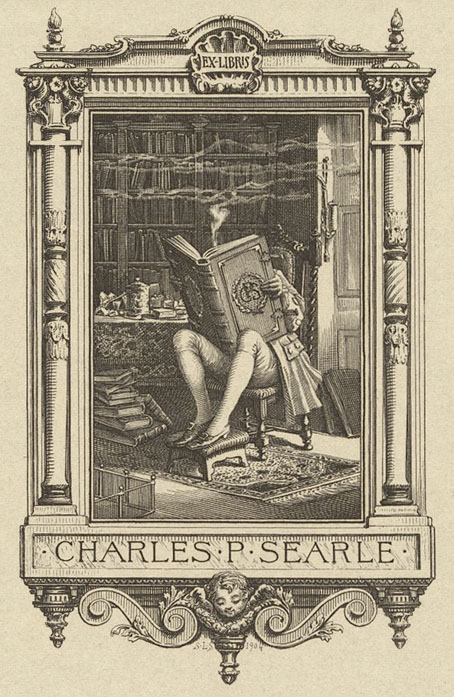
Bookplate of Charles P. Searle (1904) by Sidney Lawton Smith.

• “If Minute 9 is the first time we hear the names Deckard and Blade Runner, it’s also the first time we meet the plainclothes cop who will play a key role in LAPD surveillance of Deckard—and in the changed emphasis of four subsequent versions of Blade Runner released over the next twenty-five years.” Des Barry in the latest Minute 9 installment at 3:AM Magazine, in which a writer analyses the ninth minute of a favourite film.

• “I’ve really started to respect the journalists who are documenting what artists are doing… There’s so much reliance on social media for artists to express themselves, but maybe some don’t want to express themselves on social media all the time. Maybe they’d rather talk to a professional journalist who could parse through it for them. It can be more interesting that way.” Julia Holter talking to Skye Butchard about music-making.

• “I didn’t use any instruments that had been manufactured after 1980, but vintage analogue gear to sound like the tracks that they’re trying to evoke.” Matt Berry discussing his enthusiasm for library music, and his new album of the same for the KPM label.

• Mixes of the week: Monument Waves 002 at A Strangely Isolated Place, and DreamScenes – March 2024 at Ambientblog.

• At Public Domain Review: The Art of Sutherland Macdonald, Victorian England’s “Michelangelo of Tattooing” (ca. 1905).

• At Colossal: Unearthly characters populate Spencer Hansen’s salvaged universe.

• At Bandcamp: A Guide to Can by George Grella.

• Galerie Dennis Cooper presents…Amir Zaki.

• New music: Shoures Soote by Cerfilic.

Queens Of The Circulating Library (2000) by Coil | Library Of Solomon Book 1 (2011) by Demdike Stare | The Equestrian Library (2013) by Broadcast

Weekend links 424

calder.jpg

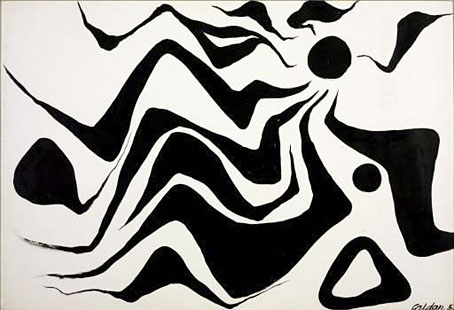
Black Sun (1953) by Alexander Calder.

• “But Berlin Alexanderplatz transcends its genre elements, largely because of Döblin’s deep lack of hope about what can be expected of human beings.” Adam Kirsch on Alfred Döblin’s Berlin.

• “I occasionally dream of finding books that do not seem to exist (yet), and sometimes remember their titles,” says Mark Valentine.

• “I don’t read fiction.” He does, however, own 11,000 books. Alan Garner on writing a memoir of his wartime childhood.

What is it that I really like? I mean that’s the question that I think every musician and artists and everybody actually, is asking themselves; what they really like. And that means the emphasis is on REALLY like, meaning how do you push aside what you’ve been told, what you’ve been taught, what your friends like, and how much you like something because your friends like it or because it’s socially popular at the moment, or your girlfriend likes it or any of those ideas.

Jon Hassell (again) in an interview at Ableton

• How Alexander Calder sparked a modern fascination with mobiles (sculptures, that is, not telephones).

• Deep in Italy, one man’s Surrealist mini-city sleeps: Francky Knapp on Tomaso Buzzi’s La Scarzuola.

• “Even before electricity, robots freaked people out”: Lisa Hix on the history of clockwork automata.

Nicolas Winding Refn’s website devoted to neglected/abandoned films was launched this week.

• Mixes of the week: FACT Mix 664 by Lucy, and XLR8R Podcast 552 by Thomas Fehlmann.

Jean-Paul Goude‘s best photograph: an androgynous Grace Jones.

Marquis de Sade: 112 pages, 100 erotic illustrations.

The world’s most beautiful libraries

Sade Masoch (1968) by Bobby Callender | I’ve Seen That Face Before (Libertango) (1981) by Grace Jones | Black Sun (2011) by Demdike Stare