
Illustrating Hyperborea

hyperborea00.jpg

The Book of Hyperborea (1996). Cover art by Robert H. Knox.

“My Hyperborean tales, it seems to me, with their primordial, prehuman and sometimes premundane background and figures, are the closest to the Cthulhu Mythos, but most of them are written in a vein of grotesque humor that differentiates them vastly.” — Clark Ashton Smith

Since re-reading Clark Ashton Smith’s The Tale of Satampra Zeiros I’ve been revisiting more of Smith’s stories set in the lost world of Hyperborea. And having put together a post some years ago that gathered all the original illustrations for Smith’s Zothique cycle, I thought I’d try and do the same for another of his story series. As I noted in the earlier post, we’re fortunate today that it’s so easy to see illustrations that in the past would have been impossible to find unless you owned (or had access to) a huge collection of pulp magazines. Pulp illustrations aren’t always very good—in the case of the early issues of Weird Tales, they’re frequently amateurish—but those that illustrate new fiction for the first time are historically important if nothing else.
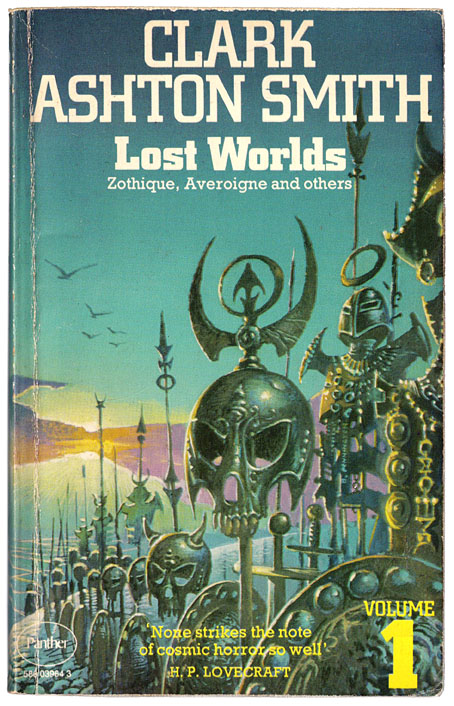
pennington1.jpg

Lost Worlds: Volume 1 (1974). Cover art by Bruce Pennington. Lost Worlds was a single-volume collection published by Arkham House (USA) and Neville Spearman (UK). The Panther paperback covers by Bruce Pennington could easily be used on other books but these were the first Smith volumes I owned.  

The first Hyperborea stories were among Smith’s earliest prose fantasies, owing something to Lord Dunsany on the one hand (HP Lovecraft detected a Dunsanian quality), and the writers of antiquity on the other, the name “Hyperborea” (“Behind the North Wind”) being borrowed from the Greeks. The northern location is about the only feature of the continent that the Greek writers would recognise, Smith’s world being a temperate pre-Ice Age realm of mountains and verdant jungles. Dinosaurs and megafauna share the lands with human inhabitants for whom sorcery is a common practice. As with Zothique, the cycle was an influential one. Lin Carter in the introduction to his Ballantine collection, Hyperborea (1971), suggests that the name of the continent might have prompted Robert E. Howard to set his Conan stories in “the Hyborean Age”. This could be the case: Howard and Smith were writing for the same publications, and the first Conan story was published in Weird Tales shortly after The Tale of Satampra Zeiros; but Howard was also reading the Greeks as well. A more substantial influence may be found in Fritz Leiber’s Nehwon, a world in which aspects of Hyperborea and Zothique are combined. Sword and sorcery begins “behind the North Wind”, in other words, although there’s very little sword-play in Smith’s fiction, that was Leiber and Howard’s department.
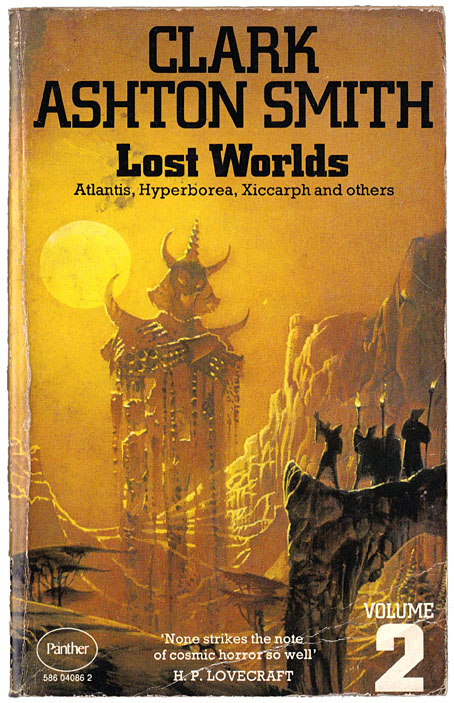
pennington2.jpg

Lost Worlds: Volume 2 (1974). Cover art by Bruce Pennington.

The original Hyperborea illustrations are fewer than those for Zothique. As with the later cycle, several of the stories are unillustrated, while others were given lacklustre artwork. In the earlier post I followed the story order chosen by Lin Carter which attempted to contrive an internal chronology for the cycle. Carter did the same with his Hyperborea collection so I’ve followed his example once again. Later collections, like Will Murray’s Book of Hyperborea, tend to order the stories by publication date.
hyperborea01.jpg

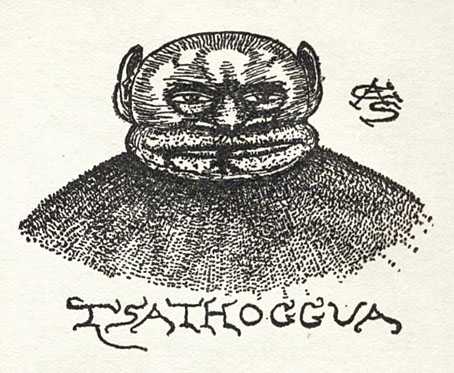
The Seven Geases, Weird Tales, October 1934.

An illustration of Tsathoggua by Smith himself. The toad-god turns up in person in this story.
hyperborea02.jpg

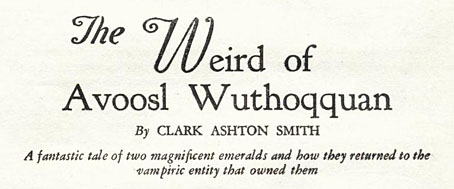
The Weird of Avoosl Wuthoqquan, Weird Tales, June 1932.

Continue reading “Illustrating Hyperborea”

Tsathoggua rising

tsathoggua.jpg

I said last week that I’d almost finished reworking my portrait of Tsathoggua for the Lovecraft book, and here it is. Tsathoggua first came into the world in a Hyperborea story by Clark Ashton Smith, The Tale of Satampra Zeiros, before being incorporated into the Cthulhu Mythos by HP Lovecraft who refers to the god-creature in several of his stories. Where Smith describes a hideous toad-like being, Lovecraft avoids being too closely bound by material specifics, referring to an “amorphous” entity which suggests a range of possibilities for illustration. To be fair to Smith, there is an amorphous and very deadly creature lurking in the temple of Tsathoggua in The Tale of Satampra Zeiros but we never learn whether this is Tsathoggua itself or some other being.

The amorphousness of Lovecraftian entities is a factor which is too often ignored in the world of weird illustration. Cosmic horror thrives on the fluidity of physics and physical matter but many illustrators seem content to copy one another instead of inventing new teratisms, a process that results in the accretion of stereotypes. Cthulhu, as I’m always reminding people, explodes into pieces after being struck by a ship at the end of The Call of Cthulhu, the remnants then recombining when the ship sails away from the scene. Lovecraft never intended his “spawn from the stars” to resemble the accreted stereotype we see today, a kind of Jolly Green Giant with squid mask and bat wings, reaching a brawny and very human arm towards the viewer. The ultimate expression of cosmic amorphousness may be found in the Shoggoths, those alien entities whose default condition is a mass of shapeless, iridescent protoplasm.

It was the amorphous nature of Tsathoggua that I wanted to honour with my original Photoshop creation in 1999. The starting point was a photograph of a cephalopod (I forget now whether it was an octopus or a squid) torn from an old issue of National Geographic. My initial experiments with the picture weren’t intended to develop into Tsathoggua; I didn’t have anything specific in mind when I started but at some point during the production of The Great Old Ones I decided to turn the picture into Smith’s entity with the addition of a toad-like head. Rather than mould the rest of the picture into more recognisable organic shapes it was left in a largely amorphous state. The eye-like shape at the top is a complete mystery to me now, I can’t say why it was there but it felt right so there it stayed. Alan Moore’s text for Tsathoggua identifies the creature with the Kabbalistic sphere of Geburah, “Strength”, a zone imbued with the martial qualities of the planet Mars. This is one of the more arbitrary assignations in The Great Old Ones—there’s nothing especially warlike about the toad-god—but something had to occupy the space, and I’d already finished the picture before Alan started writing his pieces. For the new version I’ve redrawn some areas of the original, but most of the work has been a case of sharpening edges and improving the contrast and modelling. The spiky, crown-like upper half has been emphasised a little in order to complement the martial aspect. And the bulging, convex appearance of the original has been slightly enhanced, giving the impression that the creature’s gravitational mass is of a sufficient density to bend the light around it. None of this should be taken as a negation of Smith’s description of a squatting, pot-bellied toad-god. The icons of the Great Old Ones created by human beings are exactly this: human attempts to represent alien monstrosity. Some acolyte who happens to envision the real Tsathoggua might stammer that “It looked like…a giant toad!” thereby giving a form to the subsequent iconography. But the map is not the territory. Cthulhu doesn’t, and shouldn’t look like the statues either. The Jolly Green Giant needs to ditch the mask and wings and get back to selling canned vegetables.

Elsewhere on { feuilleton }
The Lovecraft archive

Previously on { feuilleton }
H.P.L.
The Return of the Crawling Chaos
Lettering Lovecraft
Weird ekphrasis and the Dunwich Horrors
Kadath and Yog-Sothoth
Another view over Yuggoth

Elliott Dold’s Night

dold01.jpg

Looking for artwork by Elliott Dold turned up this remarkable set of illustrations for an unremarkable collection of poetry, Night, by a friend of the artist, Harold Hersey. Elliott Dold (1889–1957) was an American illustrator during the early days of the pulp magazines, best known today for drawings of huge machines which are a match for those by his more prolific contemporary, Frank R. Paul. The pulp magazines are so often filled with mediocre illustration that it’s a pleasure to find another talent lurking in their pages. But Dold was more than an illustrator of big science, as these illustrations for Hersey’s dubious poetry demonstrate.

dold02.jpg

Night is a collection of vaguely erotic poems, all of which Hersey labels “Nocturnes”. The collection was published in 1923 in a privately-printed subscriber-only edition, and every description I’ve read of it agrees that the illustrations are the best thing about it. The drawings are also radically different to Dold’s science-fiction art, to a degree that they could easily be taken for the work of a different illustrator. “What a pity the artist has to waste his time grinding out art for the pulps,” said HP Lovecraft, in a letter to Clark Ashton Smith. A pity, indeed. Dold’s illustrations are on a par with those that Wallace Smith was producing in the same year, and are close enough to Smith’s style that’s it’s tempting to accuse him of imitation. Smith’s style wasn’t unique, however; Ray Frederick Coyle was another American artist at work in the 1920s who favoured the same combination of strict black-and-white, careful linework and stylised figures. It’s curious that three books with somewhat controversial contents should have been published in the USA in 1922/23, all of them illustrated in a very similar manner: Ben Hecht’s Fantazius Malare (illustrated by Wallace Smith), James Branch Cabell’s new edition of Jurgen (illustrated by Ray Frederick Coyle), and Hersey’s Night. Rather than look for spurious influence I’d guess that this was a combination of coincidence and American literature acquiring a belated taste for Decadence which required suitably Beardsleyesque illustration. Similar trends were evident in cinema, especially in Alla Nazimova’s 1923 film adaptation of Oscar Wilde’s Salomé, where the costumes and settings were all based on Beardsley’s illustrations.

dold03.jpg

The images here are from a copy of the book at HathiTrust that’s another poor Google scan. The Hathi website isn’t as convenient for reading as the Internet Archive so I’ve downloaded all of the illustrations and, when necessary, cleaned the grey tone left by the scanner’s camera.

dold04.jpg

dold05.jpg

Continue reading “Elliott Dold’s Night”

The art of Jean-Michel Nicollet

nicollet12.jpg

French artist Jean-Michel Nicollet isn’t really known as a comic artist but one of his strips appeared in the Métal Hurlant Lovecraft special in September, 1978, and was reprinted in the Heavy Metal Lovecraft special a year later. Nicollet’s three-page story, H.P.L., is a slight thing which you can read below but his paintings present more of the atmosphere of Lovecraft’s fictional worlds than many of the other strips in those issues, including the equally slight contribution from Moebius. Prior to this, Métal Hurlant had been using some of Nicollet’s paintings for cover art, as a result of which one of the same illustrations appeared on the cover of the very first issue of Heavy Metal magazine in 1977. The winged Lovecraft from his comic strip turned up again on the cover of a Robert Bloch story collection for French publisher Nouvelles Éditions Oswald (NéO) in 1980.

nicollet09.jpg

Nicollet seems to have retired now from cover work but during the 1970s and 80s he was a very prolific illustrator, especially for NéO. NooSFere has a gallery of his covers which are mostly for reprints of early 20th-century horror, fantasy and adventure tales, also a few detective stories. He seems to have enjoyed illustrating classic detective fiction (photos show him posing with a large Holmesian pipe) so there may well be more covers which aren’t included in the NooSFere list.

nicollet11.jpg

The selections I’ve chosen here match my own preferences for cosmic horror and weird fiction, and represent another attempt to look further afield for this type of illustration. French cover design can be unsympathetic to cover illustration, crowding the paintings with poor type choices and purposeless graphics. The uniform layouts of NéO treat the artwork with more respect.

nicollet13.jpg

nicollet14.jpg

Continue reading “The art of Jean-Michel Nicollet”

Intégrale Howard Phillips Lovecraft

mnemos1.jpg

More Lovecraft book covers. Blame the season for this although depictions of Lovecraft’s cosmos have been occupying my thoughts for a while now, as I explain below.

A couple of years ago I wrote about the weird-fiction collections that Mnémos had been publishing in France, all of which used for their cover art paintings by the Polish “anti-symbolist” Zdzisław Beksiński. I like Beksiński’s paintings very much, and thought they were a good match for most of the covers that Mnémos had produced, being sufficiently weird and evocative without being directly illustrative. (The sole exception was the peculiar dog-like creature on the cover of a Frank Belknap Long collection, The Hounds of Tindalos. Long’s “hounds” are malevolent extra-dimensional entities whose name shouldn’t be taken literally.) I mentioned that Mnémos had also announced a seven-volume collection of HP Lovecraft’s fiction and non-fiction, but at the time of writing there were no pictures of the books available, and I’d forgotten all about the collection until a few days ago. All the books in the set, which are translated by David Camus, have since been reprinted as standalone volumes.

mnemos2.jpg

Intégrale Howard Phillips Lovecraft is a little deceptive as a title for a Lovecraft collection when the word “intégrale” is often applied to complete editions of something. The Mnémos set looks like it contains all of the fiction in the first few volumes plus a quantity of essays, but Lovecraft famously wrote more letters than he did stories; the letters here are a small selection inside volume 6. In addition to the books, the collection also contains a map of the Dreamlands, together with cards and bookmarks embellished with details from Beksiński’s paintings.

mnemos3.jpg

As with the Mnémos covers for Frank Belknap Long and Clark Ashton Smith, you could use many different Beksiński paintings for these editions, all of which would work to some degree. Even if some of them seem mismatched they offer a change of direction away from those varieties of fantasy art which have become very mannered in recent years when applied to weird fiction in general and Lovecraft’s stories in particular. This is partly a result of over-production: the huge success of the Call of Cthulhu role-playing game drove a demand for more and more Lovecraftian artwork, with the result that clichés emerged sooner than they would have done if the available imagery was limited to book illustrations and comic strips. I’ve contributed to the situation as much as most although I’ve also kept trying to find directions away from the stereotypes; my Cthulhoid picture was one such attempt even it still leans on the tentacular. I’ve been thinking recently of following the King in Yellow portrait with more poster-size art that explores other possibilities in this area. I’d encourage other artists to do the same when they can (commercial constraints often force your hand). Beksiński’s paintings show one route out of the mannerist cul-de-sac.

mnemos4.jpg

mnemos5.jpg

mnemos6.jpg

mnemos7.jpg

mnemos8.jpg

Elsewhere on { feuilleton }
The book covers archive
The fantastic art archive
The Lovecraft archive

Previously on { feuilleton }
Beksiński on film
Beksiński at Mnémos