Design as virus 13: Tsunehisa Kimura

kimura.jpg

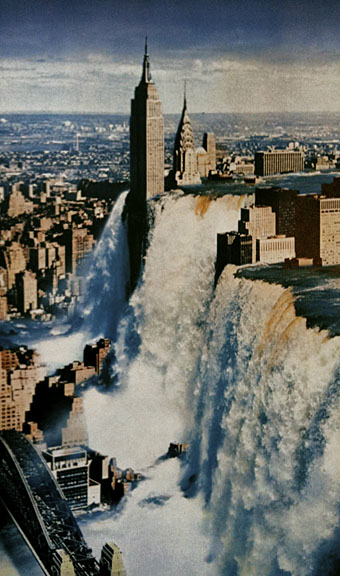
Waterfall by Tsunehisa Kimura.

Continuing an occasional series. Japanese artist Tsunehisa Kimura (1928–2008) was initially inspired by the polemical graphics of John Heartfield to create his own photomontages, a painstaking collage technique now rendered obsolete by Photoshop. Kimura’s work exchanges Heartfield’s satire for an overt and frequently apocalyptic Surrealism, as in his most visible piece, Waterfall. The copy above is one of a number of pictures reproduced by Geoff Manaugh at BLDGBLOG from a 1979 Kimura collection, Visual Scandals by Photomontage.
schutze1.jpg

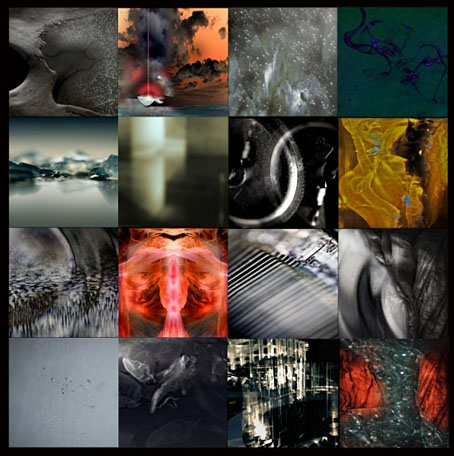
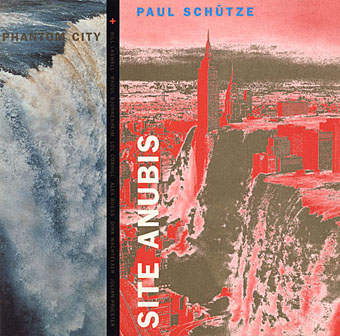
Design by Anne-Louise Falson & Paul Schütze.

I was first startled by Waterfall in 1996 when Paul Schütze released his Site Anubis album, the product of a “virtual group” comprised of musicians recording in different studios around the world:

The musicians comprising Phantom City—the name, incidentally, originating from the book title Topology of a Phantom City by French novelist Alain Robbe-Grillet—never met for the recording of Site Anubis, as each one recorded in a different studio in a different country: guitarist Raoul Björkenheim in Helsinki, bass- and contra-bass clarinetist Alex Buess in a Basel studio, soprano saxophonist Lol Coxhill in London, bassist Bill Laswell at Green Point Studio in Brooklyn, New York, trombonist Julian Priester in Seattle, drummer Dirk Wachtelaer in Brussels, and Schütze himself in London and Basel. Incredibly, Laswell had only Schütze’s electronic backing track to respond to. Wachtelaer had Laswell and Schütze to play against, Björkenheim had drums and bass,—in short, certain players had more information than others.
schutze2.jpg

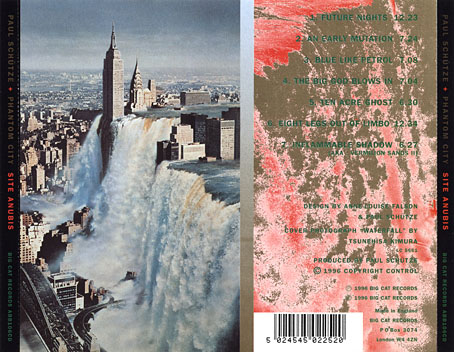
Kimura’s picture is an ideal accompaniment to this excellent album, especially when you note a Ballard reference in the titles (not the first in Schütze’s oevre), and read the scene-setting piece of fiction on the CD insert, an explanation of the album title:

That morning a report came in from an unmarked helicopter somewhere over the city. The waters were subsiding and the smoke from a thousand fires had begun to drift inland revealing an impossible new structure. Towering some eight hundred feet over the gleaming devastation of the streets, its base occupying an entire city block, was a colossal black basalt figure. The body was male and human, – the head, which stared expectantly toward the boiling western horizon, was the head of a jackal. From the air it was clear that the pattern of destruction on the ground was radial and that the massive figure was sited precisely at its centre.

Continue reading “Design as virus 13: Tsunehisa Kimura”

Rammellzee RIP

rammellzee.jpg

Rammellzee.

I consider that immortality is the only goal worth striving for: immortality in space. Man is an artefact created for space travel.
William Burroughs, 1982

We have to leave this tasteless mould of a planet.
Rammellzee, 2004

It’s fitting that a post about the late Rammellzee should follow one about Brion Gysin even if the circumstances aren’t those one would wish. Before he was involved in music Rammellzee was a graffiti artist and the convoluted mythologising which he later wove around the art of the graffiti tag—and his obsession with words and their meaning—bears comparison with Gysin and Burroughs’ similar mythologising, their theories about the viral origins of language. Look at Gysin’s calligraphic paintings (which he based on Arabic script) and you’ll see an exact analogue with the stylisations of graffiti taggers.

Given all of that, it’s even more fitting that Rammellzee was one of the voices chosen by Bill Laswell to set beside William Burroughs on Material’s finest forty minutes, Seven Souls, in 1989. I knew that voice from the great 1983 single he made with K-Rob, Beat Bop, one of many highlights on the best of the Street Sounds compilations, Electro 2, so it was a pleasant surprise finding it on the album which remains the best musical work that Burroughs was involved with. Rammellzee’s subsequent recordings with Laswell and others evolved an elaborate strain of what’s now known as Afrofuturism which he extended into paintings, collages and sculptural work. When you look at his detailed, science fiction philosophies, or at the underwater mythologies of Drexciya, it’s evident that there’s a rich seam of the African-American imagination which exactly parallels Burroughs’ visionary work. Visionaries right now are in short supply; we can’t afford to lose another.

Rammellzee: The Remanipulator versus Syntactical Virus by Peter Shapiro (1997)
No Guts No Galaxy—Rammellzee & phonosycographDISK (1999)
Rammellzee: The Ikonoklast Samurai by Greg Tate (2004)

Previously on { feuilleton }
Street Sounds Electro
The art of Shinro Ohtake

Weekend links 16

clockwork.jpg

Sumer Is Icumen In but you wouldn’t have known it today, it being cold and wet, O my brothers. The picture above is the work of David Owen whose Ink Corporation does a splendid job of updating the iconography of the folk music world. Via Electric Eden.

• Biting the hand that feeds: designer Jonathan Barnbrook’s contribution to the Biennale of Sydney takes a dig at the whole enterprise. The art market is impervious to criticism (or shame) but the gesture is an amusing one.

Emanuel Schongut’s book covers of the 1960s and 1970s on the artist’s own Flickr pages. Via A Journey Round My Skull.

• Owen Freeman on illustrating William Burroughs. Related: Reality Studio interviews Victor Bockris.

• RIP Jack Birkett, Derek Jarman’s Caliban and the Pope in Caravaggio. And RIP Dennis Hopper, actor, director and photographer.

seanettle.jpg

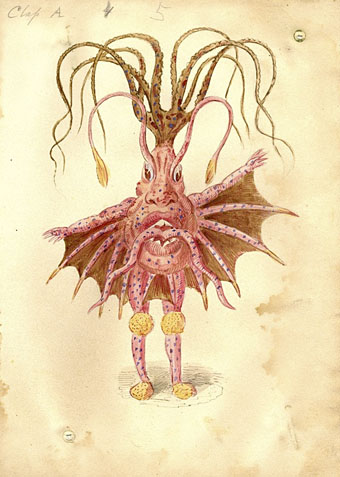
“Sea Nettle” (1873), a costume design by the Mistick Krewe of Comus. From this BibliOdyssey posting of New Orleans Mardi Gras designs.

• Chris Summerfield’s surfer boys at Lulu.

• Homotography also has a Tumblr page.

The Ghost Box Study Series Singles.

• More 3D projection on buildings.

John Foxx interviewed at FACT.

Song of the week: Ineffect (1989) by Material.

Paul Schütze online

schutze.jpg

One of the drawbacks with recommending Paul Schütze‘s music lately has been a lack of availability, with most of his CDs being out of print. That changes this month with his back catalogue returning via iTunes sporting a range of impressive new artwork (above) created by Mr Schütze himself.

Schütze’s electronic music stood out for me in the mid-Nineties for a number of reasons: firstly, and most obviously, it wasn’t always tied to the rigid metronomic pulse which governed the rest of the dance world. There were 4/4 beats at times—and he even had an album on Belgian dance label Apollo under the anagrammatical pseudonym Uzect Plausch—but his music was equally subject to unusual time-signatures with chiming timbres borrowed from gamelan orchestras.

Those timbres and their attendant tropical atmospheres were a second point of distinction. Like Jon Hassell, to whom he pays homage on Stateless (1997), there’s an acknowledgement of non-Western music without any falling into pastiche. This realises one aspect of Hassell’s Fourth World concept, whereby a meeting of the First World and the Third World creates an exclusive temporary zone that nonetheless can’t exist without the contribution of either party.

A third distinction would require a detailing of Schütze’s notable collaborators—Bill Laswell and Raoul Björkenheim among them—and his inventive track titles, many of which sound like Surrealist paintings. But describing music is always a poor thing compared to experiencing it. If you want a place to start, I’d recommend New Maps of Hell II: The Rapture of Metals (1993; reissued 1996) or Abysmal Evenings (1996), two constant favourites.

Previously on { feuilleton }
The art of Josiah McElheny
The Garden of Instruments

Aleister Crowley on vinyl

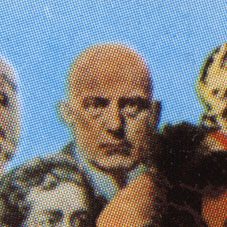
ac1.jpgThe appearance of occultist Aleister Crowley on the sleeve of Sgt Pepper is well-documented—here he is looking rather grainy on my CD insert—although I always forget which of the Beatles it was who put him in the list of “people that we like”. I’d guess John Lennon who would have appreciated Crowley’s obscene poetry, copious drug intake and ability to consistently épater la bourgeoisie.
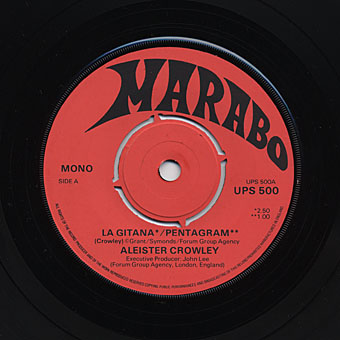
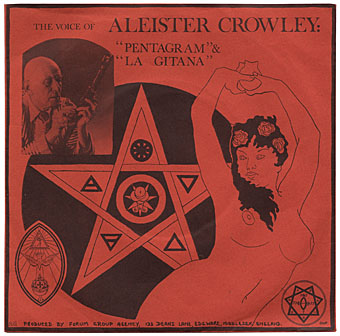
Less well-known is what I presume must be the first outing for Crowley’s voice on this rare undated single from the mid-Seventies. Along with the cassette tapes I discussed earlier, this was another item turned up during a recent clearout of household junk. I’ve yet to see a detailed description of the origin of these Crowley recordings. I have the first CD pressing and haven’t looked at later editions so can’t say whether they contain more information about what are supposed to be wax cylinder recordings copied to acetates. The first complete collection of the recordings was a vinyl release produced by David Tibet in a limited edition in 1986. I was among those that ordered a copy.

ac4.jpg

The Marabo single features two of the same recordings, of course, albeit in slightly poorer quality. (And I love the way it has a removable centre, as though it might well end up in a jukebox.) One feature of the continual reissuing of Crowley the recordings is that sound quality has improved over the years. The versions of The Pentagram and La Gitana on YouTube sound better than the ones on my CD. The occult resonance of Crowley’s voice (which always reminds me of Winston Churchill) have inevitably made it a popular sampling source. In the pre-sampling era 23 Skidoo and Psychic TV (both with David Tibet) used loops of the Enochian Calls. Bill Laswell later took to using samples on his ambient releases, while the most recent CD version includes an entire disc of ambience with Crowley’s voice subjected to digital processing.

ac2.jpg

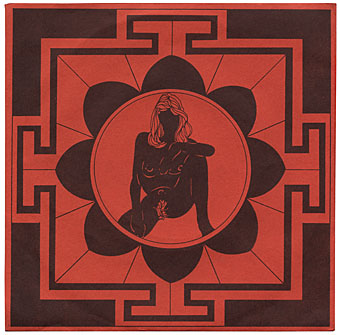
The sleeve art for the single was by Steffi Grant, occultist wife of occultist Kenneth Grant, and it’s possible the pair sing backing vocals on the less-than-compelling B-side, a soft rock number entitled Scarlet Woman by Chakra. The song is credited to “Ponton/Ayers/Grant/Magee” so even if one or other of the Grants didn’t sing they helped with the lyrics. It should be noted that Mrs Grant’s artwork is often better than these illustrations and does much to enliven her husband’s volumes of occult philosophy. Some of their work was also featured in the seven-volume encyclopedia, Man, Myth and Magic, which featured Kenneth among the staff of consultants.

ac3.jpg

Before anyone asks: no, the single isn’t for sale. I’ve sold a lot of old vinyl over the past few years but I’m keeping this particular item. I know a couple of unreleased recordings by Chakra exist; if anyone has further information about the group, please leave a comment.

Update: Jok posted a link which resolves the mystery. It was indeed Kenneth Grant on backing vocals.

Previously on { feuilleton }
Old music and old technology
The Man We Want to Hang by Kenneth Anger
The art of Cameron, 1922–1995
Austin Osman Spare