The Whistling Room, 1952

whistling1.jpg

Coincidence time again: this ancient TV drama was posted to YouTube a few days ago just as I was finishing Timothy S. Murphy’s very commendable study of William Hope Hodgson’s fiction, William Hope Hodgson and the Rise of the Weird: Possibilities of the Dark. As drama or even basic entertainment, The Whistling Room is the opposite of commendable but it is notable for being the first screen adaptation of a Hodgson story. Hodgson’s fiction has never been popular with film or television dramatists. His two major weird novels, The Night Land and The House on the Borderland, would require lavish expenditure and special effects to do them justice, while the latter has a narrative shape and a lack of characterisation that would either repel any interest or incur considerable mangling of the story.

More appealing for screen adapters are Hodgson’s tales of Carnacki the Ghost Finder, a collection of short mysteries with a supernatural atmosphere and neat resolutions. The Whistling Room, a US production for Chevron Theatre in 1952, is the first of two Carnacki adaptations, the other appearing almost 20 years later when Thames TV included The Horse of the Invisible in their first series of The Rivals of Sherlock Holmes. The Carnacki character was Hodgson’s take on the occult detective or psychic investigator, a short-lived offshoot of the post-Sherlock Holmes detection boom of the 1890s, and the concurrent interest in Spiritualism (or “Spiritism”, as Aleister Crowley always insisted it should be called). Carnacki is as resourceful and energetic as Hodgson’s other protagonists, and as an investigator he’s happy to use modern technology (electricity, cameras, vacuum tubes) to combat incursions from other dimensions. Hodgson’s descriptions of these encounters are freighted with all the capitalised terminology that recurs throughout The Night Land: “Outer Monstrosities”, “a Force from Outside”, “the Ab-human”. Carnacki’s exploits, however, have often been dismissed as hack-work when compared to the author’s novels or his tales of the Sargasso Sea. (The one Carnacki story that even detractors favour, The Hog, was a longer piece that only turned up many years after Hodgson’s death.) The stories are at their best when the mystery is an authentically supernatural menace, instead of another Scooby-Doo-like fraud being perpetrated by a disgruntled minor character.

whistling2.jpg

The Whistling Room was the third Carnacki tale from an early series of five that ran in The Idler in 1910. The story is one of those that concern genuinely supernatural events, and is essentially a repetition of the first of the Idler episodes, The Gateway of the Monster, in which a room in an old house is haunted by an antique curse that plagues the present owners. The room in question isn’t as deadly as the menace in the first story, the mysterious whistling (or “hooning”) being more of a threat to the nerves of the household than to life or limb. But the whistling soon resolves into a more material manifestation.

whistling3.jpg

Whatever power the original story may possess is thoroughly absent from the TV adaptation, a mere sketch of a narrative that wasn’t very substantial to begin with. Alan Napier—Alfred the butler in the Batman TV series—is hopelessly miscast as Carnacki, being more of a bungling buffoon than any kind of serious investigator. There’s no mention here of Carnacki’s favourite occult tools, the “Saaamaaa Ritual” and the Sigsand Manuscript, while the closest we get to his Electric Pentacle is a ridiculous “Day-Ray”, a raygun-like emitter of captured sunlight that has no effect at all on the cursed room. The room itself and its mysterious whistling is more comical than frightening, with dancing furniture that wouldn’t be out of place in Pee-wee’s Playhouse, while the Irish setting of the story is signalled by terrible attempts at Irish accents from two of the actors. Nobody actually says “begorrah” or mentions leprechauns but much of the dialogue is pure stereotype. The adaptation by Howard J. Green even shunts the resolution into Scooby-Doo territory when one of the local lads is found to be partially responsible for the whistling noises, an explanation that Hodgson’s Carnacki goes to some trouble to rule from his investigation.

whistling4.jpg

I wouldn’t usually write so much about something that scarcely deserves the attention but this film is such an obscure item we’re fortunate to be able to see it at all. I’ve been wondering what prompted the producers to choose this particular story. The Whistling Room was first published in the US in 1947, in the expanded Carnacki collection from Myecroft and Moran, an imprint of Arkham House. If Howard J. Green (or whoever) had taken the story from there then we have to wonder why he favoured this one over the others. I think it’s more likely that Dennis Wheatley’s A Century of Horror Stories (1935) was the source, a British anthology but one which would have had wider distribution than an Arkham House limited edition. The only other option listed at ISFDB is a US magazine, the final (?) issue of The Mysterious Traveler Mystery Reader. But this was published in 1952 which puts it too close to the TV production given the time required to commission and schedule an adaptation, even a poor one such as this. Whatever the answer, I feel that thanks are due to the uploader for making The Whistling Room available. Now that my curiosity has been assuaged I’ll return to hoping that someone eventually gives us a better copy of The Voice in the Night.

Previously on { feuilleton }
The art of Jean-Michel Nicollet
Suspicion: The Voice in the Night
Hodgsonian vibrations
The Horse of the Invisible
Tentacles #2: The Lost Continent
Tentacles #1: The Boats of the ‘Glen Carrig’
Hodgson versus Houdini
Weekend links: Hodgson edition
Druillet meets Hodgson

Richard Taylor’s Lovecraftiana

taylor1.jpg

The Mask of Cthulhu (1958) by August Derleth.

To look at any of the cartoons drawn for the New Yorker by Richard Taylor (1902–1970) you wouldn’t suspect that the Canadian artist had spent a few years at the end of the 1950s creating a handful of book covers for Arkham House. I’ve never read much about the history of August Derleth’s publishing endeavours so I can’t say how Taylor came to be offered this work. An unlikely choice he may have been but he did a better job with his five covers than many of the artists in the 60s and 70 who attempted to illustrate the eldritch horrors of Lovecraft, Derleth and co. The hand-drawn titles and monochrome colours make the quintet an attractive series within the Arkham House catalogue as a whole.

taylor2.jpg

The Shuttered Room and Other Pieces (1959) edited by August Derleth.

A collection of Lovecraft’s fiction fragments, some of which have been expanded by Derleth. Also remembrances of the writer by Lovecraft’s friends, plus essays and other material.

taylor3.jpg

Dreams and Fancies (1962) by HP Lovecraft.

A cover I’ve known for years as a result of its being featured in that cult volume of mine, The Fantasy Book by Franz Rottensteiner. (Previously.) I used to wonder about the contents of this book, Dreams and Fancies being an unfamiliar title that was absent from the paperback reprints of Lovecraft’s fiction. The title piece is another Derleth fabulation, a collage of Lovecraft’s transcribed dreams as they were recounted in letters to various friends. This is followed by some of the short fiction and poetry that reworked these dreams. The collection ends with the aeon-spanning novella, The Shadow Out of Time, which Tayor has taken as his subject for the cover art.

taylor4.jpg

The Trail of Cthulhu (1962) by August Derleth.

taylor5.jpg

The Horror from the Hills (1963) by Frank Belknap Long.


Note: I’m a little sceptical that the Richard Taylor responsible for these covers is the same one who was drawing cartoons for the New Yorker. The only source for this is isfdb.org, a site whose artist attributions are sometimes erroneous. If anyone can confirm or deny the accuracy of this information then please leave a comment.

Elsewhere on { feuilleton }
The book covers archive
The Lovecraft archive

Howard/Seward

hpl.jpg
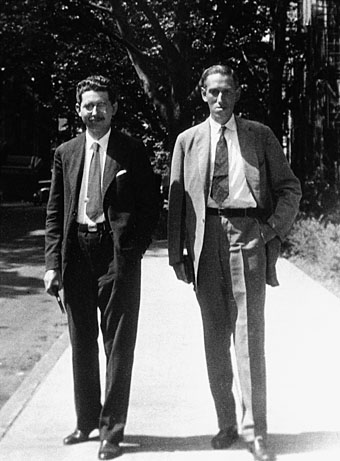
Frank Belknap Long and HP Lovecraft, New York, 1931. Photo by WB Talman.

Two friends—HP Lovecraft and Frank Belknap Long—visit the Egyptian antiquities in New York’s Metropolitan Museum of Art in the 1920s:

Tom Collins (for The Twilight Zone Magazine): I seem to recall a visit to the Metropolitan Museum of Art that you two made together.

Frank Belknap Long: You mean the time we visited the Egyptian tomb? Well, the Metropolitan apparently still has it. This was way back in the 1920s. The tomb was on the main floor in the Hall of Egyptian Antiquities, and we both went inside to the inner burial chamber. Howard was fascinated by the somberness of the whole thing. He put his hand against the corrugated stone wall, just casually, and the next day he developed a pronounced but not too serious inflammation. There was no great pain involved, and the swelling went down in two or three days. But it seems as if some malign, supernatural influence still lingered in the burial chamber—The Curse of the Pharaohs—as if they resented the fact that Howard had entered this tomb and touched the wall. Perhaps they had singled him out because of his stories and feared he was getting too close to the Ancient Mysteries.

burroughssphinx.jpg

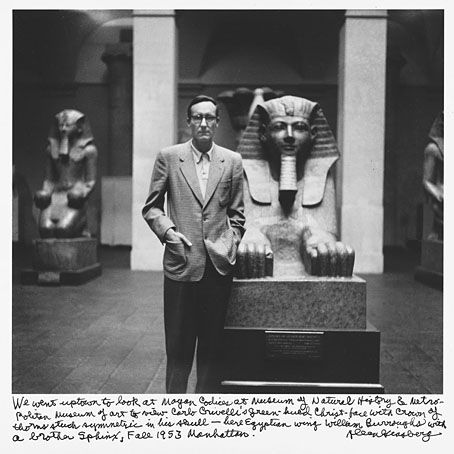
William Burroughs, New York, 1953. Photo by Allen Ginsberg.

Two friends—William Burroughs and Allen Ginsberg—visit the Egyptian antiquities in New York’s Metropolitan Museum of Art in the 1950s:

Allen Ginsberg: We went uptown to look at Mayan Codices at Museum of Natural History & Metropolitan Museum of Art to view Carlo Crivelli’s green-hued Christ-face with crown of thorns stuck symmetric in his skull — here Egyptian wing William Burroughs with a brother Sphinx, Fall 1953 Manhattan.

When I last wrote about the parallels between Lovecraft and Burroughs in a post from 2014 I wasn’t aware of Lovecraft and Long’s visit to the same museum exhibits that Burroughs and Ginsberg visited some 30 years later. I did, however, use the same photos which are posted here, a curious coincidence when Long wasn’t mentioned in the earlier post. This minor revelation is a result of reading the features in back issues of The Twilight Zone Magazine, one of which is an interview with an 81-year-old Frank Belknap Long. The coincidence is a trivial thing but it adds to the small number of connections between the two writers.

cthulhu.jpg

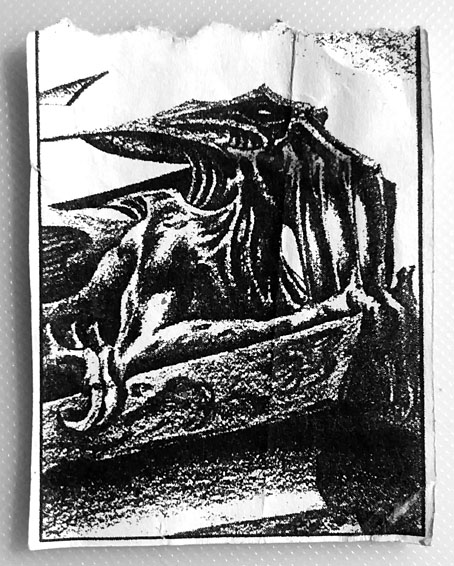
A Cthulhu Sphinx from The Call of Cthulhu, 1988.

Lovecraft and Burroughs were both living in New York City at the time of their excursions, and both touched on Egyptian mythology in their writings, so their having viewed the same museum exhibits seems inevitable rather than surprising. A more tangible connection between the pair is alluded to in Ginsberg’s photograph note when he mentions the Mayan codices. A few years before the museum visit, Burroughs had been studying the Mayan language and the Mexican codices in Mexico City under the tutelage of Robert H. Barlow, the former literary executor of HP Lovecraft. Burroughs’ studies subsequently fueled the references to Mayan mythology that turn up repeatedly in his fiction, and he was still at Mexico City College in 1951 when Barlow killed himself with a barbiturate overdose, afraid that his homosexuality was about to be exposed by one of his students. Burroughs mentioned the suicide in a letter to Ginsberg. The connections don’t end there, however. After Barlow’s death the rights to Lovecraft’s writings passed, somewhat controversially, to August Derleth and Donald Wandrei at Arkham House, and in another curious coincidence Derleth happened to be one of the complainants against a literary journal, Big Table, in 1959, when the magazine ran Ten Episodes from Naked Lunch, and was subsequently prosecuted for sending obscene material through the US mail. Derleth and Arkham House are both mentioned in the court papers.

I’ve never seen any indication that Burroughs was aware of these connections but if he was I doubt he would have paid them much attention, he always seemed rather blasé about his intersections with popular culture. He did think well enough of Lovecraft (or at least the version of Lovecraft’s fiction as presented by the Simon Necronomicon) to invoke “Kutulu” along with the Great God Pan and the usual complement of Mayan deities in Cities of the Red Night. Years later I remember seeing something in a newspaper about him retiring to Lawrence, Kansas, where he was described as passing the time “reading HP Lovecraft”. (I wish I could give a reference for this but I don’t recall the source.) If so then I like to think he might have given Creation Books’ Starry Wisdom collection more than a passing glance when it turned up at his door.

Elsewhere on { feuilleton }
The Lovecraft archive
The William Burroughs archive

Illustrating Zothique

zothique00.jpg

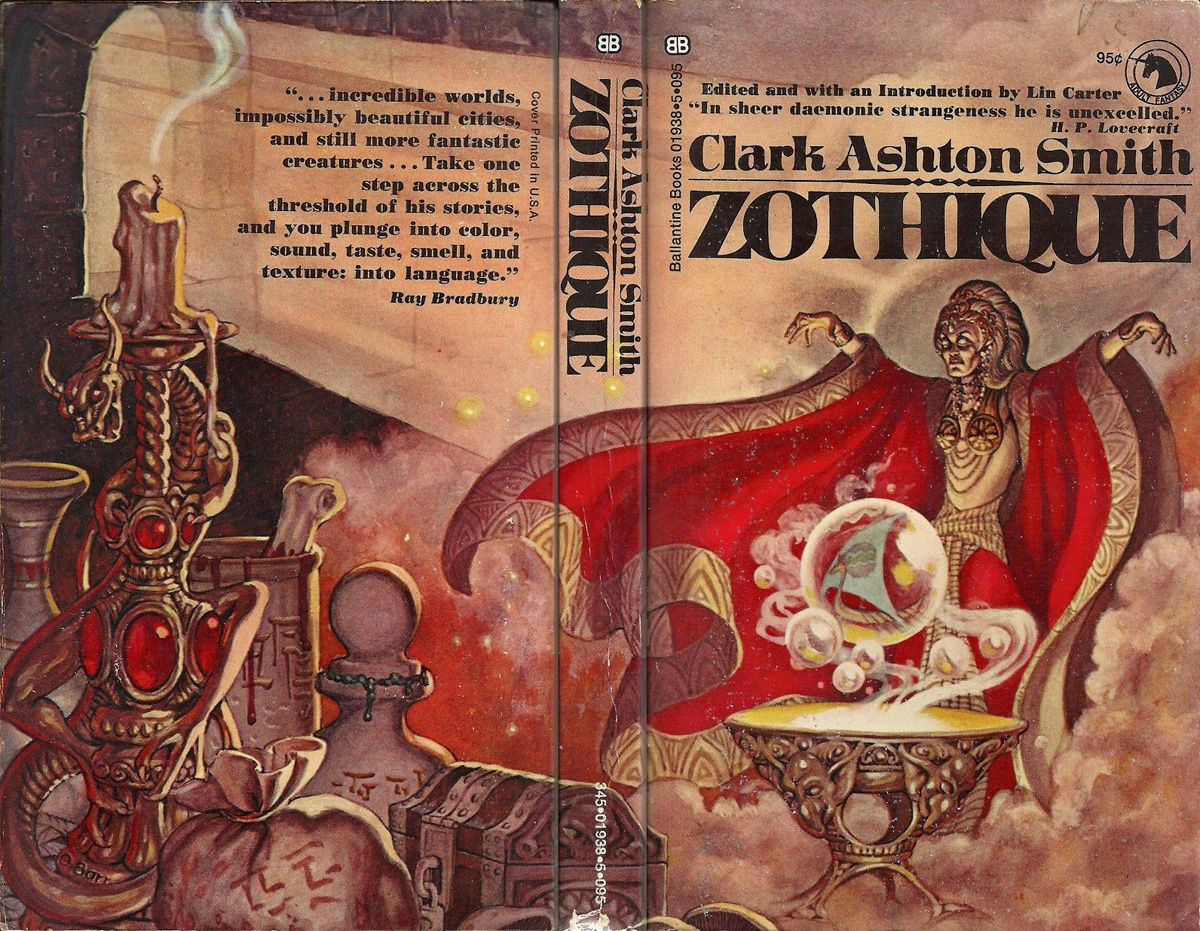
Cover art by George Barr, 1970.

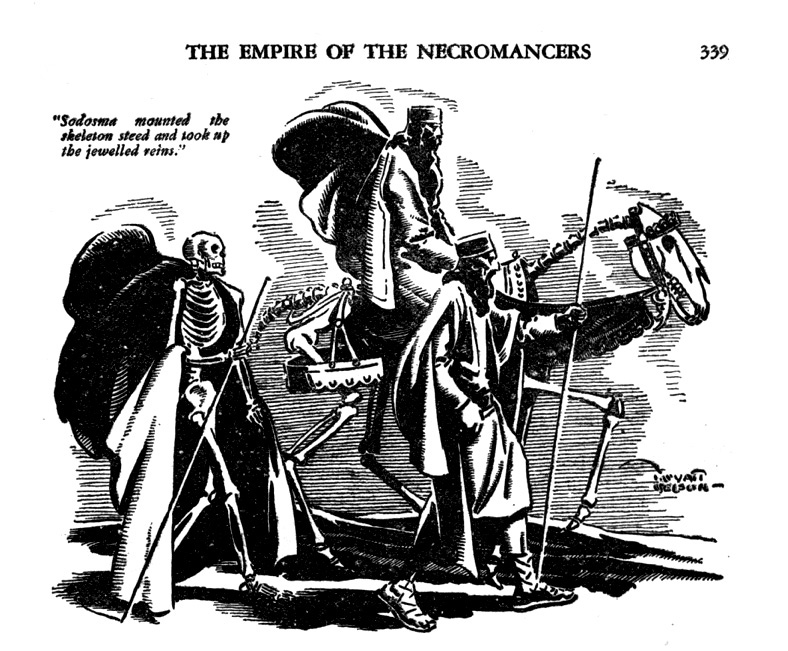
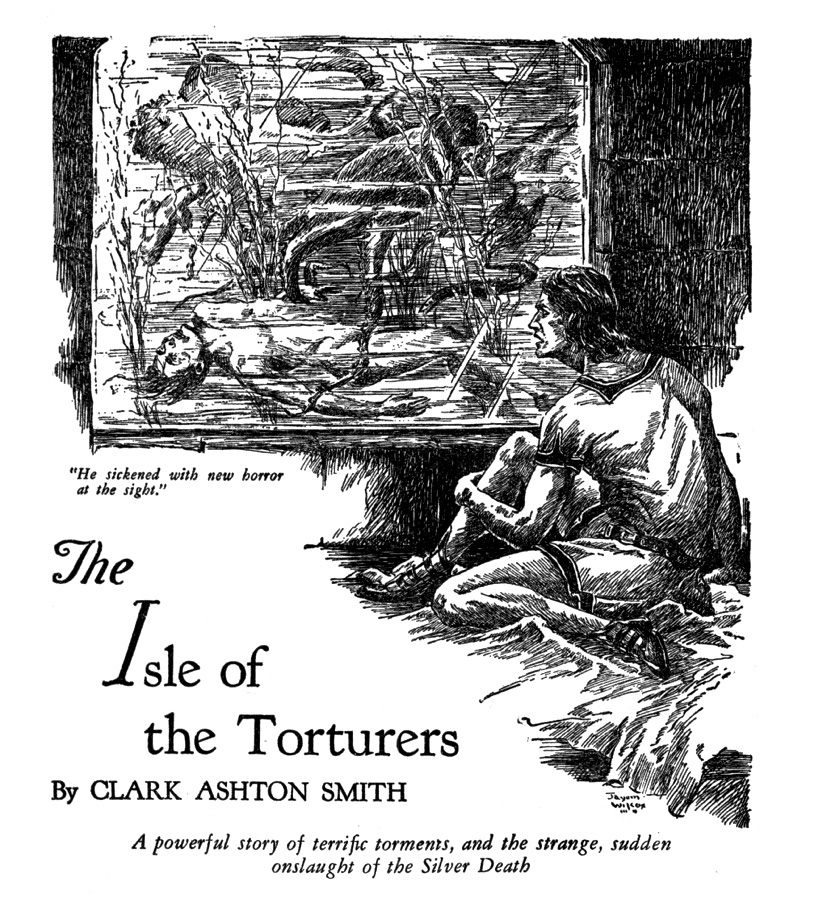
A few years ago I wrote a short piece about Virgil Finlay’s illustrations for a Zothique story by Clark Ashton Smith, The Garden of Adompha, so this post may be regarded as a more substantial sequel. If Smith remains something of a cult author then Zothique is the pre-eminent cult creation from his career as a writer of weird fiction. Most of Smith’s stories can be grouped together according to their location: Atlantis, Hyperborea, Averoigne in medieval France, the planet Mars, and so on. Zothique was a more original conception than his other worlds, being the last continent on Earth in the final years of the planet, an idea which had precedents in earlier novels such as William Hope Hodgson’s The Night Land but which hadn’t been used before as a setting for a cycle of stories. The distant future suggests science fiction but, as with the Zothique-influenced Dying Earth of Jack Vance, science and technology is long-forgotten and sorcery rules the day. The poetry that Smith wrote before he took to writing short stories had a distinctly Decadent quality—”like a verbal Gustave Moreau painting“—and Zothique is a richly Decadent world, with the entire planet in a state of decay along with its barbarous, demon-worshipping peoples.

zothique01.jpg

Weird Tales, September 1932. Art by T. Wyatt Nelson.

All the Zothique stories had their first printings in Weird Tales, a magazine that ran illustrations with most contributions, but unless you’re a pulp collector many of the illustrations have been difficult to see until very recently. One of the pleasures of looking through fiction magazines is seeing how their stories might have been illustrated when they were first published. Popular tales eventually find their way into book collections but their illustrations tend to be marooned in the titles where they first appeared unless the artist is of sufficient merit to warrant a collection of their own.

zothique02.jpg

Weird Tales, March 1933. Art by Jayem Wilcox.

The examples here are all from recent uploads at the Internet Archive which now has a complete run of Weird Tales from 1923 to 1954. The illustrations also run in order of publication with links to the relevant issues, although I agree with Lin Carter’s ordering of the stories. Smith never organised them himself, and the later reprints from Arkham House and others tend to scatter them through separate volumes. When Lin Carter edited the Zothique collection in 1970 he put the stories into an order that follows the very loose chronology running through the cycle.

zothique06.jpg

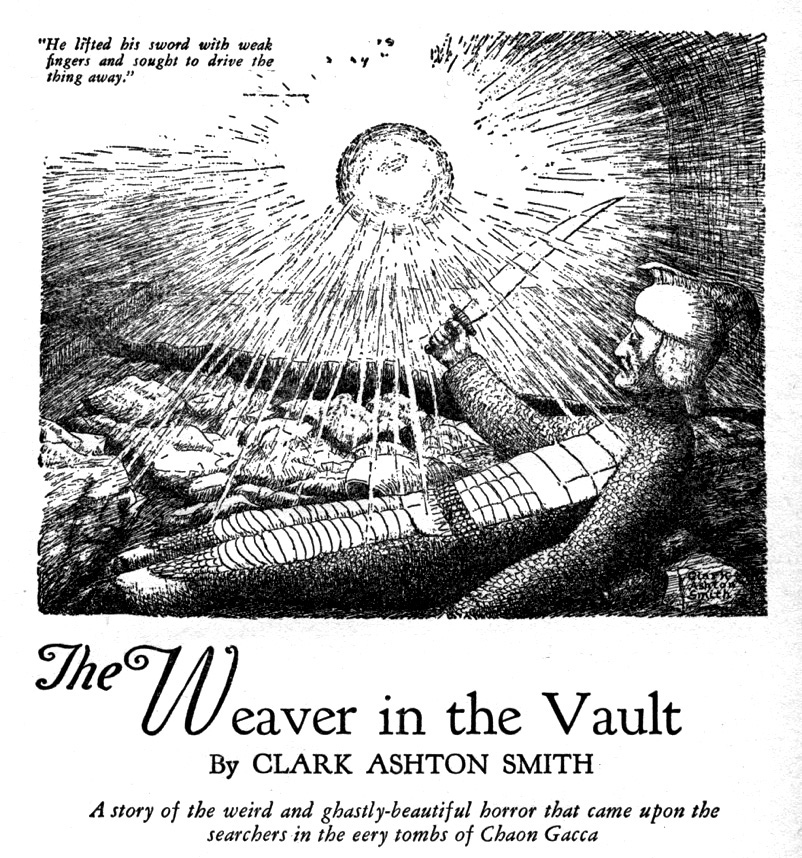
Weird Tales, January 1934. Art by Clark Ashton Smith.

One surprise of this search was discovering that Smith himself had provided illustrations for several of the stories. Some Smith enthusiasts like his drawings and paintings but I’m afraid I’m not among them, his sculpture work is better. It’s doubtful that these would have been printed at all if they weren’t the work of the author.

Continue reading “Illustrating Zothique”

The Gable Window

gable.jpg

The Gable Window (1984) by John Coulthart.

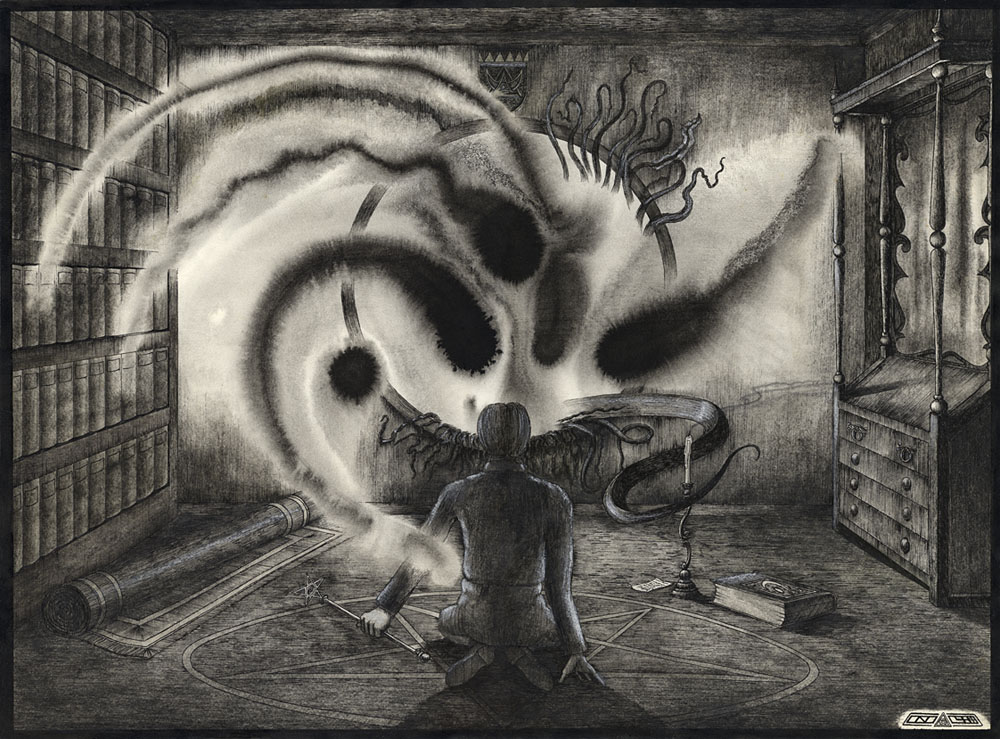
Presenting some of my first Lovecraftian illustrations, neither of which have been made public before. This drawing, and the one below, are as much Derlethian as they are Lovecraftian, depicting scenes from a short story and a short novel written by August Derleth from fragments and notes found in Lovecraft’s papers. The Gable Window was collected in The Survivor and Others (1957) which happens to be the only Lovecraft-related title I own in its original Arkham House printing. Derleth’s posthumous collaborations are often more Derleth than Lovecraft but I liked the central idea of The Gable Window which, like The Music of Erich Zann, concerns a window that also serves as a portal to other dimensions.

lurker.jpg

The Lurker at the Threshold (1982) by John Coulthart.

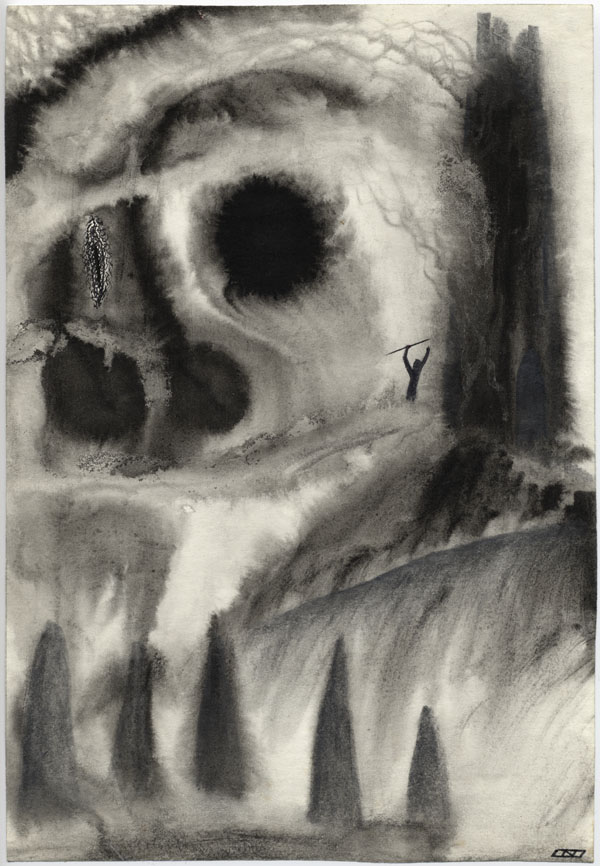
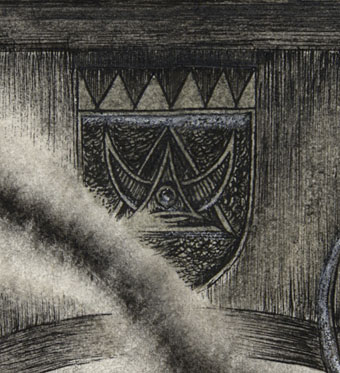
Before I began adapting The Haunter of the Dark in 1986 I hadn’t made much of an attempt to illustrate Lovecraft seriously. These drawings and a handful of other pieces were more like experimental sketches, although The Gable Window is obviously a very polished piece of work. Rather than depict anything overtly monstrous, each piece began as an arrangement of ink splotches and washes applied to cartridge paper soaked with water. The Lurker at the Threshold is one of several small pictures made with this technique in 1982, none of which are very successful. This one doesn’t look too bad but the best one, depicting the climax of The Dunwich Horror, I sent to the late Roger Dobson for possible use in an issue of Aklo, and haven’t seen it since. The Gable Window refined the technique by using fewer splotches and a more detailed drawing applied afterwards. I’ve never been happy with the figure, and the books on the left are lazily done, but it’s one of the better things I was doing in 1984. The biggest surprise looking at the drawing again was noticing the crest over the window which features a triangle/crescent motif that’s very similar to the one I designed a year later for Hawkwind’s Chronicle of the Black Sword album. This wasnt intentional.

gable-detail.jpg

Today The Gable Window seems like an indicator of where my head was at during this time. I was tired of doing Hawkwind-related things, and eager to immerse myself in something different; a series of Ballard illustrations was one potential way forward, Lovecraft was another. A year later I’d made a decision and, as it were, stepped through the window.

Elsewhere on { feuilleton }
The Lovecraft archive