Aubrey by John Selwyn Gilbert

aubrey00.jpg

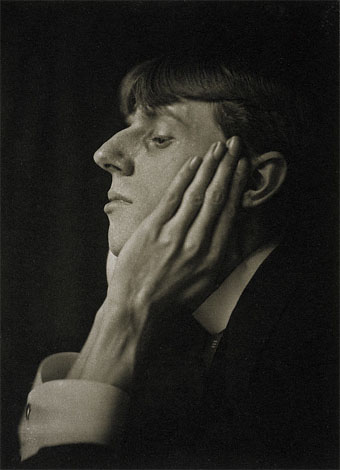
Aubrey Beardsley photographed by Frederick Evans (1894).

I’ve been going through the Coulthart VHS library recently, transferring to DVD recordings which can’t be purchased or found online. Among these is a drama from the BBC’s Playhouse strand, Aubrey by John Selwyn Gilbert, which was broadcast in 1982. This drama follows the life of artist Aubrey Beardsley from the time of Oscar Wilde’s arrest in April 1895—which event resulted in Beardsley losing his position at The Yellow Book—through the foundation of The Savoy magazine, to his tubercular death in March 1898.
aubrey01.jpg

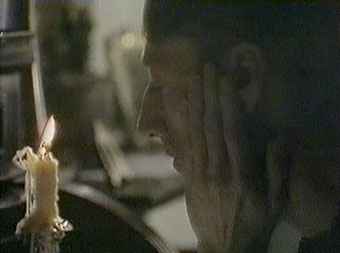
John Dicks as Aubrey.

Playhouse was a BBC 2 equivalent of Play for Today (which usually ran on BBC 1) and Aubrey, like many other dramas of the period, was shot on video in the studio. This was done for convenience as well as being cheaper than shooting on film, since scenes could be filmed using several cameras simultaneously. The drawback is that the image looks very harsh, and historical works such as this often seem unreal and artificial as a result. If you can forgive this deficiency, Aubrey was an excellent production with some great performances, especially Ronald Lacey as Leonard Smithers and Rula Lenska as Aubrey’s sister, Mabel. The details of Beardsley’s life are very accurate, down to his beloved Mantegna prints on the walls, and many of the scenes are arranged to correspond with his drawings, the production design being largely monochrome.
Continue reading “Aubrey by John Selwyn Gilbert”

The Feminine Sphinx

colette.jpg

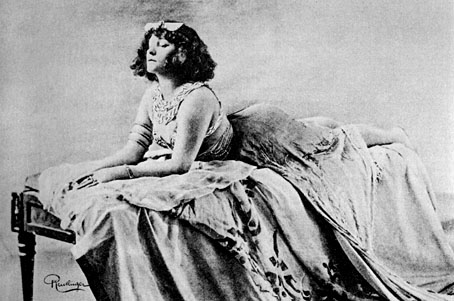
Colette.

Work this week designing a CD of readings from Colette had me searching books for pictures of the author. Of the few I found this is the most interesting, one of several Colette portraits made by photographer Leopold Reutlinger and one of at least two from 1907 which Colette used to promote her Moulin Rouge pantomime, Rêve d’Égypte. (You can see another one here.) The Egyptian theme explains the sphinx pose and her costume but there’s no indication as to whether the pose was borrowed from Franz Stuck’s famous painting (below) or whether the resemblance is coincidental.

stuck.jpg

The Sphinx by Franz Stuck (1889).

Stuck produced two nearly identical paintings on this theme; the other version is here in a rather muddy copy. I like the frame design for this one which explains in pictures the secret of the famous riddle which the Sphinx asks of Oedipus, “Which creature goes on four feet in the morning, two feet at noon, and three in the evening?” Stuck painted another sphinx picture three years earlier, The Kiss of the Sphinx, which portrays a less feminine and distinctly more rapacious hybrid.

rubenstein.jpg

Ida Rubenstein.

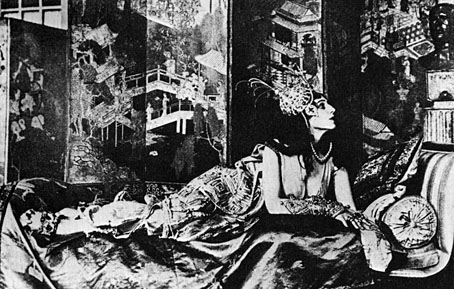
Colette was famously bisexual and so too was dancer Ida Rubenstein. In the same book as the Colette picture, there’s this photo of Ida recumbent in a sphinx-like pose in a very exotic boudoir. Photographs such as these are the material connection between the extravagances of the fin de siècle and the Decadent strain of early cinema in works such as Cabiria (written by Ida Rubenstein’s friend Gabriele D’Annunzio), Intolerance and (of course) Alla Nazimova’s Salomé.

Previously on { feuilleton }
The art of Heidi Taillefer
Dorian Gray revisited
Beardsley’s Salomé
Lussuria, Invidia, Superbia
Alla Nazimova’s Salomé
The art of Giulio Aristide Sartorio, 1860–1932

The art of Heidi Taillefer

taillefer.jpg

Frustration Attraction (2006).

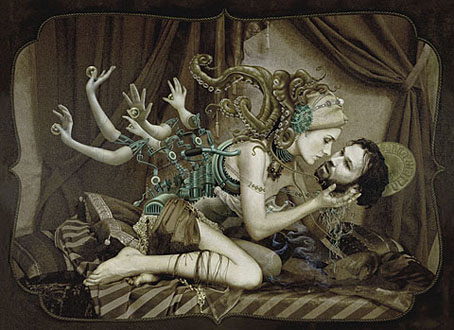
A Canadian artist works a marvellous variation on Salomé using oils and photo-printed canvas. Lots of other fine, inventive work at her site, all of it shown far too small to see the considerable detail. A tip to artists with websites: let us see the pictures properly; people appreciate it and will spread the word if they like your work. Via Fabulon.

Update: Her site has been relaunched and you can now see a lot more of the detail in her incredible paintings.

Elsewhere on { feuilleton }
The fantastic art archive

Previously on { feuilleton }
Beardsley’s Salomé
Peter Reed and Salomé After Dark
Alla Nazimova’s Salomé

Guido Reni’s Saint Sebastian

sebastian.jpg

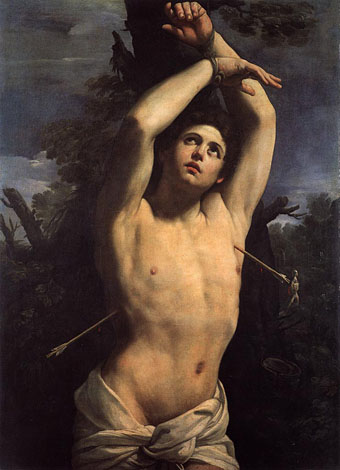
Saint Sebastian by Guido Reni (c. 1616).

The Agony and the Ecstasy is an exhibition at the Dulwich Picture Gallery, London, based around Guido Reni’s paintings of the martyr, six of which are on display.

This will be a once-in-a-lifetime opportunity to compare directly the six masterpieces which are coming from all over the world to join the St Sebastian owned by Dulwich Picture Gallery. The paintings are coming from New Zealand, South America, Madrid, Genoa and Rome.

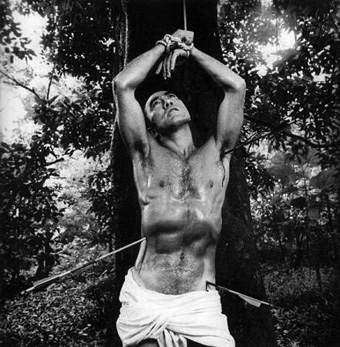
The claim for masterpieces is stretching the truth when art experts apparently believe that only two of the martyr paintings credited to Reni are original—the Genoa picture above and the Dulwich’s own version—the rest being later copies. The Genoa version became a favourite of Oscar Wilde and it was a Sebastian by Guido Reni that also excited the illicit passion of the 12 year-old protagonist in Yukio Mishima’s novel Confessions of a Mask. Wilde used the name Sebastian when he went into exile in Paris but he never took his identification with the saint as far as Mishima who adopted the typical pose in the famous photo taken shortly before the writer’s suicide. Wilde had no need of borrowed martyrdoms, his own was more than enough.

mishima.jpg

Yukio Mishima (1970).

The Agony and the Ecstasy runs until 11 May 2008. For further images of Saint Sebastian, this site is as comprehensive as it gets.

Elsewhere on { feuilleton }
The gay artists archive

Previously on { feuilleton }
Dorian Gray revisited
Beardsley’s Salomé
The art of Takato Yamamoto
Alla Nazimova’s Salomé
Fred Holland Day
The Poet and the Pope
The Picture of Dorian Gray I & II

Whistler’s Peacock Room

whistler1.jpg

Random browsing this week turned up some nice high-res photos of Harmony in Blue and Gold, as James Abbott McNeill Whistler named the room he decorated for Frederick R. Leyland in 1878. Leyland had bought one of Whistler’s paintings, La Princesse du pays de la porcelaine (1864), and architect Thomas Jeckyll was concerned that the painting and furnishings would clash, hence the invitation for Whistler to help with the colour scheme.

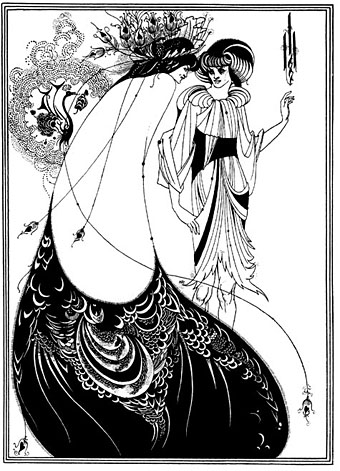
I’ve always preferred this luscious, gold-leafed design to the worthy medievalism of contemporary William Morris. Even though Whistler completed the work prior to the 1890s, the combination of Orientalism and peacocks (the signature bird of the Decadence) seems very much tied to the fin de siècle not least because of Aubrey and Mabel Beardsley’s visit to the room in 1891. Beardsley was very impressed with the painting and with the golden birds, the style of which later formed the inspiration for his famous Peacock Skirt illustration in Salomé (1894).

whistler2.jpg

There’s a good overview here of the history of the room, including details of the falling out between the combative artist and his client, and the story of the room’s removal to America and subsequent restoration.

Previously on { feuilleton }
Beardsley’s Salomé
Alla Nazimova’s Salomé