Virgil Finlay’s Salomé

finlay2.jpg

While chasing down Virgil Finlay’s illustration for Lovecraft’s The Colour Out of Space earlier this week I came across another Finlay drawing I’d not noticed before in a book I’ve owned for years. Makes me wonder what else is lurking on the shelves. Finlay’s depiction of Salomé was an illustration for Waxworks, a story by Robert Bloch published in Weird Tales for January 1939. I’ve never read much of Bloch’s fiction, this story included, so can’t say anything about it, but Finlay’s drawing impresses for the solid black night sky, and the peculiar flaming headdress, the kind of unique detail he often added to his pictures.

Bloch and Finlay had a memorable encounter a couple of years years before when Finlay illustrated The Faceless God, another Weird Tales piece which so impressed HP Lovecraft that it inspired a poem, To Mr. Finlay, Upon His Drawing for Mr. Bloch’s Tale, ‘The Faceless God’. Lovecraft’s handwritten draft can be seen (but not necessarily read) here.

Elsewhere on { feuilleton }
The Salomé archive

A Wilde Night

bragdon.jpg

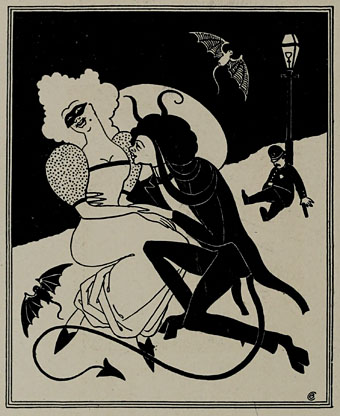
A couple more pieces from yesterday’s Posters in Miniature. The drawing above is entitled A Wilde Night and credited to Claude Fayette Bragdon (1866–1946) whose design work has appeared here before. Bragdon was an acquaintance of Will Bradley’s, and like Bradley was a man of many talents being variously employed as an architect, writer and stage designer. Bragdon and Bradley both worked together on The Chap-Book, Herbert Stone’s Chicago periodical which commenced publication in 1894, the same year as The Yellow Book, a magazine whose style and light-hearted content Stone and co. seemed keen to emulate. Bragdon’s small drawings for The Chap-Book are less Beardsley-like than Bradley’s designs which is why this very overt homage appears as a surprise.

yellowbook.jpg

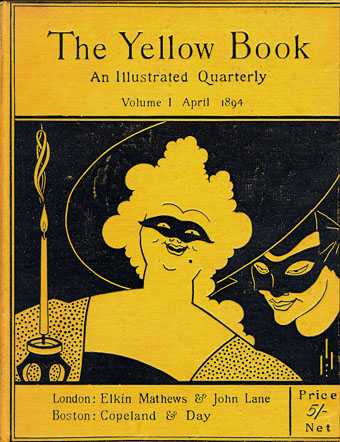
Bragdon’s picture is undated but the female figure is taken from Beardsley’s cover for the first issue of The Yellow Book which would place it in around 1894; the satyr-like male is an odd blend of bits of Beardsley’s male and female figures. Aubrey, however, would never have drawn bats like Bragdon’s, or a sleeping policeman…too gauche, my dear. As for the Wildeness, 1894 was only a year away from Oscar’s trial, a time when London was buzzing with scandalous rumours, none of which appear to have reached Chicago.

giannini.jpg

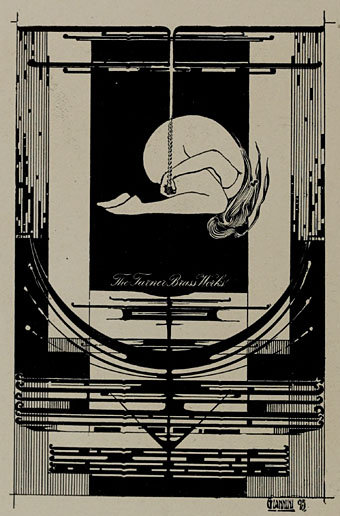
Also in Posters in Miniature is this piece by another American, Orlando Giannini (1860–1928), a glass designer and another Chicagoan who worked for a while with Frank Lloyd Wright. This design is dated 1895 and struck me with its radical appearance, so very different from the evolving Art Nouveau styles of the time. Giannini’s work as a glass designer evidently brought a different sensibility to graphic design, one which would have still looked bold and original ten years later.

Elsewhere on { feuilleton }
The Aubrey Beardsley archive
The illustrators archive
The Oscar Wilde archive

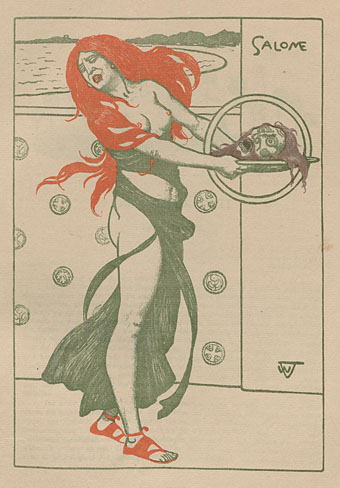
Wilhelm Volz’s Salomé

volz.jpg

Wilhelm Volz (1855–1901) was a German artist whose work I might not have paid any attention to at all had this lithograph not been featured in that cult volume Dreamers of Decadence. As a composition it’s a lot more interesting than Volz’s paintings, the circle for a halo being an unusual detail. There’s also more of an atmosphere of horror in this representation than one usually finds with the Salomé theme. The temptress doesn’t seem very enamored of her trophy, and John the Baptist’s head for once bears a suitable expression of horror. Volz’s print was published in Pan magazine in 1896, the entire edition of which may be viewed here.

Elsewhere on { feuilleton }
The Salomé archive

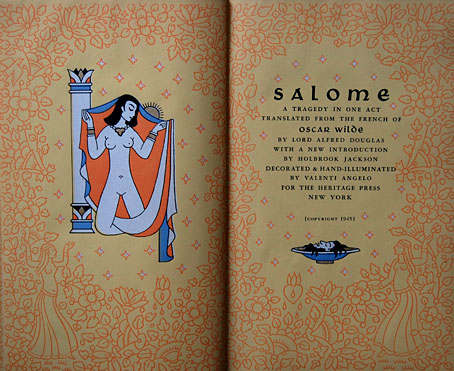
Valenti Angelo’s Salomé

angelo.jpg

And still they come… Valenti Angelo (1897–1982) was an American printmaker, author of several books for children and the illustrator of an estimated 250 classic works of fiction including this 1945 edition of Wilde’s Salomé for Heritage Press. Angelo has an engagingly simple style in this and other works, reminding me of David Sheridan’s Tarot designs. The Internet Archive has a copy of his illustrated The Imitation of Christ with drawings reminscent of Eric Gill’s woodcuts.

Elsewhere on { feuilleton }
The illustrators archive
The Oscar Wilde archive
The Salomé archive

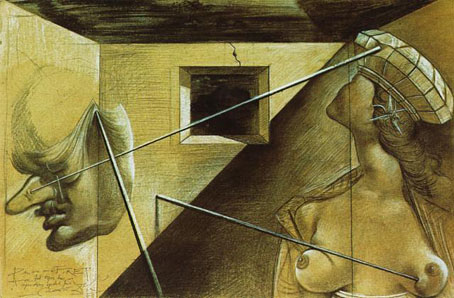
Dalí’s Salomé

dalisalome.jpg

Queen Salomé (1937) by Salvador Dalí.

Of all the Surrealists, Salvador Dalí had his fingers in the most cultural pies—designing for film and theatre, writing books (including a novel, Hidden Faces), even performing occasionally, or at least making a public spectacle of himself—so it’s no surprise to find him adding to the stock of 20th-century Salomé interpretations, first in a drawing then for the stage. The stage work was something I hadn’t run across before (not since this current obsession began, anyway), a 1949 production of the Strauss opera at Covent Garden directed by Peter Brook. The now celebrated theatre director was at the outset of his career when he chose Dalí as his designer but the resultant furore shows that Brook’s ability to challenge an audience (or at least, a gaggle of theatre critics) had an early start. The critics savaged the production and the show closed after only six performances. Brook, who was sacked, had this to say:

The critics all decided that Dali and I were only out to annoy them. There, at least, I might claim that they underestimated us; if that have been our intention I think that between us we might have done much worse… (More)

Getty Images has some tantalising photos here, here and here, but I’ve not seen anything in the way of production sketches. The objections seem to have been the usual tiresomely English revulsion against anything too original, too strange or too imaginative (it’s no wonder Leonora Carrington abandoned Britain for Mexico). An article about the production from the BBC’s Music Magazine includes this detail:

In the last scene for Dali and Brooke, [Salomé] was slowly covered over by a sort of green ooze of bile that came from the head of John the Baptist, an effect of luxuriant disgust which we can imagine without too much difficulty, bearing in mind others of Dali’s images.

That piece also mentions a proposed restaging of the opera with Dalí’s designs but I’ve been unable to discover whether this took place. If anyone knows better, please leave a comment.

Elsewhere on { feuilleton }
The Salomé archive