Weekend links 800

goya.jpg

Plate 43 from Los Caprichos: The sleep of reason produces monsters (El sueño de la razon produce monstruos) (1799) by Francisco Goya.

• At Senses of Cinema: An interview with Jacques Rivette from 2001 in which the director passes judgment on a variety of feature films, old and new. Having read a couple of Cocteau-related books recently, I was pleased to see his comments about the importance of Cocteau’s example for his own film-making. Via MetaFilter.

• “Why is sleep, which literally occurs daily on a planetary scale, so often taken for granted, and not only by most people but even by scientists? Perhaps because its essence, its key property, is to be elusive, out of sight?” A long read by Vladyslav Vyazovskiy on the nature of sleep.

• “Often one cannot be sure if an object in a Welch picture is drawn from life or from other depictions of it, in sculpture, porcelain, woodwork or embroidery.” Alan Hollinghurst on the paintings and drawings of Denton Welch. (Previously.)

• At Colossal: Sinister skies set the scene for derelict buildings in Lee Madgwick’s surreal paintings.

• New music: The Mosaic Of Starlight Slips Back Like The Lid Of An Opening Eye by Paul Schütze.

• At Public Domain Review: Charles le Brun’s Human-Animal Hybrids (1806).

• Mix of the week: DreamScenes – October 2025 at Ambientblog.

• At the BFI: Anton Bitel chooses 10 great French horror films.

Winners of the 2025 Photomicrography Competition.

• RIP Diane Keaton.

Sleep (1981) by This Heat | Sleep (1995) by Paul Schütze | Sleep (2006) by DJ Olive
Weekend links 322

quays.jpg

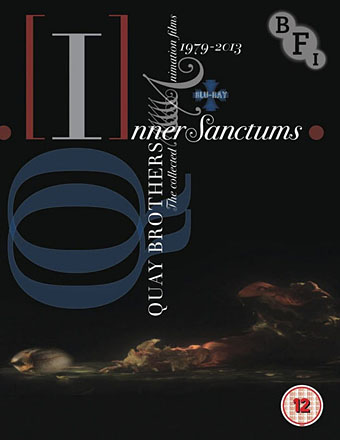
• Cover art by the Quays for Inner Sanctums—Quay Brothers: The Collected Animated Films 1979–2013, a Blu-ray collection which will be released by the BFI next month. Being something of an obsessive where the Quays are concerned I have a lot of this material already (some of the films in multiple copies), but I’ve been hankering for a BR collection for some time. The new set will include everything that’s on the BFI’s DVD collection plus more recent films, some of which have been the subject of previous { feuilleton } posts.

• Aubrey Beardsley: “The subjects were quite mad and a little indecent. Strange hermaphroditic creatures wandering about in Pierrot costumes or modern dress; quite a new world of my own creation.” Alan Hollinghurst reviews the catalogue raisonné of Beardsley’s work.

• How to find the spirit of HP Lovecraft in Providence. Related: there’s now a funding page for the statue of Lovecraft by Gage Prentiss being proposed for downtown Providence. Read about it here.

• At The Quietus: Robert Barry on KPM and the history of library music, and James De Carteret on Mike Hodges’ underrated The Terminal Man (1974).

Michael Newton reviews Erica Wagner’s First Light, “a festschrift of essays, reminiscences, poems and stories dedicated to Alan Garner and his work”.

Cosey Fanni Tutti‘s forthcoming memoir Art Sex Music should prove more interesting than some of the recent music business autobiographies.

• Mixes of the week: A New Age mix by Matthewdavid, FACT mix 563 by Deerhoof, and Secret Thirteen Mix 193 by Nite Fields.

Underground music, echoes of war: using the vast Inchindown storage chamber for its resonant properties.

Totally Lost: a photographic and video exploration of abandoned European totalitarian architecture.

• More animation: Nonsense, Cartoons, and My Post-Soviet Adolescence by Naré Navasardyan.

Annie Rose on the allure of the predatory lesbian vampire in film.

• “Let’s write an encyclopedia of things blue,” says Bernd Brunner.

• Ferrets can be gods: Katherine Rundell on the inimitable Saki.

• The Mystery of Hieronymus Bosch by Ingrid D. Rowland.

iO-808: A TR-808 drum machine for browsers.

A Good Book

Terminal Hotel (1981) by Synergy | Sataan Is Real (1992) by Terminal Cheesecake | Terminal (1999) by Monolake

Bruges-la-Morte

rodenbach.jpg

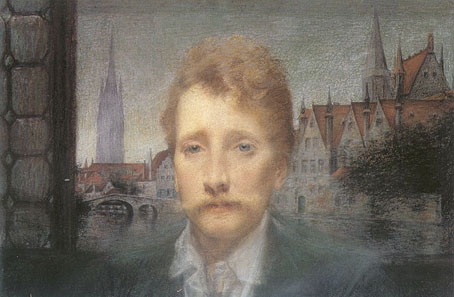
Portrait of Georges Rodenbach by Lucien Lévy-Dhurmer (1895).

Georges Rodenbach’s short, atmospheric novel is one of the key texts of Symbolism, not only for its themes but also for the art it either inspired or complemented. Bruges-la-Morte was first published in 1892 and the recent Dedalus Books edition, edited by Alan Hollinghurst and with a new translation by Mike Mitchell and Will Stone, was reprinted late last year.

Bruges-la-Morte…concerns the fate of Hugues Viane, a widower who has turned to the melancholy, decaying city of Bruges as the ideal location in which to mourn his wife and as a suitable haven for the narcissistic perambulations of his inexorably disturbed spirit. Bruges, the ‘dead city’, becomes the image of his dead wife and thus allows him to endure, to manage the unbearable loss by systematically following its mournful labyrinth of streets and canals in a cyclical promenade of reflection and allusion. The story itself centres around Hugue’s obsession with a young dancer whom he believes is the double of his beloved wife. The consequent drama leads Hugues onto a plank walk of psychological torment and humiliation, culminating in a deranged murder. This is a poet’s novel and is therefore metaphorically dense and visionary in style. It is the ultimate evocation of Rodenbach’s lifelong love affair with the enduring mystery and haunting mortuary atmosphere of Bruges.

Continue reading “Bruges-la-Morte”