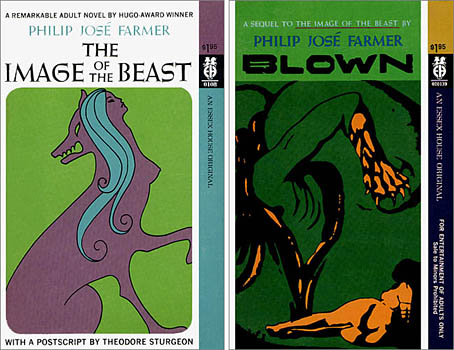
Jack Kerouac book covers

ontheroad.jpg

left: Andre Deutsch (1958); right: Penguin (1972).

In a year filled with cultural anniversaries, here’s another. Jack Kerouac’s On the Road is fifty years old next month and to celebrate this Penguin is publishing the book in its original form for the first time. Although the cover of the first edition described the text as “complete and unexpurgated”, names were changed to protect the innocent and/or guilty and other aspects, such as some very mild gay sex references, were removed. The same site I linked to last year with a great selection of William Burroughs book covers has another section devoted to Kerouac’s magnum opus.

The challenge with this book is whether or not to feature a road as the main image; some designers rise to that challenge better than others. The Ukrainian cover crudely modelled on a Jack Daniel’s label is a particularly unfortunate choice considering that the author died prematurely from cirrhosis of the liver. As with William Burroughs, some translations of the title work better than others: Unterwegs (German) sounds clunky to English ears while Sulla Strada (Italian) has more poetry than the original.

The Observer on the book’s fiftieth anniversary
Beat Scene magazine
Kerouac’s bisexuality explored at GLBTQ

Elsewhere on { feuilleton }
The book covers archive

The Darjeeling Limited

darjeeling.jpg

There aren’t many directors whose next films I await with impatience but Wes Anderson is one of them. I still haven’t seen his debut, Bottle Rocket (1996), but Rushmore (1998) was good, The Royal Tenenbaums (2001) was great and The Life Aquatic with Steve Zissou (2004) was a masterpiece. The Darjeeling Limited will be out later this year and stars Owen Wilson (who’s been in all of Anderson’s films apart from Rushmore but he did co-write that one) Adrien Brody, and Jason Schwartzman who made his debut in Rushmore and can be seen in another odd and inventive comedy, I Heart Huckabees. Schwartzman also co-writes this new opus. I have an unproven theory that Anderson is responsible for an annoying trend in recent American independent cinema—the “quirky comedy” which features multiple shots of charmingly flawed characters standing motionless centre-screen while staring at the camera. With groovy music playing on the soundtrack. Anderson does (or did) enough of this but he does a lot more besides. His films are better written and a lot more inventive than those of his imitators.

The most striking thing about the Darjeeling Limited trailers and poster (although it’s not something most people would notice) is the complete absence of Futura. Anderson is possibly unique among filmmakers in having what amounts to an obsession with a single typeface; Futura appears in different weights and styles throughout Rushmore, The Royal Tenenbaums and The Life Aquatic. I’m not quite sure which typeface is used on the poster (and neither are the people at Typophile); Proxima Sans is the closest match I can find but it may be a grotesk variant created specially for the film. I ask you: how many filmmakers are there that can get people talking about their work simply by changing a font?

Previously on { feuilleton }
Masonic fonts and the designer’s dark materials
Helvetica: the film

Black is the new black

star_flyer.jpg

This is what we want—an airline that matches my monochrome wardrobe. Star Flyer is Japanese, unfortunately, and I’m guessing that black doesn’t have the same funereal associations in Japan; that livery wouldn’t, er “fly” here. Makes a change from the sky blue monotony that’s the usual colour scheme in aircraft, anyway. PingMag looks at the resurgence of interest in black as a Japanese design choice, from toilet paper to cotton swabs, toothpaste and even black eggs. If you were eating the latter you’d have to be listening to the Nightcrawlers at the same time. And drinking black coffee. But I’d advise that you avoid black pudding; that stuff is just nasty.

Paradise Now: The Living Theatre in Amerika DVD

julian_beck.jpgMost people today know Julian Beck, if at all, for a small but unforgettable film role at the end of his career. In Poltergeist 2 (1986) Beck plays the nightmarishly sinister Reverend Henry Kane and his one full scene in that film is far more unnerving than the rest of its rubber monsters and special effects. Beck, a bisexual radical who makes most contemporary theatre directors seem as challenging as civil servants, started out as a painter but moved into theatre in the late Forties, founding the legendary Artaud-inspired Living Theatre in 1947. The Living Theatre was to the stage what the Beats were to literature, intent on shaking up the medium, the audience’s complacency and—by implication—society itself, to the fullest extent possible.

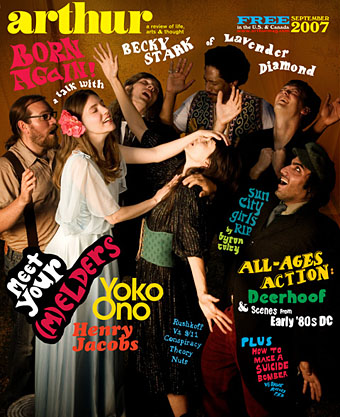
It’s the tragedy of theatre that its nature as a medium dependent on performance leaves so little record of its works behind. But there is one major film of the Living Theatre at its most provocative and it’s fitting that this should appear on a new DVD from Arthur Magazine in the year of the company’s sixtieth anniversary.

NEW FROM ARTHUR: PARADISE NOW: THE LIVING THEATRE IN AMERIKA DVD. LIMITED EDITION OF 1,000 – PRE-ORDER NOW – SHIPS OCT 1ST, 2007!

the screams
the unchained soarings of a sincerity which is on its way
to this revolution of the whole body without which nothing can
be changed. – Antonin Artaud
paradise.jpg

Arthur Magazine proudly presents our newest release PARADISE NOW: The Living Theatre in Amerika DVD featuring rare, never-before-distributed films and a bacchanal of revolutionary multimedia documents from The Living Theatre’s historic and influential ’68–’69 American tour. A fulminating art-meets-life installation brought to you in collaboration with The Living Theatre, The Ira Cohen Akashic Project and Saturnalia Media Rites of the Dreamweapon.

DVD INCLUDES – PARADISE NOW: The Living Theatre in Amerika (1969) a film by Marty Topp, produced by Ira Cohen for Universal Mutant

EMERGENCY (1968) a film by Gwen Brown, featuring precious footage of Living Theatre productions Mysteries and smaller pieces, Paradise Now, and Frankenstein

• RARE PHOTOGRAPHS of Paradise Now at Brooklyn Academy of Music by Don Snyder

• THE MAP OF PARADISE NOW, a 14″ x 19″ double-sided, commemorative poster + ‘zine including texts by Antonin Artaud, Julian Beck, Judith Malina, Ira Cohen and Don Snyder

ADDITIONAL SPECIAL FEATURES

• Slideshow / Installation, The full theatrical script

Paradise Now: A Collective Creation of The Living Theatre as written down by Julian Beck and Judith Malina

• Video Interviews with director Judith Malina, Hanon Reznikov, Steve Ben Israel, and producer Ira Cohen

The Spinning Wheel by Steve Ben Israel, soundtrack to EMERGENCY sourced from agit-prop radio broadcasts

• Akashic Video Gallery of excerpts from current and forthcoming Arthur DVD releases

WHAT IS PARADISE NOW?

In 1968 The Living Theatre, led by Julian Beck and Judith Malina, triumphantly returned to America from years of self-imposed exile in Europe with their theatrical breakthrough Paradise Now. The play introduces the practice of collective creation, dissolving the boundaries of human interactions and forging a harmony between the actors and audience. Of this process, Julian Beck writes, “Collective creation is the secret weapon of the people… This play is a voyage from the many to the one and from the one to the many. It’s a spiritual voyage and a political voyage, a voyage for the actors and the spectators. The play is a vertical ascent toward permanent revolution, leading to revolutionary action here and now. The revolution of which the play speaks is the beautiful, non-violent, anarchist revolution.The purpose of the play is to lead to a state of being in which non-violent revolutionary action is possible.”

The result of this shared voyage is the spontaneous creation of a temporary anarchist collective – free from the enslavements of war, violence, the State, money and the self.

CRITICAL PRAISE FOR PARADISE NOW

“Marty Topp’s beautiful film of Paradise Now reveals how the theories of revolutionary change and the experience of sexual liberation are not separate paths to the beautiful nonviolent anarchist revolution. Practiced together they are a single thrust, encompassing both political action and sensual joy, leading to the dreamed-of terrestrial paradise.” Judith Malina

“Paradise Now is possibly The Living Theatre’s greatest achievement – unsurpassable!” Ira Cohen

“This past spring, in a group art show at New York?s Swiss Institute, an old black-and-white television played a grainy print of bodies writhing to the tune of distant drumming. “As long as you have people working for money and not love, there will be violence,” intoned a tall, angular man on the screen. The bodies – women in scant bikinis and men in what looked like loincloths-piled together in an orgiastic tribal dance, some simulating (or perhaps actually having) sex as the voice continued: “Psycho-sexual repression is impeding the revolution.” What looked like an underworld-of the 1960’s counter-cultural variety, in this case- is the Living Theatre?s Paradise Now, as documented in the 1969 Ira Cohen-produced film Paradise Now: The Living Theatre in Amerika ? soon to be released on DVD from Arthur Magazine.” CAN THEATER STAGE A REVOLUTION – Traci Parks, Fall ’07 Preview, V MAGAZINE

“Joyous, brutal, exploding with the kinetic energies of psychic catharsis… Marty Topp’s PARADISE NOW: The Living Theatre in Amerika has captured the essence of this extraordinary theatrical experiment. It is unquestionably one of the finest artistic documentaries to come out of the United States cinema. Its heartfelt sincerity should be sheer inspiration to the many young people throughout the country who are struggling to make meaningful and influential work. It is the reverberation of a crucially important message that must not be neglected, for the consequences are too terrible to endure.

“Marty Topp’s achievement is not just in the making of a great film, but in making us remember again, Paradise as a reality.” PARADISE ON FILM – Don Snyder, July 1970, East Village Other

“Like an astonishing portion of the country’s popular music, the spectacles of The Living Theater proved to be in content and form outside the social system – not structured by it nor, except as outlet, implementing it: liberated territory.” Revolution at the Brooklyn Academy – Stefan Brecht, The Drama Review number 43: Spring 1969, The Living Theater Issue

Previously on { feuilleton }
William Burroughs by Ira Cohen, 1967
The Invasion of Thunderbolt Pagoda