Franz von Bayros’s Inferno

bayros01.jpg

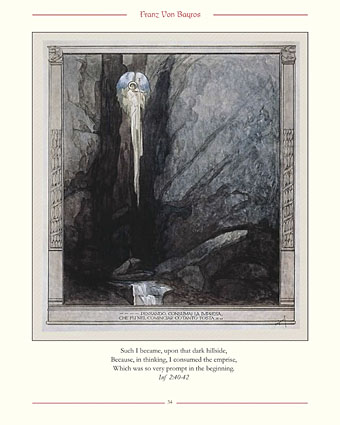
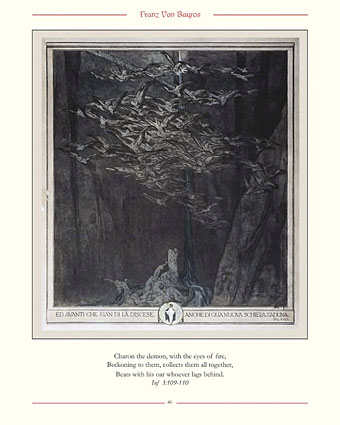
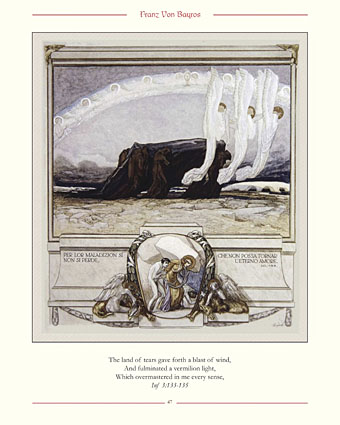
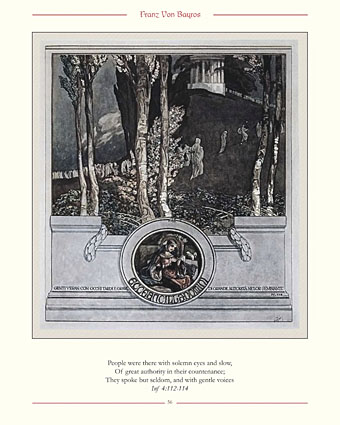
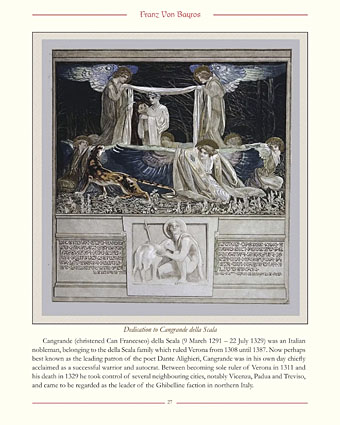
Viennese artist Franz von Bayros (1866–1924) is unusual among illustrators in that his erotic art tends to be easier to see today than his less scandalous commissions. Such is the case with his illustrations for Dante’s Inferno, some of which I’d seen before but never as many as in a book which arrived recently at the Internet Archive. This is a home-made presentation that uses the Longfellow translation of the Inferno for the text. Bayros can’t compete with the sombre spectacle of Gustave Doré’s illustrations but he depicts some of the less dramatic moments that Doré’s full-page engravings avoid, while also placing a number of his drawings in the same monumental frames he liked to use for his pornographic art.

bayros02.jpg

bayros03.jpg

bayros04.jpg

bayros05.jpg

Continue reading “Franz von Bayros’s Inferno”

T-shirts again

pp2.jpg

One of the many benefits of upgrading WordPress is that I’ve finally got a proper PayPal-oriented sales interface working on the T-shirts page. So when people click “Buy now” they get a pop-up range of options to select, plus a running total of the shirt cost, all in one place. I might have said “just in time for summer” but after last month’s heatwave the forecast here is for 16C tomorrow. Welcome to the North.

Also, I’m not bothering cross-posting this one to Twitter because bollocks to that place. Twitter killed WordPress auto-posting a while back, and since I’ve reinstalled WP it now doesn’t show image previews when I manually post them. There may be a solution to the latter issue but I really can’t be bothered finding it.

Update: Added a Summerisle shirt based on this design. Also new options for long sleeves and tie-dyes.

Previously on { feuilleton }
Getting shirty again
Getting shirty
More shirts
T-shirts by Skull Print

Weekend links 680

wijdeveld.jpg

15 Miles into the Earth (1944) by Hendrik Wijdeveld.

• “He realized that there were individuals around him who had never appeared in the great altarpieces and frescoes, individuals who had been marginalized by the cultural ideology of the previous two centuries. And there were hours of the day—transient, yet unequivocal in their lighting—which had never been reproduced, and which were pushed so far from habit and use that they had become scandalous, and therefore repressed.” Pasolini on Caravaggio.

• “Reading Albert Camus and Mikhail Bulgakov by day, by night, crucially, they were listening to Chic, Kraftwerk, Donna Summer, Michael Rother and Grace Jones in the clubs.” Graeme Thomson on the atmosphere and influences that helped create my favourite album by Simple Minds, Empires And Dance. Borges was also a minor influence, apparently, which wasn’t something I knew until this week. I like it when your favourite things join up this way.

• “This being England, a ‘tea shop’ is not a shop that sells tea. That would be a tea merchant. A tea shop serves tea.” Mark Valentine on the perennial connections between rambling and tea-drinking.

Talking about generations as if they really existed and had sway over people is much more respectable and widespread than the belief that events and personalities are governed by the movements of the planets. But is there really much more substance and reality to “generations”? If not “a bunch of bullshit”, the discourse of generations is certainly generative of bullshit: tenuously grounded overviews and opinion pieces, specious analysis and analogies, platitudes and truisms. And yet, like astrology, it is a fun game to play along with. And far more than astrology, it’s a mode of talk that partially constitutes its object: generalizing about a generation actually brings it into semi-existence, shaping how people perceive themselves and how they are perceived by earlier or later generations. What may just be an illusion, a shaky set of alleged affinities, becomes a social fact.

Simon Reynolds analyses the generation game

• More Milton Glaser: PDFs of the Glaser Gazette, a memorial publication in three parts: Vol 1 | Vol 2 | Vol 3

• New music: Tractatus Lyra-Organismus by Lyonel Bauchet, and Grounded Rectangle by Ambidextrous.

• “A digital archive of graphic design related items that are available on the Internet Archives.”

• DJ Food found a handful of psychedelic posters by Nicole Claveloux.

• “Rights to Jorge Luis Borges’s work go to his wife’s nephews.”

• “Is this the earliest known phallic art?

Young Generation Dub (1976) by Augustus Pablo | Chile Of The Bass Generation (1990) by Mental Cube | Invisible Generation (1992) by Cabaret Voltaire

Telepathic Heights by Hawksmoor

hawksmoor.jpg

No designer credited but probably the work of Adrian Self.

Too much unanticipated website wrangling has set my work back this week, but in the meantime I’ve enjoyed listening to more of the mostly-electronic music of Cabaret Voltaire (inevitably), plus the mostly-electronic music of Hawksmoor (James McKeown), whose latest album, Telepathic Heights, arrived a few days ago. According to the promotional copy this one “follows a path along the electronic skyways first created by the German/Krautrock electronic pioneers of the 1970s such as Cluster, Ash Ra Tempel, Roedelius and Michael Rother”. And so it does to an extent, although Hawksmoor’s buzzing timbres and synthesized rhythms are closer to those created by The Human League on their first two albums, Reproduction and Travelogue, a percussive pulse which an early reviewer of the League’s music compared to steamhammers in a mineshaft. The early League records, and the first album by Marsh & Ware as the B.E.F., Music For Stowaways, have always been cult items round here, so anything that approaches them is liable to catch my attention. Hawksmoor’s other albums push further buttons of interest with subjects that include Nicholas Hawksmoor’s churches (no surprise there), JG Ballard’s Concrete Island and The Crystal World, the psychogeography of Milton Keynes, and Old Weird Britain. I’m looking forward to seeing what future paths this 21st-century Hawksmoor chooses to follow.

Telepathic Heights is out now on Soul Jazz.

Previously on { feuilleton }
Talking time: Cabaret Voltaire interviews
Serious houses: The Lud Heat Tapes, 1979
German gear
Old music and old technology
A Clockwork Orange: The Complete Original Score

Fender guitar catalogue, 1976

fender01.jpg

Another post prompted by 70s Sci-Fi Art, and a publication that’s very typical of its decade. The Fender guitar catalogue for 1976 showcases its product range with a series of illustrations that carefully pastiche the kind of art you’d find in books of fairy tales. Selling rock’n’roll equipment in this manner wasn’t a trend-setting step by 1976, not with the punk hordes on the march, but corporations are seldom ahead of the general culture. The cover art by Ruby K. Lee is a copy of one of Kay Nielsen’s drawings for East of the Sun and West of the Moon. Lee also provides one of the interior drawings, with the rest of the art being the work of Bruce Wolfe. (There may be another artist involved since one of the illustrations lacks a credit.) This looks like a huge amount of effort for a small product catalogue but the illustrations were also part of an ad campaign with accompanying storybook copy. It’s good to see Busorama being used for all the headings. I’ve been using this font myself for its associations with the 1970s.

fender02.jpg

Since I keep borrowing tips from 70s Sci-Fi Art I’ll note again that Adam Rowe’s Worlds Beyond Time: Sci-Fi Art of the 1970s will be published by Abrams next month.

fender03.jpg

fender04.jpg

fender05.jpg

Continue reading “Fender guitar catalogue, 1976”