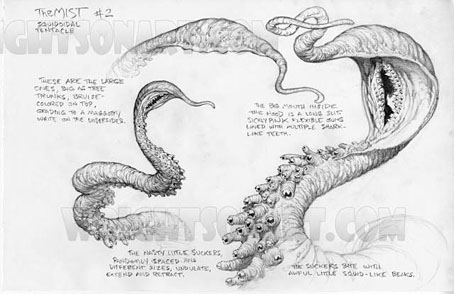
Berni Wrightson in The Mist

mist.jpg

It’s not giving too much away to let enthusiasts of tentacular horror know that Frank Darabont’s film of The Mist, currently fogging up UK cinema screens, contains these questing things among its torments. The Mist is based on a 1980 novella by Stephen King and the film has a decent King pedigree for once, with the director having previously made The Shawshank Redemption and The Green Mile while the creature designs are partly the work of Berni Wrightson, one of King’s artist collaborators. Wrightson’s web gallery has a number of his sketches on display although if you haven’t seen the film you should be warned that they spoil some of the surprises.

My good friend Mark Pilkington—weirdness wrangler, editor of Strange Attractor and all-round ubiquitous presence—reviews the film in this month’s Sight and Sound where he points out some of the Lovecraftian resonances. Tentacles aside, there’s a lumbering monstrosity near the end which manages to be far more Lovecraftian than the Cloverfield creature and I wouldn’t have minded seeing more of the larger presences than the lesser beasties. The film’s lead character is a movie poster artist and the opening scene nods to an earlier film with an equally Lovecraftian atmosphere by having Drew Struzan’s art for John Carpenter’s The Thing on the wall in the background. The film’s siege situation is more the kind of story you’d get from an earlier writer, William Hope Hodgson, another purveyor of the malevolent tentacle.

Berni Wrightson and your not-so-humble narrator appeared together recently in Centipede Press’s A Lovecraft Retrospective: Artists Inspired by H.P. Lovecraft (yes, I am going to keep going on about this book for the next few months…sue me). Wrightson is represented there by his comic strip adaptation of Cool Air but his Mist drawings would have made equally worthwhile additions. If nothing else, 2008 is turning out to be a good year for horror enthusiasts.

Previously on { feuilleton }
The monstrous tome
Octopulps
Druillet meets Hodgson

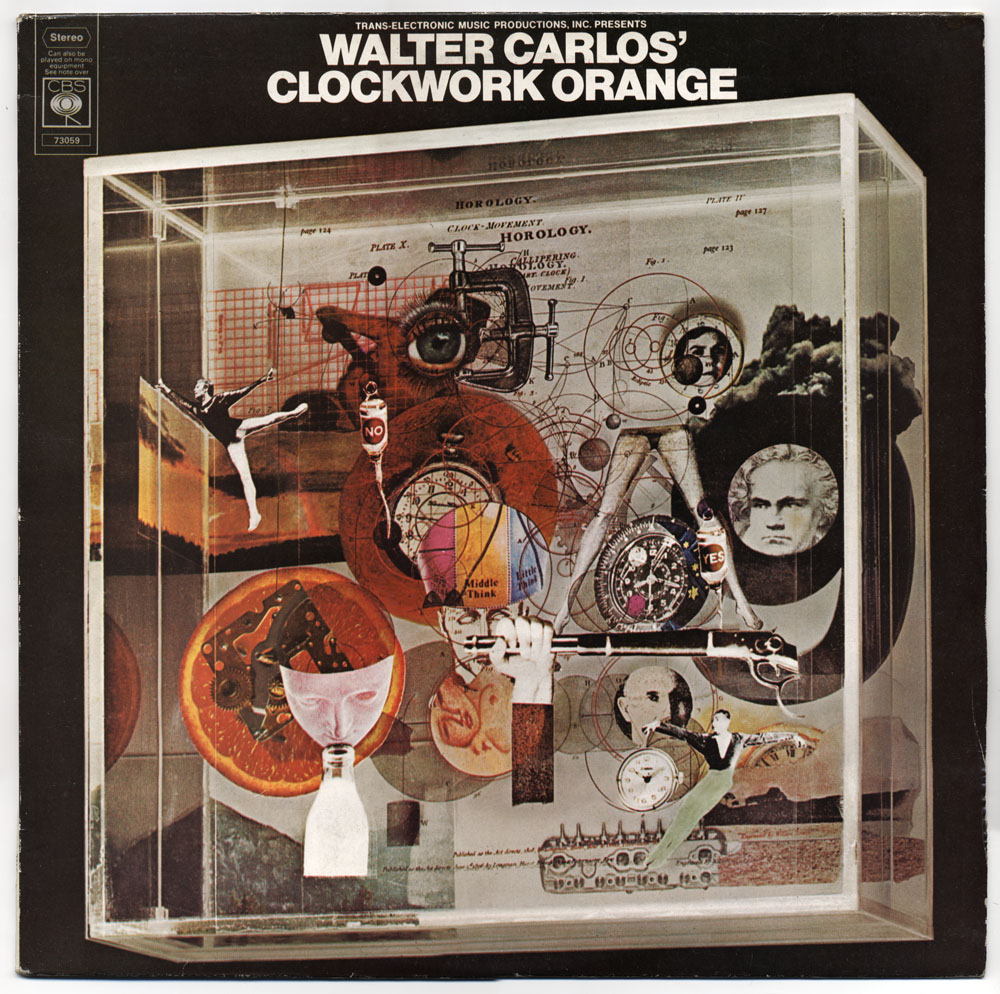
A Clockwork Orange: The Complete Original Score

aco_sleeve.jpg

CBS 73059; construction by Karenlee Grant, photo by David Vine (1972).

A1 Timesteps (13:50)
A2 March From A Clockwork Orange (7:00)
B1 Title Music From A Clockwork Orange (2:21)
B2 La Gazza Ladra (5:50)
B3 Theme From A Clockwork Orange (1:44)
B4 Ninth Symphony: Second Movement (4:52)
B5 William Tell Overture (1:17)
B6 Country Lane (4:43)

Viddy well the stuff of obsessions, O my brothers: Kubrick, cover design and electronic music in one convenient 12-inch package. Those of us in Britain who were too young to see A Clockwork Orange during its initial run had to wait a long time for its re-release after Stanley K withdrew the film from circulation. Until bootleg VHS copies started to turn up in the 80s I knew the film mostly from the MAD Magazine parody and the soundtrack album which was ubiquitous in secondhand record shops. Having become familiar with the score, an additional layer of frustration was added when it became apparent that two soundtrack albums had appeared in the 1970s, the “official” one, which was a mix of the orchestral and electronic music used in the film, and another which contained all the music Walter (later Wendy) Carlos recorded.

The Wendy Carlos music was the principal attraction for this electronic music obsessive and I fretted for a long while trying to find a copy of her Complete Original Score album which was paraded in all its elusive glory on old CBS vinyl inner sleeves. Half the tracks are present on the official release but the omissions are crucial: Timesteps, the incredible composition which accompanies Alex’s first deprogramming session was edited down from thirteen to five minutes, there was Carlos’s Moog version of Rossini’s La Gazza Ladra (an orchestral version is used in the film) and also an original piece, Country Lane, intended to accompany Alex’s police brutality session at the hands of his former droogs. The score was one of the first projects to successfully incorporate a vocoder into electronic compositions; Rachel Elkind, Carlos’s regular collaborator, provided the vocalisations. Finally securing a copy was no disappointment, in fact I was overwhelmed. This is still my favourite Wendy Carlos album and one of my top five favourite analogue synth albums. The transcription of La Gazza Ladra is nothing short of miraculous, thundering away with the power of a full orchestra yet created by laboriously recording one note at a time. (Wendy Carlos’s very thorough website goes into detail about the recording process.)

Continue reading “A Clockwork Orange: The Complete Original Score”

The art of Norbert Bisky

bisky1.jpg

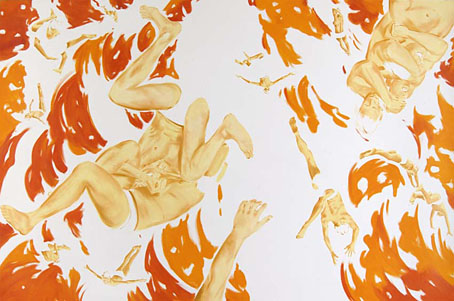
Der jüngste Tag (2004).

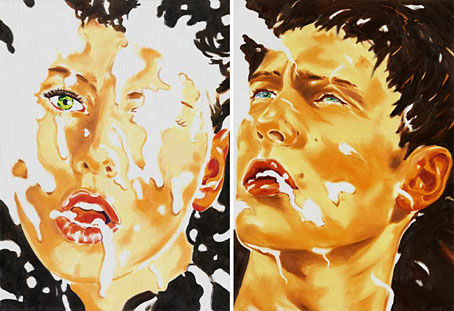
At first glance Norbert Bisky‘s paintings aren’t so different from those of other artists with a similar complement of shirtless boys, until you notice curious details such as severed heads and limbs or hanging figures. I’ll be surprised if Dennis Cooper isn’t a fan. The bland style, rendering innocuous what might otherwise be too grotesque, reminds me of Eric Fischl‘s psychosexual explorations of suburban America, which may be an influence. Bukkake Tsunami below is a worthwhile addition to the Art of Ejaculation collection.

bisky2.jpg

left: Gabi (2007); right: Bukkake Tsunami (2007).

Elsewhere on { feuilleton }
The gay artists archive

Previously on { feuilleton }
The art of ejaculation