Earthrise

earthrise.jpg

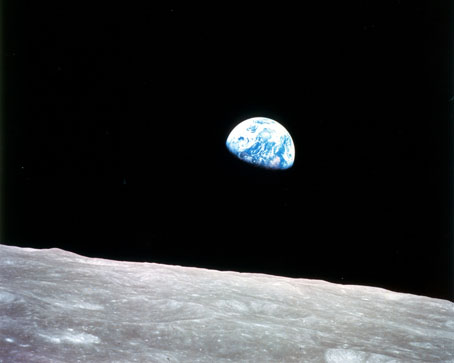
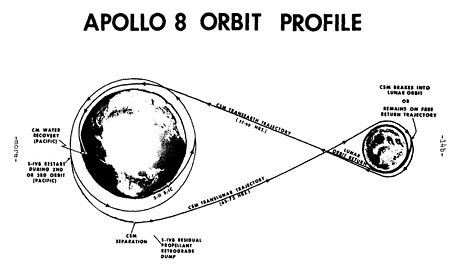
It was forty years ago this week that Apollo 8 astronaut William A Anders took this famous photograph of the Earth appearing over the Moon’s horizon. I was six years old at the time but remember the considerable interest caused by the mission, the first to leave the Earth and orbit the Moon, and I was old enough to appreciate that the flight path of the capsule formed a figure eight. This was the beginning of a four-year obsession with the Apollo missions, taking in model kits, jacket patches of spacecraft insignia and an eager viewing of every TV transmission. (Although I missed the first Moon landing a year later as it was after my bedtime.) I was convinced that by 2008 many of us would be living in space; a part of me remains disappointed that we’re not.
apollo8.jpg

The above graphic comes from the quaintly primitive Apollo 8 press kit which can be downloaded from one of NASA’s pages. On another page there’s the crew’s Christmas message to the world which controversially included readings from the Bible. And as usual with NASA you can see William Anders’ photo in a variety of sizes including luscious high-res. The impact of his picture may have diminished over the the past four decades but its import as an ecological symbol remains as pertinent as it was in 1968.

Things will be quiet here over the next few days while I visit family but I’ll be leaving the archive plug-in running for anyone who wants a random dip into the past. If you need some more retro space thrills there’s always this.

Have a good one.
afk.jpg

Previously on { feuilleton }
East of Paracelsus

Colorscreen

colorscreen.jpg

Given the time of year it’s a temptation to vent spleen and post something by the great Charles Addams. But rather than burden you with churlishness I’ll point instead to Colorscreen, a piece of web abstraction inspired by Olafur Eliasson. By the same programmer, there’s also the Random Color Generator.

Previously on { feuilleton }
The New York City Waterfalls
Take Your Time: Olafur Eliasson
Olafur Eliasson’s BMW
Olafur Eliasson’s Serpentine Pavilion
New Olafur Eliasson

The art of Claude Fayette Bragdon, 1866–1946

bragdon1.jpg

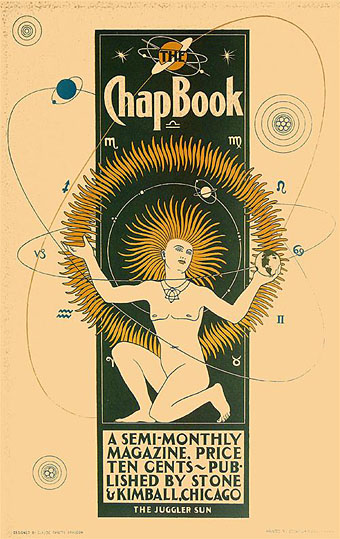
The Juggler Sun (1895).

On the shortest day of the year it seems fitting to post a picture of the sun and hope that in 2009 the clouds clear long enough for us Brits to see more than a month of it. Claude Fayette Bragdon’s poster is a remarkably stylised work for 1895 and might easily have been produced twenty or more years later. The Chap-Book was a periodical which included Bragdon among its illustrators although none of the cover designs to be found online are this striking. Bragdon wasn’t only an illustrator, however.

A man of many talents, Claude Fayette Bragdon (1866–1946) was an architect, artist, writer, philosopher, and stage designer. Bragdon’s work in these varied fields interrelated and overlapped, tied together by his theosophical belief in creating and communicating beauty. After a successful career as an architect in Rochester, NY, Bragdon entered the world of stage design in 1919, at the age of 53, by consenting to design a traveling production of Hamlet for actor-producer and personal friend Walter Hampden. Bragdon’s arrival in the world of theater came at a time when significant changes in staging techniques were on the horizon. (More.)

I usually celebrate polymathy but in Bragdon’s case his varied interests seem to have deprived us of more work by a unique illustrative talent. The indispensable VTS has further examples of his clean style from a 1915 treatise on architecture and design, Projective Ornament. It was increasingly common during this period to regard ornamentation in architecture as a 19th century evil to be purged from all future buildings, a concept expressed most notoriously by Adolf Loos in his 1908 essay, Ornament and Crime. Bragdon engaged with the argument by proposing that architects put aside historical and natural pastiche and look to geometry for a new style of decoration. His illustrations in Projective Ornament are beautifully done and some (like the one below) might almost be the work of an Art Deco illustrator such as George Barbier.

bragdon2.jpg

Elsewhere on { feuilleton }
The illustrators archive

Previously on { feuilleton }
The Decorative Age
Images of Nijinsky