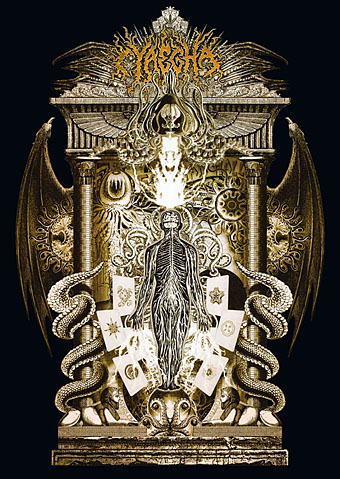
Nyarlathotep: the Crawling Chaos

nyarlathotep.jpg

Unveiling another new piece of work, this is a T-shirt design for metal band Cyaegha whose Steps of Descent album I illustrated and designed last year. They asked for something based on HP Lovecraft’s god Nyarlathotep so I thought I’d take the opportunity to rework from scratch the version of this I created in 1999 for the first edition of The Haunter of the Dark. I always felt the earlier piece was going in the right direction but lacked somewhat in execution; this makes up for that. Lovecraft’s Nyarlathotep is one of his most curious creations, in part because the conception of the character changed over many years. In various stories, letters and dream fragments the god/entity is variously described as an Egyptian pharaoh, an itinerant showman with electrical apparatus, the “black man” of European witch cults and the more typically Lovecraftian squamous alien monstrosity. The challenge, then, is to try and represent a little of each of these elements without overly favouring one or the other.

This is one of two illustrations I’ve produced in recent months which use Photoshop to imitate the engraving collage style of Wilfried Sätty, an artist whose work I discussed in an essay for Strange Attractor #2 in 2005. Sätty’s style was derived from Max Ernst’s famous collage “novels” of the 1930s and Photoshop is the ideal tool for this, far better than the old method of scissors, paper and glue. Sätty expanded Ernst’s technique by using reverse printing and the duplication of images; Photoshop extends the technique even further, making it possible to scale images up or down instead of being limited to the size of the original reproduction. The other illustration I’ve done in this style is for a short story and I’ll reveal that closer to publication. In the meantime I should be making a slightly different version of the new Nyarlathotep suitable for the usual range of CafePress products. More about those when they’re done.

Previously on { feuilleton }
The Haunted Palace
The art of Stephen Aldrich

Jack Cardiff, 1914–2009

red_shoes.jpg

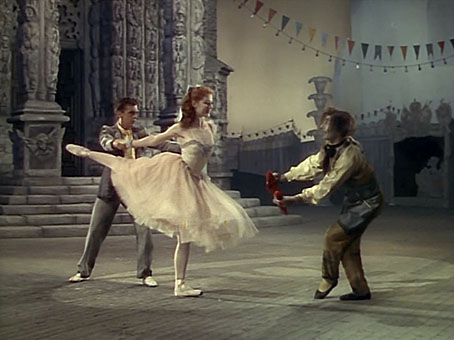
Robert Helpmann, Moira Shearer and Léonide Massine; The Red Shoes (1948).

Jack Cardiff, who died this week, was one of the great cinematographers from the postwar era, a period when British cinema was raised for a time to world-class level. His three films for the Archers, aka Michael Powell & Emeric Pressburger, are masterpieces of Technicolor photography. He won an Oscar for one of these, Black Narcissus, while his photography in The Red Shoes includes Moira Shearer’s 18-minute ballet performance, one of the most strikingly surreal sequences in the whole of British film.

Cardiff taught himself about lighting from scrutinising the Old Masters and the Impressionists, and teaching himself to observe colour, shade and reflection in everyday things. “As they say, ‘Love comes by looking’, and I was looking all the time. That’s how you learn.” He picks up one of the dozens of books on Rembrandt that he owns and draws my attention to the exquisitely painted shadow of a nose in one of his favourite portraits. We look at the interiors of other Dutch masters – Pieter De Hooch, Vermeer. It was to the work of Vermeer that the starkly beautiful images of nuns he created for his Oscar-winning movie Black Narcissus (1947) were likened.

Elizabeth Lowenthal, The Independent, 1994.

Previously on { feuilleton }
Deborah Kerr, 1921–2007
Freddie Francis, 1917–2007

Ballard and the painters

tanguy.jpg

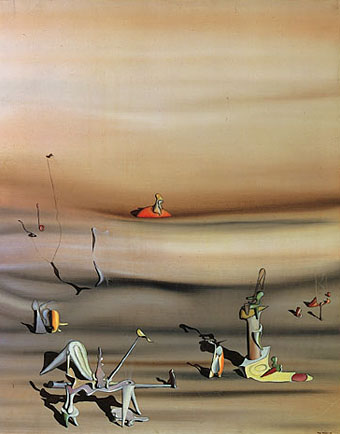
Jours de Lenteur (1937) by Yves Tanguy.

Behind it, the ark of his covenant, stood two photographs in a hinged blackwood frame. On the left was a snapshot of himself at the age of four, sitting on a lawn between his parents before their divorce. On the right, exorcizing this memory, was a faded reproduction of a small painting he had clipped from a magazine, ‘Jours de Lenteur’ by Yves Tanguy. With its smooth, pebble-like objects, drained of all associations, suspended on a washed tidal floor, this painting had helped to free him from the tiresome repetitions of everyday life. The rounded milky forms were isolated on their ocean bed like the houseboat on the exposed bank of the river.

The Drought (1965).

Following my observations yesterday about Ballard’s Surrealist influences, this post seems inevitable. By no means a comprehensive listing, these are merely some of Ballard’s many art references retrieved after a quick browse through the bookshelves earlier. I’d forgotten about the Böcklin reference in The Crystal World. The Surrealist influence in Ballard’s fiction is obvious to even a casual reader, less obvious is the subtle influence of the Surrealist’s precursors, the Symbolists. André Breton frequently enthused over Gustave Moreau‘s airless impasto visions and many of Ballard’s remote femmes fatales owe as much to Moreau’s paintings as they do to Paul Delvaux. The Symbolist connection was finally confirmed for me when RE/Search published their landmark JG Ballard in 1984; there among the list of books on his library shelves was that cult volume of mine, Dreamers of Decadence by Philippe Jullian.

Continue reading “Ballard and the painters”