Salon Futura #1

salon-futura.jpg

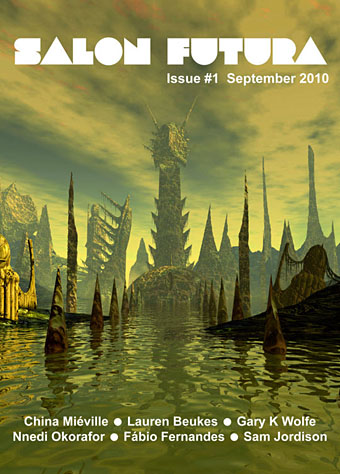
It’s been a pleasure this week seeing my 1999 portrait of Cthulhu’s rotting domicile, R’lyeh, used as the cover image for Salon Futura, a new online magazine edited by Cheryl Morgan. Cheryl describes SF as “a new and hopefully somewhat different magazine devoted to the discussion of science fiction, fantasy and other forms of speculative literature.” Among the contents there’s a podcast interview with Gary K Wolfe, Nnedi Okorafor and Fábio Fernandes (the latter is a contributor to the steampunk book I’m currently designing for Tachyon); there are video interviews with writers Lauren Beukes and China Miéville, and the Guardian‘s Sam Jordison writes an appraisal of EL Doctorow’s 1994 novel The Waterworks (about New York City’s minatory Croton Reservoir) which stimulated my interest enough to make me want to search out the book. And speaking of minatory architecture, {feuilleton} approves of the presence of Taschen’s fat volume of Piranesi works spied on China Miéville’s bookshelf. China always has interesting things to say; go and see for yourself.

Previously on { feuilleton }
Le horreur cosmique

The House of Orchids by George Sterling

sterling1.jpg

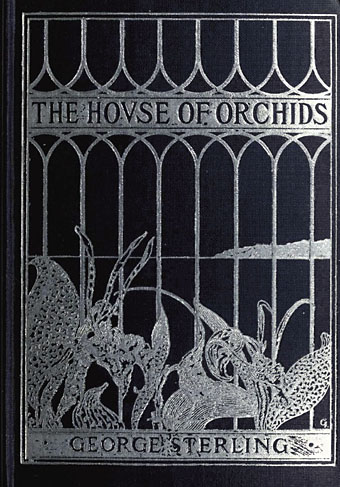
Do all roads lead to the Internet Archive? Not really but I keep ending up there when I happen to discover an interesting old book and wonder whether they have a PDF of the volume in question. The volume for consideration today, The House of Orchids, is a 1911 collection of verse by George Sterling (1869–1926), an American but another of those writers whose poetry looked to Decadent London and Paris for its flavour, hence the Wildean title, and, it should be said, the cover design. I haven’t been able to find an artist credit for this; if anyone knows who was responsible, please leave a comment.
sterling2.jpg

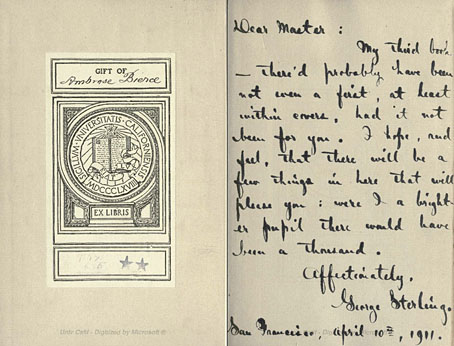
Many of the books at Archive.org are unremarkable library editions but this is a rare exception, being a gift to the University of California of writer Ambrose Bierce, Sterling’s idol and the person to whom he writes the above thanks and a dedication. Bierce praised Sterling’s work but must have passed the book on fairly soon after receiving it since he famously disappeared in Mexico two years later. Or maybe his library was passed to the university after his disappearance? Whatever the answer, this edition contains another curious feature in the form of a pasted-in newspaper clipping from 1926 concerning the death in mysterious circumstances of Sterling himself at San Francisco’s Bohemian Club. The general supposition is that he killed himself with a vial of cyanide he was in the habit of carrying around. One of Sterling’s young poetic protégés at the time The House of Orchids appeared was Clark Ashton Smith whose first volume of verse, The Star-Treader, and Other Poems, was published a year later. That book and another of Smith’s titles is also available at Archive.org, as I noted in June. Also there, and of particular {feuilleton} interest, is Sterling’s The Evanescent City, a paean to San Francisco’s 1915 Panama-Pacific International Exposition. (This site has scans of the text and photos.)

George-Sterling.org is a site devoted to the writer which includes many of his poems and other texts. Looking at his lengthy piece from 1907, A Wine of Wizardry, you can see what it was about his work that so appealed to Clark Ashton Smith and others.

Elsewhere on { feuilleton }
The book covers archive

Previously on { feuilleton }
Odes and Sonnets by Clark Ashton Smith
Clark Ashton Smith book covers
The Evanescent City

Yuri Yakovenko bookplates

jakovenko3.jpg

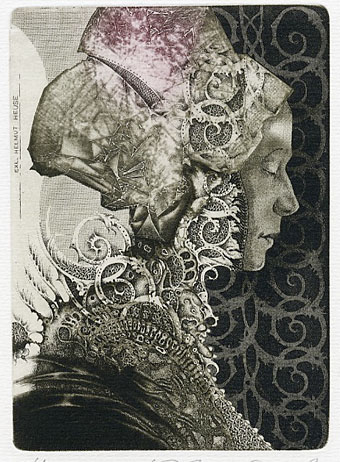
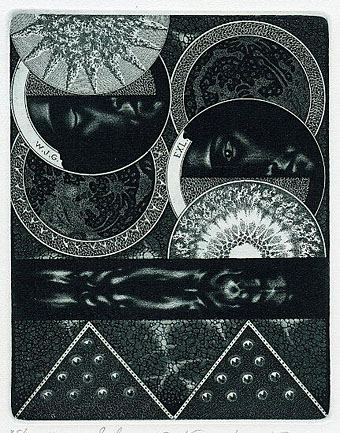
Yet more bookplates, discovered whilst browsing the wealth of material at this Japanese site recommended by Andy Paciorek. Belarus artist Yuri Yakovenko’s name is given a number of spellings on various sites so I’ve gone with the one from a Belarus art page since they can be presumed to know best how to label their fellow artists. Yakovenko’s hyper-detailed, occult-inflected brand of Surrealist imagery is so striking you have to wonder why his work hasn’t gained more visibility. Is it because the contemporary Ex Libris print world appears to be a self-contained zone within the wider art market? Whatever the answer, this is a region worthy of further investigation.

jakovenko1.jpg

jakovenko2.jpg

Elsewhere on { feuilleton }
The etching and engraving archive

Previously on { feuilleton }
Tranquillo Marangoni bookplates
Book-plates of To-day
Louis Rhead bookplates
Pratt Libraries Ex Libris Collection
The Evil Orchid Bookplate Contest
The art of Oleg Denysenko
David Becket’s bookplates

Two Brides

ansin.jpg

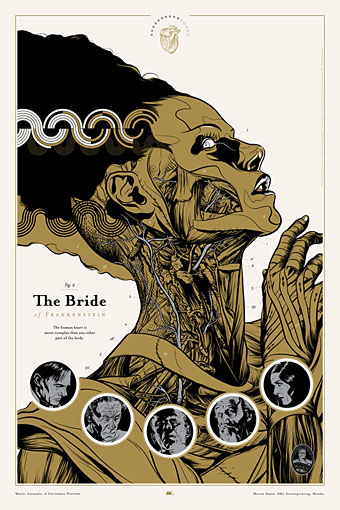
Ah, sweet serendipity… What are the odds, dear reader, of two blogospheric friends posting equally splendid pictures of everyone’s favourite hand-stitched and reanimated woman within days of each other? (It helps that Evan P and Monsieur Thombeau share a number of interests but let’s not spoil the moment.) The Gray’s-like dissection above is the work of illustrator Martin Ansin, while the painting below is by Michelle Mia Araujo, or Mia, as she prefers. Both artists have produced a quantity of other work which demands your attention. As for James Whale’s Bride of Frankenstein, it is, of course, one of the great cultural artefacts of the previous century; if you’ve never seen it there’s a Boris Karloff and Elsa Lanchester-shaped hole in your life which needs to be filled without delay.

mia.jpg

Previously on { feuilleton }
The Mask of Fu Manchu
Berni Wrightson’s Frankenstein

Tranquillo Marangoni bookplates

marangoni1

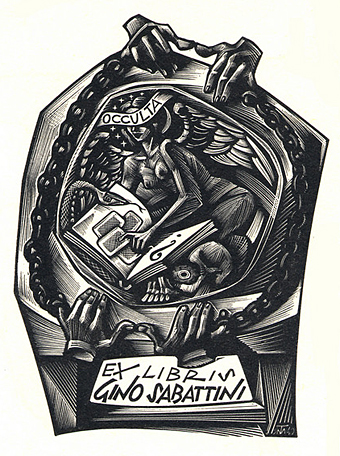
Occulta (1949).

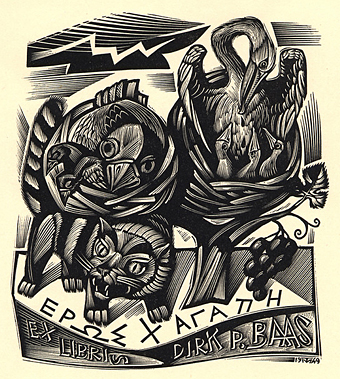
Two of the many bookplates produced by Italian artist Tranquillo Marangoni (1912–1992). The official site (in Italian) has three pages of ex libris work as well as further pages devoted to his woodcut book illustrations, postage stamp designs and other graphic productions.

marangoni2

Eros x Agapi (1949).

Elsewhere on { feuilleton }
The illustrators archive

Previously on { feuilleton }
Book-plates of To-day
Louis Rhead bookplates
Pratt Libraries Ex Libris Collection
The Evil Orchid Bookplate Contest
David Becket’s bookplates