Picturing Dorian Gray

dorian1.jpg

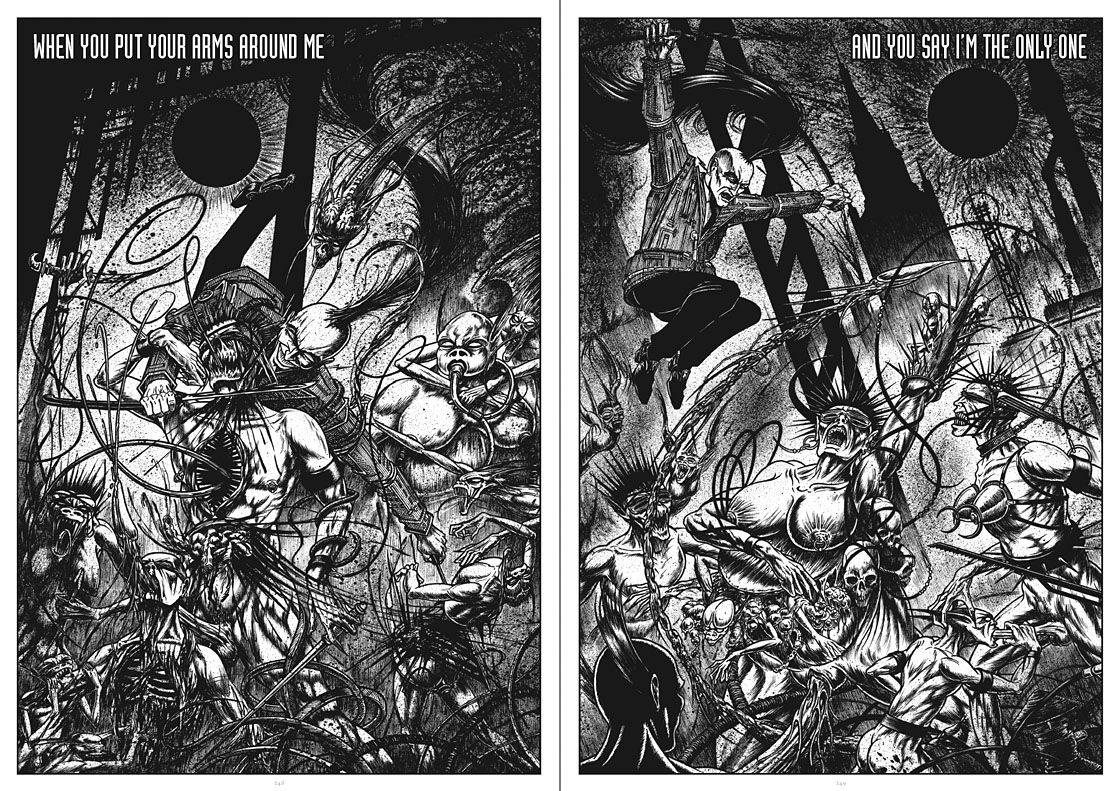
It’s taken a while but here at last are some of the pages from my series of illustrations based on The Picture of Dorian Gray, as featured in volume 2 of The Graphic Canon (“The World’s Great Literature as Comics and Visuals”) edited by Russ Kick. I agreed with Russ not to run everything so there’s some incentive to buy the book (or books…there are three volumes altogether). Now I’ve seen the printed edition the whole project seems even more remarkable: 500 large illustrated pages in a variety of media and art styles. Volume 2 runs through the 19th century and ends with my contribution; I opted to do this story in black-and-white but there’s colour used throughout the books. I especially like the Moby-Dick sequence by Matt Kish, a very different take on a very familiar tale.

As with many of the things I’ve been doing recently I opted for adapting materials of the period. Since I have a lot of Oscar Wilde-related reference material I was able to go further and incorporate details that relate directly to the book and Wilde’s life. All the text is taken from a scan of the first printing of the novel at the Internet Archive, the title lettering being drawn originally by Wilde’s friend, publisher and illustrator Charles Ricketts. A heavy black square on each page provides some continuity as well as resembling the frames of comic pages. (Or a picture frame.) The silhouette on the opening page is another of Wilde’s friends, the writer Max Beerbohm, taken from a drawing by William Rothenstein. The pair were dandyish Café Royal regulars throughout the 1890s.

dorian2.jpg

This is my favourite page. I liked the way the composition came together and also enjoyed being able to use John Singer Sargent’s portrait of W. Graham Robertson as the picture of Dorian. I’ve noted in an earlier post the similarity between this painting and the portrait seen in the BBC’s adaptation of the novel by John Osborne. Robertson was a theatre designer and illustrator who Wilde consulted when planning stage designs for what would have been the London debut of Salomé. Robertson was also (so far as we know) homosexual which adds an extra resonance.

dorian3.jpg

The Sibyl Vane page: a combination of details from The Studio, The Strand and The Magazine of Art. The motif at the foot of the page is by Walter Crane. Nothing of Wilde’s appeared in The Strand but that magazine’s most popular writer, Arthur Conan Doyle, had his second Sherlock Holmes adventure, The Sign of Four, commissioned at the same dinner that saw the commissioning of Dorian Gray, both novels being published by Lippincott’s Monthly Magazine in 1890.

dorian4.jpg

A page depicting Dorian’s distracting obsession with jewels and luxurious goods. This chapter can seem somewhat superfluous unless seen in the light of Wilde’s intention to write something like Huysmans’ À rebours (1884).

dorian5.jpg

The “Love that dare not speak its name” page. This makes explicit the subtext of the book although if you read the two paragraphs I selected it’s evident enough why Dorian is causing a problem for so many young men. The blindfolded Eros was a drawing by Walter Crane which I doubled then re-drew slightly so the pair were holding hands. The boy below is a picture from The Strand of the young Edward VII, a robust heterosexual in later years but with a son, Prince Albert Victoria, who became linked to the notorious Cleveland Street Scandal which involved a male brothel catering to aristocrats. The two young men in the picture frame are described as a pair of “panthers” in Neil McKenna’s The Secret Life of Oscar Wilde (2003), by which he means that they were fin de siècle rent boys (as in Oscar’s remark about “feasting with panthers”); McKenna doesn’t give any further details about the photo but it suited the picture.

In addition to this series of illustrations, volume 2 of The Graphic Canon includes two of my Lewis Carroll illustrations in a section by different artists based on the Alice books. I’d be recommending The Graphic Canon even if I wasn’t a contributor, as I said above it’s a remarkable achievement. Watch out for it.

Elsewhere on { feuilleton }
The Oscar Wilde archive

Painting the Henge

stonehenge1.jpg

Wiltonia sive Comitatus Wiltoniensis; Anglice Wilshire (1649) by Atlas van Loon.

Avebury doth as much exceed Stonehenge in grandeur as a Cathedral doth an ordinary Parish Church.

John Aubrey

John Aubrey (1626–1697) was the pioneering antiquarian and archaeologist whose interest in the ancient sites of southern England made him the first person to subject Avebury to any serious study. As a consequence his comparison between Avebury and Stonehenge may contain some bias—Stonehenge’s site on the desolate Salisbury Plain made its presence well-known even if it was little understood—but it should be noted that in Aubrey’s time there were more stones at Avebury than there are today, and the long avenues leading to and from the outer circle were still intact. The stones of Avebury were unfortunately small enough to be broken up by the locals for building materials.

stonehenge2.jpg

Stonehenge (1835) by John Constable.

The size of the stones, and the isolation of the site explains why Stonehenge has proved more attractive to the arts than other Neolithic monuments. William Macready in the 19th century added Stonehenge-like trilithons to his stage designs for King Lear, an addition that persisted for decades; Thomas Hardy’s Tess of the d’Urbervilles (1891) famously ends with a scene at the stones, while in the 20th century Stonehenge was shoehorned into Night of the Demon (1957), Jacques Tourneur and Charles Bennett’s film adaptation of Casting the Runes by MR James. James was an antiquarian himself so may well have approved of the inclusion, especially the way the stones are used in the opening scene.

stonehenge3.jpg

Stonehenge at Sunset (1835) by John Constable.

Painted renderings of the stones tend to be a mixture of archaeological studies and depictions like those featured here. The site had an understandable attraction to the Romantics, and drew both Constable and Turner there. (See Turner’s paintings and sketches here.) Constable’s watercolour of the stones against a turbulent sky is oft-reproduced. Some of the stones seen in 19th paintings and drawings lean more than they do today, having been restored to the vertical in the 20th century.

stonehenge4.jpg

Stonehenge – Twilight (c. 1840) by William Turner of Oxford (not to be confused with his more famous namesake).

Closer to our own time there’s Henry Moore’s marvellous series of lithograph prints from 1973 which study the stones from a variety of angles. These include close views, something few other artists seem to attempt. The photo print below shows the site as it was in the 1890s with cart tracks passing nearer to the stones than visitors today are allowed to venture.

stonehenge5.jpg

Previously on { feuilleton }
Stonehenge
Stonehenge panorama

Zimbu Xolotl Time

wb1.jpg

Or The Wild Boys revisited. These are two of Emma Doeve’s Wild Boys paintings from the Academy 23 book which was published in October by WhollyBooks to coincide with the recent London event remembering and celebrating The Final Academy, a William Burroughs-themed series of events held in London and Manchester in 1982. I’ve mentioned before that the book contains an edited version of my post about the event at Manchester’s Haçienda club. The book is now sold out but I expect some copies will find their way into the secondhand market eventually. Had Emma’s pictures been around a year ago I would have included them in my post about The Wild Boys and the various music and art inspired by Burroughs’s novel. They’re also a reminder that I ought to finish my own Wild Boys portfolio which has languished this year while I’ve been engaged with other things, not least finishing the Reverbstorm book. Something for the future, then. As for Zimbu Xolotl Time, Phil Hine can explain.

wb2.jpg

Elsewhere on { feuilleton }
The William Burroughs archive

Early British Trackways

watkins01.jpg

Continuing the Earth mysteries/megaliths theme, Early British Trackways: Moats, Mounds, Camps, and Sites (1922) by Alfred Watkins (1855–1935) was the first book in which the ley lines theory was proposed. Watkins was an amateur archaeologist (more a kind of early psychogeographer), photographer and writer who theorised that ancient Britons had marked the land with pathways connected by a variety of natural and man-made features: hills, mounds, trees, ponds, hillside notches and (of course) standing stones. Watkins coined the term “ley” after noticing that many of the lines connecting these features ran through villages or areas of land whose names ended in “-ley”, “-lay” or similar. The thesis was developed more fully in The Old Straight Track (1925), a book which became the ur-text for subsequent ley hunters. I’ve never seen any of Watkins’ books so it was interesting finding this short volume at the Internet Archive, not least because several of the photos appear in Mysterious Britain (1972) by Janet & Colin Bord, a classic guide to Britain’s sacred sites and folk rituals.

watkins02.jpg

Watkins never regarded ley lines as having any mystic significance, he thought they were probably old trade routes. Archaeologists have never agreed with his suppositions, however, and Watkins himself might have disapproved of the conjectures added to his theories by John Michell in The View Over Atlantis (1969) which wedded ley line theory to feng shui to create the whole “lines of energy” idea. Whatever one thinks of Michell’s theories, that book and subsequent volumes put ley lines firmly into popular culture, and without them we wouldn’t have the references in Children of the Stones, Steve Hillage’s Green (1978) (pretty much a Michell-inspired concept album), Nigel Kneale’s Quatermass (1979) and so on. But this slim book is where it all begins.

tvoa.jpg

Illustration by Roger Dean (1972).

watkins03.jpg

Continue reading “Early British Trackways”

Milbury souvenirs

milbury.jpg

A little something I ran up this weekend inspired by a certain TV serial which has been the subject of discussion recently. This is now a new design at CafePress. The idea was to do a travel poster in the style of those produced by London Transport in the 1920s promoting their destinations outside the city. I’ve always liked the colours and bold design of those prints so this piece is based on posters by artist Noel Rooke (1881–1953).

rooke.jpg

Betchworth by Noel Rooke.

The picture of the stones was adapted from a photo by Jim Champion which is made available under the Creative Commons licence. I took the liberty of enlarging the stone on the left to give it more presence. I couldn’t find a font that was a good match for Noel Rooke’s pen lettering so I scanned an alphabet from a lettering book my mother used to use when she was at art school (thanks, Mum!). The snake design is based on a postcard seen in the TV serial; nothing else looked as effective, and the combination of the snake with the slogan adds the requisite sinister touch.

Previously on { feuilleton }
A Journey to Avebury by Derek Jarman
Children of the Stones
Avebury panoramas