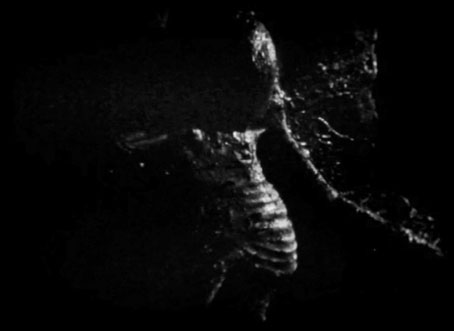
I never used a graphics tablet for drawing, in the past if I needed to draw something I’d use pencil and paper then scan the results. In recent years, however, I’ve grown dissatisfied with this process, especially after I rearranged my work area and packed away the space-hogging Ikea table I used to use as a drawing surface. This left me without a decent drawing area so this week I’ve finally capitulated and bought an Wacom Intuos tablet. The Giger-esque mess above is the result of playing around in Photoshop for a couple of hours. Having spent years using the blunt instrument of a mouse for Photoshop painting the combination of pen and tablet had immediate benefits, and I’ve found them both very easy to use. The sensitivity of the pen is impressive, something I was always dubious about. With the right brush selection it’s almost exactly like using a pencil or pen. Almost. I’m still not feeling as entirely in control of the end result as you do when drawing on paper, but I’ve not even used the thing for a whole day yet so I imagine that will change. I’m also surprised by how quickly the nib wears down; fortunately the pen comes supplied with a small stock of fresh nibs. The next week or so will be spent in further experimentation so if any interesting results materialise I’ll post them here.
Zone music
Undulating terrain: Stalker (1979).
Marking the boundaries of an obsession, this post follows the discovery last week of the Sine Fiction soundtracks for science fiction novels, one of which was five tracks by Jos Smolders for Arkady and Boris Strugatsky’s Roadside Picnic. That album set me wondering what other recordings might have been inspired by that bounded region known as the Zone, whether derived from the Strugatskys’ novel, from Andrei Tarkovsky’s 1979 film Stalker (for whom the Strugatskys provided a screenplay) or even from the real-life Zone around the irradiated Chernobyl disaster site in Ukraine.
The cult status of the book and film can be measured by the following list which I’m sure will have many omissions, not least because searching music sites for “stalker”, “zone” and “roadside picnic” yields multiple results; all three of those terms happen to also be the names of musical artists or groups, as well as the names of labels, albums and individual recordings. (I’ll skip over the S.T.A.L.K.E.R. series of computer games. All have music but since I’ve not played any of them I can’t say much about them.)
The stalker’s dream from Stalker.
The first release is of course the haunting film theme by Edward Artemyev, a mere five minutes of music which nonetheless adds a great deal to Tarkovsky’s unforgettable images. Artemyev also provided music for Tarkovsky’s Solaris (1972) and Mirror (1975) yet nothing else I’ve heard by the composer resembles this piece which wouldn’t be out-of-place on a compilation of German Kosmische music from the 1970s.
While that long camera shot over waterlogged objects is still in mind, there’s the following from Nova Swing (2006) by M. John Harrison, a science fiction novel which riffs on both Stalker and Roadside Picnic:
Upstairs, Emil Bonaventure was propped upright against the pillows like a corpse, his skin yellow in the streetlight from the window, his old ribs slatted with shadows. The energy had drained out of his smart tattoos and he was breathing ever so lightly. Edith watched the pulse in his neck. She could almost see the life through the skin, the thoughts in his head, and what were they but the dreams he couldn’t any longer have? Shallow water over cracked chequerboard tiles and cast-off domestic objects, books, plates, magazines, empty tunnels smelling of chemicals, a black dog trotting aimlessly round him in his sleep on some dirty waterlogged ground neither in nor out of anything you could think of as the world, while a woman’s voice mourned open-throat from a house not far enough in the distance.
Nova Swing will be available in a new edition later this year.

Stalker (1995) by Robert Rich & B. Lustmord.
The doomy atmospherics which have become the hallmark of Zone music begin with this album by Robert Rich and B. Lustmord. Seven tracks take Tarkovsky’s film as an inspiration with vaguely allusive titles—Undulating Terrain—and occasional snatches of dialogue buried in the mix. A superb piece of late-night listening even without the associations.
London zoom
I’m generally indifferent to panoramic views of cities, especially London where the sprawl lacks the distinct contours of Manhattan or the Napoléonic severity of Hausmann’s Paris. This view is different, however, being a 320 gigapixel panorama of the capital seen from the top of the BT Tower. This view is currently the world’s largest panoramic photo, and while the wide view is of the usual grey cloudscape and undifferentiated vista of 19th-century roofs and 20th-century ducting, the ability to zoom down into the streets (and, in some cases, into windows) is unprecedented at this resolution.
These screengrabs show a zoom towards the river from the widest angle down to the painted sign of the Duke of York pub on the corner of Rathbone Street and Charlotte Place in Fitzrovia. At the end of the zoom there’s a reverse view from Google Maps showing the pub itself, and the tower, the one landmark you won’t otherwise see. MetaFilter’s members have bookmarked various points of interest. I’m surprised there are so many roof gardens in this area of London although I think Paris still has the edge in that department.
Weekend links 148
Quantum Entanglement by Duda Lanna.
• An hour-long electronica mix (with the Düül rocking out at the end) by Chris Carter for Ninja Tune’s Solid Steel Radio Show.
• “…a clothes-optional Rosicrucian jamboree.”: Strange Flowers on the paintings of Elisàr von Kupffer.
• A Paste review of volume 2 of The Graphic Canon has some favourable words for my contribution.
It is an entertaining thought to remember that Orlando, all sex-change, cross-dressing and transgressive desire, appeared in the same year as Radclyffe Hall’s sapphic romance The Well of Loneliness. The two novels are different solar systems. The Well is gloomy, beaten, defensive, where women who love women have only suffering and misunderstanding in their lonely lives. The theme is as depressing as the writing, which is terrible. Orlando is a joyful and passionate declaration of love as life, regardless of gender. The Well was banned and declared obscene. Orlando became a bestseller.
Jeanette Winterson on Virginia Woolf’s androgynous fantasia.
• Jim Jupp discovers the mystical novels of Charles Williams.
• Michael Andre-Driussi on The Politics of Roadside Picnic.
• Les Softs Machines: 25 August 1968, Ce Soir On Danse.
• At 50 Watts: Illustrations and comics by Pierre Ferrero.
• Soviet posters: 1469 examples at Flickr.
• Oliver Sacks on drugs (again).
• At Pinterest: Altered States.
• Farewell, Kevin Ayers.
• Why Are We Sleeping? (1969) by The Soft Machine | Lady Rachel (1969) by Kevin Ayers | Decadence (1973) by Kevin Ayers
Une Collection Particulière by Walerian Borowczyk
British animator Bob Godfrey died this week but as a result of copyright restrictions there’s little of his work on YouTube aside from the films he made for children’s television in the 1970s and 1980s. One of those series, Roobarb (1974), is a personal favourite, but Godfrey had a long career in animation, and worked in many different styles. Two years before Roobarb he caused a stir with the bawdy Kama Sutra Rides Again (1972), a cartoon that was banned for a while, animated films being subject to the same ignorant reaction as comics from those who see them as a medium solely for children. Since we can’t watch Godfrey’s film online here’s something he may have appreciated, fellow animator Walerian Borowczyk in 1973 showing off his collection of vintage erotic art. After this Borowczyk abandoned animation for the no doubt more lucrative world of the sexploitation feature film.
Previously on { feuilleton }
• Dom by Walerian Borowczyk and Jan Lenica
• Les Jeux des Anges by Walerian Borowczyk
• Labirynt by Jan Lenica
• Short films by Walerian Borowczyk