Tsathoggua rising

tsathoggua.jpg

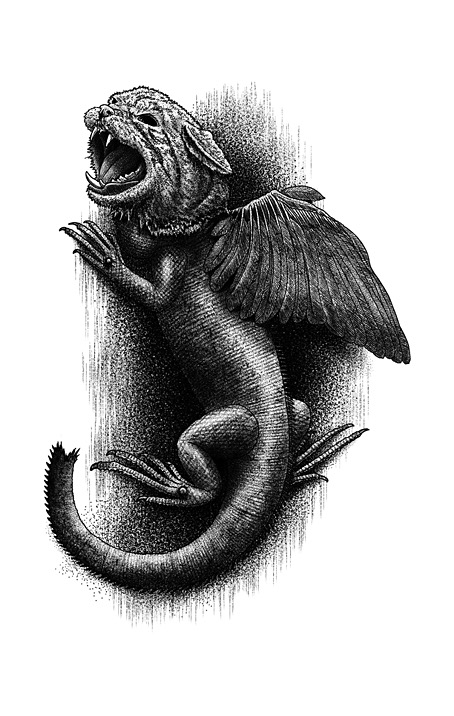
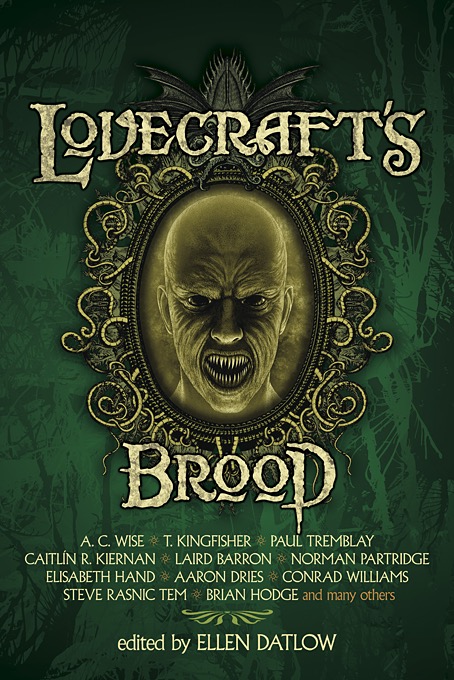
I said last week that I’d almost finished reworking my portrait of Tsathoggua for the Lovecraft book, and here it is. Tsathoggua first came into the world in a Hyperborea story by Clark Ashton Smith, The Tale of Satampra Zeiros, before being incorporated into the Cthulhu Mythos by HP Lovecraft who refers to the god-creature in several of his stories. Where Smith describes a hideous toad-like being, Lovecraft avoids being too closely bound by material specifics, referring to an “amorphous” entity which suggests a range of possibilities for illustration. To be fair to Smith, there is an amorphous and very deadly creature lurking in the temple of Tsathoggua in The Tale of Satampra Zeiros but we never learn whether this is Tsathoggua itself or some other being.

The amorphousness of Lovecraftian entities is a factor which is too often ignored in the world of weird illustration. Cosmic horror thrives on the fluidity of physics and physical matter but many illustrators seem content to copy one another instead of inventing new teratisms, a process that results in the accretion of stereotypes. Cthulhu, as I’m always reminding people, explodes into pieces after being struck by a ship at the end of The Call of Cthulhu, the remnants then recombining when the ship sails away from the scene. Lovecraft never intended his “spawn from the stars” to resemble the accreted stereotype we see today, a kind of Jolly Green Giant with squid mask and bat wings, reaching a brawny and very human arm towards the viewer. The ultimate expression of cosmic amorphousness may be found in the Shoggoths, those alien entities whose default condition is a mass of shapeless, iridescent protoplasm.

It was the amorphous nature of Tsathoggua that I wanted to honour with my original Photoshop creation in 1999. The starting point was a photograph of a cephalopod (I forget now whether it was an octopus or a squid) torn from an old issue of National Geographic. My initial experiments with the picture weren’t intended to develop into Tsathoggua; I didn’t have anything specific in mind when I started but at some point during the production of The Great Old Ones I decided to turn the picture into Smith’s entity with the addition of a toad-like head. Rather than mould the rest of the picture into more recognisable organic shapes it was left in a largely amorphous state. The eye-like shape at the top is a complete mystery to me now, I can’t say why it was there but it felt right so there it stayed. Alan Moore’s text for Tsathoggua identifies the creature with the Kabbalistic sphere of Geburah, “Strength”, a zone imbued with the martial qualities of the planet Mars. This is one of the more arbitrary assignations in The Great Old Ones—there’s nothing especially warlike about the toad-god—but something had to occupy the space, and I’d already finished the picture before Alan started writing his pieces. For the new version I’ve redrawn some areas of the original, but most of the work has been a case of sharpening edges and improving the contrast and modelling. The spiky, crown-like upper half has been emphasised a little in order to complement the martial aspect. And the bulging, convex appearance of the original has been slightly enhanced, giving the impression that the creature’s gravitational mass is of a sufficient density to bend the light around it. None of this should be taken as a negation of Smith’s description of a squatting, pot-bellied toad-god. The icons of the Great Old Ones created by human beings are exactly this: human attempts to represent alien monstrosity. Some acolyte who happens to envision the real Tsathoggua might stammer that “It looked like…a giant toad!” thereby giving a form to the subsequent iconography. But the map is not the territory. Cthulhu doesn’t, and shouldn’t look like the statues either. The Jolly Green Giant needs to ditch the mask and wings and get back to selling canned vegetables.

Elsewhere on { feuilleton }
The Lovecraft archive

Previously on { feuilleton }
H.P.L.
The Return of the Crawling Chaos
Lettering Lovecraft
Weird ekphrasis and the Dunwich Horrors
Kadath and Yog-Sothoth
Another view over Yuggoth

The Elegant and Useful Book of Urban Wyss

wyss01.jpg

Work-related research over the past week has had me looking for interesting 14th-century alphabets. This is a period I usually ignore in favour of the designs of the following century which tend to be a lot more florid, often to the point of illegibility. (Michael Baurenfeind’s books offer prime examples.) Medieval alphabets are more readable on the whole, once you attune yourself to the missing letters (“j”, “u” and sometimes “w”), also the common occurrence of the long “s”, the bar that crosses the “x”, and the way that “z” will resemble a number 3.

wyss02.jpg

The examples below are the more eccentric samples given in Libellus Valde Doctus Elegans, et Utilis, Multa et Varia Scribendarum (Elegant and Useful Book on the Learned Art of Writing), a collection by Urban Wyss published in Switzerland in 1564. Wyss presents the Gothic scripts that are common to the period before showing the reader a number of pages unlike any I’ve seen elsewhere, including one with the text running in reverse across the page. (This may be a printing error but I’m assuming not.) The book has an obvious pedagogic intent: the first page shows the student the best way to hold a pen when writing, while the second page depicts a classroom where a group of infants are learning to read and write.

wyss03.jpg

The passages of text that separate the alphabets are mostly aphoristic rather than referring to the stylistic variations on display. I was hoping the text might be more technical, and that the changes of style would be there to emphasise some point being made. This would have made the book a very early example of graphic design in which the form of the text was used to reinforce an argument. An article in a 1945 issue of Graphis refutes this:

Unlike other books on calligraphy the Libellus valde doctus is for the most part composed in Latin and intended for pupils of academic schools. The texts chosen for the models are drawn from the works of Cicero, the most read Latin writer at that time. They are meant to serve not only for the mechanical training of the copyist but further for his schooling in good Latin expression, not to speak of the beneficial influence on the pupil of their content in wisdom.

This does at least give us a very minor connection to graphic design beyond the letterforms themselves. Cicero may not be quoted so often today but some of his writing is put to use whenever a designer fills a column with Lorem ipsum placeholder text, the words of which are extracted from De finibus bonorum et malorum. Posthumous recognition of a sort, although I expect the Roman senator would prefer to be remembered for the meaning of his statements rather than the individual words used to compose them.

wyss04.jpg

wyss05.jpg

Continue reading “The Elegant and Useful Book of Urban Wyss”

Weekend links 807

kouninos.jpg

Poster art by Nicholas Kouninos for Procol Harum / Pink Floyd / HP Lovecraft at the Fillmore, San Francisco, 1967.

• Take a break from so-called reality with Gruesome Shrewd, more queasy psychedelia by Moon Wiring Club. MWC’s Ian Hodgson described his intentions to Simon Reynolds in a Reynolds roundup which notes the 20th anniversary of the Ghost Box project. The label is apparently on hold for the moment but I have to admit that my interest waned some time after the 10th anniversary, when it became increasingly apparent that the ghost had fled the box. Reynolds ends his piece with a list of favourite GB recordings which I mostly agree with, although I’d shuffle the order and swap some entries with Pye Corner Audio.

• “‘You know that feeling you get when you’ve just gotten back from the dry cleaners a pair of slacks, Dacron slacks, and you reach your hand in a pocket and you feel those fuzzy sandwiches with your fingers? Well, that’s the feeling I’m looking for.’ I just nodded and replied, ‘OK, Dave, I know exactly what you mean.’” Barry Gifford remembers David Lynch.

Aschenbach’s Last Journey: Lesley Chamberlain, the most recent translator of Thomas Mann’s Death in Venice, approaches the text by following the progress of its doomed protagonist from Brioni to the Venetian Lido. Related: Polly Barton describes to Katy Whimhurst some of the difficulties involved in translating Japanese fiction to English.

• From The Shout to Bait: Darran Anderson on the uses of sound in cinema. Rupert Hines’ soundtrack to The Shout has just been released by Buried Treasure.

• Video footage of modular synthesists Arc (Ian Boddy & Mark Shreeve) performing Arcturus live in 2004: part one | part two.

• At Aeon: “Black holes may be hiding something that changes everything,” says Gideon Koekoek.

• At the BFI: Michael Brooke selects 10 great Hungarian films.

• Steven Heller’s font of the year is Fillmore.

Shout The Storm (1984) by :Zoviet:France: | Shout At The Devil (2002) by Jah Wobble & Temple Of Sound | Shout (2005) by Tod Dockstader

H.P.L.

hpl.jpg

It’s that man again. Presenting the latest reworked page from the ongoing reconstruction/improvement of my Haunter of the Dark book. The picture will illustrate “Abdul Alhazred”, the final section of Alan Moore’s text for The Great Old Ones in which HP Lovecraft is positioned at Malkuth, the “Kingdom” in Alan’s eldritch Kabbalah. This makes Lovecraft himself the receptive vessel of the energies descending from the spheres above, while paradoxically being the source of those energies. Or some of them at least… The Great Old Ones is a Mythos Kabbalah which features Dagon, Hastur, Tsathoggua and Yig as well as Cthulhu and the rest. Alan doesn’t subscribe to Kenneth Grant’s baseless theory that Lovecraft really was a receptacle for transmissions from interdimensional entities, but the incorporation of the writer into his own pantheon isn’t unprecedented. Abdul Alhazred was a childhood persona of Lovecraft’s before he assigned the name to the author of Al Azif, or the Necronomicon; further personas may be found in Through the Gates of the Silver Key (“Ward Phillips”), Robert Bloch’s The Suicide in the Study (“Luveh-Keraph, priest of Bast”), and other fictions.

hpl.jpg

HPL (1937) by Virgil Finlay.

Whether this literary sport warrants the apparently limitless production of Lovecraftian art featuring the man himself, usually sprouting or festooned with tentacles, is a debatable matter. Virgil Finlay began the fantastic portrait trend in 1937 with his memorial depiction of the author writing with a quill pen while dressed in 18th-century garb. The earliest example that I can think of showing Lovecraft paired with the ubiquitous tentacles was the Moebius cover for Lettres d’Arkham in 1975, although there may well be other drawings prior to this. I’ve often wondered what Lovecraft would have made of the deluge of publications and images derived from his work, especially those that place him inside the products of his imagination.

moebius.jpg

Cover art by Moebius, 1975.

And speaking of which… I was at a loss at first with how to approach a new Lovecraft portrait, all I knew was that one was necessary. The original Malkuth picture from 1999 is another poor Photoshop job which has nevertheless been reused elsewhere on a few occasions, even appearing in 2007 on the cover of an issue of FATE magazine. For the new version I started with the portrait itself, using white lines on black to copy the same portrait photograph that formed the centre of the older picture. This was then duplicated and flipped horizontally to create a kind of Janus head which gives the portrait a suitably weird quality without wreathing it in tentacles. The mirrored head harks back to a sequence of treated photos by JK Potter which I first saw in the Heavy Metal Lovecraft special in 1979. Potter had used the same portrait photo to create effects that were somewhat compromised by poor reproduction, leading me to be believe that I’d created something slightly different to the first panel in his sequence. While researching this post I turned up an earlier version of the artwork which appeared on the back of the first issue of a US fanzine, Fantasy Mongers, also in 1979. The clearer reproduction revealed that the first head in Potter’s sequence is almost identical to my own. Ah well…

jkpotter.jpg

Photo art by JK Potter from the back cover of Fantasy Mongers #1, 1979.

The rest of the picture was improvised around this central image. Having drawn the portrait in white-on-black I decided to use a similar technique for the other elements. The Cthulhoid pillars are based on those in my Red-Night Rites painting from 1997, one of which appeared in the 1999 picture. The smaller figure on the right is from one of the photos that Wilfred Talman took while wandering the streets of New York with Lovecraft and Frank Belknap Long. This also appeared in the 1999 picture but for the new version I’ve emphasised what appears to be a book that Lovecraft is carrying in his right hand. Searching around for a complementary figure that might represent Abdul Alhazred turned up a 19th-century photo of a character who not only looked the part but is also standing in a manner similar to the Talman Lovecraft. If you look closely he’s also carrying a book, an addition of my own which turns him into the author of Al Azif. The polyhedra supporting the pair aren’t as arbitrary as they may seem. The spheres serve a dual purpose, preventing the figures from floating in space (or standing in water) while also relating to the Sephiroth of Malkuth which is identified with the Earth in the Kabbalistic scheme of planetary associations.

The next reworked picture will be Tsathoggua which is being polished rather than completely overhauled. I’m hoping I might have this done by the end of the month but I’m still chipping away at The Dunwich Horror while doing all this, as well as working on things which pay the bills. (I’ve just finished designing and illustrating another book.) Further progress will be announced in due course.

Elsewhere on { feuilleton }
The Lovecraft archive

Previously on { feuilleton }
The Return of the Crawling Chaos
Lettering Lovecraft
Weird ekphrasis and the Dunwich Horrors
Kadath and Yog-Sothoth
Another view over Yuggoth

Shin-Bijutsukai

shinbijutsukai01.jpg

If you’ve spent a great deal of time looking at European design publications from before or after 1900 you may experience a shock of surprise when you encounter a Japanese publication from the same period. Shin-Bijutsukai (“New Oceans of Art”) was a Japanese magazine published in monthly issues from 1902 to 1906. At first glance it looks like an equivalent of European design samplers such as Dekorative Vorbilder or Documents d’atelier: Art décoratif moderne, another collection of colour plates with little or no accompanying text. Many of the samples, however, are the kinds of designs you wouldn’t see in Europe for another 20 years, or even 50 years in some cases. The book linked here seems to contain a complete run of the magazine, and is part of the Smithsonian collection at the Internet Archive, a holding I still haven’t explored very thoroughly. A task for the future.

shinbijutsukai02.jpg

shinbijutsukai03.jpg

shinbijutsukai04.jpg

shinbijutsukai05.jpg

Continue reading “Shin-Bijutsukai”