Several more Salomés

durnov.jpg

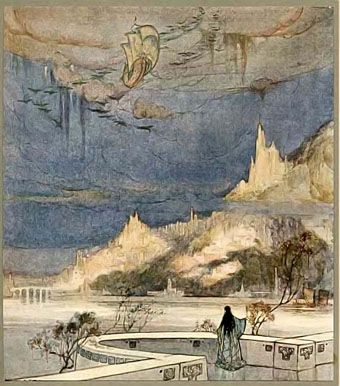
Cover of Salome by Oscar Wilde (1903) by Modest Alexandrovich Durnov.

Gathering a few more Salomé renderings which have caught my attention recently. The biggest surprise is the one from Picabia since he’s an artist who these days is almost always associated with the Cubists and Dadaists. In the 1920s he returned to figurative painting and produced a number of pieces in this style. The overlaying of images reminds me of some of Hans Bellmer’s drawings.

Michael Zulli is an American comic artist whose work I’ve always liked a great deal. No information about his drawing, unfortunately, so I can’t say whether it’s a one-off or part of a larger project.

wilmer.jpg

Salomé (1917) by John Riley Wilmer.

picabia.jpg

Salomé (c. 1928) by Francis Picabia.

kalmakov.jpg

Salomé Sphinx (1928) by Nicholas Kalmakoff.

zulli.jpg

Salomé (no date) by Michael Zulli.

Elsewhere on { feuilleton }
The Salomé archive

Ogdens’ Nut Gone Flake

ogdens1.jpg

More psychedelia (there’s always more psychedelia). Listening to this Small Faces album this week I couldn’t remember whether my vinyl reissue from the 1980s had survived the vinyl purge I instituted a few years ago. It turns out I do still have the vinyl copy, a facsimile of the original circular sleeve. Ogdens’ Nut Gone Flake was released in 1968. Despite the innovative sleeve design and the generally tripped-out atmosphere (especially on side two) it seldom gets included in retrospectives of psychedelic album art. This is surprising since for design and execution it’s far better than the sleeves for Their Satanic Majesties Request and Magical Mystery Tour, the latter a great album with a really awful cover. I suspect the Small Faces’ album gets overlooked because the most typically psychedelic aspect of the artwork—the drawing/collage below—is hidden inside, the rest of the cover being a careful imitation of an “Ogdens’ Nut-brown Flake” tobacco tin. XTC borrowed the circular sleeve idea for their 1984 album The Big Express.

ogdens2.jpg

Interior panel. Illustration by P. Brown.

The drawing is credited to one “P. Brown”; the sleeve design, we’re told, was the work of Mick Swan who did nothing else in this area. If I’m vague about the details it’s because my copies of the album (CD and vinyl) contain no information other than the label copy. I imagine recent reissues which have had booklet notes will are more enlightening. This page has some comments from the band as to how the tobacco tin idea came about.

ogdens3.jpg

The opened-out sleeve.

Original copies of this album used to command high prices (so to speak) since the fragile nature of the hinges holding together each part of the sleeve meant they rapidly wore out. Subsequent editions tended to be in regular square sleeves. My CD edition from 1989 was the first to make the most of the tobacco tin concept by packaging the whole thing in a tin. Inside you get a small reproduction of the fold-out sleeve and six somewhat redundant beer mats or coasters.

The band played two-thirds of the album on the BBC’s Colour Me Pop in 1968, complete with an appearance by Stan “The Man” Unwin who provides the “loony links” on the second side of Ogdens’ Nut Gone Flake. Most editions of Colour Me Pop are lost but that episode survived, and may be watched here.

ogdens4.jpg

The opened-out sleeve (obverse).

Elsewhere on { feuilleton }
The album covers archive

Tadanori Yokoo animations

yokoo13.jpg

Kiss Kiss Kiss (1964).

A follow-up to yesterday’s post, and three short films by the artist from the 1960s. As animations go these are fairly crude but they do have the benefit of showing Yokoo’s sense of humour, something which isn’t necessarily so obvious in his poster art. Kiss Kiss Kiss is a short sequence of juxtaposed couples from the same American romance comics that Roy Lichtenstein spent much of his time plundering. Kachi Kachi Yama, the longest of the three, opens with the unlikely claim that it features Alain Delon, Elizabeth Taylor, Richard Burton, Marilyn Monroe and The Beatles, then makes good by showing drawings of all of these in a witty melodrama which is like Yokoo’s poster art brought to life. Tokuten Eizou Anthology No. 1 is a lot less explicable being a display of the artist’s drawings together with the occasional photograph. All three films can be seen together at Ubuweb.

yokoo14.jpg

Kachi Kachi Yama (1965).

yokoo15.jpg

Tokuten Eizou Anthology No. 1 (1964).

Previously on { feuilleton }
Tadanori Yokoo album covers

Tadanori Yokoo album covers

yokoo01.jpg

Kokoro No Uramado (1969) by Asaoka Ruriko.

A few examples of Tadanori Yokoo’s earlier cover designs which are the ones I prefer. Although he’s continued to produce collage art for music releases, the CD format does his work few favours. I lose interest musically in Santana after about 1970 so I’d not looked properly at their triple-live set Lotus before, an album which is one of those worth having for the cover alone. Worth having for the cover and the music is Miles Davis’s thundering jazz-rock monolith Agharta which for some reason was given a different cover by Elena Pavlov on its US and European release. For Yokoo’s more recent cover art see his Discogs page.

yokoo02.jpg

Lotus (1974) by Santana.

yokoo03.jpg

Lotus (1974) by Santana.

yokoo04.jpg

Lotus (1974) by Santana.

Continue reading “Tadanori Yokoo album covers”

William E. Jones on Fred Halsted

halsted1.jpg

Presenting an interview by John Wisniewski with William E. Jones, author of Halsted Plays Himself (2011). The subject is gay filmmaker and performer Fred Halsted (1941–1989) whose 1972 film LA Plays Itself was a pioneering piece of low-budget cinema which combined a fragmented view of Los Angeles with explicit liaisons between several men, one of them portrayed by Halsted himself. Halsted took advantage of the period between 1970 and 1975 when porn in the US was no longer illegal but hadn’t yet been industrialised. As with Genet’s Un Chant d’Amour, what you get on the screen isn’t a product, it’s the representation of an obsession. It’s this that makes LA Plays Itself a still surprising and provocative piece of work.

I arrived at this film and Halsted somewhat belatedly, in fact I don’t think I’d read anything about him at all until William E. Jones was interviewed when his book was published. (Matters haven’t been helped in this country by the way hardcore porn of any kind was still illegal into the 1990s.) LA Plays Itself fascinates for the view it gives of the LA cruising scene which John Rechy described in considerable detail in The Sexual Outlaw. It’s a curiously hybrid film, neither straightforward porn—many of the sex scenes are fragmented—nor is it narrative fiction or outright documentary. Together with the recently reissued films of Peter de Rome, it’s the kind of thing that few people would be likely to make today, despite the easier access to film technology and the relaxing of censorship. And like all porn films of this era, it now has a unique look simply because it’s been shot on film.

halsted2.jpg

None of Halsted’s films appear to be on DVD at the moment, and as William Jones notes below, Sextool (1975), the film Halsted regarded as his major work, may only exist as a single fading print.

Here’s John and William.

* * *

John Wisniewski: Why did you choose to write your book on filmmaker Fred Halsted?

William E. Jones: For several years I made money in the adult video industry, producing budget DVD compilations (4 hours for $10) sold in adult video stores. Before technological innovation rendered my job redundant, I watched over 700 hours of gay adult film and video produced between 1969 and 1999. In such vast quantities, the material, especially from the second half of the period, began to seem nightmarish in its ugliness. I would relish the opportunity to see any earlier title, produced before 1985, directed more or less like a movie, shot on location, and sometimes even acted fairly well. I can say without hesitation that Fred Halsted’s films were my favorites of all the videos I saw during those years in the porn industry.

Fred Halsted’s films have many fans but few advocates, and I thought my book could intervene in a decisive way before his legacy – the films and the memories of those who knew him personally – disappears completely. I also chose him as my subject because of his connection to Los Angeles. He lived and worked in neighborhoods I pass through nearly every day. But there was something else that drew me to his films, the uncanny power of work by a novice, and a self-taught one at that. His films are crude, idiosyncratic, and at their best have the force of a revelation.

Continue reading “William E. Jones on Fred Halsted”