Psyché Rock

henry1.jpg

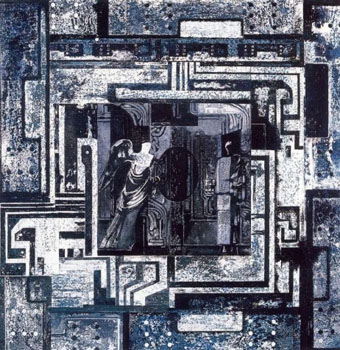
Messe Pour Le Temps Present (1967).

Electro-acoustic composer Pierre Henry probably wouldn’t thank you for calling Psyché Rock his finest moment but it’s a favourite of mine. It’s also his most well-known composition although most people know it as a putative inspiration for Christopher Tyng’s theme to Futurama. The YouTube version here is the original mix. Many other uploads are later remixes which disgracefully downplay the wonderful out-of-time synth shrieks.

henry2.jpg

Too Fortiche / Psyché Rock / Teen Tonic / Jericho Jerk (1967). Credited to “Les Yper-Sound”.

Psyché Rock was the second track on Messe Pour Le Temps Present, an album of music composed in part with Michel Colombier. (It was also released on an EP with three other Henry/Colombier tracks, and later as a single in its own right.) The Messe section of the album was the score for a Maurice Béjart dance piece, a small example of which can be seen here. There’s also this silly dance sequence from French TV featuring stripping meter maids.

perrey.jpg

Moog Indigo (1970).

Another French composer, Jean-Jacques Perrey,  looked from inner to outer space in 1970 with E.V.A., a track on his Moog Indigo album. This sounds very similar to Psyché Rock, albeit less wild and much more groovy, and may also be an inspiration for the Futurama theme. This train of associations has given E.V.A. a life beyond its album release.

futurama.jpg

As to Futurama, there’s a mass of clips and themes of differing lengths out there. I’ll mention Fatboy Slim’s remixes only to say that I’ve never been very enamoured of Quentin’s compositions so the less said about him (and them), the better. Les Jerks Électroniques De La Messe Pour Le Temps Présent Et Musiques Concrètes De Pierre Henry Pour Maurice Béjart was available on CD as recently as 2009 in a package which shows some of the equipment used to produce its sounds.

Previously on { feuilleton }
The music of Igor Wakhévitch

Design as virus 16: Prisms

dsotm1.jpg

The Dark Side Of The Moon (1973) by Pink Floyd. Design by Hipgnosis.

Dark Side of the Moon is one of seven or eight suggestions we submitted to Pink Floyd. It relates to the Floyd’s concerts and their use of light shows. Specifically it was sparked off by Rick Wright who wanted something very simple, clinical and precise. It’s not a particularly original design but I do feel it is very appropriate and highly effective.

Storm Thorgerson in An ABC of the Work of Hipgnosis: Walk Away René (1978)

Continuing an occasional series. Album cover designer Storm Thorgerson died in April, a month after the 40th anniversary of the release of The Dark Side of the Moon by Pink Floyd. Thorgerson may have downplayed the originality of the cover design but it remains the most well-known of the many covers produced by Hipgnosis, a combination of the enormous commercial success of the album and the success of the design itself.

The variations below are post-Hipgnosis productions by Thorgerson and his various assistants for reissues of the album. I did have the idea of collecting a few of the better unofficial variants and pastiches but a quick image search turns up a daunting quantity of homages, parodies, imitations and other derivations. This is partly down to the way the internet stimulates an accelerated recycling of cultural signifiers, but it still shows how this simple design continues to affect people beyond its original application.

The 2011 Immersion Box Set featured further variations, some of which have been used to promote the 40th album anniversary. There’s a poster available with even more variations. If you’re still not sated after that lot then deviantART is the place to go for endless collisions between the Floydian prism and all the hottest emblems of pop culture. Just keep scrolling…

dsotm2.jpg

30th Anniversary reissue. Design by Storm Thorgerson & Peter Curzon.

dsotm3.jpg

The Dark Side Of The Moon: The Making of Pink Floyd’s Masterpiece (2005) by John Harris. Designed pseudonymously by Storm Thorgerson.

dsotm4.jpg

Immersion Box Set (2011). Design by Storm Thorgerson & StormStudios.

Previously on { feuilleton }
Design as virus 15: David Pelham’s Clockwork Orange
Design as virus 14: Curse of the Dead
Design as virus 13: Tsunehisa Kimura
Design as virus 12: Barney’s faces
Design as virus 11: Burne Hogarth
Design as virus 10: Victor Moscoso
Design as virus 9: Mondrian fashions
Design as virus 8: Keep Calm and Carry On
Design as virus 7: eyes and triangles
Design as virus 6: Cassandre
Design as virus 5: Gideon Glaser
Design as virus 4: Metamorphoses
Design as virus 3: the sincerest form of flattery
Design as virus 2: album covers
Design as virus 1: Victorian borders

Astronomiae Instauratae Mechanica

tycho01.jpg

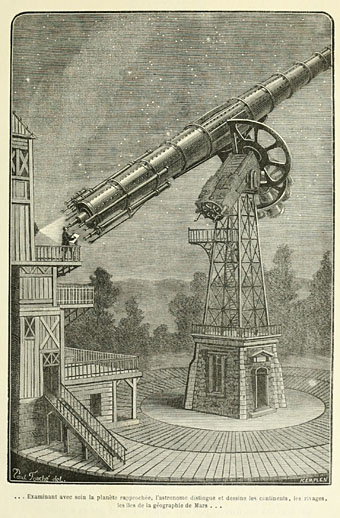
Let there be no complaints about lack of variety: fetish photography one day, 17th-century astronomical instruments the next. Tycho Brahe’s Astronomiae Instauratae Mechanica (1602) is a description of the astronomical devices used at Brahe’s Stjerneborg (Star Castle) on the island of Ven in Oresund, Denmark. One of the plates below shows the layout of the Star Castle while the others detail various sextants, armillary spheres and the like. A number of these are familiar from their more recent use as book illustrations so it’s good to once again find the source volume.

The concept of an observatory garden is very reminiscent of the Peking Observatory, and the much more impressive structures at Jaipur. Brahe wrote: “My purpose was partly to have placed some of the most important instruments securely and firmly in order that they should not be exposed to the disturbing influence of the wind, and should be easier to use, partly to separate my collaborators when there were several with me at the same time, and have some of them make observations in the castle itself, others in these cellars, in order that they should not get in the way of each other or compare their observations before I wanted this.”

Browse the rest of the book here or download it here. Tip via this tweet which linked to coloured copies of the plates.

tycho02.jpg

tycho03.jpg

tycho04.jpg

tycho06.jpg

Continue reading “Astronomiae Instauratae Mechanica”

Fetish photographer Rick Castro

castro.jpg

Photographs by Rick Castro.

Presenting another guest post from John Wisniewski who back in May contributed an interview with William E. Jones about gay film director Fred Halsted. The subject this time is Rick Castro, pioneering bondage/S&M photographer, and also the proprietor of the Antebellum Gallery in Los Angeles which bills itself as the only fetish gallery in America. Castro has worked with Joel-Peter Witkin and Bruce LaBruce, and also photographed subjects as diverse as the Dalai Lama and Kenneth Anger, neither of them in bondage, unfortunately. As before, John offers a list of ten questions. Read on to discover why hustlers always used to wear white jeans (I have wondered about this)…

* * *

John Wisniewski: When did you begin photographing?

Rick Castro: 1986…around June…. My first photo was of my longtime friend (and former GF!), Odessa. I was a wardrobe stylist at the time, so I dressed her like Morticia Addams. Very high contrast/high shadowed B&W.

My second photo was of Tony Ward. I cast him for his first “mainstream” photo shoot. Editorial for a now defunct men’s magazine, INSTYLE, (published by porn mag IN TOUCH). We were working for photographer Albert Sanchez at the time. Between takes I’d dressed him up in full leather fantasy—leather hood, harness, gauntlets, codpiece, boots and horsetail!

JW: Whom are some of your influences in photography and art?

RC: I like the dead guys: Brassai, Pierre Moliner, F. Holland Day, Julia Margaret Cameron, Otto Dix, Paul Cadmus, Egon Schiele, Tennessee Williams, Pier Paolo Pasolini, Gilles De Rais.

JW: When did you meet fellow photographer Joel-Peter Witkin?

RC: Also during 1986, I bought Joel’s first book. At the back of the book was a request: “I am looking for people with physical deformations, amputees. Quadriplegics, burn victims, persons into extreme S&M, a woman with three breasts, geeks, pinheads, a woman with severe skin disease that will pose in an evening gown, anyone bearing the wounds of Christ, Christ.”

Later that year the new annex of Book Soup on Sunset Blvd hosted the first LA photo exhibit for Joel. I attended, introduced myself and gave him a stack of photos I had taken of my potential “models.” He called me the next morning. From then I worked with Joel on 13 of his most iconic photographs as a wardrobe stylist, costume designer, location scout, model scout, casting director, photo assistant, art director, make up artist and all around assistant.

Continue reading “Fetish photographer Rick Castro”

The poster art of Frank McCarthy

mccarthy06.jpg

The Venetian Affair (1967).

“Murder! Spies! Women!” If you added “guns” and “explosions” to that list you’d have the ingredients of the wild poster art of Frank McCarthy (1924–2002). I used to love posters like this when I was a boy, especially those from the everything-happening-at-once school which, by the look of these examples, was McCarthy’s specialty. Where action films are concerned the posters are often more exciting than the scenes they depict, in part because artists such as McCarthy were often working from their own imaginations as much as from any stills they’d been given.

mccarthy04.jpg

The Caper of the Golden Bulls (1967).

McCarthy had a career painting Western scenes which explains why his horses are so good. Some of his posters are for very well-known films, including a couple of Bond pictures, but I prefer those where he evidently had more of a free reign. The painting for The Caper of the Golden Bulls is a great composition with a use of colour you wouldn’t see today. Below there’s an example of the colossal title lettering that Terry Gilliam used to enjoy parodying. I still wonder which film did this first. Was it Ben-Hur? See more of Frank McCarthy’s poster art here.

mccarthy01.jpg

Genghis Khan (1965).

mccarthy02.jpg

Around the World Under the Sea (1966).

Continue reading “The poster art of Frank McCarthy”