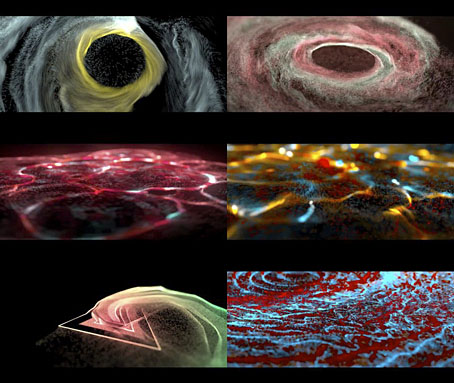
According to the notes for Xiang Pu Zhu’s short demo piece, all the shots here are computer generated. Some are more obvious than others but the combinations of liquid and particles are very impressive. The music is by Esther Garcia.
A journal by artist and designer John Coulthart.
According to the notes for Xiang Pu Zhu’s short demo piece, all the shots here are computer generated. Some are more obvious than others but the combinations of liquid and particles are very impressive. The music is by Esther Garcia.
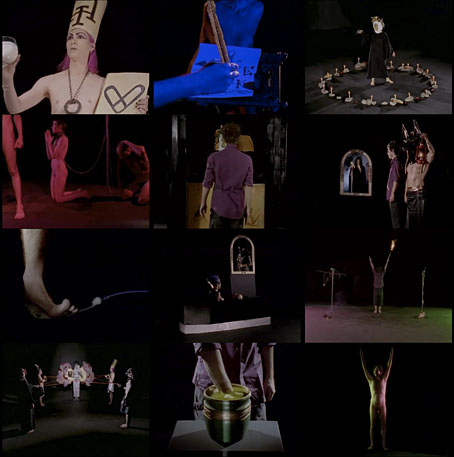
A couple of Austin Spare-related news items arrive in the same week so it’s worth linking again to Earth: Inferno (2003), a short film by Mor Navón & Julián Moguillansky based on the book by Austin Osman Spare. This is a production I have to damn with faint praise by being pleased that Spare is the focus of the work while being disappointed in the film as a whole. Despite the elaborate costumes, careful tableaux and copious nudity, Earth: Inferno confirms that an occult film needs to be more than a record of people dressing up and gesturing hieratically. If nothing else, occult rituals transform the perceptions of those involved, and this quality should be represented or implied in any film dealing with magical operations. The films of Kenneth Anger and Derek Jarman show different approaches, with the raw image transformed by superimposition, exaggerated grain, accelerated/decelerated motion, and so on. Inauguration of the Pleasure Dome and In the Shadow of the Sun are examples to follow. And now the news:
• Lost Envoy: The Tarot Deck of Austin Osman Spare, edited by Jonathan Allen & Mark Pilkington. Out later this year from the fabulous Strange Attractor.
• Surrealism, Austin Osman Spare and the Occult Underground of 1890s and 1990s London:
Nadia Choucha discusses the context and evolution of her ground-breaking book, Surrealism and the Occult, first published in 1991. The book traces the evolution of Surrealist ideas and situates them within the occult currents of fin-de-siècle European culture, revealing how these currents infused the work of various thinkers and artists in their quest for the ‘marvellous’. The work of Austin Osman Spare is also discussed as a way of comparing and contrasting his methods and techniques with those of the Surrealists. With the 25th anniversary of the publication of the book approaching, this evening will also present an analysis of the work as occurring within a unique historical and cultural moment.
Jun 23rd, 6:30 pm–8:00 pm at the Last Tuesday Society, London.
Previously on { feuilleton }
• A Book of Satyrs by Austin Osman Spare
• Spare things
• Dreaming Out of Space: Kenneth Grant on HP Lovecraft
• MMM in IT
• Abrahadabra
• Murmur Become Ceaseless and Myriad
• New Austin Spare grimoires
• Austin Spare absinthe
• Austin Spare’s Behind the Veil
• Austin Osman Spare
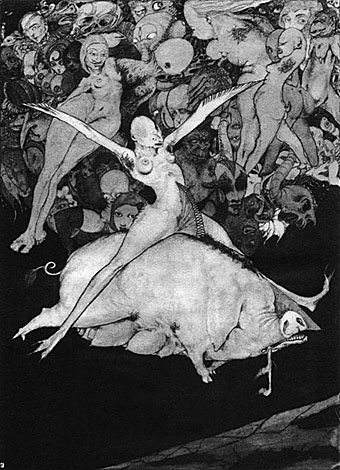
“On to the brocken the witches are flocking.” From Faust (1925) by Harry Clarke.
Spotted earlier this week, a rather blatant swipe from Harry Clarke’s Faust by an unknown cover artist for the Avon Fantasy Reader. Such borrowings weren’t uncommon in the pulp magazines—the pressure of deadlines no doubt encouraged them—and I’ve logged a couple of other examples in the past, here and here. Clarke’s scene shows a crowd of his mutated witches flaunting themselves in a manner that was too strong for a fantasy magazine. The Avon cover is probably illustrating The Day of the Dragon (1934), a novelette by Guy Endore. Everything in this edition was a reprint, and among the contents there’s also The Yellow Sign by Robert Chambers.
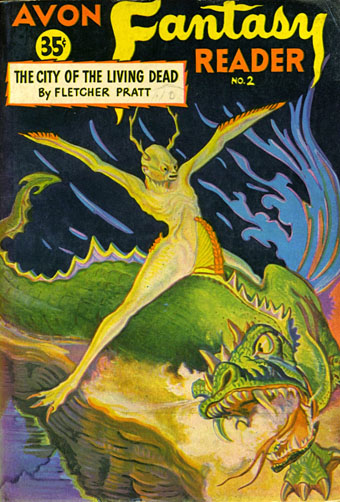
Avon Fantasy Reader, No. 2, 1947.
Previously on { feuilleton }
• Harry Clarke’s Fairy Tales of Charles Perrault
• Harry Clarke in colour
• The Tinderbox
• Harry Clarke and the Elixir of Life
• Cardwell Higgins versus Harry Clarke
• Modern book illustrators, 1914
• Illustrating Poe #3: Harry Clarke
• Strangest Genius: The Stained Glass of Harry Clarke
• Harry Clarke’s stained glass
• Harry Clarke’s The Year’s at the Spring
• The art of Harry Clarke, 1889–1931
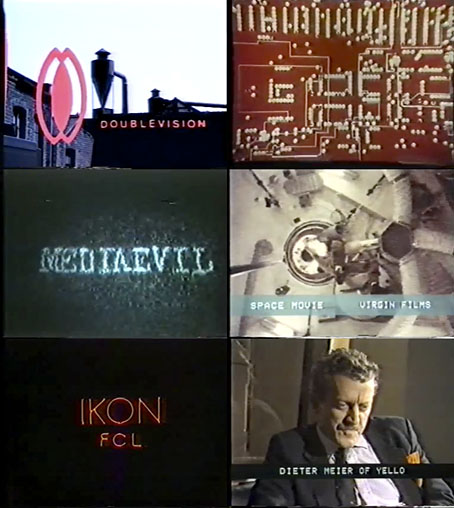
TV Wipeout, as detailed in an earlier post, was a one-off “video magazine” compiled and released on VHS by Cabaret Voltaire in 1984. This was the fourth title on the Cab’s own Doublevision label which was easily the best of the UK’s independent video labels at the time. Many of the other Doublevision releases have either been reissued on DVD or can be found online but TV Wipeout has remained elusive, in part because it contains material that would offend YouTube’s copyright restrictions. Cabaret Voltaire’s deal with Virgin Records enabled them to pad the running time with music promos and trailers for some of the films on Virgin’s own video label.
Back in 2012 I was able to find some of the more popular items but not the obscurities, a situation that’s now resolved by this YouTube playlist which has uploaded the entire cassette as a series of separate items. Most of the previously missing pieces will only be of interest to completists—some of them are scratch-video creations that look very dated today—but if you’re like me, and have waited over 30 years to see this thing in its entirety, it means your curiosity can now be assuaged. A couple of items by Cabaret Voltaire and Japan are still missing but they’re easily found elsewhere.
Update: As noted in the comments, the Japan clip was missing due to an oversight, and is now in place. I’m still getting a message saying the Cabaret Voltaire video is “blocked in your country on copyright grounds” so that must be UK-specific.
Previously on { feuilleton }
• Cabaret Voltaire on La Edad de Oro, 1983
• Doublevision Presents Cabaret Voltaire
• Just the ticket: Cabaret Voltaire
• European Rendezvous by CTI
• TV Wipeout
• Seven Songs by 23 Skidoo
• Elemental 7 by CTI
• The Crackdown by Cabaret Voltaire
• Network 21 TV
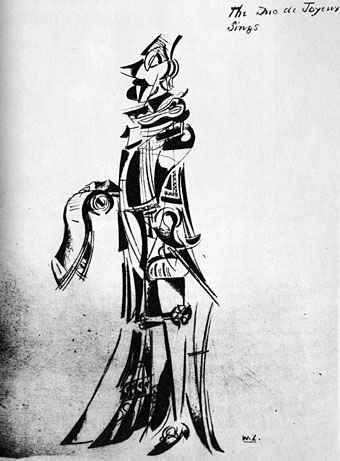
I was writing about the Vorticists last week so for the traditional Bloomsday post here’s a portrait of Joyce by Wyndham Lewis. The Vorticists were supporters of Joyce (he’s praised in the first issue of Blast), and Lewis produced several portrait sketches. This one—The Duc de Joyeux Sings—is the only example I’ve seen in something approaching the Vorticist style. It’s also a little cartoony but then there’s something of the caricature in many of Lewis’s more serious portraits. As usual, the month of June brings the Joyce-related news stories:
• Signed first edition of Ulysses set to make over €100,000
• How Would Ulysses Be Received Today?
• Finnegans Wake is a bestseller in China
• Ulysses and Us by Declan Kiberd
Previously on { feuilleton }
• Dubliners
• Covering Joyce
• James Joyce in Reverbstorm
• Joyce in Time
• Happy Bloomsday
• Passages from James Joyce’s Finnegans Wake
• Books for Bloomsday