The art of Karel de Nerée tot Babberich, 1880–1909

babberich1.jpg

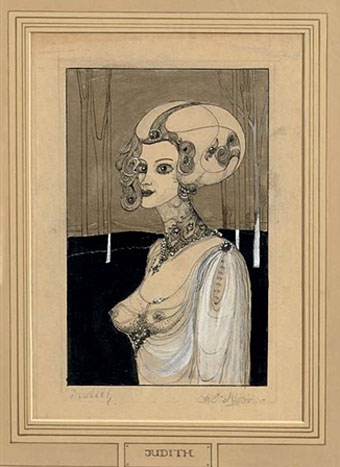
Judith (no date).

Another Decadent type who died young, de Nerée was a Dutch artist and illustrator whose work in these pictures owes a great deal to Aubrey Beardsley. As Beardsley-influenced pieces go they’re rather crude, although it’s unfair to be too judgemental since there’s so little of his work available to see online. Following yesterday’s post, it’s inevitable that he produced a Salomé picture of his own but there’s no sign of that, the curiously space-age (or alien) Judith above is the closest you’ll get.

babberich2.jpg

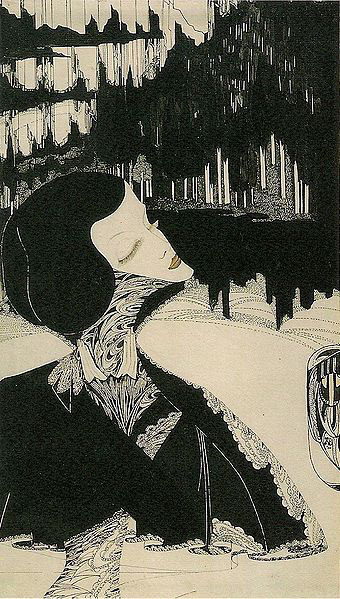
Introduction to Extaze (1900-01).

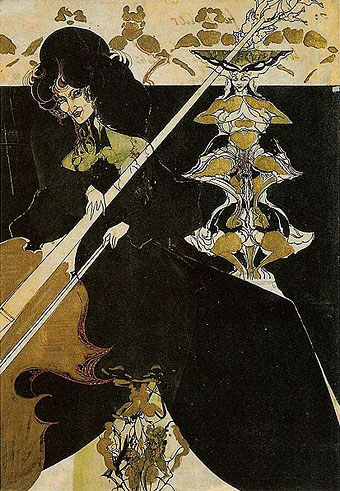
On the strength of these drawings I’d probably have de Nerée down as a post-Beardsley pasticheur similar to Alastair (aka Hans Henning Voigt) but there’s another side to his output evident in his painted works which show a far more assured Symbolist style, with a figurative approach closer to another Dutch artist of the period, Jan Toorop. It’s a shame the photos there are little more than snapshots, I’d like to see more of these. The Wikipedia article has a couple more drawings, and there’s another Beardsley-esque piece here.

babberich3.jpg

La musique (1904).

Elsewhere on { feuilleton }
The illustrator’s archive

Previously on { feuilleton }
More decorated books from the Netherlands

Several Salomés

fowler.jpg

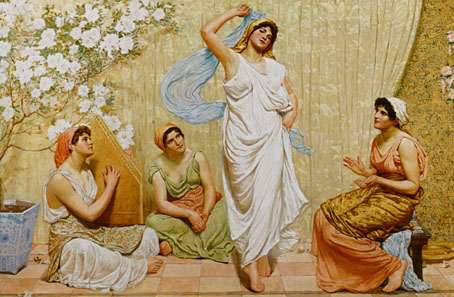
The Dance of Salomé (1885) by Robert Fowler.

There’s always more to find… Unfortunately, Robert Fowler’s academic tableaux is a prime example of bad Victorian art: carefully modelled but overlit, dull and lifeless. And worst of all for the subject at hand: deeply unerotic. We’re supposed to believe that this woman wrapped in a bedsheet would exude enough eros to drive her father to lustful recklessness. This was the bloodless “good taste” against which Oscar Wilde and the Aesthetes set themselves.
moreau.jpg

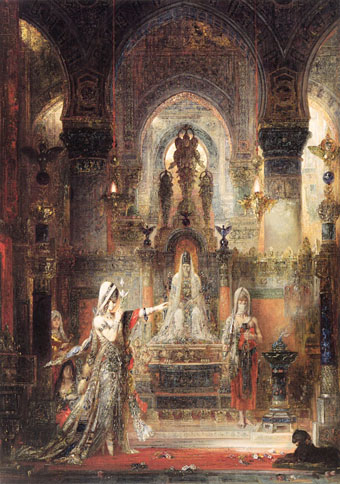
Salomé Dancing before Herod (1876) by Gustave Moreau.

Wilde’s idea of Salomé can be seen here in one of Gustave Moreau‘s many paintings on the theme. Wilde would have preferred Moreau’s paintings, or something similar, to adorn his published play but he ended up with Aubrey Beardsley instead. You only have to compare Beardsley’s Stomach Dance with Fowler’s painting to see why Aubrey’s art made such a dramatic impression in the 1890s.
pell.jpg

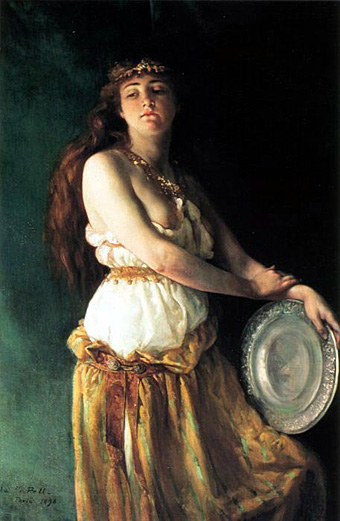
Salomé (1890) by Ella Ferris Pell.

Ella Ferris Pell’s painting isn’t the only portrait of Salomé by a female artist of this period but it’s the one which Bram Dijkstra chose as the cover image for his excellent study Idols of Perversity: Fantasies of Feminine Evil in Fin-de-Siècle Culture (1986). Of this work Dijkstra writes:

In Pell’s painting a number of the most characteristic turn-of-the-century attributes of the biblical temptress are absent. She does not glare at us with a look of crazed sexual hunger; she does not have the wan, vampire features of the serpentine dancer; nor does she show herself to be a tubercular adolescent … Pell’s Salomé, a real life-woman, independent, confident, and assertive, was far more threatening, far more a visual declaration of defiance against the canons of male dominance than any of the celebrated viragoes and vampires created by turn-of-the-century intellectuals could ever have been. Such a woman could not be disposed of in as cavalier a fashion as the evil women in man’s mind. Her indomitable reality was this feminist Salomé’s most formidable weapon, far more dangerous than any imaginary decapitating sword.
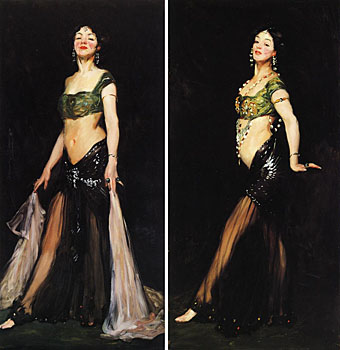
henri.jpg

Salomé (1909), two paintings by Robert Henri.

Finally, there’s this pair of paintings by American artist Robert Henri whose work resembles John Singer Sargent’s in its shadowed backgrounds and light brushstrokes. Salomé was no longer a perennial theme by this point but Maud Allan’s improvised dance performance, Vision of Salomé, was proving enormously popular at the time Henri painted these pictures which may explain his choice of subject. There’s little in the rest of his oeuvre along similar lines.

Elsewhere on { feuilleton }
The Salomé archive

Vintage eye candy

sargent.jpg

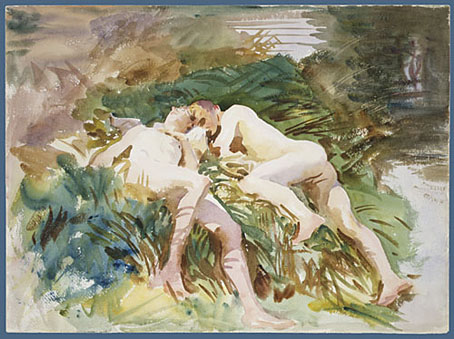
Tommies Bathing by John Singer Sargent (1918).

More discoveries from recent image trawls. There’s been plenty of speculation about the sexuality of John Singer Sargent—see here, for example—and this watercolour depiction of relaxing British soldiers would seem to be another of his works which confirms an enchantment with the male form. Lust aside, it’s a remarkable and typically assured sketch in a difficult medium.

hicok1.jpg

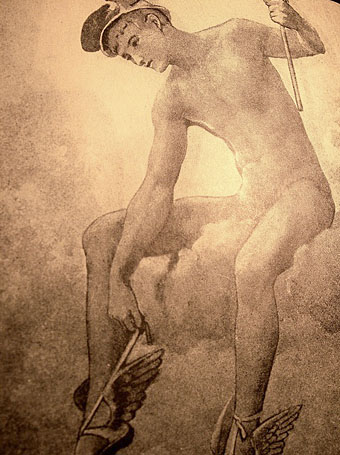
Hermes by Will H. Low (1885).

Will Low’s Greek god is from an illustrated edition of Keats’ Lamia, a PDF of which can be found at the Internet Archive although the compression setting is so severe that the drawings are pretty much ruined throughout. This is how Microsoft and Google are safeguarding the world’s artistic heritage… The copy above comes via another Flickr set.

hicok2.jpg

Also at Archive.org, and far better quality, is another book illustrated by Will Low, In Arcady by Hamilton Wright Mabie, a rather insipid parable in a faux-Classical manner which gave the artist an opportunity to fill the pages with piping fauns and naked youths. It wouldn’t be fair to paint Low as another closet Uranian like Sargent solely on account of this handful of drawings; for now he can remain a further victim of our salacious modern sensibilities.

Elsewhere on { feuilleton }
The illustrators archive

The art of Ignacio Goitia

goitia1.jpg

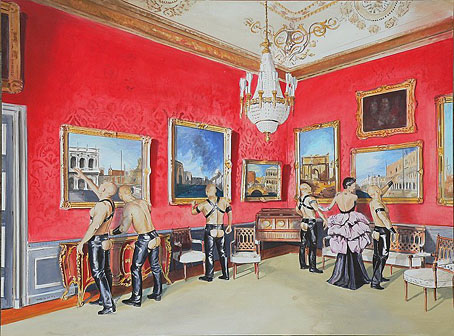
Pasión por Canaletto (2005).

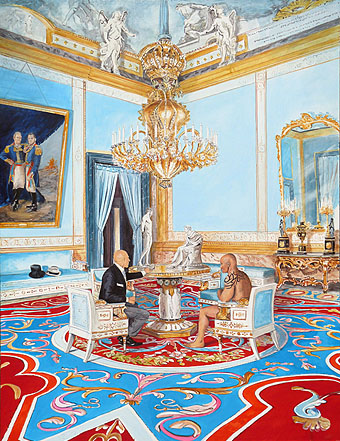
Ignacio Goitia is a Spanish artist whose depictions of opulent aristocracy manage to be subversively homoerotic thanks to the addition of figures we can interpret as boyfriends, sex slaves or wish-fulfilling phantasms; Ludwig II would no doubt approve of the sentiment even if he disagreed with some of the decor. Goitia’s art increases the Surrealist incongruity in other paintings with a preponderance of giraffes, although none of them appear to be burning à la Dalí. You’ll have to browse his galleries to see how he uses them.

Another Thombeau tip—thanks Tom!

goitia2.jpg

Royal couple (2010).

Elsewhere on { feuilleton }
The gay artists archive

Previously on { feuilleton }
Schloss Neuschwanstein

Weekend links 29

dancer.jpg

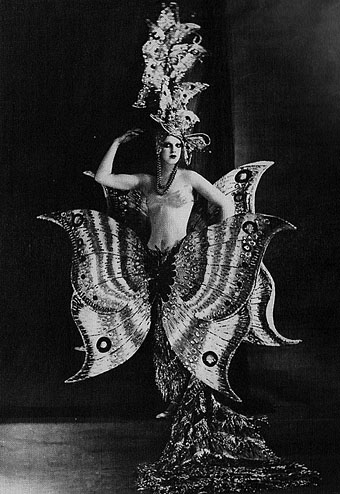
A Folies Bergère dancer, c. 1909.

Six Novels in Woodcuts: The Library of America publishes a boxed set of Lynd Ward’s works: Gods’ Man, Madman’s Drum, Wild Pilgrimage, Prelude to a Million Years, Song Without Words and Vertigo.

• RIP ace graphic designer Raymond Hawkey. Related: Raymond Hawkey: An eye for detail, and Hawkey’s James Bond cover designs from the mid-60s.

The Record: Contemporary Art and Vinyl, an exhibition at Duke University, North Carolina, features work by 41 artists from around the world, from the 1960s to the present, using vinyl records as subject or medium.

decaris.jpg

The Île de la Cité, a steel engraving by Albert Decaris (1950).

Fred Tomaselli will have a new exhibition of his work at the Brooklyn Museum next month.

Socialist Monuments in Bulgaria photographed by Linda Ferrari.

• What would Howard think of the Mythos Art Dildo?

Space is Process, a film about Olafur Eliasson.

Thurston Moore’s Indie Books.

Chris Colfer in a leather bar.

Ephemeral New York.

• Chrome! Helios Creed’s YouTube channel.