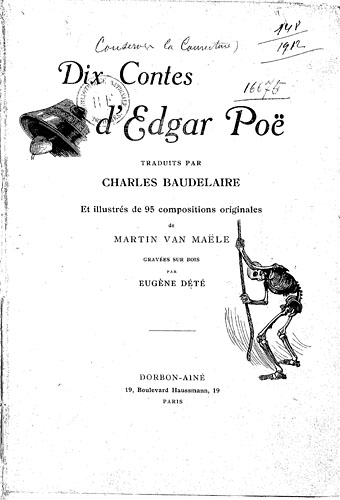
Martin van Maële’s illustrated Poe

poe01.jpg

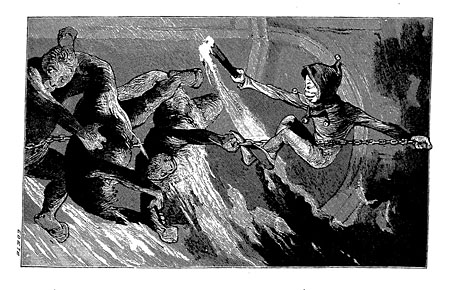
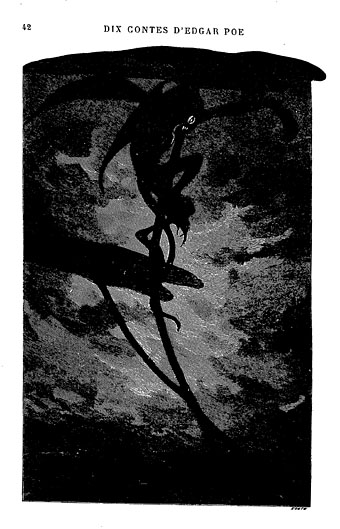
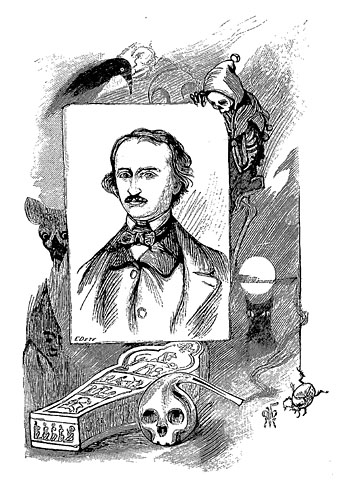
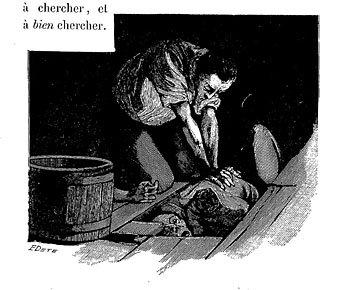
I’ve waited months to write about this book in the run-up to Halloween. Several years ago I wrote a series of pre-Halloween posts about the illustrators of Edgar Allan Poe, with the final entry containing a lone illustration for The Tell-Tale Heart by Martin van Maële (1863–1926). At the time van Maële’s book was unavailable online so I was left to wonder what the rest of his illustrations might be like. Dix contes d’Edgar Poe (1912) is the volume in question, a collection of moody full-page illustrations plus many small vignettes, all of them engraved on wood by Eugène Dété.
poe02.jpg

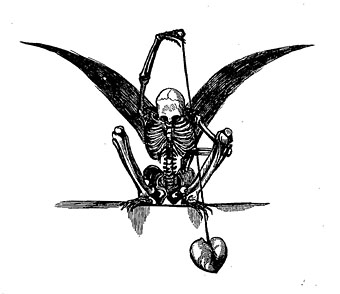
I’d been familiar with several other pieces from this book for many years without knowing their origin thanks to their appearance in the 1986 Penguin Encyclopedia of Horror and the Supernatural, an excellent guide edited by Jack Sullivan with a minor deficiency in that many of the illustrations are uncredited. (They did credit van Maële for two of his pictures but spelled his name as “van Moële” which doesn’t help.) The startling picture of a skeleton pushing a shrouded woman back into her tomb—which I now know is van Maële’s portrait of Madeline Usher—was one of the uncredited drawings, as was the vignette of another skeleton holding a heart like a ticking pendulum (The Tell-Tale Heart again). There are many more skeletons in this book. Van Maële’s illustrations oscillate between two pictorial extremes, from shadow-filled realism in the full-page drawings to Doré-like spot illustrations that suit Poe’s fatalism and macabre sense of humour. It’s a shame that many of these reproductions are darker than they should be, being from the old series of Gallica scans which remove all the grey tones from the images, but at least we can see the book as a whole. My thanks again to Mr TjZ for alerting me to this!
poe03.jpg

The Tell-Tale Heart.

Van Maële might be better known today if more of the books he illustrated had been suitable for a general audience. In a reversal of the usual state of affairs most of his illustrated editions are the classic works of erotic literature by Apuleius, Choderlos de Laclos, Anatole France et al, plus obscure works devoted to le vice Anglais, while his non-erotic titles by Poe and Conan Doyle are in the minority. If he had a flair for the erotic then he also had a flair for the macabre. Some of his erotic drawings manage to combine the two, notably in La Grande Danse Macabre des Vifs (1905), a portfolio which approaches Félicien Rops by bringing to erotic art a quality of imagination that would usually be rejected for distracting from the primary purpose of pornographic imagery. Wikipedia has this and many more of van Maële’s erotic illustrations.
poe04.jpg

The Tell-Tale Heart.

poe05.jpg

Hop-Frog.

poe06.jpg

Silence.

Continue reading “Martin van Maële’s illustrated Poe”

Peculiar Shocks

bodyshocks02.jpg

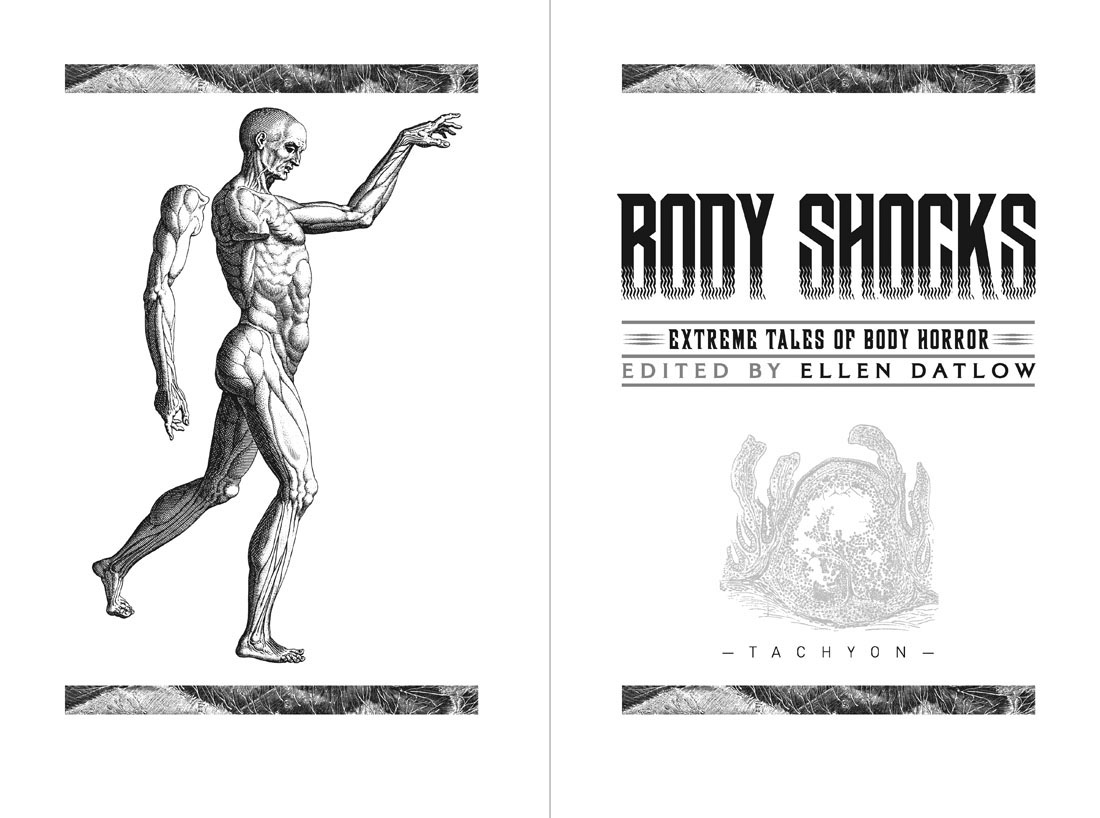
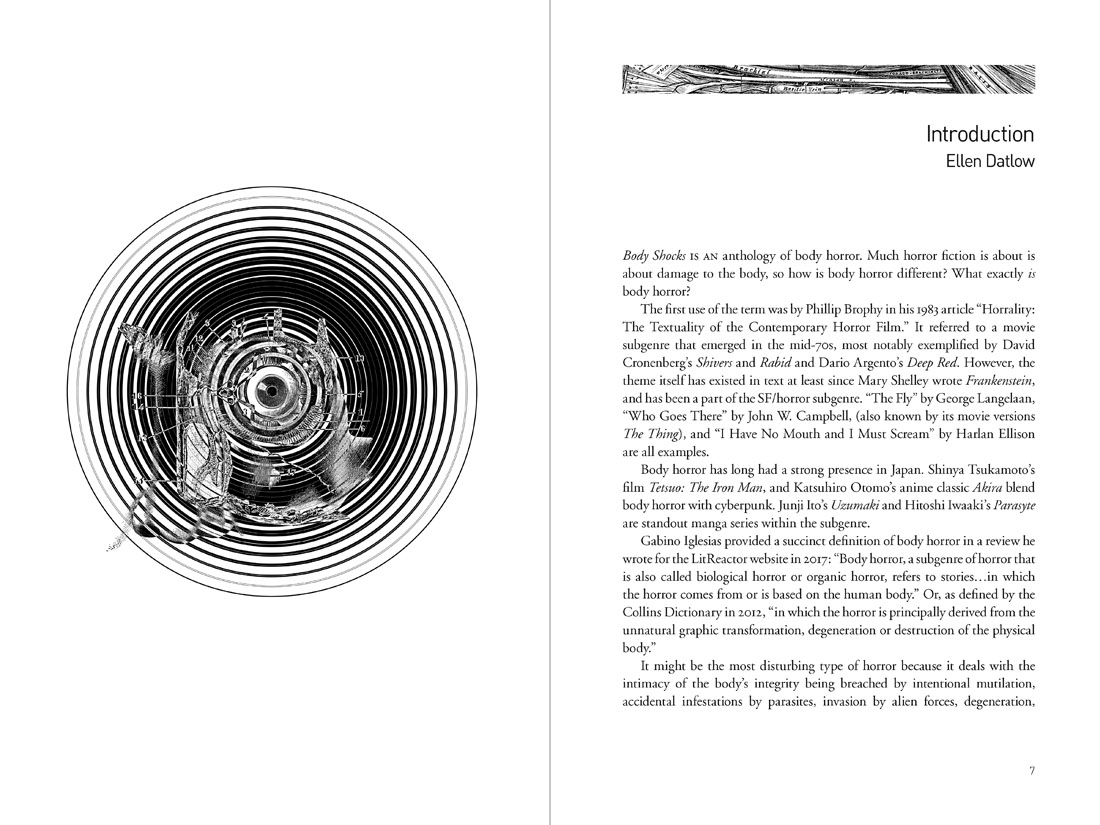
My cover design for Body Shocks, the body-horror story collection edited by Ellen Datlow, appeared here back in March. Now that the book is out from Tachyon I can show some of the interior design. In the earlier post I mentioned cover drafts that featured anatomical illustrations, none of which worked as well as the eyeball collage that became the final cover. The rejected pieces were better suited to the interior which combines engraved illustrations with the kind of sans-serif typography you might find on modern medical labels.

bodyshocks03.jpg

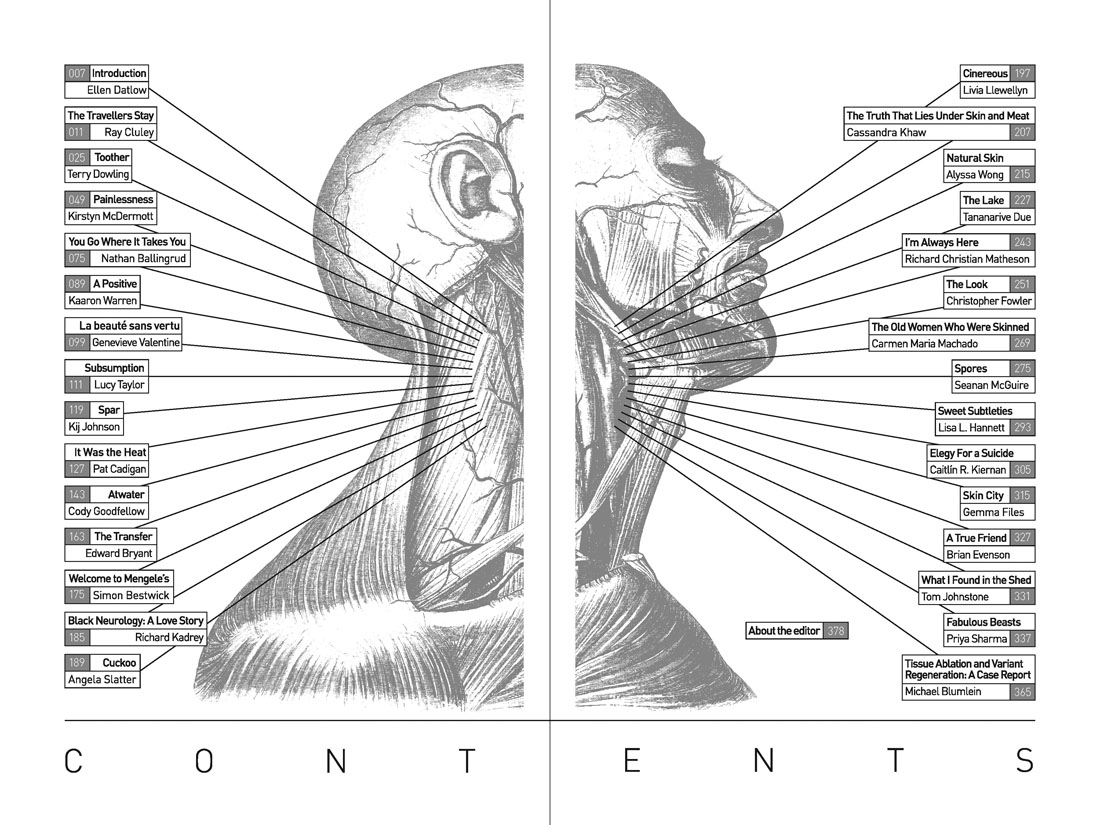
The diagram of veins that fills out the contents spread looks like an illustration from a 19th-century edition of Gray’s Anatomy but it’s actually an illustration from a book about massage whose title I don’t seem to have made a note of. Gray’s is a thorough volume, being a complete guide to the human body, but the illustrations aren’t as large or as detailed as those you can find elsewhere. The header bands used to indicate the beginning of each story are from Gray’s, however, while many of the stories end with full-page plates from The Anatomy of Humane Bodies by William Cowper. These are mostly engravings of autopsies which I processed by inverting the images then overlaying them with parallel lines. You can still tell the pictures are medical illustrations but they’re not as obtrusive as they would be if they’d been left untreated.

bodyshocks04.jpg

Continue reading “Peculiar Shocks”

Weekend links 592

anderson.jpg

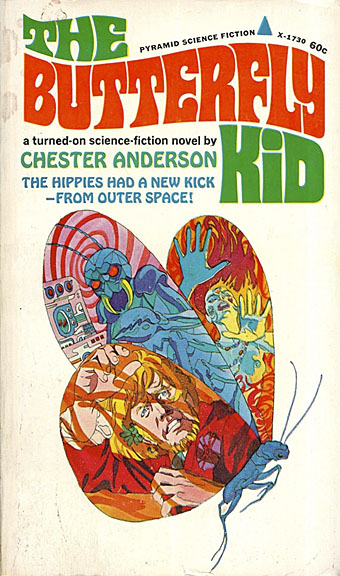
Cover art by Gray Morrow; design by Henry Berkowitz, 1967.

• “Dial-a-Poem received more than a million calls before it lost funding and ended in 1971. There were complaints of indecency, claims that the poems incited violence. The FBI investigated…” Ralf Webb on John Giorno’s Dial-a-Poem project which is still active at the US and UK numbers on this page.

• Mixes of the week: Halloween approaches so for those who require themed mixes you can take your pick from these selections by Kaptain Carbon; at The Wire there’s a Halloween-free mix by Kuunatic.

• New music: New Moon by Laetitia Sadier, and The Reinterpretation Of Dreams (Remixed) by Tomoroh Hidari; not-so-new music: Velocity Of Sleep by Kali Malone.

The activist’s whole identity is tied up in him being denied, as opposed to him manifesting. Nobody can give you your freedom. You ARE free. It is your natural state, okay? You can give it all away if you want, but: no. I can’t GIVE you your rights. I can’t give you your freedom. And to go and beg the Man for your rights and BEG the Man for your freedom? LIVE your freedom.

One of Berg’s phrases was “life actor.” “Theatre of the streets.” All of this as theatre. As opposed to in a different arena you would call politics or activism or so on. But using theatre as a way to open doors that might not be opened if someone was approaching it in other ways. Out of that comes this whole sense of “create the reality you want to live in.” Which is a powerful, profound concept. People are trapped in the paradigm: you can’t even think there is an outside of the box. Just that notion of thinking, and living outside that paradigm, was real powerful stuff.

Claude Hayward of the San Francisco Diggers talking to Jay Babcock for the eighth installment of Jay’s verbal history of the hippie anarchists

Joanna Moorhead on the creation of the Mae West lips sofa, a collaboration between Salvador Dalí and Edward James.

• The latest book from Rixdorf Editions is Papa Hamlet by Arno Holz and Johannes Schlaf.

• At Sweet Jane’s Pop Boutique: Op and Pop | Art Forms in Furnishing (1966).

Denis Bovell’s favourite music.

• At Dennis Cooper’s: Coffins.

Love At Psychedelic Velocity (1966) by The Human Expression | Hamlet (Pow, Pow, Pow) (1982) by The Birthday Party | The Art Of Coffins (2002) by Bohren & Der Club Of Gore

Mask of the Red Death, 1969

masque.jpg

More animation, and more Edgar Allan Poe, although the story is reduced to a minimal trace in this 1969 short from the Zagreb animation studios. I’ve no idea whether the title is a misreading (or mistranslation) of Poe’s or a deliberate play on the masks used in the masque but I’ve gone with the most common labelling. Directors Branko Ranitovic and Pavao Stalter use a paint technique to sketch the stages of a tale that continues to resonate today. Watch it here.

Previously on { feuilleton }
The Pendulum, the Pit and Hope
The Tell-Tale Heart from UPA

The Hangman by Paul Julian and Les Goldman

hangman1.jpg

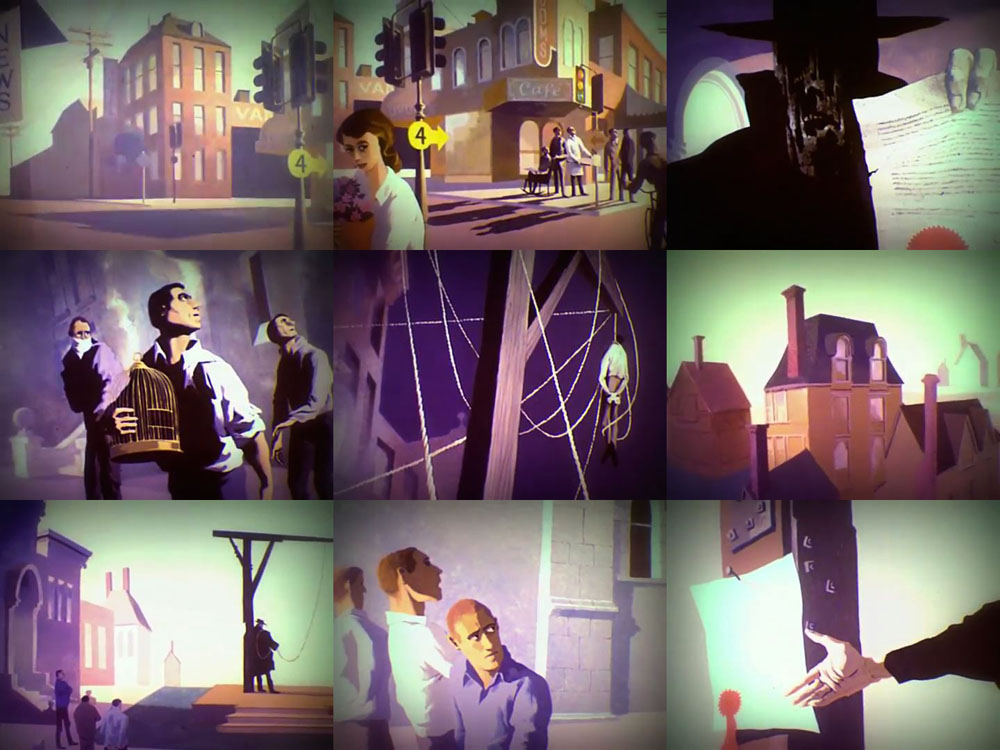
After mentioning Paul Julian in the previous post I went looking for examples of his work. The production design and background paintings that Julian created for the animated adaptation of The Tell-Tale Heart (1953) are perennially celebrated, especially around Halloween, but director Ted Parmelee tends to receive all the credit. The Tell-Tale Heart was a production for UPA but Julian had a long career in animation, especially for Warner Bros., and his voice (if not his name) are universally familiar from the sounds the Road Runner makes in the Wile. E Coyote cartoons. Until this week if I’d thought about this at all I would have assumed that the “hmeep-hmeep” sound (as Julian described it) was created by Mel Blanc, not one of the cartoon’s background artists.

hangman2.jpg

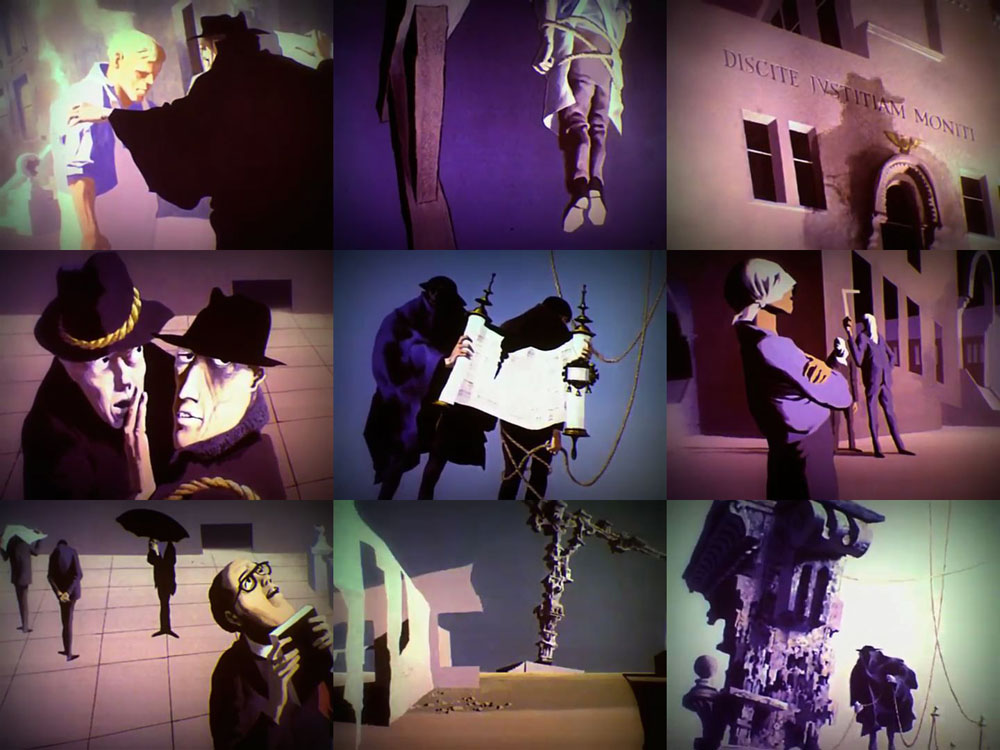
The Hangman (1964) is an 11-minute animation that, like The Tell-Tale Heart, is a long way from Looney Tunes and Merrie Melodies. Herschel Bernardi reads a poem by Maurice Ogden that describes a hangman who arrives in a small town and begins executing the citizens one after the other. No-one is spared, even those who support the actions of the hangman when his first victims are Jewish, Black, an unspecified “alien” and a man who openly questions the executions. The poem was written during the McCarthy era but is the kind of moral fable whose sentiments can be applied to any time, even if the design makes the context a specifically American one. Paul Julian painted the backgrounds and co-directed with Les Goldman, while Julian’s wife, Margaret, provided the minimal animation. The jazzy score—which doesn’t really suit the theme—was the work of Serge Hovey. Julian’s townscapes start out as Edward Hopper-like scenes of tall houses, old storefronts and wide roads striped with sunset shadows. In the second half of the film a Surrealist quality takes over. The gallows pole slowly consumes the town as well as its people, dismantling the buildings in order to grow into a towering edifice. The characterisations and the scene transitions make it plain how much of The Tell-Tale Heart was Julian’s work, while the film as a whole reminds me of one of Ray Bradbury’s morality tales. Watch it here.

Previously on { feuilleton }
The Tell-Tale Heart from UPA