Weekend links 607

cadmus.jpg

Jerry (1931) by Paul Cadmus.

• “I wanted to photograph naked young men as opulently and as attentively as those professional ladies appearing in Playboy-type magazines.” RIP James Bidgood, photographer and director of no-budget gay-porn classic Pink Narcissus. Also in the obituary notices this week: Monica Vitti and John Appleton, composer of electronic music and inventor of the Synclavier sampling keyboard.

• “…the Sola Busca deck is limited in its use for divinatory purposes today, and yet, since its enigmatic imagery irresistibly invites decoding, the deck nonetheless beckons twenty-first century cartomancers into a game of high imagination.” Kevin Dann on the mysteries of the world’s oldest complete Tarot deck.

• “This Missouri company still makes cassette tapes, and they are flying off the factory floor.” Jennifer Billock reports.

He attended to his own talent, not in the interest of bombast or self-aggrandisement, but rather like a faithful watchman. He had the fixity of the great and therefore no need of vanity. He estimated that three shillings would be a reasonable price for Ulysses. A tiresome book, he admitted. At the same time he was dogged by fear that the printing house would be burnt down or that some untoward catastrophe would happen. He assisted Miss Beach in wrapping the copies, he autographed the deluxe editions, he wrote to influential people, he hawked packages to the post office. He knew that the illustrati would change their minds many a time before settling down to a final opinion and that many another would know as much about it as the parliamentary side of his arse.

Edna O’Brien on James Joyce

• At Wormwoodiana: Mark Valentine on The Secret Glory by Arthur Machen, another novel now in its centenary year.

• At Aquarium Drunkard: It Is Not My Music, (1978) an hour-long Swedish TV documentary about Don Cherry.

• At Bandcamp: The transportive psychedelia of Moon Glyph records.

• Mix of the week: Fact Mix 844 by A Psychic Yes.

• Steven Heller’s font of the month is Show.

• At Dennis Cooper’s: Guitar.

Mumblin’ Guitar (1960) by Bo Diddley | Electric Guitar (1979) by Talking Heads | Impossible Guitar (1982) by Phil Manzanera


Quay Brothers record covers

quays01.jpg

Institute Benjamenta (1998) by Lech Jankowski.

Continuing an occasional series about artists or designers whose work has appeared on record sleeves. Regular readers won’t be surprised to hear that I’ve had this one in mind for some time but it’s taken a while to put together. The main problem has been the Quay Brothers’ habit of using a variety of different names when they were working as designers; variations include “Stefen” rather than Stephen Quay, the Brothers Quai, Gebr. Quay, Jumeaux Quay, The Quays, Atelier Koninck (or Koninck Atelier), and so on. The catalogue compilers at Discogs do a good job of keeping up with the alternate names of groups or musical artists but stumble over those used by anyone else associated with an album’s production. Consequently, this collection of covers shouldn’t be taken as complete or final. Some of the discoveries would have been impossible without the checklist of Quays ephemera that accompanied the MoMA exhibition in 2012.

quays02.jpg

Blood, Sweat & Tears (1968) by Blood, Sweat & Tears.

This must be one of the earliest of the Quays’ commercial works. As with other covers from the first decade of their career, the credit is for illustration alone, graphic design came later.

quays03.jpg

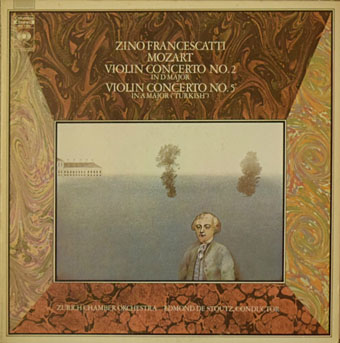
Mozart: Violin Concerto No. 2 In D Major, Violin Concerto No. 5 In A Major (“Turkish”) (197?); Zurich Chamber Orchestra, Zino Francescatti, Edmond De Stoutz.

quays04.jpg

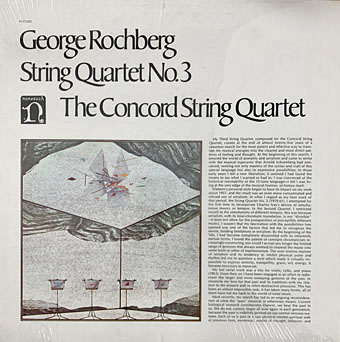
George Rochberg: String Quartet No. 3 (1973); The Concord String Quartet.

quays05.jpg

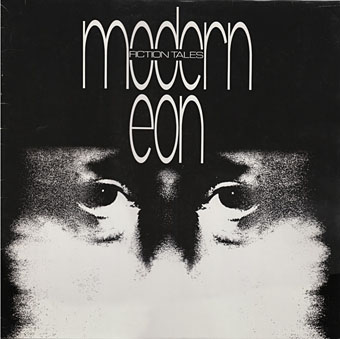
Fiction Tales (1981) by Modern Eon.

Continue reading “Quay Brothers record covers”

Fantaisies Florales

pilters01.jpg

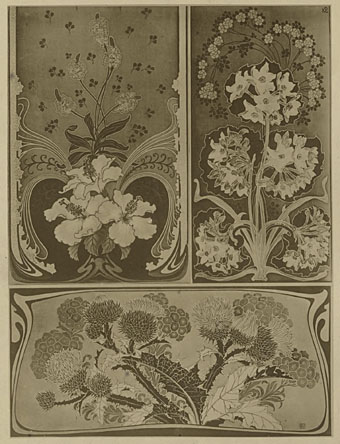
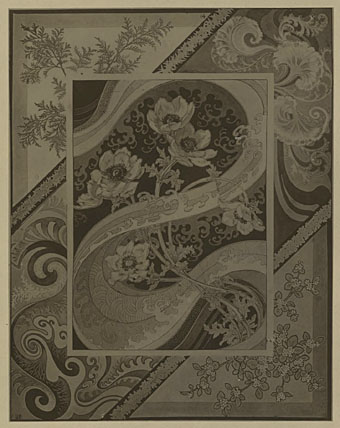
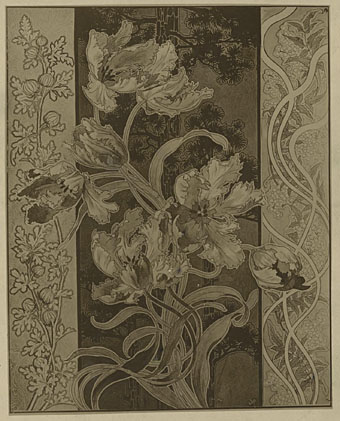
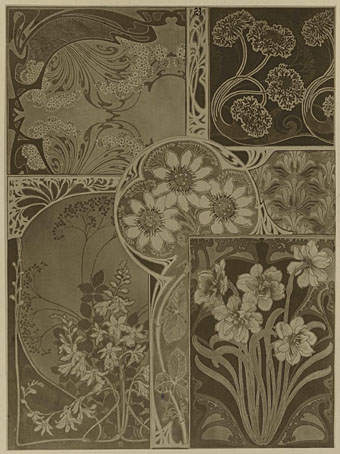
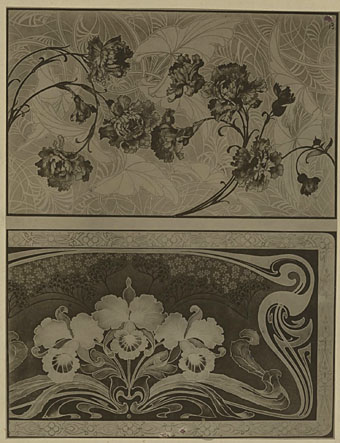
Plants and flowers are a common feature of Art Nouveau sourcebooks; Alphonse Mucha, Eugène Grasset and Maurice Verneuil all produced books for designers filled with floral patterns and motifs which generally remain faithful to their models. The designs in Fantaisies Florales by Jean Pilters are less concerned with fidelity to nature, especially in the background decorations whose swirling elaborations look like precursors of the psychedelic art that would help revive popular interest in Art Nouveau decades later. Pilters’ designs were published as a series of loose-leafed portfolios which in these copies have lost their covers, hence the gummed labels which spoil two of the plates.

pilters02.jpg

So who was Jean Pilters? Information is scarce, unfortunately, beyond descriptions of the artist as a French designer. The plates, which possibly date from 1910 (nobody is sure about the year of publication either), look like copies of colour originals but if an earlier colour edition exists I’ve yet to find any examples. Monochrome and tanned with age they may be but there’s enough here for me to work with. I may be borrowing some of these details in the near future.

pilters03.jpg

pilters04.jpg

pilters05.jpg

Continue reading “Fantaisies Florales”

Weekend links 606

smith.jpg

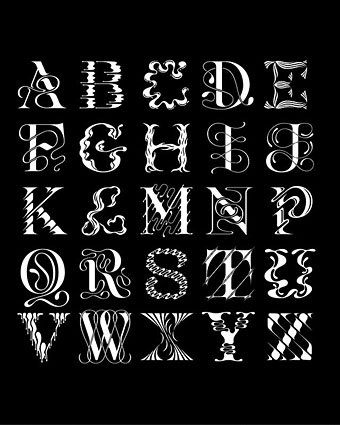
An alphabet by Tina Smith.

• Coming in March from Warp records: reissues of three Broadcast releases that were previously only available in limited quantities, Microtronics, Volumes 1 & 2, and Mother Is The Milky Way. The latter is an EP which makes a perfect companion to Witch Cults Of The Radio Age, and while its reissue means I’ll no longer be able to brag about owning one of the rare originals it really ought to have been more widely available. In addition, Warp will be releasing the group’s first live album, BBC Maida Vale Sessions, a collection of performances for radio. All these releases are packaged in new cover designs by Julian House.

• “Nature Boy was the conduit through which vegetarian ideals, nonconformism and notions of living in harmony with nature began to filter into US culture.” Jon Savage on the exotic world of Eden Ahbez.

• At Dennis Cooper’s: Two booklets of Austin Osman Spare: Earth: Inferno (1905), The Book of Pleasure (Self-Love) (1913).

Joyce refused to fix the meaning of the words on the page and left the reader to fend for themselves. So the content may not be actually shocking, but the book feels exciting—as though it might turn shocking any second. Anything might stir in the body or consciousness of a character, in the body or consciousness of the reader. My mother was right to consider it a dangerous text. The thing the censors worried about were the uncensored workings of their own minds.

More than any other book, Ulysses is about what happens in the reader’s head. The style obliges us to choose a meaning, it is designed to make us feel uncertain. This makes it a profoundly democratic work. Ulysses is a living, shifting, deeply humane text that is also very funny. It makes the world bigger.

Anne Enright on Ulysses at 100

• At Aquarium Drunkard: occult scholar Mitch Horowitz on the Transmissions podcast.

• 5th Dimension: DJ Food examines a piece of psychedelic Op-art by Michael English.

• New music: Möbius by Jonathan Fitoussi/Clemens Hourrière.

• At Spoon & Tamago: Hiraku Suzuki’s Constellations.

• The month in type at I Love Typography.

Wyrd Daze Six Star.

Nature Boy (1975) by Big Star | Nature Boy (1980) by Manu Dibango | Nature Boy (1999) by Jon Hassell

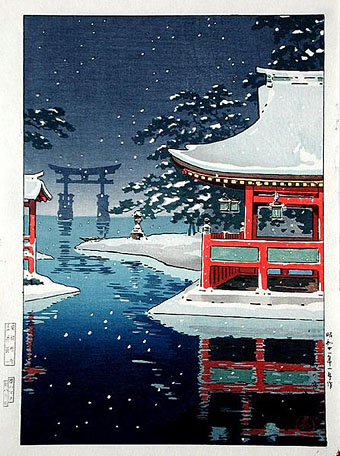
Ten views of the Itsukushima Shrine

itsukushima07.jpg

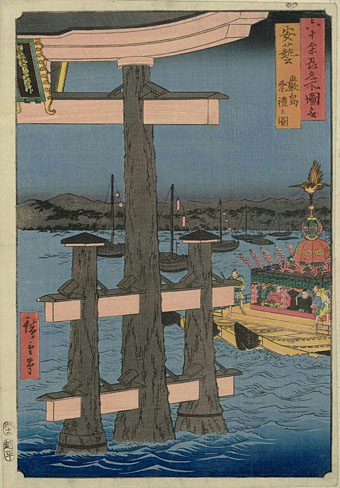
Aki Province: Itsukushima, Depiction of a Festival, from the series Famous Places in the Sixty-odd Provinces (1853) by Utagawa Hiroshige.

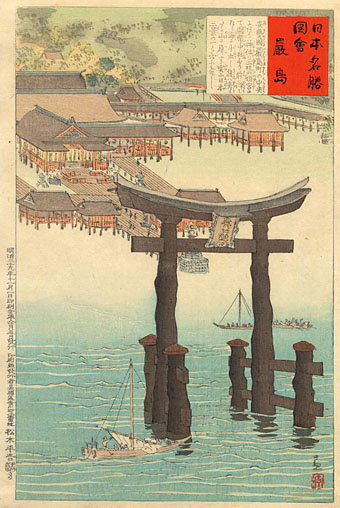
The most recognizable and celebrated feature of the Itsukushima shrine, is its fifty-foot tall vermilion otorii gate (“great gate”), built of decay-resistant camphor wood. The placement of an additional leg in front of and behind each main pillar identifies the torii as reflecting the style of Ryobu Shinto (dual Shinto), a medieval school of esoteric Japanese Buddhism associated with the Shingon Sect. The torii appears to be floating only at high tide. When the tide is low, it is approachable by foot from the island. Gathering shellfish near the gate is also popular at low tide. At night, powerful lights on the shore illuminate the torii. Although the gate has been in place since 1168, the current gate dates back only to 1875. [more]

itsukushima06.jpg

Torii at Itsukushima (1896) by Kobayashi Kiyochika.

itsukushima08.jpg

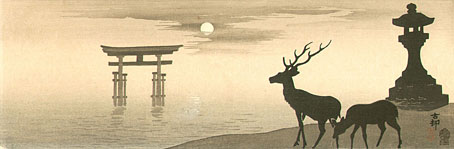
Deer and Torii (1910) by Shoson Ohara.

itsukushima01.jpg

Miyajima in Snow (1934) by Tsuchiya Koitsu.

itsukushima02.jpg

Snowy Miyajima (1936) by Tsuchiya Koitsu.

Continue reading “Ten views of the Itsukushima Shrine”