The art of Gérard Trignac

trignac1.jpg

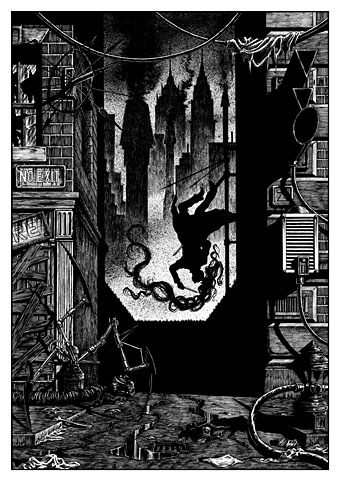
Gérard Trignac produces etchings of a kind I’d most likely be doing myself if I wasn’t otherwise occupied, detailed architectural fantasies that owe a lot to my sainted Piranesi and (I’m guessing, since they’re both French) Charles Méryon. As usual with contemporary artists of this nature one can find the pictures but information about the artist is harder to come by. A web search reveals this:

Gérard Trignac was born in 1955, and initially trained to become an architect—training which is evident in his imagined cityscapes. Each of his prints begins with a detailed sketch, which is then fully developed on the copper plate. Each print can take months to complete. Besides individual prints, Trignac has often turned his talents to series of prints used to illustrate classic texts by authors such as Calvino, Borges, and others. His work is in the collection of numerous museums and public collections in Europe and the United States.

trignac2.jpg

The wonderful (French-only) Egone.net has an artist’s quarter with two Trignac portfolios (scroll to the bottom of the page—and look at some of the other work while you’re there). Work by Gérard’s sister, Colette, is also featured. Other print collections can be found here, here and here.

Elsewhere on { feuilleton }
The etching and engraving archive

New things for August

kabbalah.jpg

A couple of updates to the site this month. Firstly there’s another interview with Eroom Nala focussing on life, art and (inevitably) my forthcoming Haunter of the Dark book.

And I’ve finally got round to expanding the line of CafePress products (T-shirts and a larger poster print) for my Kabbalah poster which seems to be my most popular work judging by sales there. This surprises me seeing as it was done on a whim in 2000 after a visit to London. Alan Moore later used it in an issue of Promethea but I don’t know whether the people interested in it are Promethea fans or some of the new breed of Kabbalists.

I’ll be adding more products for other lines, and some new things, as time permits over the next few weeks.

Update: CafePress have decided that my artwork may need “copyright clearance”. So don’t bother trying to buy anything just yet.

Update 2: CafePress tell me that “Transport for London provided us with a notice stating that the use of the London Underground Roundel infringes upon their intellectual property rights”. I presume this means now I’ll have to amend the artwork to remove the offending article. Copyright hell: it’s the wave of the future. Get used to it. See this Boing Boing post for a good example of London Transport’s dead hand.

Update 3: Products reworked with slightly amended artwork although for some reason the page is still showing the old items.

Helvetica: the film

helvetica.jpg

Yes, a documentary about a typeface by Gary Hustwit. And why not, say I? More films about typography, please. I paid homage to the ubiquitous Swiss font with my design for Savoy’s A Serious Life which used Helvetica Neue in various weights throughout.

Helvetica is a feature-length independent film about typography, graphic design and global visual culture. It looks at the proliferation of one typeface (which will celebrate its 50th birthday in 2007) as part of a larger conversation about the way type affects our lives. The film is an exploration of urban spaces in major cities and the type that inhabits them, and a fluid discussion with renowned designers about the choices and aesthetics behind their use of type.

Helvetica encompasses the worlds of design, advertising, psychology, and communication, and invites us to take a second look at the thousands of words we see every day.

The film was shot in high-definition on location in the United States, England, the Netherlands, Germany, Switzerland, France and Belgium. It is currently in post-production and is slated to begin screening at film festivals worldwide starting in early 2007.

Interviewees in Helvetica include some of the most illustrious and innovative names in the design world, including Erik Spiekermann, Matthew Carter, Massimo Vignelli, Michael Bierut, Wim Crouwel, Hermann Zapf, Stefan Sagmeister, Jonathan Hoefler, Tobias Frere-Jones, Experimental Jetset, and many more.

Via Typographica.

A few thousand science fiction covers

sf_covers.jpg

Seems that this has been around for a while but I’ve only just run across it. Jim Bumgardner has created a browsable “table-top” of thousands of sf magazine covers using minimal Flash and Perl scripting; unlike many Flash-oriented web toys you don’t have to waste valuable minutes watching a progress bar before it starts working. Rest your mouse anywhere on the picture and a cover lifts itself from the mass; double-click that cover and it grows larger. He also has a similar page for covers of Mad magazine and 1001 graphic novels and comics. And an explanation of how it all works.

Previously on { feuilleton }
The book covers archive

The music of Igor Wakhévitch

igor1.jpg

Igor Wakhévitch and feathered friend.

Continuing the Francophile theme, I felt that now was a good time to plumb the mysteries of the enigmatic Igor Wakhévitch. Who? Well… In 20th century music there’s strange and there’s weird and then there’s off-the-wall unclassifiable which is the place where we have to file Igor’s compositions. After half a lifetime spent trawling record shops for unusual music these albums had somehow managed to remain off the radar until a CD reissue set, Donc…, appeared courtesy of Fractal Records and a friend with similarly outré tastes (hi Gav!). The obscurity of these remarkable recordings can’t solely be due to Monsieur Wakhévitch being French; Richard Pinhas, Bernard Szajner and (of course) Magma, have been given enough attention over the years.

So what does this stuff sound like? Thankfully the redoubtable Alan Freeman tackled the problem of describing the albums in Audion (reproduced below), a task I would have found rather daunting. Docteur Faust is probably my favourite, a crazily eclectic and doomy album which lurches from rock freakout to contemporary orchestral/choral to electro-acoustics and back again. Imagine the witch cult from Rosemary’s Baby jamming with Alpha Centauri-era Tangerine Dream while Peter Maxwell Davies and Amon Düül 2 slug it out in the background. The clincher is a great cover by French comic artist Philippe Druillet.

One other notable album that the Donc… collection omits is the 1974 recording of Salvador Dalí’s opera, Être Dieu. Dalí wrote the libretto in 1927 with Federico Garcia Lorca but the piece wasn’t recorded until Wakhévitch provided a score. The result is pretty much the same as Wakhévitch’s other work, with the added bonus of the Surrealist master declaiming and frequently shrieking over the music.

For more information about Donc… and Igor Wakhévitch see the Fractal Records review page.

Continue reading “The music of Igor Wakhévitch”