Ten

maruyama.jpg

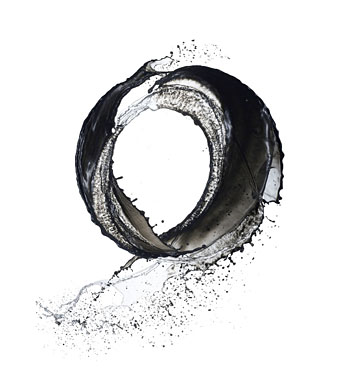
From the Kusho series by Shinichi Maruyama.

It was February 13th, 2006, when I sat down and wrote some words from Charles Fort—”One measures a circle, beginning anywhere”—as a title of the first post here. Ten years on, and the circle has turned ten times, or once if you’re measuring in decades. This time last year I made the decision that when I reached the tenth anniversary I was going to reduce the activity a little. Writing a blog post on a different subject every single day of the week requires discipline even if it’s your main line of work. This has never been my main line of work, but I’ve nonetheless managed to rack up 4,035 posts while juggling design and illustration work, and while (somehow) writing an as-yet-unpublished 217,000-word novel. When the workload has been heavy it’s been a chore having to write another daily post yet the improvisational nature of the thing has always been fun. Writing something new every day puts you on the spot; it forces you to get your thoughts in order (or scale them back), and it also hones your writing skills. I don’t know what I expected of this blog in 2006 but I’m fairly sure I didn’t expect to be writing it daily for ten years. And yet here we are.

So with that said, I’m going to discontinue the daily posting for the time being although the weekend post will follow tomorrow as usual. One thing that’s become apparent is that the first five years were easier than the second five because I seemed to have more time on my hands. The increased visibility of my work in recent years has meant that I’ve been more in demand, and I’ve been subject to increasing periods of all work and no play. When that happens, something has to give, and not having to write something here every single day will give me an hour (or more) free time each day. There will still be posts, of course: this forum is too useful to abandon, and on the work level alone I have some high-profile projects due out this year. I’d also like to be able to write longer posts from time to time. One hazard of the daily post is that longer pieces have to be written over several days while still writing a daily post as well.

My thanks, as always, to regular readers and commenters. Don’t be alarmed by a few days’ silence. Things will continue but at a slower pace.

John x
Foreign appearances

steam1.jpg

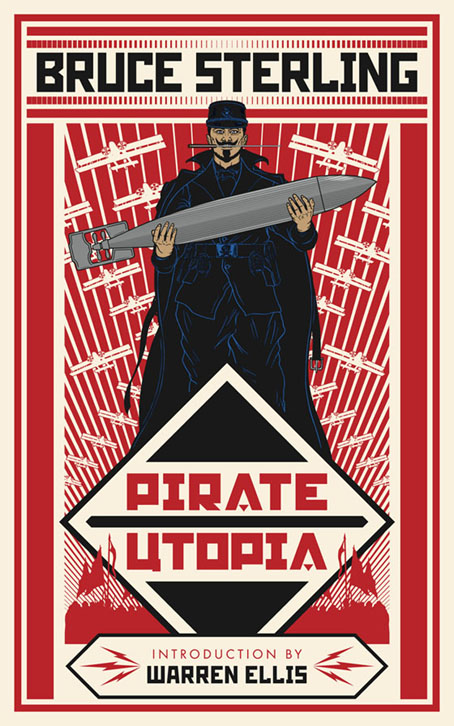
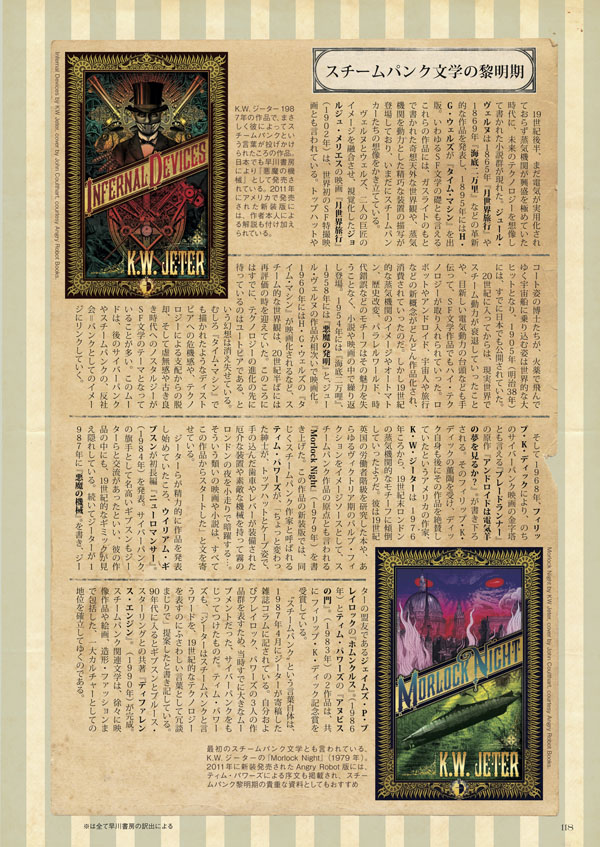
My work has appeared in a couple of foreign collections recently, each approaching popular culture from very different directions. The volume above is called Steampunk Japan Fashion Book according to a German bookseller although the title may read differently to Japanese speakers. This was published at the end of last year, and features my ever-popular covers for the Angry Robot editions of two steampunk novels by KW Jeter, Infernal Devices and Morlock Night. The book is the work of a collective who call themselves The Japanese Steampunkers.

steam2.jpg

popculture1.jpg

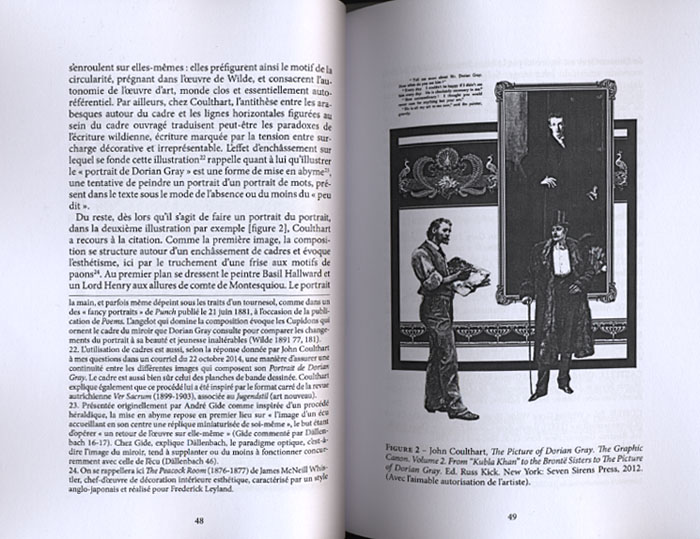
Meanwhile in France, Imaginaires #19: Les cultures populaires aujourd’hui is a collection of academic pieces about popular culture published by ÉPURE, Éditions et Presses universitaires de Reims. Inside there’s an essay by Xavier Giudicelli (University of Reims Chamapgne-Ardenne), The Picture of Dorian Gray et la culture populaire: du texte à la bande dessinée, which compares Wilde’s novel to various graphic adaptations. Xavier wrote to me some time ago about my Dorian Gray adaptation for the Russ Kick-edited Graphic Canon (2012) so the piece includes some of my remarks about my interpretation together with two of the pages.

popculture2.jpg

Previously on { feuilleton }
Picturing Dorian Gray

Weekend links 291

brooks.jpg

Femme avec des fleurs (1912) by Romaine Brooks.

• This week’s anniversary of the Charlie Hebdo murders was noted by some of those who defended the magazine last year. “I don’t write about Charlie Hebdo in France,” said Robert McLiam Wilson, “they have plenty of people who can do that. But I’ll do almost anything I’m asked to do in the anglosphere. Why? Well, two reasons. Because none of the other Charlie people bothers to do it. And because, really, that’s where all the bullshit lives.” A year on, and the bullshit-mongers seem to have fallen silent, what with knee-jerk outrage being a short-lived affair, and the Bataclan massacre having demolished one of the main criticisms, namely that the magazine wouldn’t have been attacked if the artists and writers had shown some respect. “[Charlie Hebdo‘s] real crime is not racism but its challenge to what has become an unbreakable commandment for many contemporary liberals: ‘Thou shalt not cause offence’,” says Kenan Malik. At Literary Hub Adam Gopnik explored the same issue in a foreword for Stéphane Charbonnier’s Open Letter.

• “Immersion in the past is no escape from the present, but it supplies a constant corrective to the narrative spit out daily by media, advertising, politics, and all those other forces that attempt to mould our thinking like jelly in a pan.” Luc Sante (again) talking to Simone Wolff about his books, Low Life and The Other Paris.

• “…throwing a lot of money behind vintage equipment? Well, that’s just a millionaire’s game. Dave Grohl can do that, but David Bowie doesn’t care about that. Just stick a microphone in front of him and he’s really happy.” Tony Visconti talking to Allyson McCabe about the music business and producing Bowie.

• “Nico Hogg’s photography captures the transformation of urban London,” says George Kafka who talks to Nico about a collection of his work, Sign & Signifiers, which I designed late last year.

• At Strange Flowers: James Conway talks to Cassandra Langer about her recent biography of artist Romaine Brooks (1874–1970).

• At Dangerous Minds: Godzilla, girls and guns, the science-fiction art of Noriyoshi Ohrai. There’s more at Pinterest.

• Mixes of the week: XLR8R Podcast 420 by Andrey Pushkarev, and Secret Thirteen Mix 172 by Julien Bayle.

• Alan Moore’s magnum opus, Jerusalem, will be published later this year. Gosh Comics has a teaser.

New York Public Library makes 180,000 high-res images available online.

Prints of darkness: macabre vintage posters

Scarfolk Television is coming

Godzilla (1977) by Blue Öyster Cult | Giant Robot / Machines in the Modern City / Godzilla (1992) by Praxis | Free-Bass (Godzillatron Cush) (1995) by Axiom Funk

All About Being Loud

lemmy.jpg

Photo by Motorcycle Irene.

It was very loud. The crowd roared and some yelled “It’s not loud enough!” Lemmy said “Oh” and turned his amp up more, before they went into Keep Us On The Road which was very loud until Lemmy’s amp gave up its internal struggle and was replaced on the run while Eddie (Clarke, the guitarist) played the riff over and over. At the end of the number earlier complaints bellowed “Turn it up, it’s not loud enough!” to which Lemmy rejoined—”I can’t get it no damn louder, shut your trap”. Never the less, the new amp was miked up thru the P.A., so Lost Johnny was very, very loud and The Watcher was louder still. At the end of it Lemmy apologized for being so quiet and said the band were as disappointed as everyone else about not being louder. Then they played Iron Horse, which was as loud as a Tube train running through your inner ear or as loud as the First World War if they crammed the whole thing together and held it in a phone booth.

Paul Sutcliffe, gig review, Sounds

Paul Sutcliffe’s quote is on the back page of a Motörhead tour programme from 1978, a publication that’s also the source of the moody signed portrait above. Despite hanging around with metal-heads and bikers in my idle youth I never got to see Motörhead live, the tour programme—signed by all three band members, and aptly titled All About Being Loud—was a gift from a friend. Years ago I scanned the whole thing and turned it into a PDF to send to another friend so I’ve uploaded it here. Most tour programmes are rather pedestrian affairs but the Motörhead one shows the band’s sense of humour, being a collection of quotes testifying to the loudness of their shows with the page backgrounds filled out by ads for hearing aids. The Q&A notes for each band member are also revealing for mentioning three songs from the psychedelic 60s. Lemmy always spoke of his fondness for classic rock’n’roll (Motörhead covered Louie Louie in their early days) but it’s a surprise seeing him list Sour Milk Sea by Jackie Lomax as his favourite single. His album choice—Back In The USA by The MC5—is more the kind of thing you’d expect. Eddie Clarke’s favourite single is Purple Haze, while the late Phil Taylor has Itchycoo Park by The Small Faces listed with Anarchy In The UK.

motorhead.jpg

Art by Joe Petagno.

So I never got to see Motörhead play but in 1984 I did provide the cover art for Hawkwind’s Night Of The Hawks EP, a 12-inch single that featured Lemmy as guest bassist and vocalist on his first recording with the group after being sacked following a drug bust in 1975. I may no longer like the artwork but the EP was also dedicated to Barney Bubbles so it was a good thing to be involved with. As for Lemmy, everyone will be (and is) linking to Ace Of Spades but I’d offer Capricorn from the Overkill album as a memorial number. I always liked Jimmy Miller’s reverberant production, and the lyrics make it a musical self-portrait.

Weekend links 289

hermes.jpg

Fathomless Sounding (1932) by Gertrude Hermes.

• Over at Greydogtales (“weird fiction, weird art and even weirder lurchers”) I talk about art, design, the writing of this blog, and I also reveal more about my ongoing Axiom project. The latter currently stands at two novels, a couple of half-finished stories and a few pieces of artwork. I may be unveiling some of the art in the new year so watch this space.

• Howard Brookner’s Burroughs: The Movie (1983), a definitive film portrait of William Burroughs, is released at last on DVD/Blu-ray. US-only for the moment but further releases elsewhere are promised. The director’s nephew, Aaron Brookner, has a documentary about his uncle released next year.

• “…beautifully articulated bawdiness, perverse pleasures and a radical, though nondidactic, political view.” Melissa Anderson reviews Boyd McDonald’s Cruising the Movies: A Sexual Guide to Oldies.

The crisis, as Ellis and Silk tell it, is the wildly speculative nature of modern physics theories, which they say reflects a dangerous departure from the scientific method. Many of today’s theorists — chief among them the proponents of string theory and the multiverse hypothesis — appear convinced of their ideas on the grounds that they are beautiful or logically compelling, despite the impossibility of testing them. Ellis and Silk accused these theorists of “moving the goalposts” of science and blurring the line between physics and pseudoscience. “The imprimatur of science should be awarded only to a theory that is testable,” Ellis and Silk wrote, thereby disqualifying most of the leading theories of the past 40 years. “Only then can we defend science from attack.”

Natalie Wolchover on A Fight for the Soul of Science

• Mixes of the week: A mix by Front & Follow, and The Ivy-Strangled Path Vol. XIV by David Colohan.

• “Psychedelics can’t be tested using conventional clinical trials,” says Nicolas Langlitz.

• At Dangerous Minds: Ralph Steadman illustrates Ray Bradbury’s Fahrenheit 451.

• Why does Moby-Dick (sometimes) have a hyphen? Erin Blakemore investigates.

• My thanks again to Dennis Cooper for including this blog on his year-end list.

• Cian Traynor was given 20 minutes to ask Ennio Morricone some questions.

Lolita at 60: Ten writers reconsider Nabokov’s novel, page by page.

• At Ballardian: High-Rise: Wheatley vs Cronenberg.

Poison Ivy: The Queen of Psychobilly Punk

The Cinema of Hotels: a list

Solo intimacy DIY

Moby Dick (1970) by Led Zeppelin | William Burroughs Don’t Play Guitar (1996) by Islamic Diggers | Physical (2001) by Goldfrapp