Fire works

votf.jpg

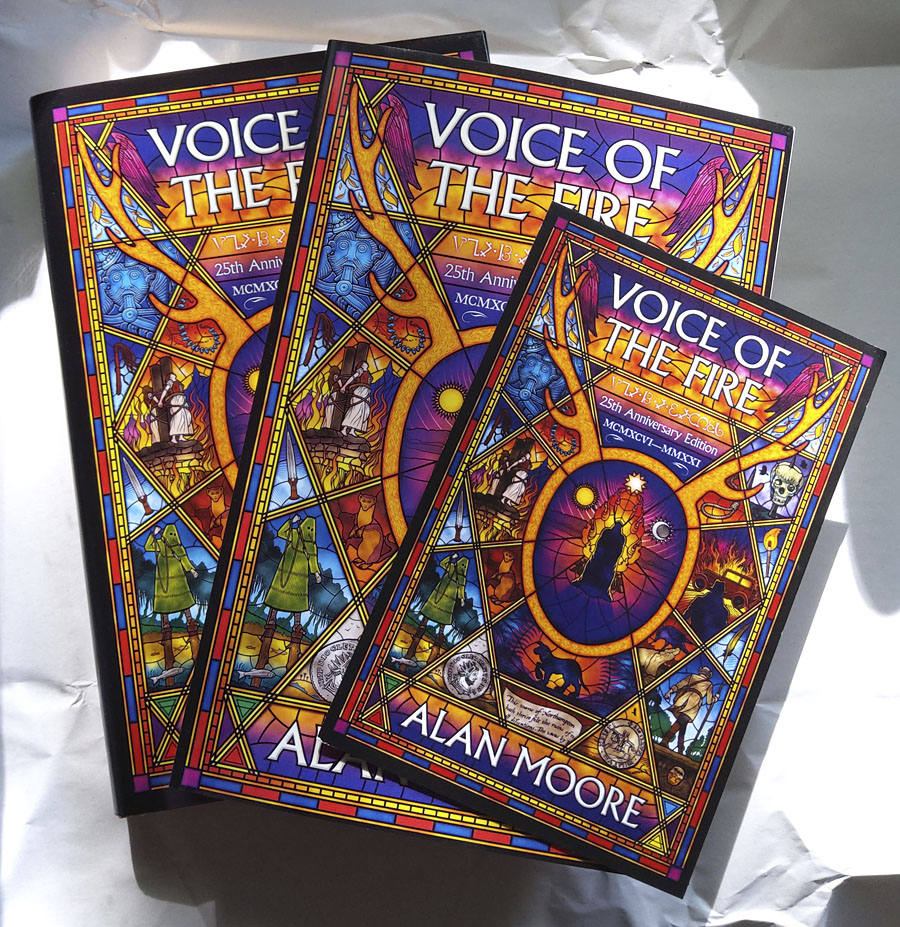
Glowing in the intermittent spring sunshine, the new hardback, paperback and bonus postcard of Alan Moore’s Voice of the Fire from Knockabout. The postcard is signed by the author, and only available with the hardbacks which are a limited run of 300 copies. Top Shelf will be publishing the book in the US (and also using my cover art) but I don’t know whether they’ll be following suit with signed cards. Anyone wanting more information about both editions is advised to check the publishers’ websites.

Previously on { feuilleton }
Voice of the Fire by Alan Moore

The Devourer Below

devourer.jpg
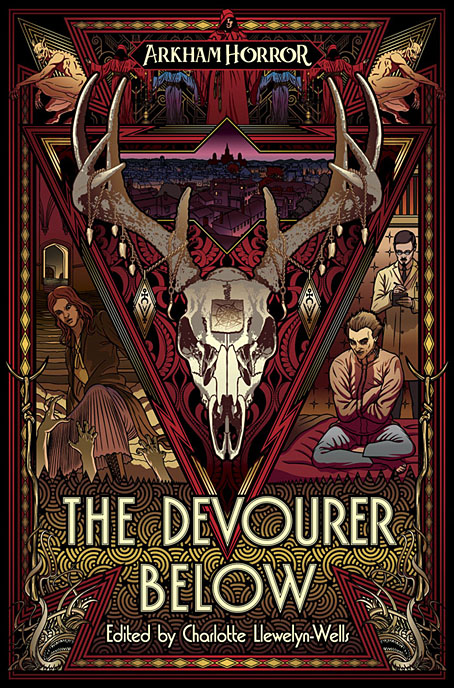
Another week, another cover design. This is the third cover of mine for the Arkham Horror line from Aconyte Books, a fiction series which complements the Lovecraftian Arkham Horror game:

Something monstrous has come to Arkham, Massachusetts. There have always been shadows here, but now a new hunger has risen from the depths and threatens those who dwell here. But there are heroes too—people who stand up and fight to stem the tide, even when it costs them everything. Explore eight shocking new tales of occult horror, captivating mystery, and existential fear—from a zealous new heroine to conniving cultists, bootleg whiskey to night terrors, and fiends that crawl from open graves. A nightmare has fallen across Arkham, and it will devour all.

As with the earlier titles I’ve worked on, The Last Ritual and Litany of Dreams, the general style is Art Deco in keeping with the period in which the game and the stories are set. The new cover worked out especially well thanks to the brief which suggested extending the triangle that appears on the previous covers so that it became a frame for a deer skull bedecked like a ritual artefact. This created a little more space for the requisite character panels, the figures here being an underworld investigator and a lycanthropic asylum inmate, both of whom feature in the game. The brief also requested that Arkham be represented somewhere, so I spent a lot of time drawing a view over the gambrel rooftops of the haunted town, only to shrink the panel down to a size which loses much of the detail. It may be a miniature view but it’s like one of those special effects shots you see in a film, something you know must have taken a lot of work to achieve but which is only visible for a few seconds; a minor presence that adds to the texture of the whole. And the view of nocturnal architecture provides a further link with the previous covers.

The Devourer Below will be available in ebook and US paperback in July, with a UK paperback following in September.

Elsewhere on { feuilleton }
The Lovecraft archive

Previously on { feuilleton }
Litany of Dreams
The Last Ritual

32 Short Lucubrations Concerning Alan Moore

am.jpg

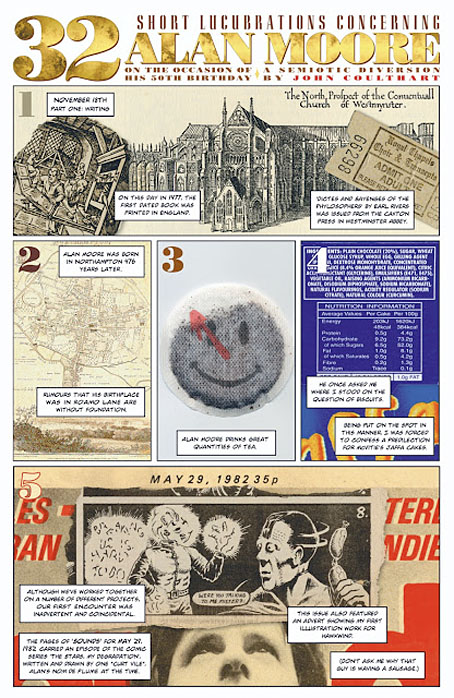
One of my few comic strips that isn’t either a Lovecraft adaptation or part of the Lord Horror mythos is a five-page piece I produced in 2003 for Alan Moore: Portrait of an Extraordinary Gentleman. This was a book compiled by Smoky Man to honour Alan’s 50th birthday, for which my strip was one of many other comics, one-off portraits and contributions by different artists and writers. The book is out of print so Smoky has been posting extracts (with permission) on his blog. My strip may now be seen in full here.

I got the idea for this one from Thirty Two Short Films About Glenn Gould (1994), a feature-length portrait of the celebrated pianist which evaded the clichés of the biopic by addressing its subject through self-contained sequences in a variety of modes: dramatic reconstruction, interviews with Gould’s friends, documentary material, a spectrographic display from the playback of one of his Bach recordings, even a short piece of animation. My strip is less ambitious but it combines factual trivia about Alan Moore with personal reminiscences plus significant historical details connected with his birth date, 18th November, 1953. It was fun to put together, and a reminder that comic strips can be used for more than just telling stories.

Previously on { feuilleton }
Voice of the Fire by Alan Moore
The Blake Video
The Cardinal and the Corpse
Mapping the Boroughs
Art is magic. Magic is art.
Alan Moore: Storyteller
Alan Moore: Tisser l’invisible
Dodgem Logic #4

More Swans and Robots

robotartists01.jpg

Real Italian fantascienza is an authentic expression of Italian culture, which is brainy, nerdy, gutsy and pulp, it’s far-out but down-home, and raw but civilized. I would not proclaim that it’s the best fantasy writing ever created in the world, but it encourages and motivates me.

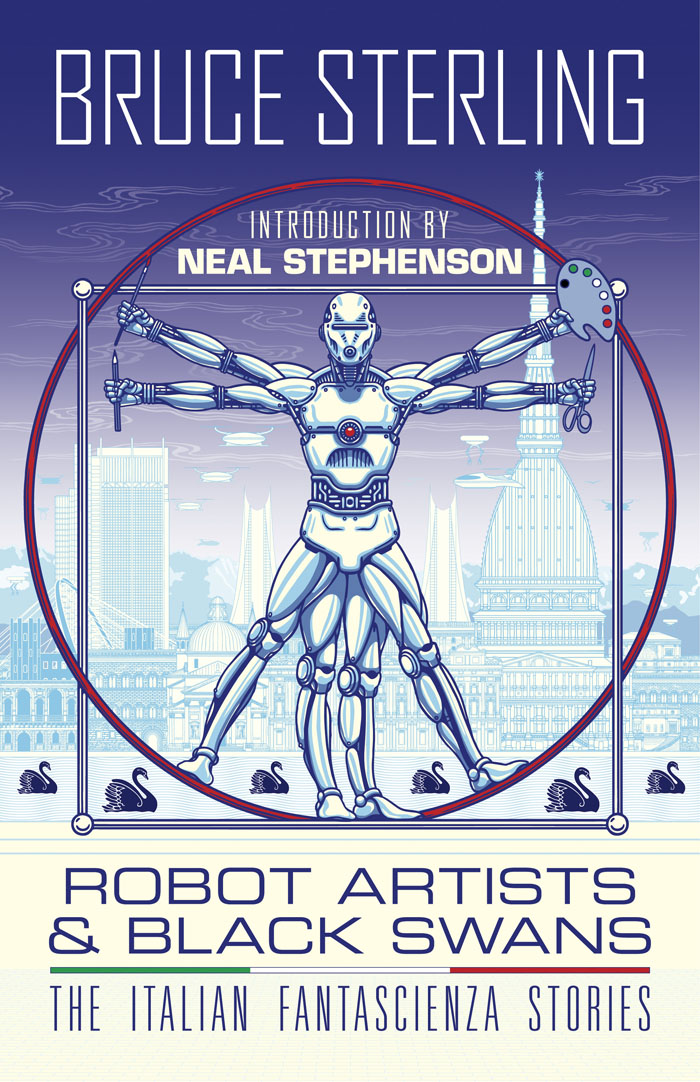
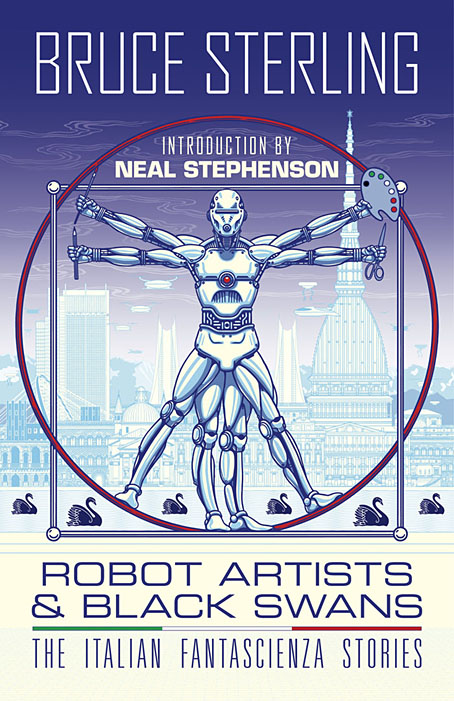
Bruce Sterling talking to Paul Semel about his collection of fantascienza stories, Robot Artists and Black Swans. My cover design was posted here last September; the book itself is published this week by Tachyon so I can at finally reveal the interior illustrations. Sterling’s collection presents seven stories written by his Italian alter-ego, Bruno Argento, with several of them appearing in English for the first time. The Italian theme informs the design as well as the content, although the associations aren’t always as obvious as they are in my illustrations for Sterling’s earlier fantascienza book for Tachyon, Pirate Utopia, the art and design for which adapted graphics by the Italian Futurists.

robotartists08.jpg

As I mentioned in the earlier post, while searching for more recent Italian graphics I came across the work of Franco Grignani (1908–1999), a designer whose most famous work was the Woolmark logo, one of those international symbols that most people will have seen even if few know who was responsible for its creation. The Woolmark’s black-and-white stripes are typical of Grignani’s designs, many of which work variations on the eye-jangling Op Art style pioneered by Bridget Riley. Grignani’s work seemed at first as though it might offer a suitable model for the cover design but it quickly became apparent that his style wasn’t suitable for this title so I went in another direction. Grignani’s influence is present inside the book, however, in the more abstracted illustrations, and in the parallel lines that provide a connecting thread between the stories and their illustrations. The Eurostile fonts used throughout the book also have an Italian flavour. They’re a little clichéd for science fiction but I liked the way they combined SF associations with more Italian design, being the work of Alessandro Butti and Aldo Novarese.
robotartists15.jpg

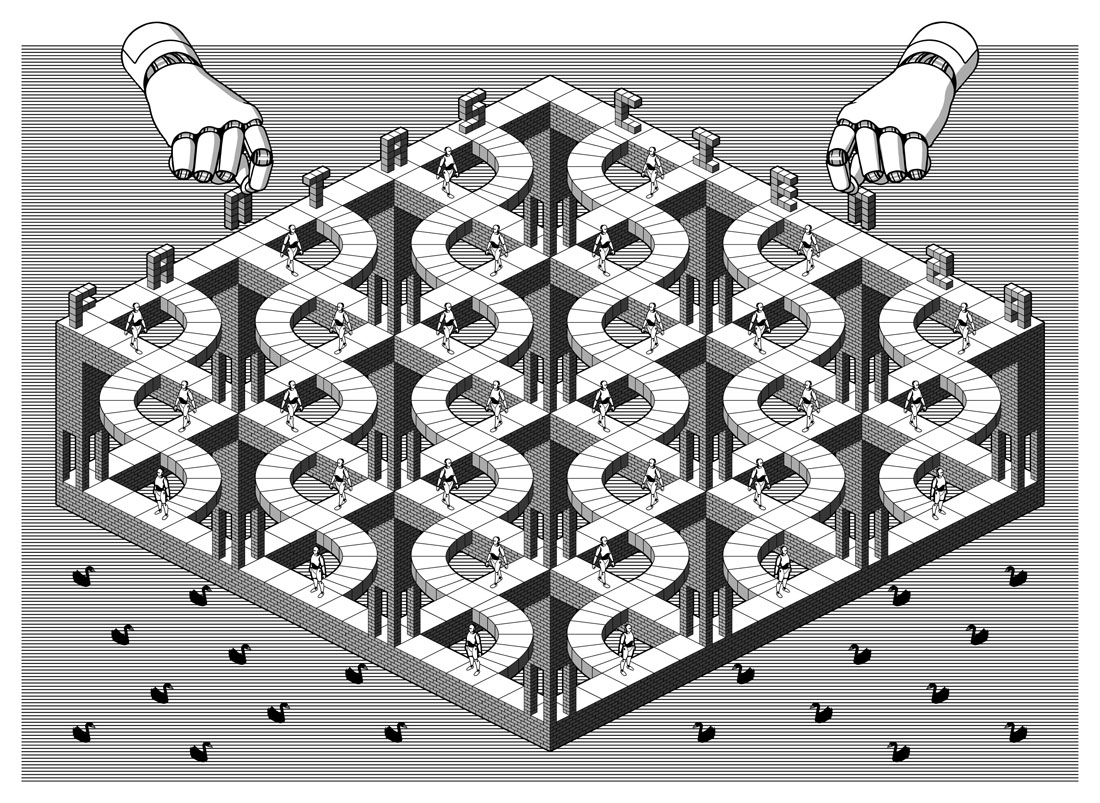
The other design influence, and a more identifiable source, is MC Escher, a choice prompted by the black swans in the title. Escher’s tessellated patterns feature a variety of animals, swans included, so I adapted two of the artist’s swan patterns to prevent the illustration from being robot-heavy. Escher also has an Italian side, as it happens; he enjoyed holidaying in Italy, and the vernacular architecture of the country’s small coastal towns may be found in many of his lithographs. The Escher swans led in turn to a self-indulgent illustration that fills two pages at the front of the book, something that came about after I was playing with Penrose triangles in Illustrator. I’d made a group of these impossible shapes into a construction which a little tweaking turned into a piece of equally impossible architecture, rather like those in the Escher-influenced mobile game, Monument Valley. All that was required to flesh things out was to cover the walls in a brick pattern then add a few swans and robots.

Continue reading “More Swans and Robots”

Body Shocks

bodyshocks.jpg

Presenting my latest cover design for Tachyon Publications, and one which it hardly needs stating is another collection of horror stories edited by Ellen Datlow. Body horror is the general theme but these aren’t all accounts of evisceration and dismemberment of the type that made the later Pan horror collections an increasingly dismal read. Several of the stories are outright science fiction, while the final entry, Tissue Ablation and Variant Regeneration: A Case Report by Michael Blumlein, is a Ballardian critique of a former US President that unnerves with its dispassionate medical tone.

eyeballs.jpg

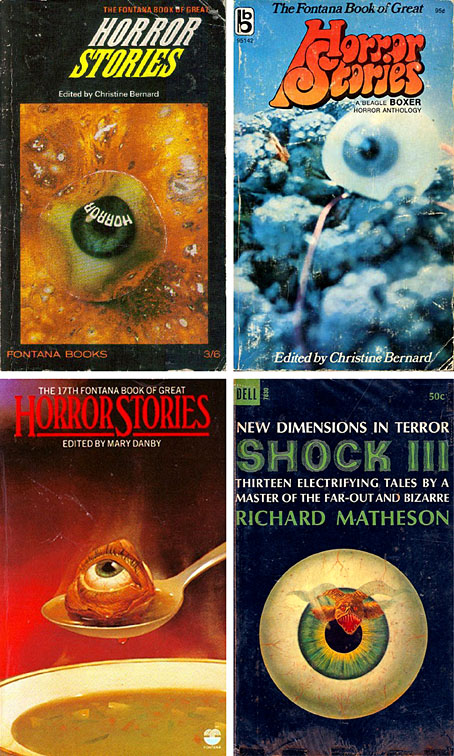
The cover design for this one went through many drafts before everyone was satisfied, the placing of the solitary eyeball being the crucial element. This is something of a stereotype on horror covers, a feature I’ve seen often enough to have it mentally tagged as “the Eyeball of Horror” (see above). But design stereotypes evolve because they serve their purpose so well, as this one does. Some of the earlier drafts incorporated anatomical diagrams but none of the results were really satisfying, especially when a large amount of text also needed to be placed on the cover. In the past I might have posted one or two of these early versions but I was dissuaded from doing this when Jonathan Barnbrook wrote about the gentle rebuke he received from David Bowie after he showed the preliminary stages of his cover design for Bowie’s The Next Day. Bowie’s attitude was that making public a working version changed the audience’s perception of the end result, a comment that comes to mind every time Spine has a new post showing drafts of recent cover designs.

Body Shocks will be published in October.

Previously on { feuilleton }
The Monstrous
Lovecraft’s Monsters unleashed
New work: Two forms of darkness