Weekend links 782

binnie.jpg

Ushiwakamaru and Benkei (2015) by Paul Binnie.

• “Gohatto depicts homosexuality within a very specific subset of society. Kubi explores further than that, depicting homosexuality between equals, and between bosses and subordinates. It tries to depict the relationship between power and authority, and how sexuality is used to maintain that authority.” Takeshi Kitano talking about Kubi, his film about sex among the samurai, which is receiving a belated release in the UK.

• “De Rome later said he’d never felt persecuted for his sexuality, and it’s this sense of the carefree that’s reflected in the lightness of his filmmaking.” Luke Turner on Peter De Rome’s homoerotic films which are currently being screened at the Barbican, London.

• At Public Domain Review: Helen Haiman Joseph’s A Book of Marionettes (1920), “The first comprehensive history of marionette artistry in the English language.”

• Mixes of the week: Isolatedmix 132: Psilocybin Therapy Protocol v1.22a by Matt Xavier, and DreamScenes – June 2025 at Ambientblog.

• At Sight and Sound: Backwards through the backwoods: music editors Dean Hurley and Lori Eschler on David Lynch and  Twin Peaks.

Dennis Cooper’s favourite fiction, poetry, non-fiction, film, art, and internet of 2025 so far. Thanks again for the link here!

• New music: Interior of an Edifice Under the Sea by Pan American & Kramer, and Modulations IV by Ian Boddy.

• At The Quietus: Peer Review: Peter Strickland interviews Cosey Fanni Tutti…and vice versa.

Cosmic Dawn: A feature-length NASA documentary about the James Webb Space Telescope.

• RIP Sly Stone and Brian Wilson.

Les Marionnettes (1991) by Zbigniew Preisner | Sword Of The Samurai (2006) by Lisa Gerrard | Seven Samurai (Ending Theme) (2012) by Ryuichi Sakamoto

Jean Cocteau: Autoportrait d’un inconnu

cocteau1.jpg

The title translates as “self-portrait of an unknown” although “unknown man” would be better English. The phrase is a curious one to apply to Jean Cocteau, an artist (or “poet”, to use his favourite epithet) who was known for his creative work from a very early age. Director Edgardo Cozarinsky uses Cocteau’s own narration from a collection of documentary films to chart the evolution of a polymathic public life, following the progress of Cocteau’s art from the poetry of his youth (which the older man deemed “absurd”), to his involvement with the Ballets Russes, his films and plays, and his later flourishing as a painter of murals like those in the Chapelle Saint-Pierre de Villefranche-sur-Mer.

cocteau2.jpg

In one of the later scenes Cocteau is shown talking to a wax figure of himself, describing the dummy as the one who goes out into the world to receive the plaudits and brickbats accorded to “Jean Cocteau” while the real Cocteau stays quietly at home in the south of France. The quotidian Cocteau would be the “unknown” in this respect; there’s no mention of his life with Jean Marais, for example, but I’m happy enough to spend an hour listening to him talking about his art. The reference to brickbats is a reminder that in France he was often reviled during his lifetime, regarded as a dilettante and a fraud. This was especially the case in André Breton’s Surrealist circle where those who wanted to avoid excommunication had to support the master’s lasting animus against the unknown poet.

cocteau-dali.jpg

A pair of Surrealist untouchables, 1953.

Given this, I was amused to see a brief shot of Cocteau signing a wall with the most notorious member of Breton’s long list of outcasts, Salvador Dalí. Cocteau was friends with Dalí in later years, and in one of the film clips mentions the painter introducing him to the concept of “phoenixology” or the revival of dead matter. Dalí had biological science and his own immortality in mind but for Cocteau the idea becomes a metaphor for the artistic process, something we see in Le Testament d’Orphée and La Villa Santa Sospir when he pieces together the petals of disassembled flowers.

I was watching a copy of Cozarinsky’s film which may be downloaded at Ubuweb. The narration is in French throughout but English subtitles are available here.

Previously on { feuilleton }
Orphée posters
Cocteau and Lovecraft
Cocteau drawings
Querelle de Brest
Halsman and Cocteau
La Belle et la Bête posters
The writhing on the wall
Le livre blanc by Jean Cocteau
Cocteau’s sword
Cristalophonics: searching for the Cocteau sound
Cocteau at the Louvre des Antiquaires
La Villa Santo Sospir by Jean Cocteau

Nightmare Alleys

nightmare05.jpg

Undated paperback.

My reading this week has been William Lindsay Gresham’s Nightmare Alley, a novel I’d been intending to read for some time after becoming familiar with the story from the first film adaptation. (I haven’t seen the recent version.) Whenever I’m reading a novel that’s been around for a while I have to see how it was presented in the past by designers and illustrators. Nightmare Alley was published in hardback originally, and the book today is marketed as a literary classic, but Gresham’s account of cheap carnivals and fraudulent mediums is sufficiently lurid enough to warrant a variety of different treaments, including pulp excess. The paperback at the top of this post is an extreme example but the cover could easily be applied to any number of noirish thrillers, there’s nothing in the artwork to suggest the carny world or the Spiritualism that the novel’s protagonist, Stanton Carlisle, mercilessly exploits.

nightmare01.jpg

First edition, USA, 1946.

The first edition isn’t a great design but it happens to be faithful to the core storyline, more so than many of the covers that follow. In the film we’re left to guess what the “nightmare alley” of the title might be but in the novel this is a symbol that recurs throughout the story, a literal nightmare of Carlisle’s in which he dreams he’s being chased down a dark alleyway towards a light that remains continually out of reach. The dream weighs enough on Carlisle’s mind for him to regard it as a symbol of the human condition, or at least his soured perception of the same. The cover of the first edition combines this image with the Tarot trump of The Hanged Man which Carlisle turns up in a reading as a signifier of his destiny. Tarot scholars may quibble with this detail—The Hanged Man isn’t as doom-laden or negative as the novel suggests—but Gresham makes good use of Tarot as a structural element, with each chapter named after one of the trump cards, and with elements of the story reflecting the Tarot imagery. Given all this you’d expect cover artists to use Tarot symbolism much more than they do.

nightmare03.jpg

First paperback edition, USA, 1948.

Another odd omission is the colour of Carlisle’s hair which the novel repeatedly tells us is blond. When Carlisle begins his career as a phony preacher and medium his blue-eyed “golden boy” persona is one of his tools for charming and deceiving wealthy widows. Gresham reinforces this in the chapter named after The Sun trump card by having Carlisle identified with the god Apollo. The film adaptations and almost all of the book covers ignore this detail.

nightmare02.jpg

Film tie-in, USA, 1948.

The 1947 film adaptation was directed by Edmund Golding from a screenplay by Jules Furthman. The storyline is condensed and inevitably sanitised for the screen but it’s still one of the best film noir entries from the prime noir decade.

nightmare04.jpg

Art by James Avati, USA, 1949.

James Avati was one of the great paperback illustrators yet even he gives Carlisle dark hair. I suspect by this point everyone expected as much after Tyrone Power’s memorable performance.

nightmare06.jpg

USA, 1986.

And Power’s saturnine features are still providing the dominant image forty years later.

Continue reading “Nightmare Alleys”

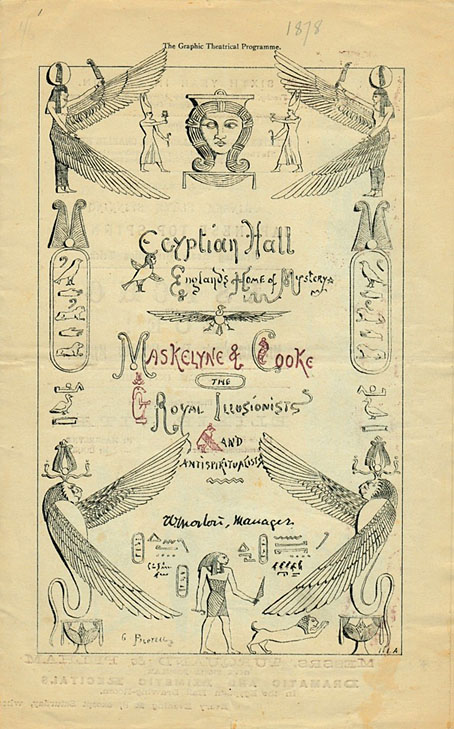
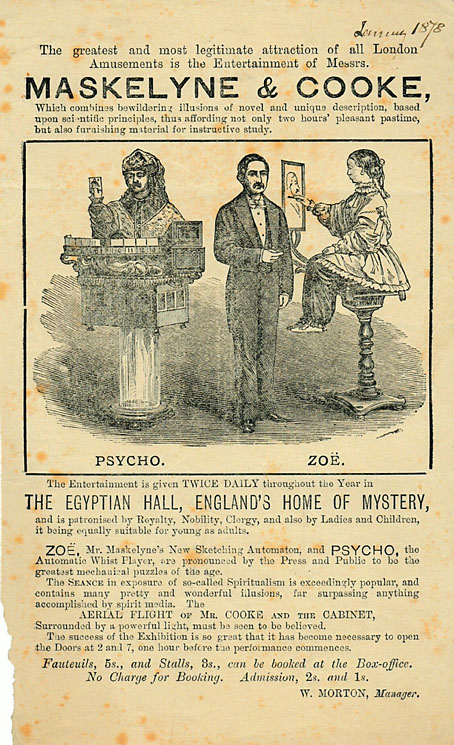
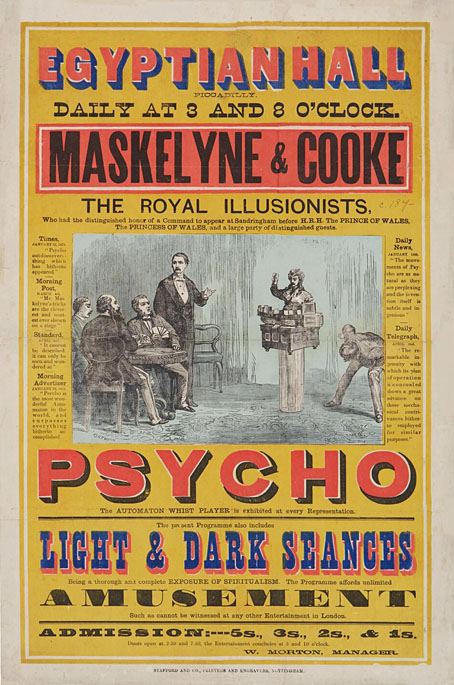
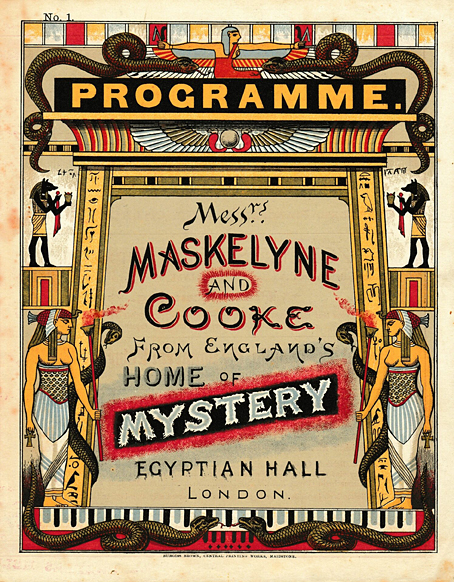
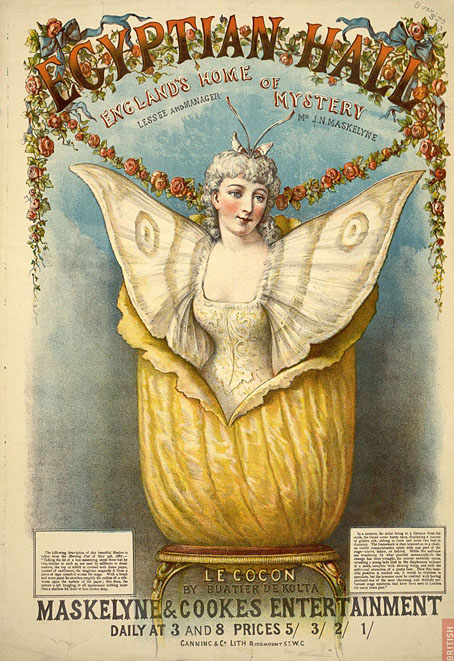
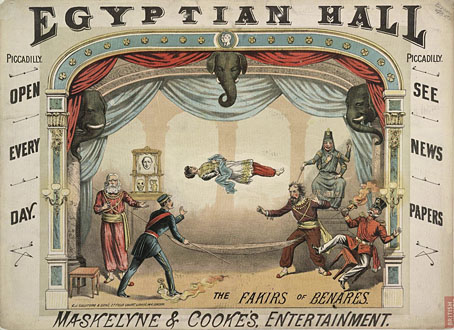
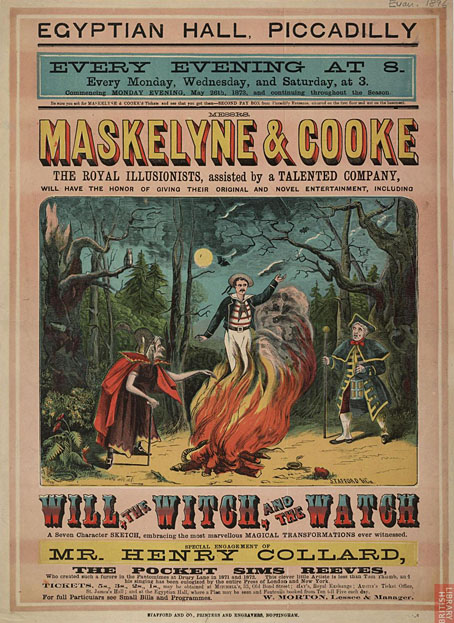
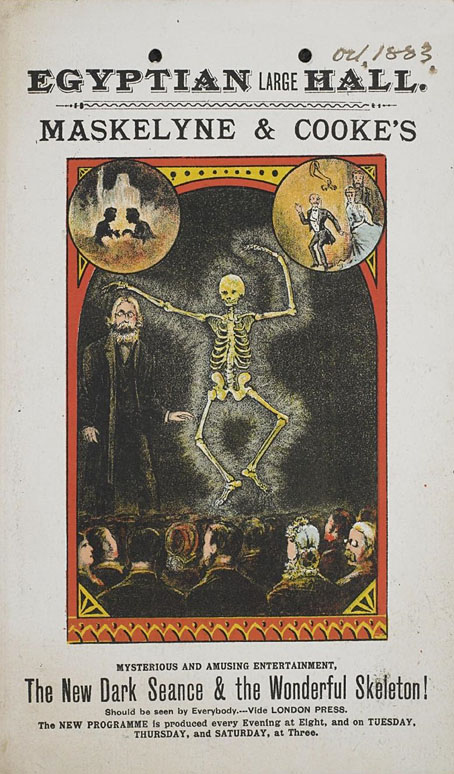
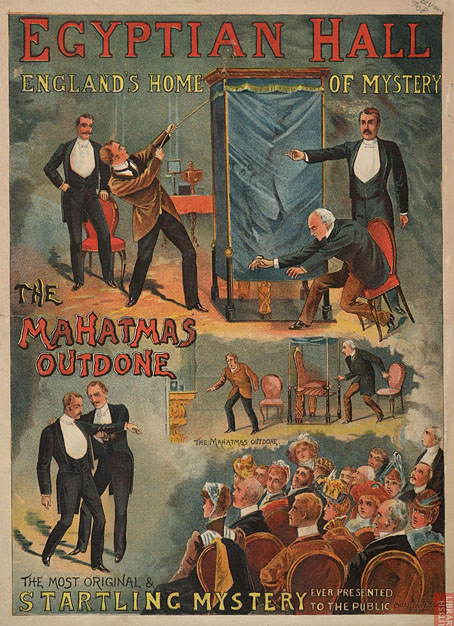
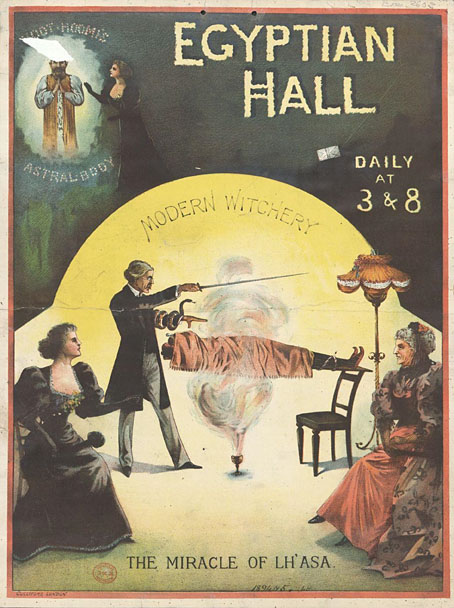
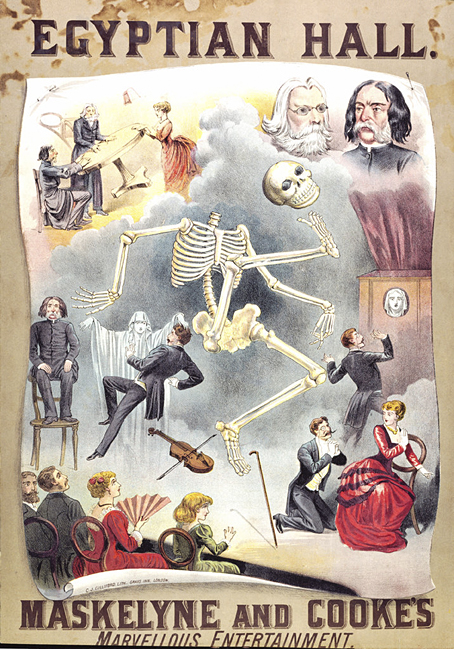
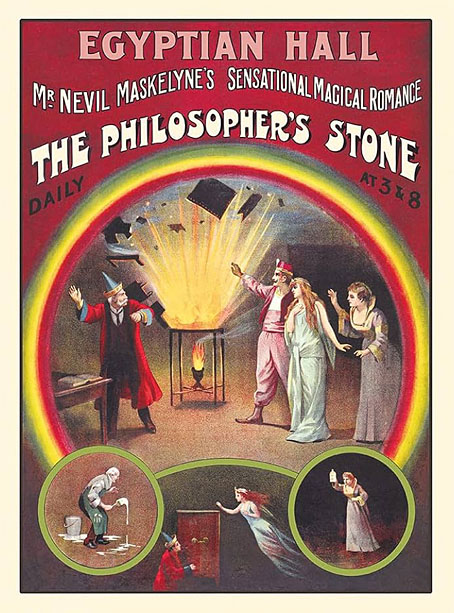
Maskelyne and Cooke at the Egyptian Hall

egyptianhall.jpg

The Egyptian Hall, Piccadilly, circa 1896.

The Egyptian Hall, the front of which forms one of the most noticeable features on the southern side of Piccadilly, nearly opposite to Bond Street, was erected in the year 1812, from the designs of Mr. G. F. Robinson, at a cost of £16,000, for a museum of natural history, the objects of which were in part collected by William Bullock, F.L.S., during his thirty years’ travel in Central America. The edifice was so named from its being in the Egyptian style of architecture and ornament, the inclined pilasters and sides being covered with hieroglyphics; and the hall is now used principally for popular entertainments, lectures, and exhibitions. Bullock’s Museum was at one time one of the most popular exhibitions in the metropolis. It comprised curiosities from the South Sea, Africa, and North and South America; works of art; armoury, and the travelling carriage of Bonaparte. The collection, which was made up to a very great extent out of the Lichfield Museum and that of Sir Ashton Lever, was sold off by auction, and dispersed in lots, in 1819.

Here, in 1825, was exhibited a curious phenomenon, known as “the Living Skeleton,” or ‘the Anatomic Vivante,” of whom a short account will be found in Hone’s “Every-Day Book.” His name was Claude Amboise Seurat, and he was born in Champagne, in April, 1798. His height was 5 feet 7½ inches, and as he consisted literally of nothing but skin and bone, he weighed only 77¾ Ibs. He (or another living skeleton) was shown subsequently—in 1830, we believe—at “ Bartlemy Fair,” but died shortly afterwards. There is extant a portrait of M. Seurat, published by John Williams, of 13, Paternoster Row, which quite enables us to identify in him the perfect French native.

Of the various entertainments and exhibitions that have found a home here, it would, perhaps, be needless to attempt to give a complete catalogue; but we may, at least, mention a few of the most successful. In 1829, the Siamese Twins made their first appearance here, and were described at the time as “two youths of eighteen, natives of Siam, united by a short band at the pit of the stomach—two perfect bodies, bound together by an inseparable link.” They died in America in the early part of the year 1874. The American dwarf, Charles S. Stratton, “Tom Thumb,” was exhibited here in 1844; and subsequently, Mr. Albert Smith gave the narrative of his ascent of Mont Blanc, his lecture being illustrated by some cleverly-painted dioramic views of the perils and sublimities of the Alpine regions. Latterly, the Egyptian Hall has been almost continually used for the exhibition of feats of legerdemain, the most successful of these—if one may judge from the “run” which the entertainment has enjoyed—being the extraordinary performances of Messrs. Maskelyne and Cooke.

From Old and New London: A Narrative of its History, its People and its Places, Vol. 4 (1887) by Walter Thornbury

mandc09.jpg

mandc11.jpg

mandc01.jpg

mandc12.jpg

mandc02.jpg

mandc03.jpg

mandc04.jpg

mandc05.jpg

mandc06.jpg

mandc07.jpg

mandc10.jpg

mandc08.jpg

Previously on { feuilleton }
Martinka & Co. catalogue, 1899
Learned Pigs and other moveables of wonder
Magicians
Hodgson versus Houdini

Weekend links 758

laloy.jpg

Monstrum in animo (1955) by Yves Laloy.

• This week’s obligatory Bumper Book of Magic links: Alan Moore World has more of my ongoing comments about the creation of the book, while Séamas O’Reilly talked to Alan about the book itself and its connections with The Great When. The latter piece lowered my already low opinion of the late Genesis P-Orridge.

• At Timeless: A reprint of Bright Lights and Cats With no Mouths by John Balance. Still in print is The Cupboard Under the Stairs, a selection from JB’s notebooks.

• If you enjoy sleight-of hand magic—and I most certainly do—then Ricky Jay & His 52 Assistants (1996) is 58 miraculous minutes by a master of the art.

• Mixes of the week: Winter Solstice 6 at Ambientblog; a mix for The Wire by Rafael Toral; and Reflection on 2024 at a Strangely Isolated Place.

• “Whatever the reason, there is something sorrowful about the disposal of art, whatever the perceived quality,” says Steven Heller.

• New music: The Path Of The Elder Ones by Nerthus.

Bright Lights (1959?) by Wade Curtiss & The Rhythm Rockers | Bright Lights, Big City (1961) by Jimmy Reed | I Want To See The Bright Lights Tonight (1974) by Richard & Linda Thompson