John Austen’s Hamlet

austen01.jpg

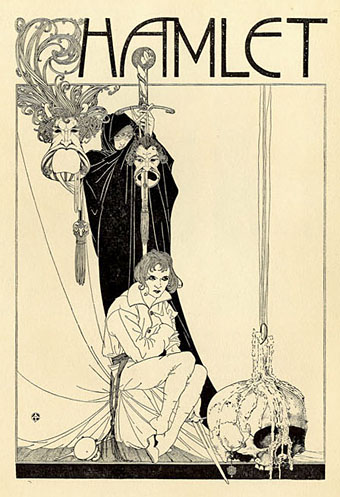
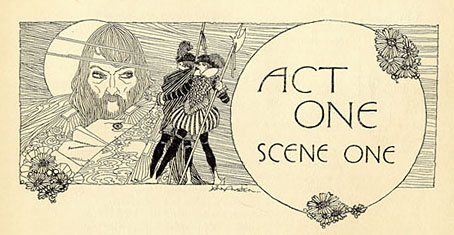
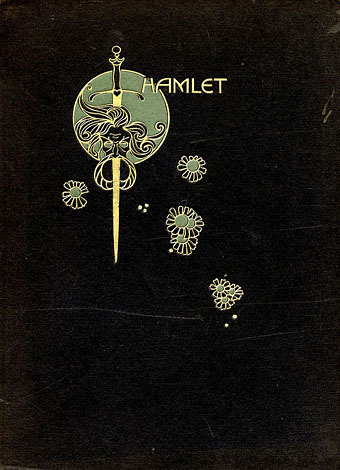
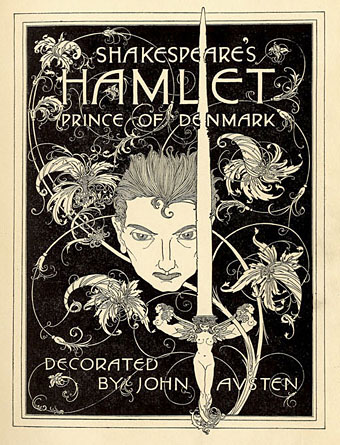
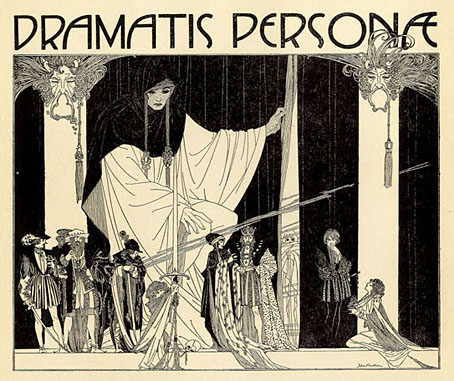
The 1922 edition of Hamlet “decorated” by British artist John Austen (1886–1948) is a lot more visible today than it was a few years ago, thanks to a reprint by Dover Publications in their Calla Editions series. The scans here are from an original printing at VTS. Austen’s Hamlet is often rated as his chef d’oeuvre, and with good reason, he manages to lend some visual splendour to a play whose concerns are a lot more introspective than the usual illustration standards of The Tempest and A Midsummer Night’s Dream. Masks, swords and skulls are recurrent symbols. Yes, the drawings owe a great deal to Harry Clarke’s example—all those manga faces, spiny fingers and swathes of black—but that’s no bad thing if you can pull it off. If you’re going to borrow a style then you may as well take from the best.
austen02.jpg

austen03.jpg

austen04.jpg

austen04-1.jpg

Continue reading “John Austen’s Hamlet”

The Marat/Sade

maratsade1.jpg

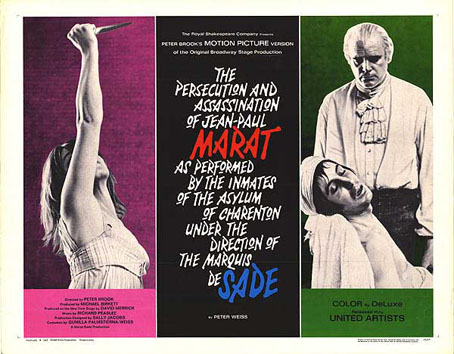
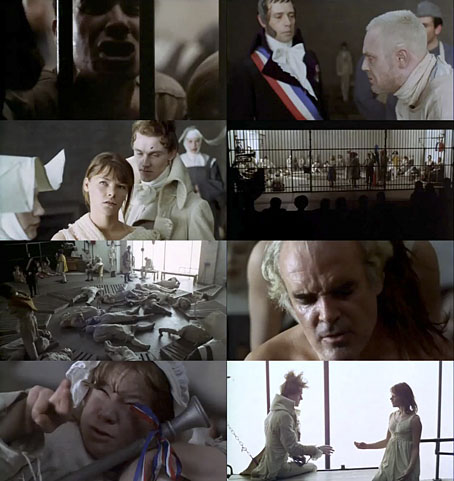
The Marat/Sade (1967).

Good to find this Peter Brook film on YouTube (for the time being…) as I’d been watching Ian Richardson in a couple of things recently and wanted to remind myself of how he fares here. He’s excellent, of course, as the serious foil to Patrick Magee’s equally serious Marquis de Sade. Brook’s film is a recording of his stage presentation of Peter Weiss’s play, in which the two actors embody the poles of a dialogue about the perennially knotty problems of revolution, freedom, and the interests of the individual in the face of political abstractions. What fascinates most about this is the Brechtian nature of the drama: structured as a play-within-a-play (we’re watching the inmates of an asylum performing a fictional Sade drama), and with a proxy audience regarding the performance through iron bars, the staging is as far away from dry theorising as you can get. Brief moments of debate between Sade and the asylum inmate portraying Marat act as punctuations between scurrilous chorus songs and frequent scenes of outright chaos which erupt when the demands of performance become too much for the inmates. It’s loud, sardonic, cynical, and often riveting. One of the more miserable features of drama from the 1960s and 70s is the recurrence of ham-fisted political didacticism which, however well-intentioned, makes for a dismal viewing experience. Weiss’s play shows how well you can deliver political rhetoric when the staging doesn’t ignore the presence of a possibly sceptical audience who might also like to be entertained.

maratsade2.jpg

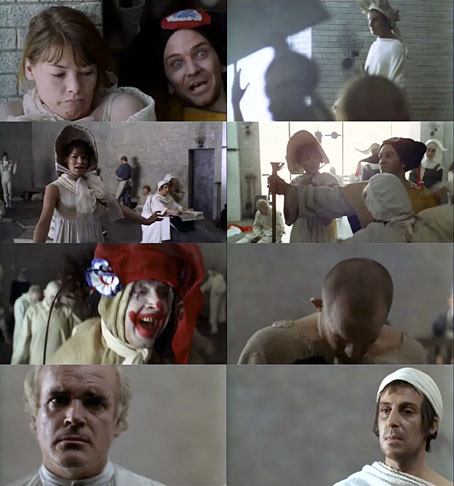
Peter Brook has had a peculiar career as a film director, most of his films being screen adaptations of his stage productions, or odd one-offs such as his documentary-like (and somewhat superfluous) film of Lord of the Flies, and the bizarre Meetings with Remarkable Men. (More about that later.) Brook’s Royal Shakespeare Company staging of the Weiss play was performed to great acclaim in 1965 so we’re fortunate that it’s captured so well here. The cast includes many first-rate actors, not only Richardson and Magee but Glenda Jackson as the inmate given the task of portraying Charlotte Corday, Michael Williams as the Herald, and (easy to miss among the clown-faced chorus) Freddie Jones. A low-grade YouTube copy does little for David Watkin’s superb photography which gives the film a very different look to other films of the 1960s. Studios films of the era tended to be horribly over-lit so it’s refreshing to find a film such as this using only the available light to illuminate the action. Searching around for DVDs reveals a single Spanish edition which I’m tempted to buy if I could be sure it was widescreen and with the English soundtrack intact. As for the play itself, the concerns may be typical of the period but many of the sentiments have lost none of their relevance. Highly recommended.

maratsade3.jpg

Fenella Fielding reads Colette

fenella1.jpg

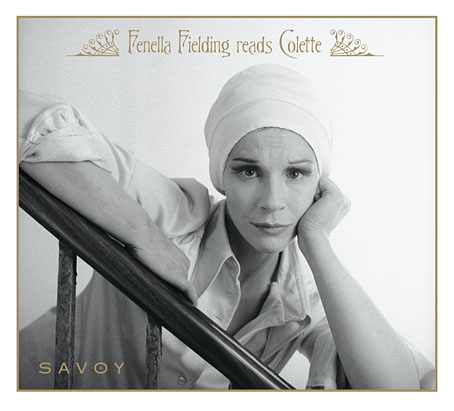
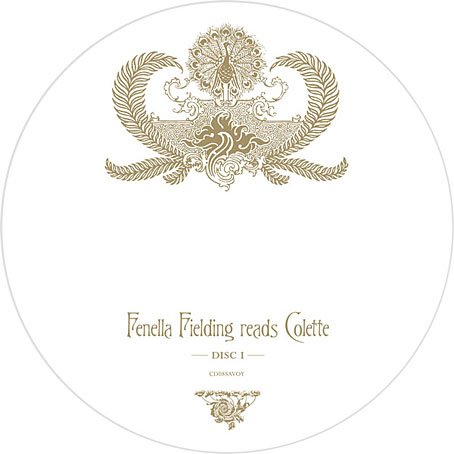
The latest post at Strange Flowers reminded me of some work of mine that appeared earlier this month which I can finally mention. Fenella Fielding reads Colette is another of those long-gestating recordings from Savoy’s audio division which has been released at last after a lengthy hiatus. This is a double-disc CD set of Fenella’s own selection from the writings of Colette, an author Fenella knows well having portrayed her in Colette, a play by Elinor Jones.

fenella2.jpg

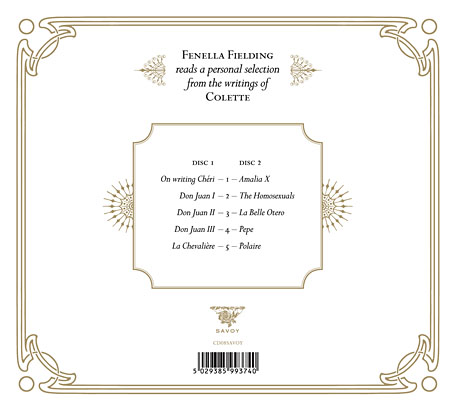
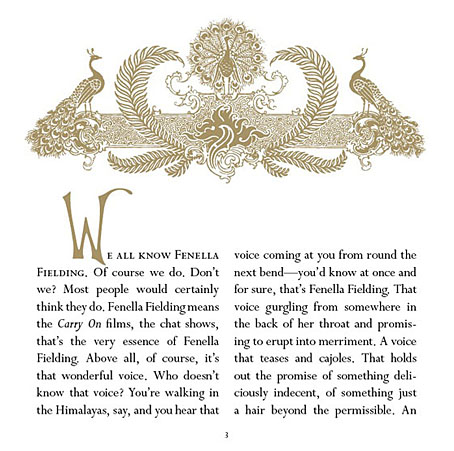
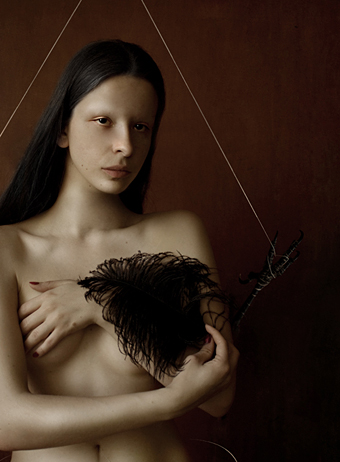
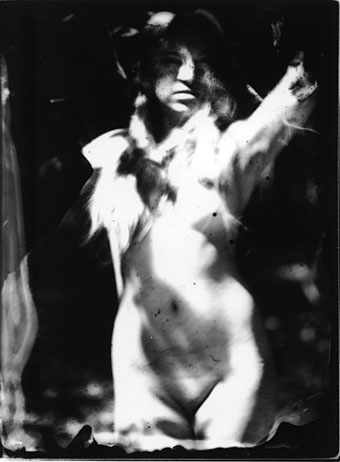
The CD set is a digipak which I designed using a variety of Art Nouveau motifs printed in metallic gold on white card. All the photos are either of Colette or Fenella herself, past and present; the lengthy booklet notes were by the late Monty Haltrecht, a novelist and friend of Fenella’s who followed her career for many years. Monty approved of my initial draft of the design so it’s a shame he wasn’t able to see the finished thing. For the moment the CDs are available only through Savoy but the readings should be on iTunes in due course.

fenella3.jpg

fenella4.jpg

I:MAGE: An Exhibition of Esoteric Artists

francov.jpg

El Trigono de las lesiones (2010) by Cristina Francov.

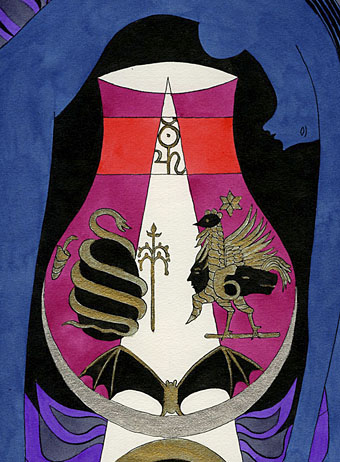
I:MAGE is an exhibition of occult-inspired art which opens a week on Sunday, 19th May at the Store Street Gallery, Bloomsbury, London. As exhibitions go it’s modest in scale but with an impressive roster of contributors old and new: Agostino Arrivabene, Ithell Colquhoun, Denis Forkas Kostromitin, Steffi Grant, Orryelle, David Chaim Smith, Michael Bertiaux, Andrew Chumbley, Cristina Francov, Barry William Hale, Francesco Parisi, Austin Osman Spare, Jesse Bransford, Peter Dyde, Rik Garrett, Noko, Residue, and Michael Strum. A few examples of the work on display are shown here, some of which will be available for purchase.

The event is being organised by Fulgur Esoterica, and their website has details of some related events including John Constable’s one-man play, Spare (about artist Austin Osman Spare), a one-off performance which will be held at Treadwell’s, London, on the 24th. This catches my attention because Constable was responsible for the acclaimed theatre adaptation of Mervyn Peake’s Gormenghast which David Glass and company staged in the 1990s. It’s always good to find one’s favourite people joined through these lateral connections.

garrett.jpg

The Earth Magic Series (2012) by Rik Garrett.

grant.jpg

Steffi Grant.

kostromitin.jpg

Demon by Denis Forkas Kostromitin.

Michael Powell’s Bluebeard revisited

powell1.jpg

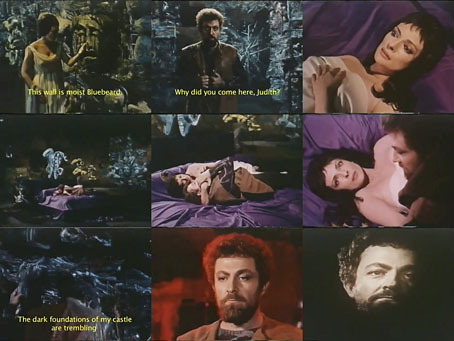
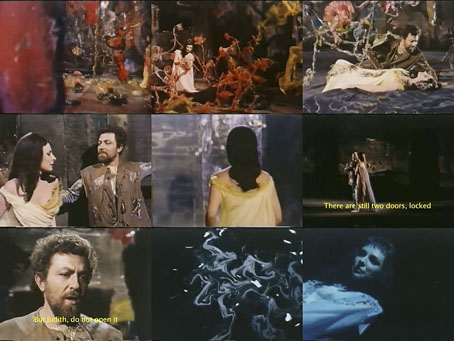
Yesterday’s post prompted me to look again for one of Michael Powell’s scarcest films, his television version of Bartók’s Bluebeard’s Castle made for  Süddeutscher Rundfunk in 1963. Sure enough, it’s now on YouTube in a watchable copy taken from VHS tape. Herzog Blaubarts Burg (to use its German title) was made post-Peeping Tom when the director’s career was at its lowest ebb, and while the production values don’t match those he’d been used to in the 1940s he was no doubt happy to be working at all after being vilified by the UK press. Norman Foster is Bluebeard and Ana Raquel Satre plays Judith, with the libretto being a German translation with English subtitles. I ought to note here that I’ve not read the second volume of Powell’s biography (mea culpa) so the only information I have about this comes from Ian Christie’s Arrows of Desire: The Films of Michael Powell and Emeric Pressburger (1985). Christie doesn’t have much to say about it other than pointing out that Norman Foster financed the film, and that it’s seldom been screened in Britain: IMDB has the first UK screening as 1978, just prior to the time when Powell and Pressburger began to receive to some belated recognition.

powell2.jpg

The YouTube copy suffers in the sound department by being a muffled mono transmission but it’s the visuals which will be of most interest to Powell aficionados. Powell & Pressburger’s regular production designer Hein Heckroth created the multi-coloured labyrinth which serves as the castle. The overall effect is stagey but contains some unique details, such as the rune-etched standing stones shown at the opening and close, and also some painted moments similar to those seen during the celebrated dance sequence in The Red Shoes (1948). Powell’s staging is much more vivid and artificial than Leslie Megahey’s 1988 adaptation whose Gothic gloom remains a personal favourite. Despite its shortcomings, when compared to the other Powell films that came after—the two Australian features, the Children’s Film Foundation commission which reunited him with Pressburger—this is far closer to the greatest works of the Archers era, and provides a more satisfying career coda for the man who directed The Red Shoes and The Tales of Hoffmann.

Previously on { feuilleton }
Joseph Southall’s Bluebeard
Leslie Megahey’s Bluebeard
Powell’s Bluebeard
The Tale of Giulietta