The art of Félicien Rops, 1833–1898

rops1.jpg

Pornokrates (1878).

After Mr Peacay’s comments regarding Félicien Rops I thought it time to devote a post to this impious artist.

Rops, a Belgian working in Paris, is curious even by the standards of the disparate group who comprised the Symbolists and with whom he had some connections. Whereas many artists of the time might hint at a fashionable blasphemy or Satanism, Rops’ dealings with these subjects were unequivocal, as was the outright pornographic tone of many of his drawings. This can make much of his work seem modern in a way few artists of that period achieve today, and it’s a good bet that many Christians (especially those of the puritan American variety) would still find his pictures offensive. These weren’t the only works that Rops produced, there were plenty of landscapes and society portraits, but it’s these that he’s remembered for. Once again, posterity favours the forthright and the unique over uniformity and compromise.

The Félicien Rops Museum
Les Diaboliques by Barbey d’Aurevilly (1874): 8 illustrations
Gallery of pornographic drawings at Arterotismo
Continue reading “The art of Félicien Rops, 1833–1898”

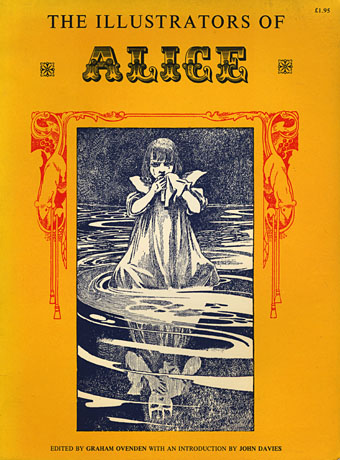
The Illustrators of Alice

alice1.jpg

Latest book purchase is this large format volume from 1972, one of a number of interesting art books produced by Academy Editions in the early seventies. I also have their monographs on Odilon Redon, “insane” painter Richard Dadd, and their collection of Félicien Rops‘ pornographic and “Satanist” drawings which remains one of the few Rops books published in English.

alice2.jpg

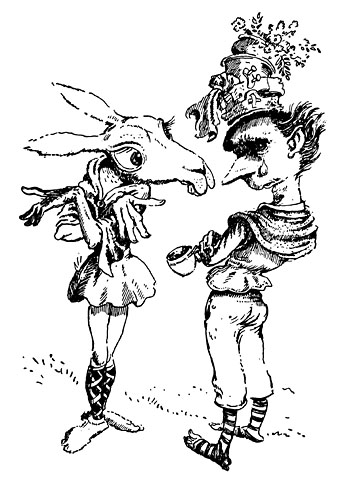
Through the Looking-Glass by Mervyn Peake (Allen Wingate, London, 1954).

This collection is worth seeking out if you’re interested in minor Victorian and Edwardian illustrators. The book goes through each chapter of the Alice stories showing examples of illustrated editions by a wide range of illustrators and artists, from Lewis Carroll’s original drawings, Tenniel’s inimitable renderings, then on through the twentieth century, featuring artists such as Peter Blake, Ralph Steadman and even a picture by Max Ernst. The cover drawing is one of my favourites, from Charles Robinson, brother of the more famous William Heath. I also like the pictures by the great Mervyn Peake, one of the few illustrators who seemed able to overcome Tenniel’s dominance and show us something new.

The Alice books are one of the great “standards” (in the jazz sense) of illustration although I can’t say I’ve ever felt the temptation to approach them myself. Loathsome monstrosities from hideously-angled dimensions beyond space and time, yes; small Victorian girls and white rabbits, no.

Elsewhere on { feuilleton }
The illustrators archive

Czanara’s Hermaphrodite Angel

czanara.jpg

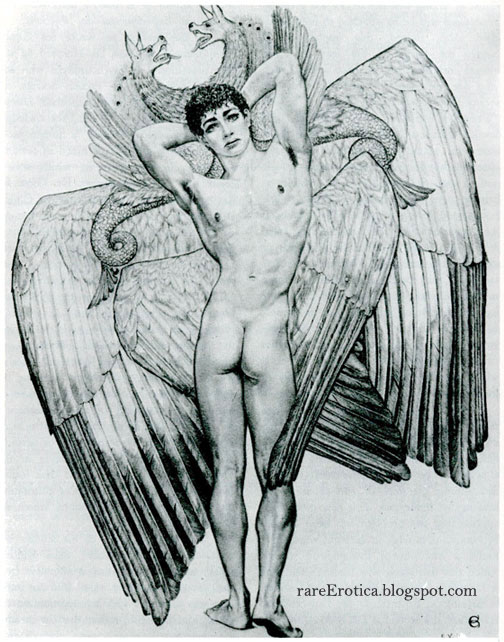
More obscure art, only now we’re talking really obscure. This remarkable picture, The Hermaphrodite-Angel of Peladan by Czanara, turned up in the archives of Russ Kick’s seemingly abandoned Rare Erotica blog. “Czanara” was one Raymond Carrance (1921–?), a gay artist who I haven’t come across before and who seems to be completely absent not only from my library, but from most of the web. A great shame, if there’s more of his work like this I want to see it.

The “Peladan” of the title might be a reference to Sâr Péladan, founder of the Catholic Order of the Rose and the Cross in fin de siècle Paris, and guru to a number of significant Symbolist painters, including the brilliant Jean Delville. Hermaphroditism and androgyny were important themes for Péladan who declared, in an outburst typical of the period, “the androgyne, is the plastic ideal!” Czanara’s picture is certainly Symbolist in its details—those multiplied wings and hippogriffs—even if its intent is most likely a result of mundane pornographic imperatives.

Elsewhere on { feuilleton }
The gay artists archive
The fantastic art archive

Previously on { feuilleton }
Angels 4: Fallen angels

The Masks of Medusa

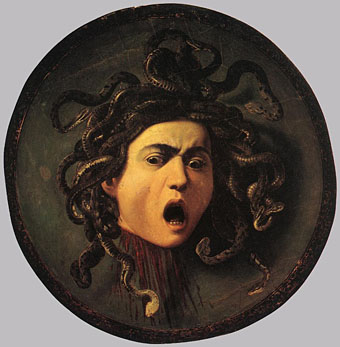
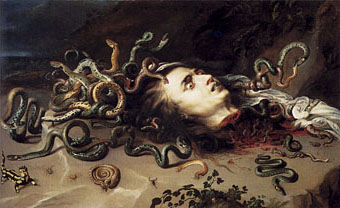
We had Sartorio’s Gorgon and the Heroes yesterday so here’s some Medusas to continue the theme. Art history, especially in the nineteenth century, is full of Medusa portraits; these are some of the better ones.

medusa_caravaggio.jpg

Medusa by Caravaggio (1598-1599).

medusa_rubens.jpg

Head of Medusa by Peter Paul Rubens (1617).

Continue reading “The Masks of Medusa”

The art of Giulio Aristide Sartorio, 1860–1932

sartorio7.jpg

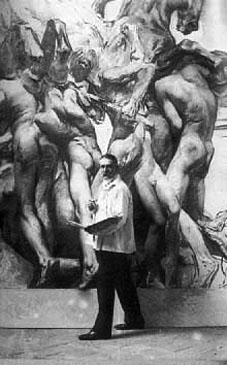
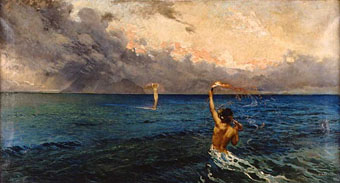
Giulio Aristide Sartorio is generally counted as one of the Italian Symbolists, along with painters such as Giovanni Segantini. He’s also one of the few notable artists of the period to have worked as a film director.

I’ve been fascinated by the curiously erotic academic style of Sartorio’s early work for years but these paintings rarely appear in books (although there have been a couple of monographs) and there’s little decent attention given to him on the web. Philippe Jullian in his essential guide to Symbolism, Dreamers of Decadence (Pall Mall Press, 1971), describes his work as being “vast paintings… full of handsome warriors who are always naked and generally dead.” Gabriele D’Annunzio, who knew heroic camp when he saw it, became a fan when the pair met in Rome in the 1880s. Sartorio illustrated D’Annunzio’s Isaotta Guttadàuro in 1886 and they continued to collaborate into the 1920s. One possible reason for Sartorio’s falling out of favour may have been later association with Mussolini’s Fascists, something else he shared with D’Annunzio.

sartorio1.jpg

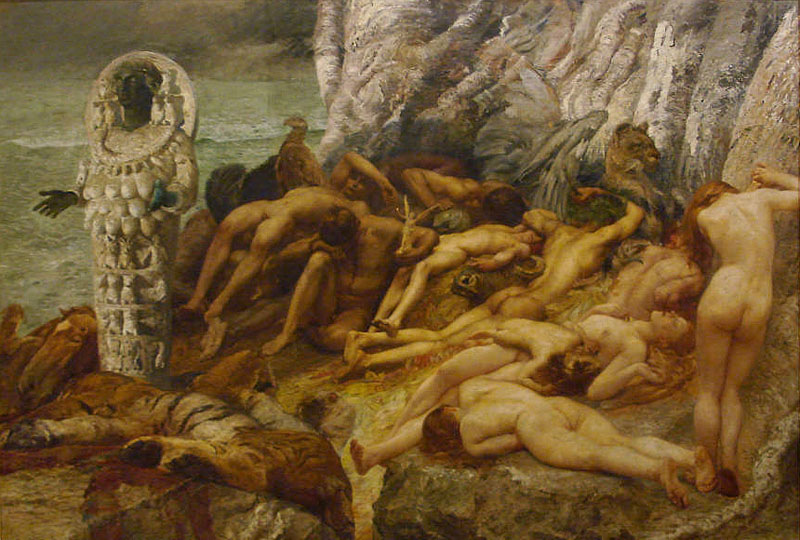
Diana of Ephesus and the Slaves (1893–98).

Much as I’d like to point you to a large reproduction of the bizarre Diana of Ephesus and the Slaves, there doesn’t seem to be one around just now. However, you can see a few gallery pages of Sartorio’s work here if you don’t mind the copyright label spoiling everything.

Update: A reasonable copy of the Diana painting has turned up. Click the image above.

sartorio2.jpg

Diana of Ephesus and the Slaves (detail).

sartorio3.jpg

Gorgon and the Heroes (1895–99).

sartorio4.jpg

L’Invasione degli Unni (no date).

sartorio8.jpg

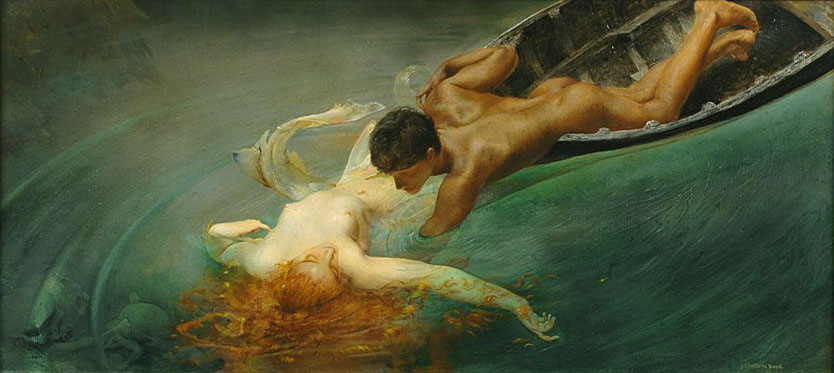
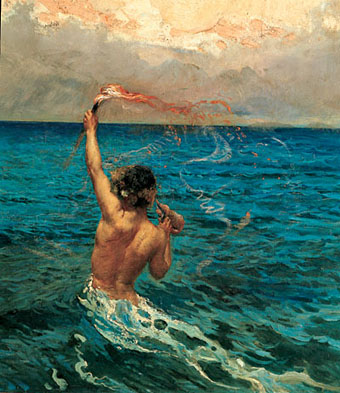
Siren or The Green Abyss (1900).

sartorio5.jpg

Pico, roi du Latium, et Circé de Thessalie (1904).

sartorio9.jpg

Pico, roi du Latium (detail).

sartorio6.jpg

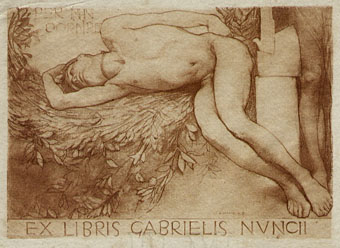
Ex libris Gabrielis Nuncii “per non dormire” (1906).

Elsewhere on { feuilleton }
The gay artists archive

Previously on { feuilleton }
Angels 4: Fallen angels