L’Androgyne

seon.jpg

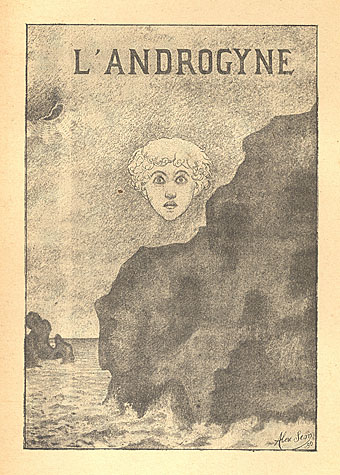
L’Androgyne by Alexandre Séon (1890).

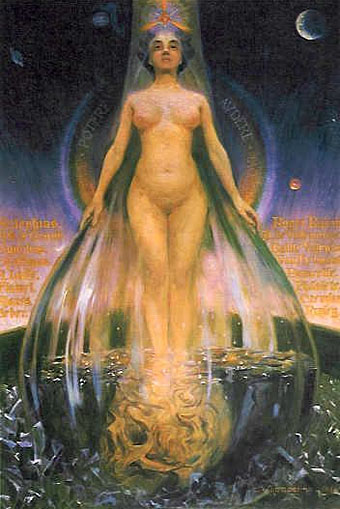
Related to yesterday’s post, I’ve been re-reading various books this week for details of the most curious character associated with the French Symbolist movement, novelist and occultist Joséphin Péladan (1859–1918), also known as Sâr Peladan, a Babylonian title he bestowed upon himself as more befitting his adopted role as Rosicrucian mystic. Péladan’s writings and occult art theories spurred many of the painters who banded together as part of his Salon de la Rose+Croix, a kind of anti-salon intended to stand in opposition to what the Sâr saw as the drab realism of the Impressionists and the staid historicism of academic painters. One gets the impression reading about Péladan that he was probably a rather preposterous figure—his obsession with androgyny caused him to change his forename from Joseph to Joséphin yet he kept his length of bristling beard. But, like Oscar Wilde in London, his presence in the pool of fin de siècle art creates considerable ripples. Alexandre Séon, whose frontispiece above was created for Péladan’s semi-autobiographical essay, L’Androgyne, was particularly devoted to him, as was Carlos Schwabe. Séon’s picture depicts “the androgyne Samas, stupefied by the sexual enigma”, a character with whom Péladan fully identified as he describes his youth and its apparent state of androgynous grace.

mitchenko.jpg

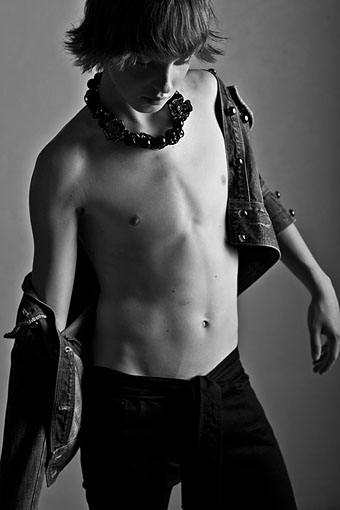
One doesn’t need a Rosicrucian salon today for examples of creative androgyny, of course, all you have to do is go to Flickr where you’ll find creatures such as the boy above from Roman Mitchenko’s photostream. The photos there are at the fashion end of the spectrum; for more of an amateur or semi-professional perspective there are groups like the Androgyny pool, and the Mommy, I want to be androgynous! pool, the latter featuring many striking boyish girls and girlish boys.

Previously on { feuilleton }
Arthur Tress’s Hermaphrodite
Carlos Schwabe’s Fleurs du Mal
Czanara’s Hermaphrodite Angel

Delville, Scriabin and Prometheus

delville1.jpg

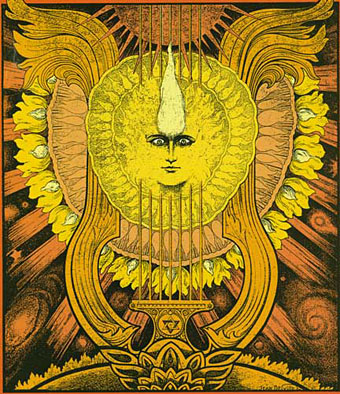
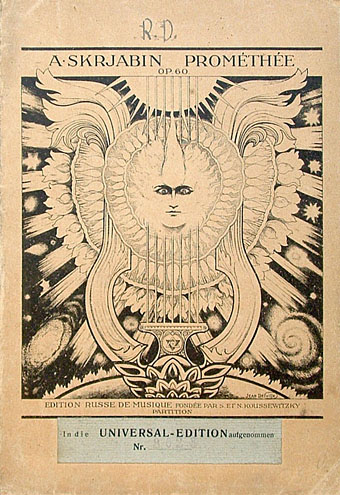
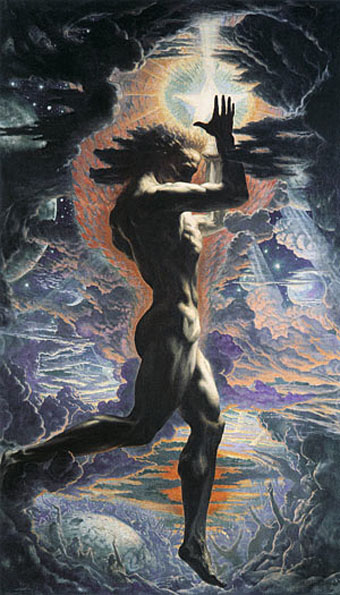
Another striking design found by chance. Symbolist artist Jean Delville (1867–1953) created this sheet music title page for Promethée by Scriabin in 1912, and the pair are well-matched given their shared predilection for mysticism (Theosophy in Delville’s case). Delville had also dealt with Prometheus in a typically dramatic, if sexless, picture a few years earlier (below). Once again it’s unfortunate that one of the really great artists of the Symbolist period is so poorly-served by the web that one has to discover his work by accident. There’s a dedicated site here but the gallery pages are only harvesting what’s already scattered around. Delville had a long and consistently high-quality career; he deserves better.

delville2.jpg

delville3.jpg

Prometheus (1907).

Update: Dave C reminds us of another Delville site with a better selection of pictures including a photo of the artist at work.

Previously on { feuilleton }
The faces of Parsifal
Masonic fonts and the designer’s dark materials
Angels 4: Fallen angels

The art of Julien Champagne, 1877–1932

champagne1.jpg

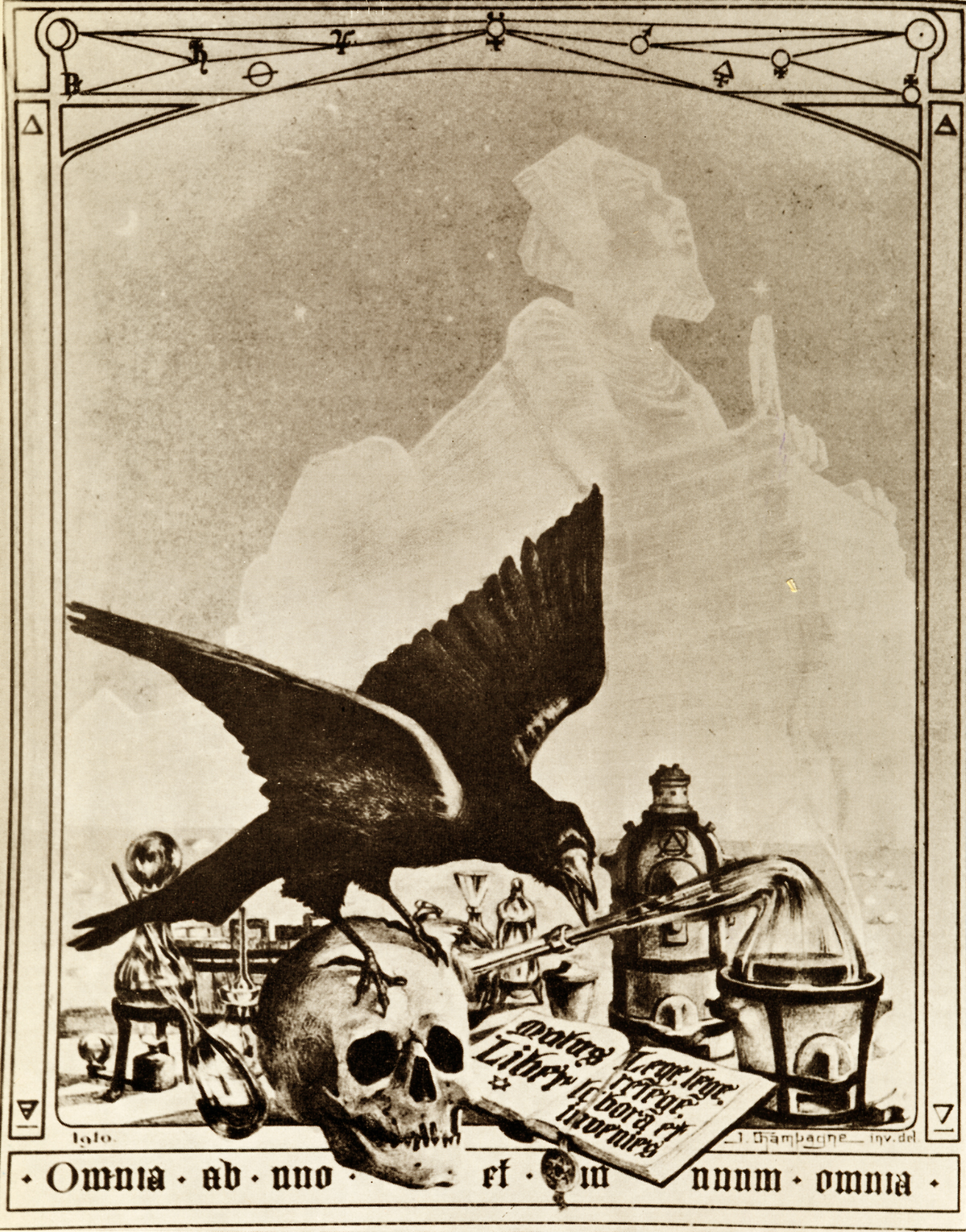
An obscure occult artist even among catalogues of obscure occult artists, Julien Champagne (also listed as Jean-Julian) is known principally for his associations with the persistently elusive 20th century alchemist Fulcanelli. Champagne provided a frontispiece (below) for Fulcanelli’s examination of architectural symbolism, Le Mystère des Cathédrales (1926), and is continually rumoured to have been Fulcanelli himself. Whatever the solution to that mystery, the alchemist’s book is rather more visible than the artist’s distinctly Symbolist paintings. There’s a French blog devoted to his life and works here but little else around. I wouldn’t mind seeing a decent online gallery of his pictures at some point.

champagne2.jpg

Previously on { feuilleton }
Digital alchemy
The art of Pamela Colman Smith, 1878–1951
The art of Andrey Avinoff, 1884–1949
The art of Cameron, 1922–1995
Austin Osman Spare

The eyes of Odilon Redon

redon1.jpg

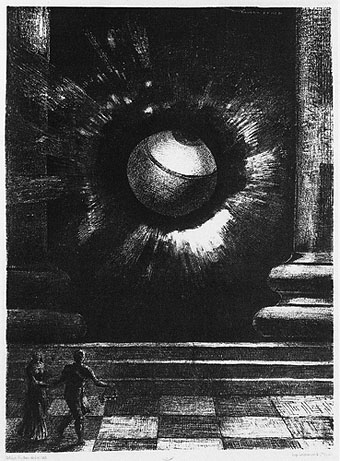
L’Oeil, comme un ballon bizarre se dirige vers l’infini from A Edgar Poe (1882).

Another decently thorough Symbolist website covers the life and work of Odilon Redon (1840–1916), an artist whose pastels and prints were strange even by the standards of his contemporaries. His giant eyeballs and other floating figures are always startling and point the way inevitably to Surrealism, especially in dream lithographs like the one below.

redon2.jpg

Vision from Dans le Rêve (1879).

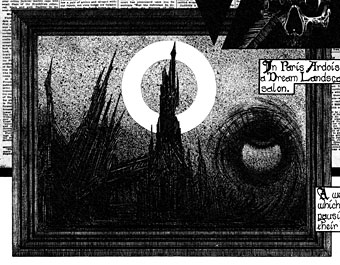
I compounded that Symbolist/Surrealist association when I was drawing The Call of Cthulhu in 1987 by showing Ardois-Boonot’s Dream Landscape (which Lovecraft doesn’t describe beyond the word “blasphemous”) as being a Max Ernst-style frottage canvas with a Redon eye rising from the murk. Cthulhu’s presence reduced to a single ocular motif like the eye of Sauron.

call.jpg

The Call of Cthulhu (1988).

And while we’re on the subject there’s Guy Maddin’s typically phantasmic short, Odilon Redon or The Eye Like a Strange Balloon Mounts Toward Infinity made for the BBC in 1995. Ostensibly based on the balloon picture above, this manages to reference a host of other Redon lithographs and charcoal drawings in the space of four-and-a-half minutes. Sublimely weird and weirdly sublime.

Elsewhere on { feuilleton }
The fantastic art archive

Previously on { feuilleton }
Arthur Zaidenberg’s À Rebours
The Heart of the World

The art of Elihu Vedder, 1836–1923

vedder1.jpg

The Last Man (1886–1891).

Vedder was one of the principal American Symbolists, possibly the leading one although there wasn’t the same degree of competition in the United States as there was in Europe. Last time I was casting around the web for his work he wasn’t so visible but that’s changed recently with a dedicated website. Vedder’s 1884 edition of the The Rubáiyát of Omar Khayyám is highly-regarded and at least one of those drawings—The Cup of Death—was reworked as a painting. Compared to his Continental contemporaries he’s a particularly gloomy artist, with sombre subjects rendered in a sombre palette. The Last Man is typical as well as being curiously inexplicable; is the serpent there a Satanic presence? And why is there a dead (?) angel boy at the feet of the Last Man?

The Smithsonian American Art Museum has a set of the Rubáiyát illustrations.

vedder2.jpg

Soul in Bondage (1891–1892).

Previously on { feuilleton }
Angels 5: Angels of Death