The art of Mikalojus Konstantinas Ciurlionis, 1875–1911

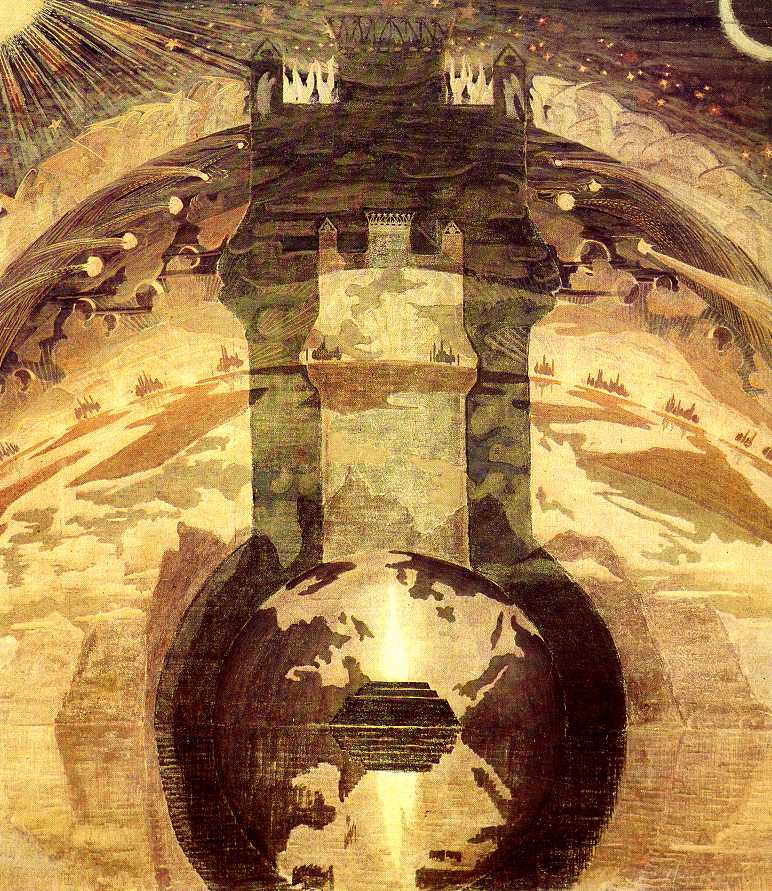
ciurlionis1.jpg

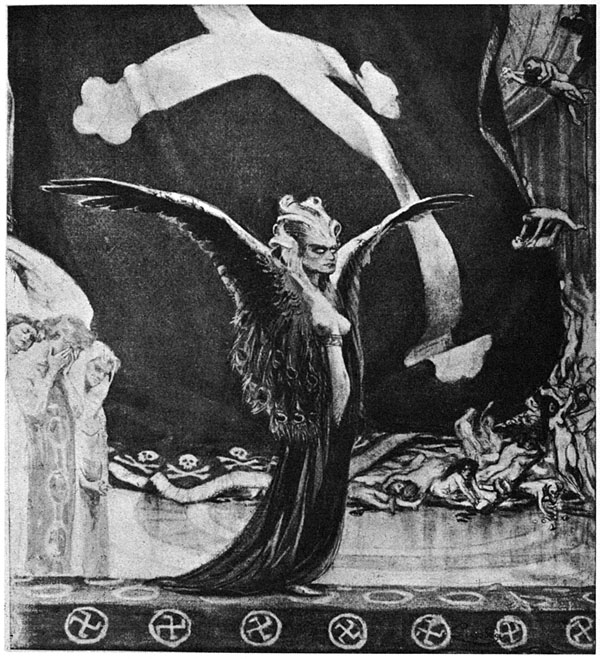
Rex (1909).

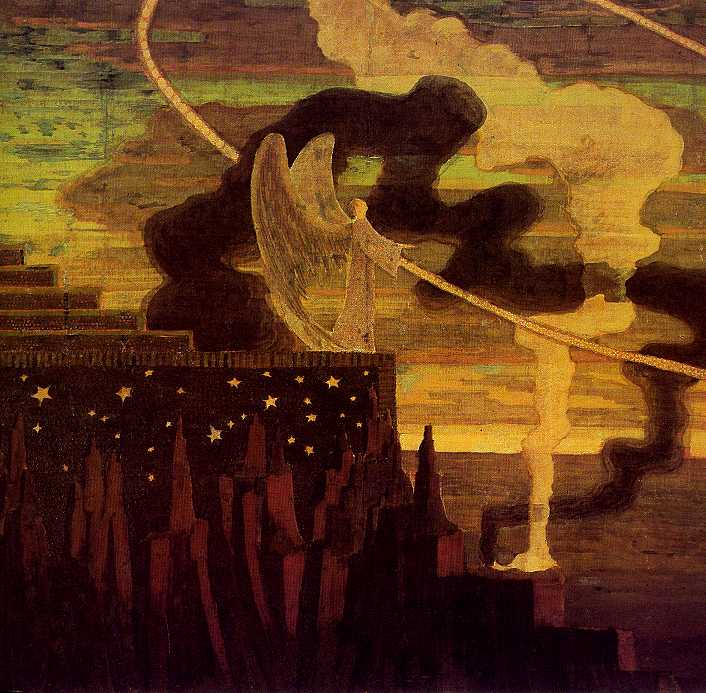
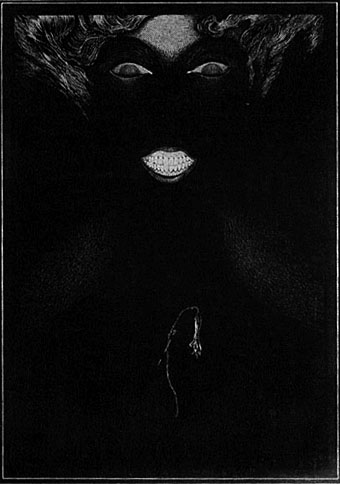
Another relatively obscure Symbolist, Mikalojus Ciurlionis was a Lithuanian artist and composer whose painted output might have graded to total abstraction if he’d lived a few more years. This site has a substantial gallery section and details of his life and other work.

ciurlionis2.jpg

The Offering (1909).

Previously on { feuilleton }
Delville, Scriabin and Prometheus

Illustrating Poe #5: Among the others

kupka_poe.jpg

The Conqueror Worm (c. 1900) by František Kupka.

Poe’s illustrators are legion, you could easily devote an entire blog to nothing but depictions of his stories and poems. By way of rounding off this week of posts I thought I’d point to some of the works which have caught my attention over the years, several of them being obscure enough to warrant further investigation.

František Kupka’s drawing is, as far as I can gather, one of a series based on Poe’s poem; this seems to be a related piece. As with many Symbolists artists, you can spend a great deal of time scouring the available resources to find more of their work. We’re told that one of Kupka’s more well-known paintings, The Way of Silence (1903), was inspired by the poem Dream-land.

martini_poe.jpg

Berenice (1905) by Alberto Martini.

Alberto Martini (1876–1954) is a fascinating artist whose work bridges the decline of Symbolism and the rise of Surrealism. He’s also another talent whose work is woefully underrepresented on the web so let’s hope that changes soon. Wikipedia describes him as having produced 135 Poe illustrations of which only a small handful are visible online, and most of the ones that are go unlabelled. I know this one is for Berenice since I have it in a book but any Poe reader should guess the title from those blazing teeth. A few more of Martini’s drawings can be seen here.

Continue reading “Illustrating Poe #5: Among the others”

Diaghilev’s World of Art

miriskusstva1.jpg

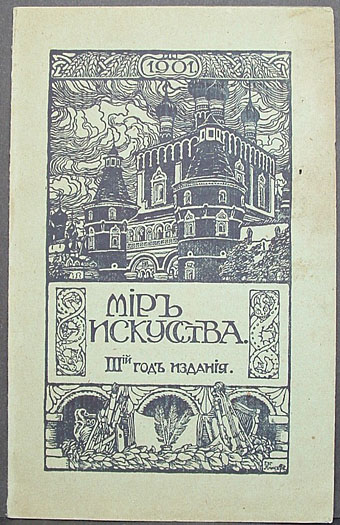
Cover by Evgeny Lanceray for Prospectus of the Magazine, 1901.

Previous posts here have concerned fin de siècle art magazines like The Savoy, Pan and Jugend; yesterday we had Sergei Diaghilev so it seems fitting to mention Diaghilev’s own magazine, Mir Iskusstva (World of Art), founded in 1899 with similar intentions to the European magazines which were highlighting developments in art beyond the academic sphere. Mir Iskusstva was also the name of the Russian art group who used the magazine as their forum, and a number of the artists involved in the movement, notably Léon Bakst, Ivan Bilibin and Nicholas Roerich, went on to work for Diaghilev at the Ballets Russes.
miriskusstva2.jpg

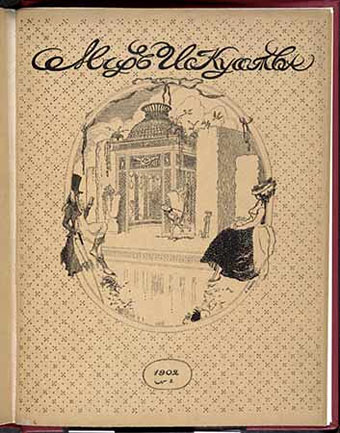
Cover by Léon Bakst for Mir iskusstva #8 (1902).

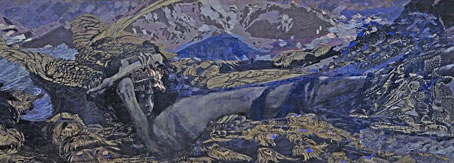
I find this later development especially fascinating since it positions the magazine as a precursor to the groundbreaking works which followed rather than being—as so many periodicals were and still are—a publication which had its moment of glory then faded from view. Of the works shown here, Vrubel’s Symbolist Demon, one of several painted by the artist, was featured in a 1903 edition of the magazine, whilst the Bakst painting, depicting the destruction of Atlantis, shows a Symbolist side to an artist who later became far better known for his Ballets Russes costume designs.
vrubel.jpg

Demon (1902) by Mikhail Vrubel.

Unlike the other magazines mentioned above, I’ve yet to come across a cache of whole editions of Mir Iskusstva (and I’m still waiting for Ver Sacrum to turn up somewhere). This page has an overview of the Russian art movement and its journal, while this page has a selection of works by the artists involved. For more of Vrubel’s work, Wikimedia Commons has the best collection of the artist’s paintings and sculpture.
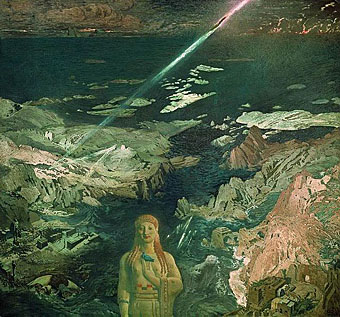
bakst.jpg

Terror Antiquus (1908) by Léon Bakst.

Previously on { feuilleton }
Diaghilev and the Ballets Russes
Pamela Colman Smith’s Russian Ballet
The art of Ivan Bilibin, 1876–1942
Magic carpet ride
Le Sacre du Printemps
Images of Nijinsky

The art of Karel de Nerée tot Babberich, 1880–1909

babberich1.jpg

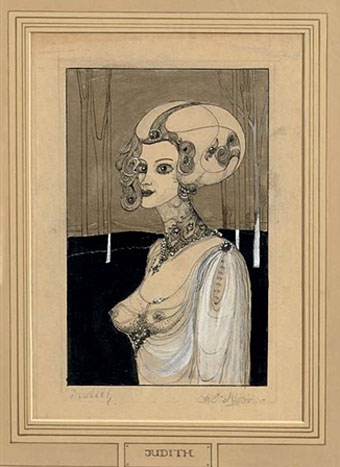
Judith (no date).

Another Decadent type who died young, de Nerée was a Dutch artist and illustrator whose work in these pictures owes a great deal to Aubrey Beardsley. As Beardsley-influenced pieces go they’re rather crude, although it’s unfair to be too judgemental since there’s so little of his work available to see online. Following yesterday’s post, it’s inevitable that he produced a Salomé picture of his own but there’s no sign of that, the curiously space-age (or alien) Judith above is the closest you’ll get.

babberich2.jpg

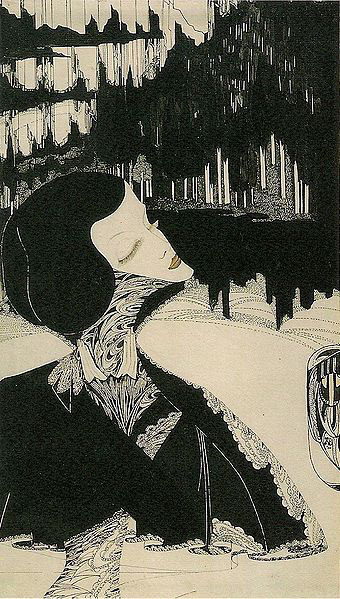
Introduction to Extaze (1900-01).

On the strength of these drawings I’d probably have de Nerée down as a post-Beardsley pasticheur similar to Alastair (aka Hans Henning Voigt) but there’s another side to his output evident in his painted works which show a far more assured Symbolist style, with a figurative approach closer to another Dutch artist of the period, Jan Toorop. It’s a shame the photos there are little more than snapshots, I’d like to see more of these. The Wikipedia article has a couple more drawings, and there’s another Beardsley-esque piece here.

babberich3.jpg

La musique (1904).

Elsewhere on { feuilleton }
The illustrator’s archive

Previously on { feuilleton }
More decorated books from the Netherlands

Several Salomés

fowler.jpg

The Dance of Salomé (1885) by Robert Fowler.

There’s always more to find… Unfortunately, Robert Fowler’s academic tableaux is a prime example of bad Victorian art: carefully modelled but overlit, dull and lifeless. And worst of all for the subject at hand: deeply unerotic. We’re supposed to believe that this woman wrapped in a bedsheet would exude enough eros to drive her father to lustful recklessness. This was the bloodless “good taste” against which Oscar Wilde and the Aesthetes set themselves.

moreau.jpg

Salomé Dancing before Herod (1876) by Gustave Moreau.

Wilde’s idea of Salomé can be seen here in one of Gustave Moreau‘s many paintings on the theme. Wilde would have preferred Moreau’s paintings, or something similar, to adorn his published play but he ended up with Aubrey Beardsley instead. You only have to compare Beardsley’s Stomach Dance with Fowler’s painting to see why Aubrey’s art made such a dramatic impression in the 1890s.

pell.jpg

Salomé (1890) by Ella Ferris Pell.

Ella Ferris Pell’s painting isn’t the only portrait of Salomé by a female artist of this period but it’s the one which Bram Dijkstra chose as the cover image for his excellent study Idols of Perversity: Fantasies of Feminine Evil in Fin-de-Siècle Culture (1986). Of this work Dijkstra writes:

In Pell’s painting a number of the most characteristic turn-of-the-century attributes of the biblical temptress are absent. She does not glare at us with a look of crazed sexual hunger; she does not have the wan, vampire features of the serpentine dancer; nor does she show herself to be a tubercular adolescent … Pell’s Salomé, a real life-woman, independent, confident, and assertive, was far more threatening, far more a visual declaration of defiance against the canons of male dominance than any of the celebrated viragoes and vampires created by turn-of-the-century intellectuals could ever have been. Such a woman could not be disposed of in as cavalier a fashion as the evil women in man’s mind. Her indomitable reality was this feminist Salomé’s most formidable weapon, far more dangerous than any imaginary decapitating sword.

henri.jpg

Salomé (1909), two paintings by Robert Henri.

Finally, there’s this pair of paintings by American artist Robert Henri whose work resembles John Singer Sargent’s in its shadowed backgrounds and light brushstrokes. Salomé was no longer a perennial theme by this point but Maud Allan’s improvised dance performance, Vision of Salomé, was proving enormously popular at the time Henri painted these pictures which may explain his choice of subject. There’s little in the rest of his oeuvre along similar lines.

Elsewhere on { feuilleton }
The Salomé archive