Particle physics

itunes1.jpg

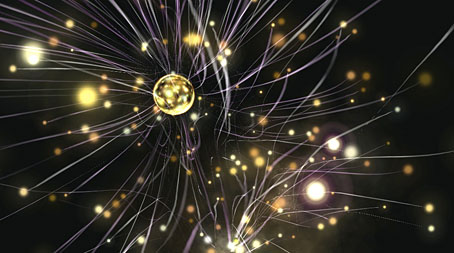
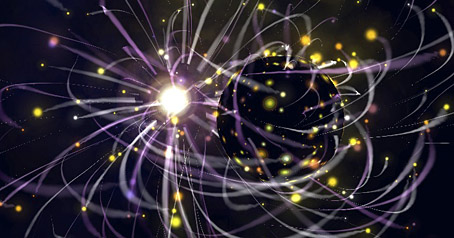
It’s perhaps fitting that in the same week (almost the same day) that the Large Hadron Collider was finally switched on, Apple should release iTunes v. 8.0. The improved Visualizer for this application generates patterns not so far removed from the graphics created to explain quantum interactions or cosmic motion. (And while we’re discussing quantum events, let’s not forget this.)

I enthused last year about the Jelly setting of the Visualizer but these new graphics are a step—a quantum leap, even—beyond that, with a variety of spinning orbs and glowing lights which shoot out streams of sparks and flares of colour. Variations can be had by pressing the M key which cycles through the settings. The abstract fish and/or spermatozoa are especially impressive the way they charge around the screen while their world revolves in three dimensions. If Jelly makes you feel like you’re on drugs, watching these new effects reacting in time to some suitably contemporary music—Aerial by 2562, for instance—makes me feel for once that I’m living in the future I expected to find this side of the year 2000.

• Nature explains what the LHC has actually been built for.
itunes2.jpg

Previously on { feuilleton }
• Aerial by 2562
• From LSD to OSX
• iTunes 7
Roger Hiorns’ crystal world

hiorns.jpg

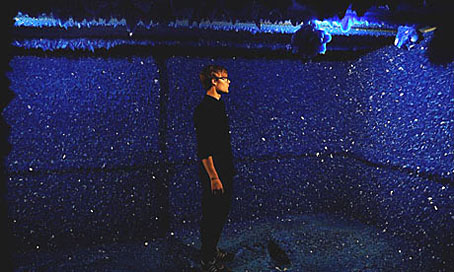
A visitor examining Seizure. Photograph by Sarah Lee.

I’d love to see this installation work which opened on Wednesday at 157 Harper Road, Southwark, London. British artist Roger Hiorns has transformed a flat awaiting demolition by growing thick mats of copper sulphate crystals on all the interior surfaces, a work he calls Seizure. Copper sulphate always brings back memories of chemistry lessons at school and childhood chemistry sets. I recall growing the crystals in a test tube but such meagre attempts at efflorescence give little indication of how beautiful these things are at a larger scale. Happily Flickr has further documentation of Hiorns’ work while Adrian Searle reviews it for The Guardian, fittingly referencing JG Ballard’s The Crystal World. “Seizure is a sort of sci-fi nightmare in Southwark, and that this happens in a council flat makes it all the more uncanny and disturbing,” he says. A shame, then, that it wasn’t situated in an empty high-rise block for maximum Ballard overload.

Seizure runs until 2 November, 2008. Artangel has location details and opening times.

Previously on { feuilleton }
• JG Ballard book covers

The Lagoon Nebula

lagoon.jpg

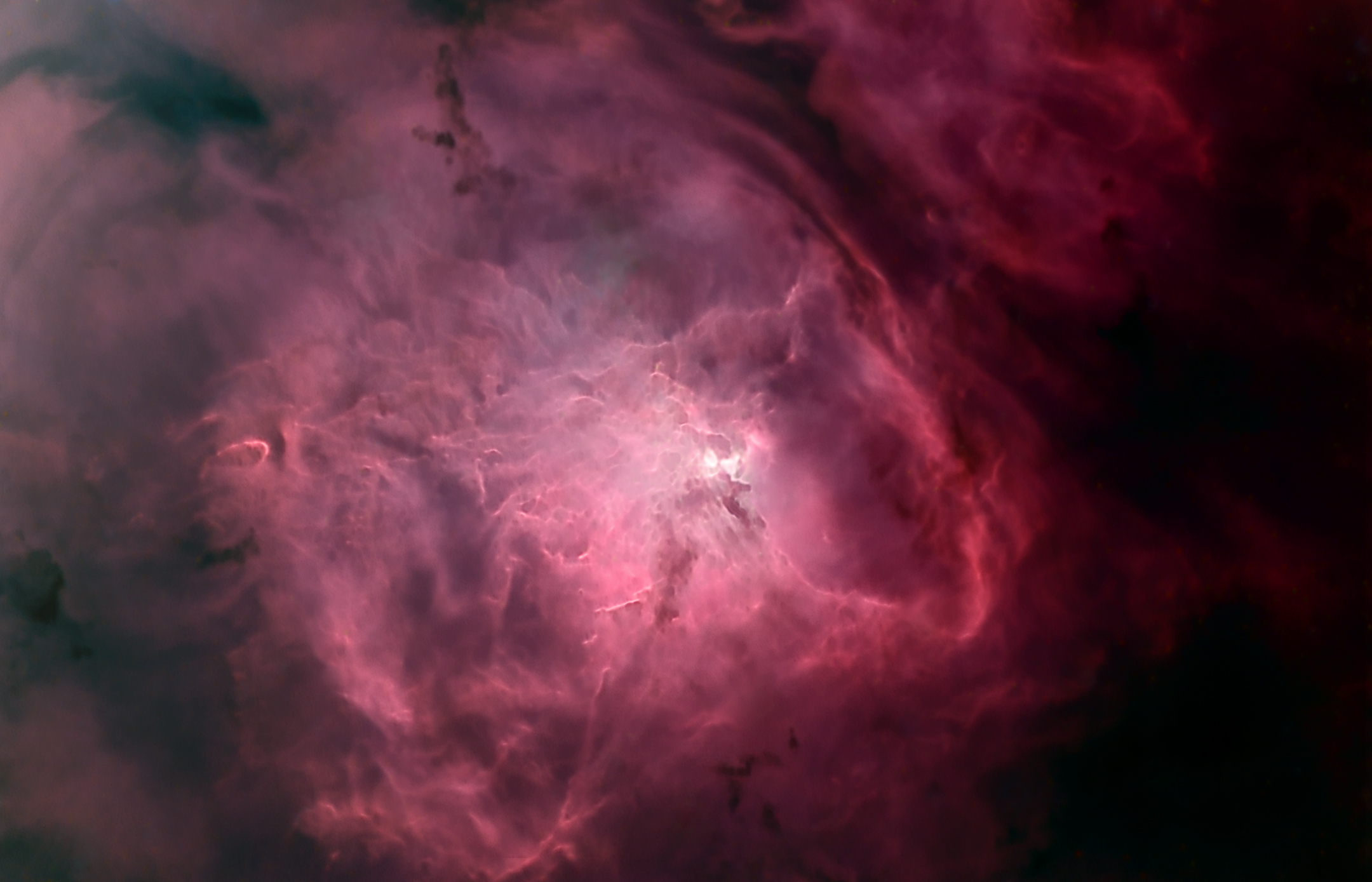
Gas and Dust of the Lagoon Nebula by Fred Vanderhaven.

The Pink Lagoon, NASA’s Astronomy Picture of the Day.

This beautiful cosmic cloud is a popular stop on telescopic tours of the constellation Sagittarius. Eighteenth century cosmic tourist Charles Messier cataloged the bright nebula as M8, while modern day astronomers recognize the Lagoon Nebula as an active stellar nursery about 5,000 light-years distant, in the direction of the center of our Milky Way Galaxy. Striking details can be traced through this remarkable picture, processed to remove stars and hence better reveal the Lagoon’s range of filaments of glowing hydrogen gas, dark dust clouds, and the bright, turbulent hourglass region near the image center. This color composite view was recorded under dark skies near Sydney, Australia. At the Lagoon’s estimated distance, the picture spans about 50 light-years.