Illustrating Hyperborea

hyperborea00.jpg

The Book of Hyperborea (1996). Cover art by Robert H. Knox.

“My Hyperborean tales, it seems to me, with their primordial, prehuman and sometimes premundane background and figures, are the closest to the Cthulhu Mythos, but most of them are written in a vein of grotesque humor that differentiates them vastly.” — Clark Ashton Smith

Since re-reading Clark Ashton Smith’s The Tale of Satampra Zeiros I’ve been revisiting more of Smith’s stories set in the lost world of Hyperborea. And having put together a post some years ago that gathered all the original illustrations for Smith’s Zothique cycle, I thought I’d try and do the same for another of his story series. As I noted in the earlier post, we’re fortunate today that it’s so easy to see illustrations that in the past would have been impossible to find unless you owned (or had access to) a huge collection of pulp magazines. Pulp illustrations aren’t always very good—in the case of the early issues of Weird Tales, they’re frequently amateurish—but those that illustrate new fiction for the first time are historically important if nothing else.
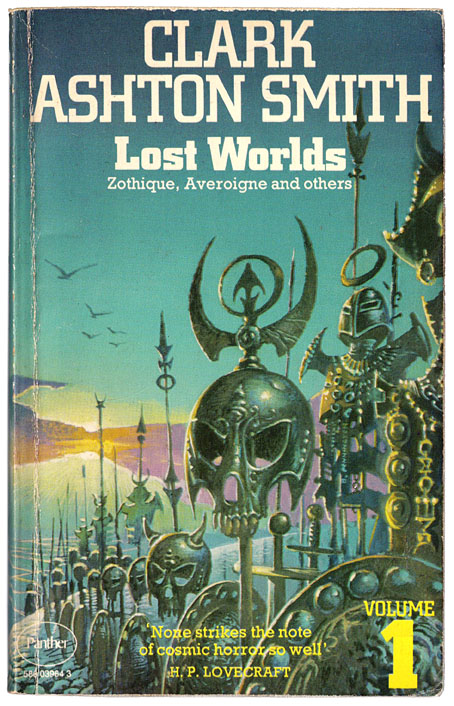
pennington1.jpg

Lost Worlds: Volume 1 (1974). Cover art by Bruce Pennington. Lost Worlds was a single-volume collection published by Arkham House (USA) and Neville Spearman (UK). The Panther paperback covers by Bruce Pennington could easily be used on other books but these were the first Smith volumes I owned.  

The first Hyperborea stories were among Smith’s earliest prose fantasies, owing something to Lord Dunsany on the one hand (HP Lovecraft detected a Dunsanian quality), and the writers of antiquity on the other, the name “Hyperborea” (“Behind the North Wind”) being borrowed from the Greeks. The northern location is about the only feature of the continent that the Greek writers would recognise, Smith’s world being a temperate pre-Ice Age realm of mountains and verdant jungles. Dinosaurs and megafauna share the lands with human inhabitants for whom sorcery is a common practice. As with Zothique, the cycle was an influential one. Lin Carter in the introduction to his Ballantine collection, Hyperborea (1971), suggests that the name of the continent might have prompted Robert E. Howard to set his Conan stories in “the Hyborean Age”. This could be the case: Howard and Smith were writing for the same publications, and the first Conan story was published in Weird Tales shortly after The Tale of Satampra Zeiros; but Howard was also reading the Greeks as well. A more substantial influence may be found in Fritz Leiber’s Nehwon, a world in which aspects of Hyperborea and Zothique are combined. Sword and sorcery begins “behind the North Wind”, in other words, although there’s very little sword-play in Smith’s fiction, that was Leiber and Howard’s department.
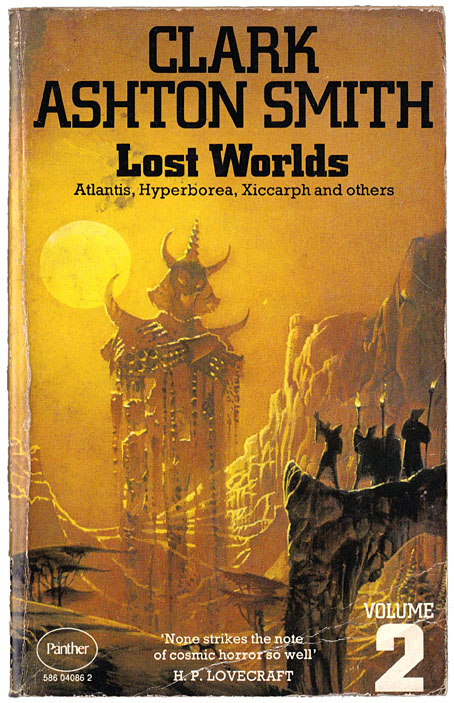
pennington2.jpg

Lost Worlds: Volume 2 (1974). Cover art by Bruce Pennington.

The original Hyperborea illustrations are fewer than those for Zothique. As with the later cycle, several of the stories are unillustrated, while others were given lacklustre artwork. In the earlier post I followed the story order chosen by Lin Carter which attempted to contrive an internal chronology for the cycle. Carter did the same with his Hyperborea collection so I’ve followed his example once again. Later collections, like Will Murray’s Book of Hyperborea, tend to order the stories by publication date.
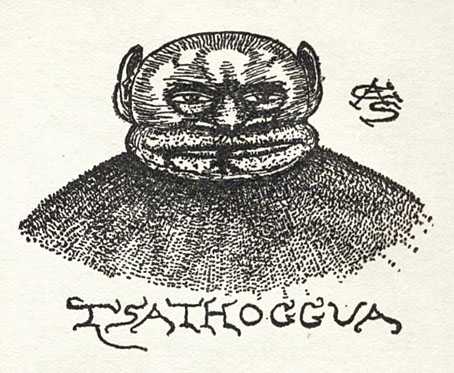
hyperborea01.jpg

The Seven Geases, Weird Tales, October 1934.

An illustration of Tsathoggua by Smith himself. The toad-god turns up in person in this story.
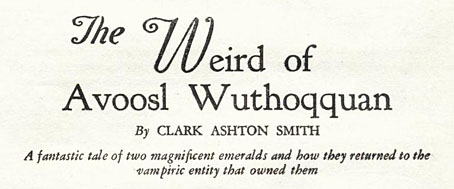
hyperborea02.jpg

The Weird of Avoosl Wuthoqquan, Weird Tales, June 1932.

Continue reading “Illustrating Hyperborea”

Nightmare Alleys

nightmare05.jpg

Undated paperback.

My reading this week has been William Lindsay Gresham’s Nightmare Alley, a novel I’d been intending to read for some time after becoming familiar with the story from the first film adaptation. (I haven’t seen the recent version.) Whenever I’m reading a novel that’s been around for a while I have to see how it was presented in the past by designers and illustrators. Nightmare Alley was published in hardback originally, and the book today is marketed as a literary classic, but Gresham’s account of cheap carnivals and fraudulent mediums is sufficiently lurid enough to warrant a variety of different treaments, including pulp excess. The paperback at the top of this post is an extreme example but the cover could easily be applied to any number of noirish thrillers, there’s nothing in the artwork to suggest the carny world or the Spiritualism that the novel’s protagonist, Stanton Carlisle, mercilessly exploits.

nightmare01.jpg

First edition, USA, 1946.

The first edition isn’t a great design but it happens to be faithful to the core storyline, more so than many of the covers that follow. In the film we’re left to guess what the “nightmare alley” of the title might be but in the novel this is a symbol that recurs throughout the story, a literal nightmare of Carlisle’s in which he dreams he’s being chased down a dark alleyway towards a light that remains continually out of reach. The dream weighs enough on Carlisle’s mind for him to regard it as a symbol of the human condition, or at least his soured perception of the same. The cover of the first edition combines this image with the Tarot trump of The Hanged Man which Carlisle turns up in a reading as a signifier of his destiny. Tarot scholars may quibble with this detail—The Hanged Man isn’t as doom-laden or negative as the novel suggests—but Gresham makes good use of Tarot as a structural element, with each chapter named after one of the trump cards, and with elements of the story reflecting the Tarot imagery. Given all this you’d expect cover artists to use Tarot symbolism much more than they do.

nightmare03.jpg

First paperback edition, USA, 1948.

Another odd omission is the colour of Carlisle’s hair which the novel repeatedly tells us is blond. When Carlisle begins his career as a phony preacher and medium his blue-eyed “golden boy” persona is one of his tools for charming and deceiving wealthy widows. Gresham reinforces this in the chapter named after The Sun trump card by having Carlisle identified with the god Apollo. The film adaptations and almost all of the book covers ignore this detail.

nightmare02.jpg

Film tie-in, USA, 1948.

The 1947 film adaptation was directed by Edmund Golding from a screenplay by Jules Furthman. The storyline is condensed and inevitably sanitised for the screen but it’s still one of the best film noir entries from the prime noir decade.

nightmare04.jpg

Art by James Avati, USA, 1949.

James Avati was one of the great paperback illustrators yet even he gives Carlisle dark hair. I suspect by this point everyone expected as much after Tyrone Power’s memorable performance.

nightmare06.jpg

USA, 1986.

And Power’s saturnine features are still providing the dominant image forty years later.

Continue reading “Nightmare Alleys”

Enfantômastic!

fantomas01.jpg

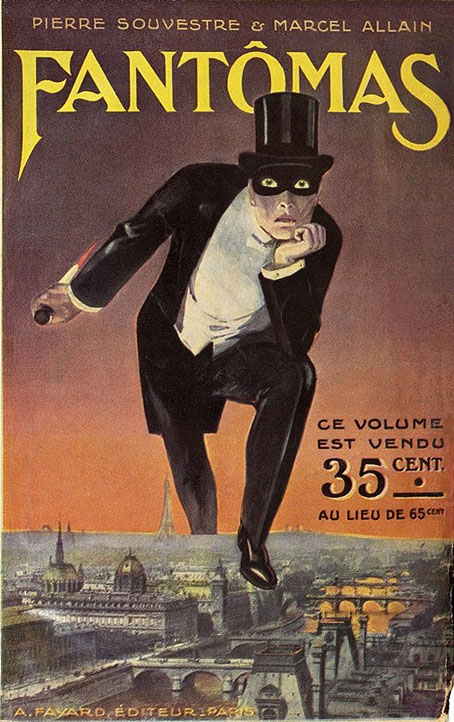
Uncredited cover art for the first publication, 1911.

The post title is a word apparently invented by James Joyce, one whose origin I’ve yet to discover. There may be some slight disparagement in its use of “enfant”, a suggestion that the Fantômas novels (or the films derived from them) were childish pleasures. If so, those childish pleasures had many supporters among the cultural avant-garde of Paris, as we’ll see below.

fantomas02.jpg

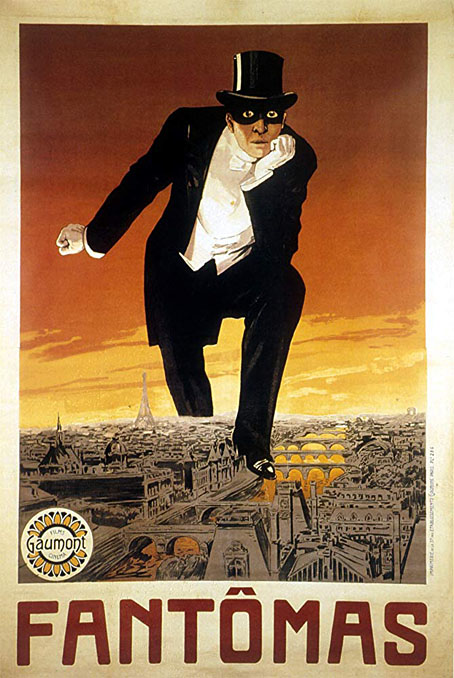
Uncredited poster art, 1913. The blood-stained dagger on the cover of the novel was too much for Gaumont.

This isn’t the first time I’ve written about Fantômas, the master criminal whose exploits thrilled French readers in the years before the First World War. But I’m writing now having finally read a translation of Marcel Allain and Pierre Souvestre’s first Fantômas novel, and also watched the five Louis Feuillade films which introduced Fantômas to an international audience in 1913 and 1914. The novel was worth reading even though it doesn’t rise much above the pulp fiction of the time; Allain and Souvestre were writing in haste, their books were never going to win any literary awards. Fiction doesn’t have to be finely-crafted in order to capture the popular imagination (look at James Bond…), but Fantômas is unusual for being so popular while also being essentially formless: a persistently elusive criminal mastermind with no substantiated identity that the police can discover, whose prowess with disguise enables him to infiltrate French society at all levels. Criminal masterminds are plentiful in English literature but they’re usually hiding in the background of stories with heroes as the central character, as with Professor Moriarty and Sherlock Holmes. Guy Boothby’s Doctor Nikola has Fantômas-like qualities but he’s a more ambivalent character, less of an outright villain. A closer English comparison might be Fu Manchu whose first appearance in print was in 1912, a year after the literary debut of Fantômas. The rivalry between Fu Manchu and Denis Nayland Smith of Scotland Yard matches the tireless pursuit of Fantômas by Inspector Juve of the Sûreté; yet Fu Manchu still has a personal history and, in the later novels, motivations beyond mere criminality. Nothing is known of Fantômas outside his criminal endeavours. His character is so nebulous that one of the later stories sees Inspector Juve arrested after his superiors have convinced themselves that he must be the real hand behind the Fantômas crimes.

fantomas03.jpg

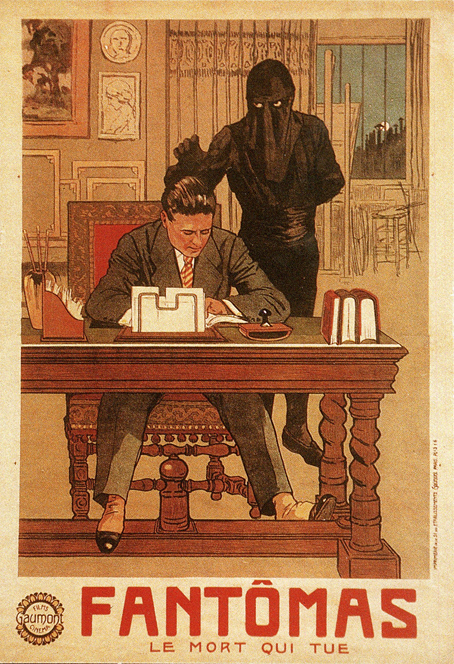
Uncredited poster art, 1913. Fantômas is about to turn his unwitting victim into “The Corpse that Kills”.

On an artistic level the Feuillade adaptations are much more satisfying than their source, even though Fantômas in the films isn’t as triumphantly murderous as he is in the books. After years of only knowing the adaptations from blurred and washed-out stills it’s been a revelation to see the recent Gaumont restorations which have been mastered from the best available prints, cleaned of scratches and other flaws, and projected at the proper speed. The Feuillade serials have circulated for years in inferior copies but I’d always held off watching them in the hopes that better prints might arrive. I’m glad I waited. Cinema was still a young medium in 1913 but Feuillade was a good director, skilled at creating suspense and engineering sudden surprises. He was also working with a decent troupe of actors, especially René Navarre as the villainous leading man. The misconception that early silent acting is all grandiose gestures and exaggerated facial expressions is dispelled in films like these where the acting is generally restrained even when the subject matter is lurid and melodramatic.

fantomas04.jpg

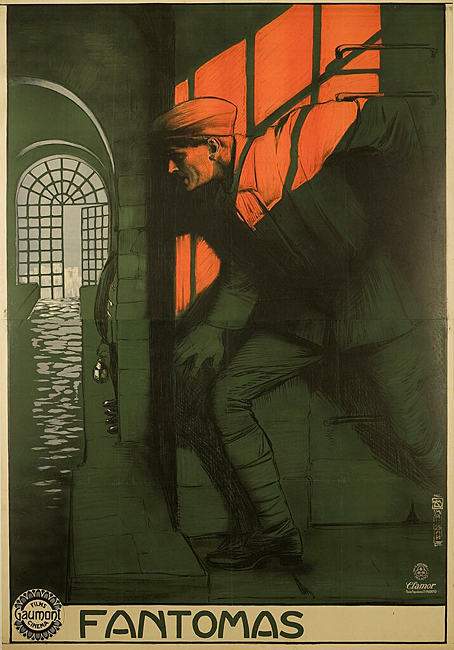
Poster art by Achille Mauzan, 1913.

The UK release of the Feuillade films by Eureka happens to arrive just after 100th anniversary of the first Surrealist Manifesto, a coincidence, no doubt, but a fitting one. The Surrealists enjoyed the “waking dream” quality of the cinema experience, and were especially besotted with Feuillade’s Fantômas serials:

Over the next two decades, Fantômas was championed by the Parisian avant-garde, first by the young poets gathered around Guillaume Apollinaire, who, together with Max Jacob, founded a Société des Amis de Fantômas in 1913, and later by the Surrealists. In July 1914, in the literary review Mercure de France, Apollinaire declared the imaginary richness of Fantômas unparalleled. The same month, in Apollinaire’s own review, Les Soirees de Paris, Maurice Raynal proclaimed Feuillade’s Fantômas saturated with genius. Over the next two decades, poets such as Blaise Cendrars (who called the series “The Aeneid of Modern Times”), Max Jacob, Jean Cocteau, and Robert Desnos, and painters such as Juan Gris, Yves Tanguy, and René Magritte, incorporated Fantômas motifs into their works. Pierre Prévert’s 1928 film, Paris la Belle, featured a Fantômas book cover in the closing sequence, and the Lord of Terror was adapted to the Surrealist screen in Ernest Moerman’s 1936 film short, Mr. Fantômas, Chapitre 280,000. As the century progressed, Fantômas remained a minor source of artistic inspiration as the subject of cultural nostalgia.

Robin Walz from Serial Killings: Fantômas, Feuillade, and the Mass-Culture Genealogy of Surrealism (1996)

All of which has had me searching for examples of the above, some of which I hadn’t seen before. Fantômas was a recurrent source of inspiration for René Magritte yet “the Lord of Terror” is often reduced to a footnote in discussions of Magritte’s career. The appropriation of the name of Fantômas, along with motifs from the novels and films, is a unique moment in art history, one that points the way to the further appropriations of Pop Art and the cultural free-for-all we see in the art world today.

Continue reading “Enfantômastic!”

The art of Hannes Bok, 1914–1964

bok01.jpg

Altars of Patagonia (1946)

Like the huge cache of Virgil Finlay art that turned up at the Internet Archive a couple of years ago, the pictures here are from a two-volume collection made by an enthusiast gathering together yet more illustrations from the pulp magazines of the 1940s and 50s. Hannes Bok (real name Wayne Francis Woodard) wasn’t as prolific as Virgil Finlay, but the careers of the two men intersected in the pages of Weird Tales where they both used stipple shading to compensate for the poor reproduction of pulp paper. Bok’s work tended to be more stylised than Finlay’s, with a quirkiness that makes his art easy to spot once you’ve seen a few examples.

bok02.jpg

Boomerang (1947)

The two volumes contain a total of over 300 illustrations so any selection will only be a small sampling. Many of the drawings were new to me. The first volume is mostly work from magazines such as Weird Tales and the minor SF mags; the second includes book covers, calendar illustrations and other work. As with the Finlay collections, both volumes are available in a range of file formats which include cbz files, a format I prefer to pdf for browsing image-heavy documents. For more about cbr/cbz files, see the end of this post.

bok03.jpg

Cross of Mercrux (1942)

bok04.jpg

Daughter of Darkness (1941)

bok05.jpg

Dimensional Doors (1944)

Continue reading “The art of Hannes Bok, 1914–1964”

Weekend links 661

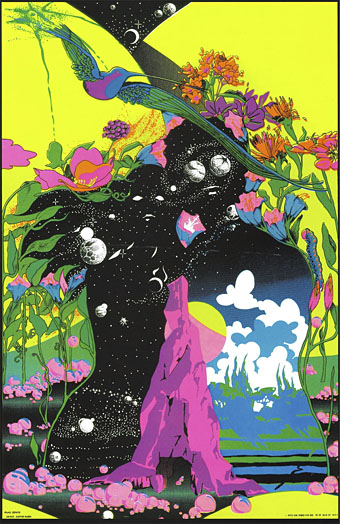
rubin.jpg

Zephyr (1970), a blacklight poster by Jupiter Rubin. Via.

• I wouldn’t usually expect Clark Ashton Smith’s Zothique to be mentioned at Literary Hub for any reason, but there it is. Emily Temple recommends some of the best stories from a century of Weird Tales that you can read online.

• Mixes of the week: A mix for The Wire by Gamut Inc, and The Last of Us, “a non-stop mix of ambient soundscapes, experimental electronics and modern classical music”.

• “…Yaggy believed that wonder was the helpmate of learning.” Sasha Archibald on Levi Walter Yaggy’s Geographical Maps and Charts (1887/93).

Stylistically, Beardsley’s pictures for Salome are among his most derivative and original. In the sharpness of their lines and great swaths of black and white, we see the well-documented influences of Japanese woodcuts and Ancient Greek vase-painting. And yet, Beardsley’s work bridges these grand traditions of East and West with such fresh dynamism and taboo as to be undeniably, and ultimately definitionally, Nouveau.

Mirror and Window Both: The Brief Superabundance of Aubrey Beardsley by A. Natasha Joukovsky

• New music: Rhinog Fawr by Somatic Responses, and Sargo/Posidonia by Sleep Research Facility/Llyn Y Cwn.

• “Why is there such a voracious consumer appetite for miniature things?” asks Steven Heller.

• At Dennis Cooper’s: Spotlight on…Julio Cortázar Blow Up and other Stories (1967).

• At Unquiet Things: The Prolific Pioneering Pulp Art Of Ed Emshwiller.

Random images from DJ Food’s desktop.

Miniature Sun (1989) by XTC | Adventures In A Miniature Landscape (2009) by Belbury Poly | Miniature Magic (2020) by Plone