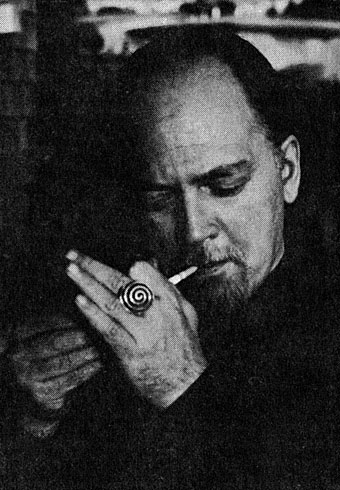
Robert Anton Wilson, 1932–2007

raw.jpg

There are few people who really change your life but Robert Anton Wilson—who died earlier today—certainly changed mine. Wilson’s Illuminatus! trilogy (written with Robert Shea) was my cult book when I was at school in the 1970s, a rambling, science fiction-inflected conspiracy thriller that opened the doors in my teenaged brain to (among other things) psychedelic drugs, HP Lovecraft, James Joyce, William Burroughs and Aleister Crowley as well as being a crash-course in enlightened anarchism. I’ve had people criticise the books to me since for their ransacking of popular culture but this was partly the point, they were collage works, and they worked as a perfect introduction for a young audience to worlds outside the usual circumscribed genres.

The philosophical side of Wilson’s work was probably the most important at the time (and remains so now), his “transcendental agnosticism” made me start to question the adults around me who were trying to force my life to go in a direction I wasn’t interested in at all. I’m sure I would have resisted that kind of pressure anyway but the value of RAW’s writings in Illuminatus! and the later Cosmic Trigger came with being given an intelligent rationale for those decisions; I couldn’t necessarily articulate why I was “throwing my life away” by wanting to drop out of the whole education system but Wilson’s work had convinced me it was the right thing to do. I still mark the true beginning of my life as May 1979, the month I left school for good.

He wouldn’t want us to be maudlin, I’m sure. It’s typical for a writer who spent so much of his life writing about drugs and coincidences that he managed to die on Albert Hofmann’s birthday. So I’ll just say thank you Robert, for changing my life. And Hail Eris!

Previously on { feuilleton }
The Absolute Elsewhere

Another blow for the god squad

mob.jpg

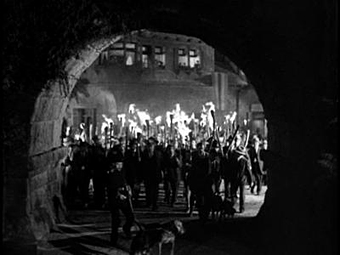
A mob on the march from Frankenstein (1931).

That’s blow as in bludgeon, not, er, smoking drugs or oral sex… From the BBC:

New rules outlawing businesses from discriminating against homosexuals have been upheld in the House of Lords.

A challenge led by Lord Morrow of the Democratic Unionist Party failed by a majority of three to one.

He had argued that the rules forced people to choose between obedience to God and obedience to the state.

But Northern Ireland Minister Lord Rooker said it would be “quite wrong” to elevate the rights of one group above those of another.

In the time-honoured tradition of angry mobs everywhere, “Christian and Muslim groups … stage(d) a torchlit protest outside the House of Lords tonight against a proposed new gay rights law that they say would force them to “actively condone and promote” homosexuality.” The law would do nothing of the sort but these aren’t the kind of people to worry themselves with inconvenient facts. No reports as to whether they were carrying nooses and pitchforks along with their flaming brands but their chilly vigil was in vain, the challenge was defeated by 199 votes to 68. As Warren Ellis so aptly put it: “House Of Lords To Homophobes & Intolerant Christians: Shut The Fuck Up”. Amen to that. Polly Toynbee had a great piece of polemic in The Guardian eviscerating the litany of nonsense being used to support the challenge. All this and the iPhone too; that’s what I call a good day.

Reasons to be cheerful

Forty-six percent of white evangelical Christians believe it’s at least somewhat likely that Jesus Christ will return in 2007, while 22 percent believe it’s very likely. Thirty-four percent of Protestants say it’s at least somewhat likely, compared with 17 percent of Catholics. Ten percent of those with no religion believe that Christ is at least somewhat likely to return in 2007.

Er, okay…. That paragraph should have the word “American” in it, of course.

If you’d like some prognostication from Americans (and others) with brains, the essential Edge.org has unveiled its annual question to scientists, philosophers and futurologists, the subject this time being “What are you optimistic about? Why?”. Lots of juicy speculation from people whose thoughts and opinions are a deal more informed than the usual gaggle of pundits. “The future may be a bit more like Sweden and a bit less like America,” says Brian Eno. Looking at the statistics above, let’s hope so.

Angels 6: Paradise stands in the shadow of swords

stuck_angel.jpg

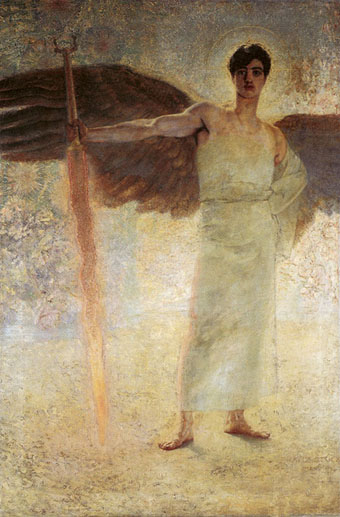
The Guardian of Paradise by Franz Stuck (1889).

We’ll let Coil have the final word on the angel theme, the post title being taken from their Cathedral In Flames. Those words recognise—as does the painting above—that the Christian concept of Heaven is of a gated community guarded by warriors to keep the undesirable at bay.

Symbolist painter Franz Stuck was (as far as we know) robustly heterosexual but his angel isn’t far removed from the work of contemporary photographers like Anthony Gayton who specialise in teasing out the erotic undercurrents in this kind of imagery. Which brings us full circle, seeing as we started with Caravaggio and his distinct brand of religious subversion. The irony is that some of the more vocal elements of Christianity can’t help subverting themselves or their own messages, as John Patterson notes in his Guardian piece today, alluding not only to the Ted Haggard debacle but also to Haggard’s favourite artist, Thomas Blackshear, both of whom were discussed here in November. Patterson writes that the recent brand of bigoted fervour that’s swept America seems to have abated, or at least retreated, after threatening to become a mainstream force. Europe often seems a haven of healthy heathen sanity by comparison, a part of the undesirable world being kept outside the American Paradise. St. Peter now demands retinal scans, fingerprints and a biometric passport. Continual rumbles from Pope Maledict and his closeted cardinals are an increasing irrelevance, the background static of a dying regime. Paradise may be guarded by attractive angels but we can only look and never touch. As Patterson says, the devil has all the best tunes. And the best books and movies and games. And sex and fun. I know which side of the fence I’d rather be on.

Elsewhere on { feuilleton }
The gay artists archive
The men with swords archive

Previously on { feuilleton }
Gay for God

Death from above

bombs.jpg

The apocalyptic spectacles of Romantic painter John Martin are routinely treated by art critics as kitsch, a dismissal which ignores the considerable power and perennial attraction that many of his best pictures possess. Kitsch is a bad thing, it seems, unless you’re Jeff Koons or Jake and Dinos Chapman.

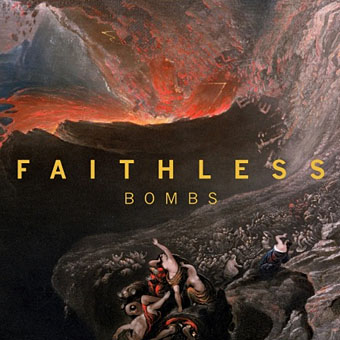
Martin’s most famous work, The Great Day of His Wrath, has raised its tumultuous head again on the cover of Bombs, a recent single by Faithless. The painting depicts a scene from the Book of Revelations with city-capped mountains being upturned onto terrified sinners while lightning cuts through the sky. The video for the song is an anti-war affair by Howard Greenhalgh, juxtaposing innocuous images of everday life with weapons being fired and soldiers being attacked, often in the same shot. So a happy family skips along a beach while a mushroom cloud grows on the horizon. The moral guardians at MTV have duly banned this in order to spare the delicate sensibilities of America’s teenagers. And they wonder why people like YouTube so much? Or Google Video?

heresy.jpg

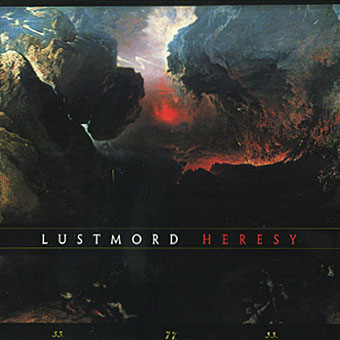
Faithless are a bit late to John Martin’s table, Lustmord featured the painting in full on the cover of Heresy in 1990, an album whose doomy rumbles I much prefer to the duo’s lightweight soul. Better late than never, I suppose.

Previously on { feuilleton }
The apocalyptic art of Francis Danby
The Enigma of Desiderio