Weekend links 472

isono.jpg

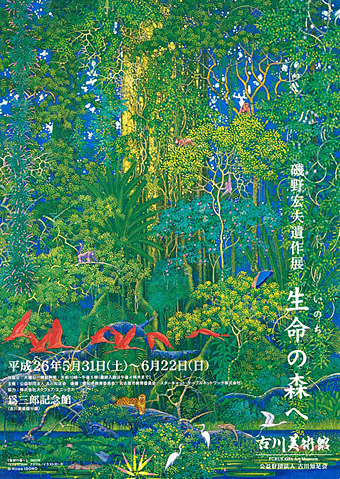
Poster art by Hiroo Isono.

• “[Divine] didn’t want to pass as a woman; he wanted to pass as a monster. He was thought up to scare hippies. And that’s what he wanted to do. He wanted to be Godzilla. Well, he wanted to be Elizabeth Taylor and Godzilla put together.” I can’t help linking to yet another John Waters interview when he always has things like this to say.

• Fifty shades of grey: great towers of the Eastern bloc photographed by David Navarro & Martyna Sobecka.

• Seeking Beastliness and Defining Beauty: Clive Hicks-Jenkins on visualisations of Beauty and the Beast.

Fire Temple by Bobby Krlic (The Haxan Cloak) from the Midsommar soundtrack.

Brad Jolliff & Mark Robinson on the scientific legacy of the Apollo programme.

John Boardley on Renaissance memes and the chemical pleasure garden.

• “It’s important to go out and feel the so-called reality,” says David Lynch.

Peter Strickland talks to Robert Barry about his new film, In Fabric.

Nico in Manchester: “She loved the architecture—and the heroin”.

• Mix of the week: Secret Thirteen Mix 292 by Paco Sala.

• Andrei Codrescu on the many lives of Lafcadio Hearn.

Hiroo Isono: Into the Depths of the Sacred Forest.

• At Dennis Cooper’s: Queer.

The Beast (1956) by Milt Buckner | The Beast (1989) by Rhythm Devils | Beast (1994) by Brian Eno
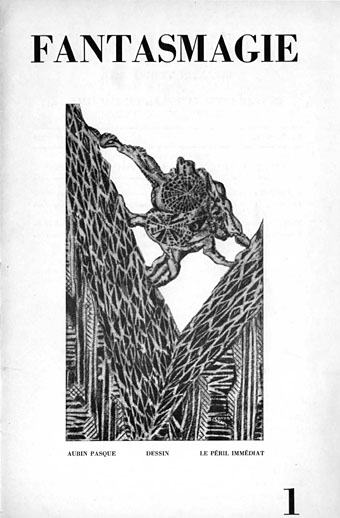
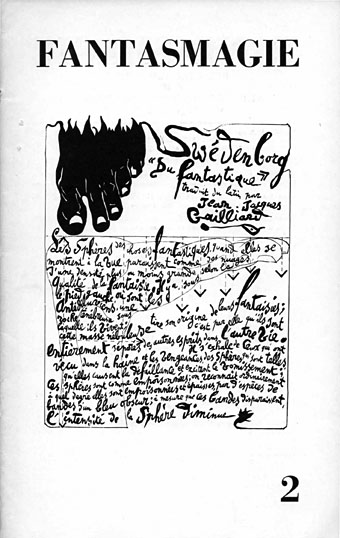
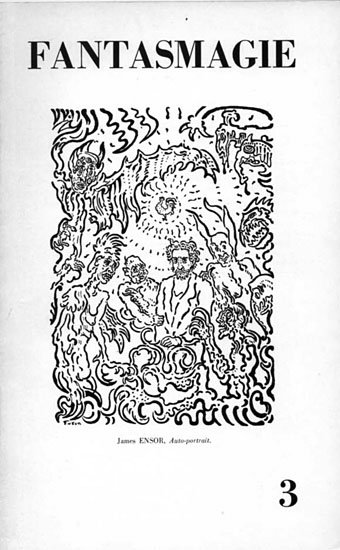
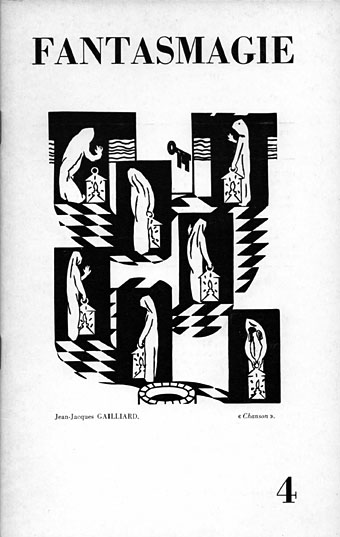
Fantasmagie

fantasmagie01.jpg

Another post with a Belgian theme (a coincidence despite my present preoccupation with Franco-Belgian culture), and another that has to be filed under “further research required”. The splendidly titled Fantasmagie was founded by author Serge Hutin and artist Aubin Pascale, and was the newsletter/review for the Centre International pour l’étude de l’Art Fantastique et Magique. 52 issues were published from 1959 to 1979 charting the Belgian continuation of the Surrealist project.

fantasmagie02.jpg

I’d been hoping there might be a collection of all the issues online somewhere but this isn’t the case to date. However, the first 11 issues may be browsed in full at Scribd or downloaded if you use one of the PDF scrapers (search for “Scribd free”). Each issue showcases art by contemporary Surrealists or practitioners of what Ernst Fuchs called Fantastic Realism, all of which was of little interest to the art establishment of the time so from our perspective the artists are fresh discoveries. Issue 8, which is a collage special, is especially good.

fantasmagie03.jpg

fantasmagie04.jpg

Continue reading “Fantasmagie”

The art of Jacob Bendien, 1890–1933

bendien07.jpg

Corner of a Canal (1919–20).

This week’s post is another by Sander Bink about a Dutch artist whose work may be unfamiliar to those outside the Netherlands. Jacob Bendien was certainly new to me. My thanks again to Sander for the post.

* * *

Jacob Bendien, born in Amsterdam in 1890, was one of the pioneers of abstract art (“absolut art” as Bendien and kindred artistic spirits called it) but is nevertheless little known in the Anglophone world. In the Netherlands he is not ignored or forgotten since he is mentioned in most overviews of early Dutch abstract art. Bendien’s work belongs to a somewhat later period than the other Dutch artists in this series but can be related thematically via his roots in the mystical/Symbolist art from around 1900.

Although Bendien was an early admirer of Mondrian’s art, his work differs from Neo-plasticism in its use of lines and round forms instead of bars and straight lines.

bendien01.jpg

Composition (1912); Stedelijk Museum, Amsterdam.

bendien02.jpg

Peinture I (1912); Centraal Museum, Utrecht.

Two examples of Bendien’s early abstractions are the graceful oil-on-canvas Composition from 1912, and the slightly Surrealist portrait Peinture I from the same year.

bendien03.jpg

Amsterdam Canal (1916).

Somewhere between Surrealism, Modernism and Symbolism is the lithograph Amsterdam Canal which could just as well be a décor for some German Expressionist movie from the 1920s.

bendien04.jpg

Seven Masks (1917); Museum Belvédère, Heerenveen.

Surreal and Redon-like is his chalk drawing Seven Masks from 1917.

bendien05.jpg

Melancholy (1917).

Around 1916 Bendien made some drawings which seem to be directly inspired by Dutch Decadent-Symbolist artist Carel de Nerée (see this Dutch article) of which his self-portrait Melancholy is a fine example.

bendien06.jpg

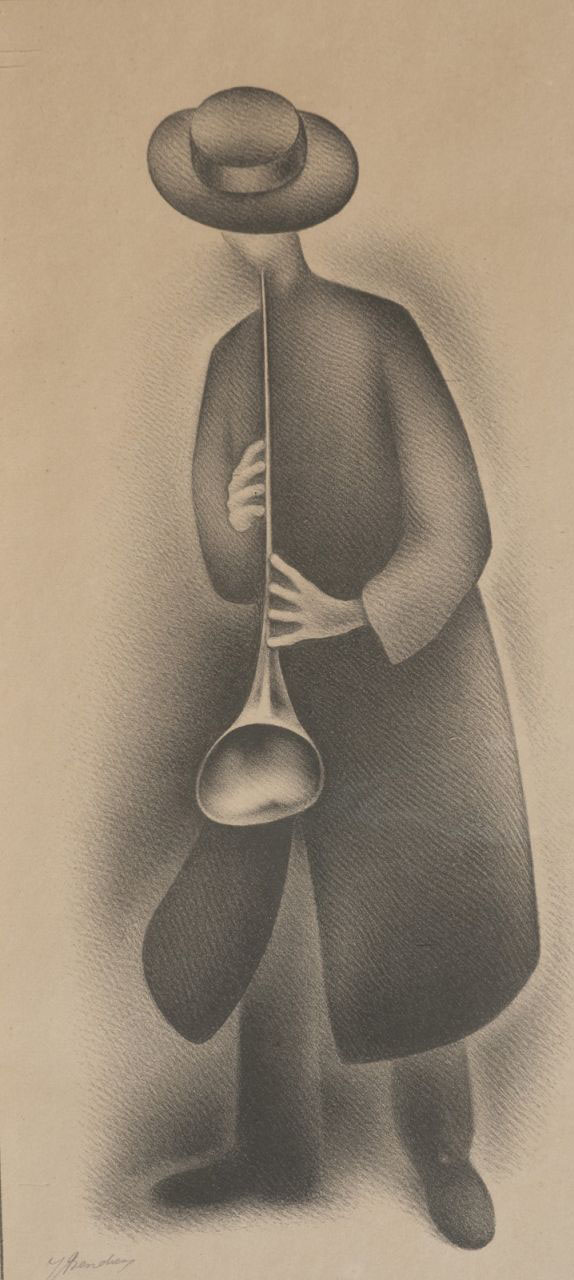
Musician.

More realist but quite endearing is his Musician lithograph from the early 1920s.

As far as I know the last Bendien exhibition was in Utrecht in 1985. His work is hard to find and rarely offered on sale although if one is lucky one can find his lithographs.

Sander Bink

Previously on { feuilleton }
The art of Henricus Jansen, 1867–1921
The art of Antoon van Welie, 1866–1956
The art of Simon Moulijn, 1866–1948
René Gockinga revisited
Gockinga’s Bacchanal and an unknown portrait of Fritz Klein
More from the Decadent Dutch

The art of Maurice Wade, 1917–1991

wade1.jpg

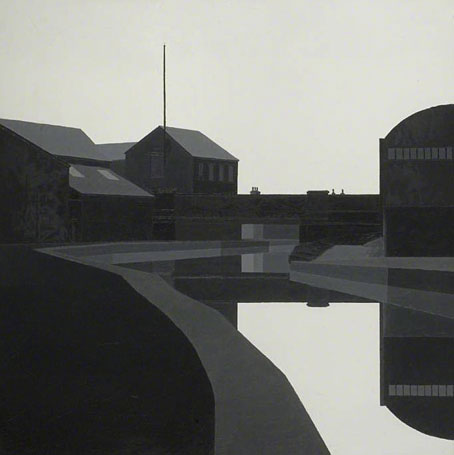
Canal at Longport (1970s).

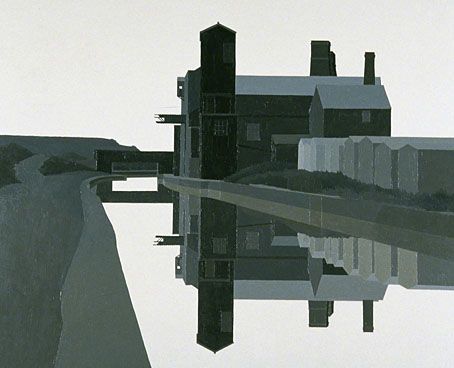
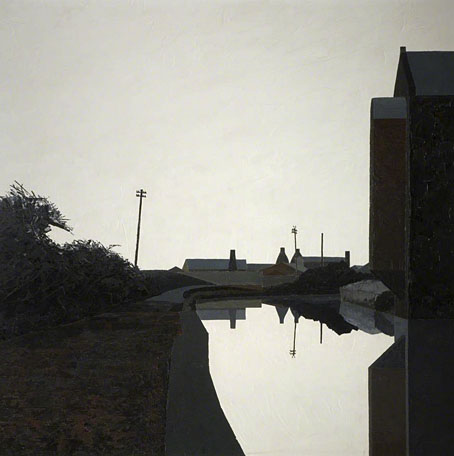
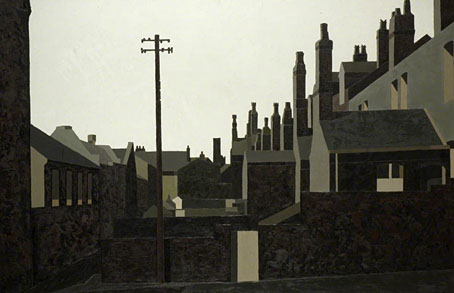
Maurice Wade‘s paintings of factories and back streets in Staffordshire are perfect examples of what the I Ching would call “accumulation through restraint”, using a flat rendering and a limited palette to achieve effects that a more detailed examination would fail to capture. Many of Algernon Cecil Newton‘s paintings possess the same stillness, and also depict the parts of urban Britain that are usually shunned as artistic subjects—in the case of canals, the literal backwaters—but Wade’s paintings are even more depopulated, silent and still. Henry Birks discusses Wade’s life and work here, noting that the artist painted over 300 landscapes. He’s evidently overdue for greater recognition.

wade2.jpg

Canal at Middleport (1976).

wade3.jpg

Canal at Longport III (1970s).

wade4.jpg

Kitchen Chimneys (1964).

Previously on { feuilleton }
Valette’s steam and smoke

Weekend links 460

treister.jpg

Black Hole (1987) by Suzanne Treister.

• “Most people who are considered heroes are always to be found messing about in someone else’s affairs, and I don’t think that’s very heroic.” Robert Altman talking in 1974 to Jan Dawson about The Long Goodbye.

• “Tea is calming, but alerting at the same time.” Natasha Gilbert on the science of tea’s mood-altering magic.

• Alien spaceship, Hammer horror? Philip Hoare on the pulsating visions of Harry Clarke.

“…world cinema, particularly European cinema…hasn’t shied away from sex and, in fact, has often found ways of using sex to tell a story. Movies like The Duke of Burgundy or Sauvage or BPM gracefully integrate eroticism into the narrative—even when the sex itself is far from graceful. Even the American films that have focused on sex tend to do it with a leer and luridness, regarding sex with a certain narrative fetishism, as opposed to matter-of-factly.”

Rich Juzwiak talking to Catherine Shoard about the current state of sex in the cinema

• Chernobyl again: photographs by David McMillan from inside the exclusion zone.

Lasting Marks: the 16 men put on trial for sadomasochism in Thatcher’s Britain.

• Before Tarkovsky: Michael Brooke on the Russian TV adaptation of Solaris.

• Mix of the week: XLR8R Podcast 588 by Rouge Mécanique.

• Dustin Krcatovich on The Strange World of Mark Stewart.

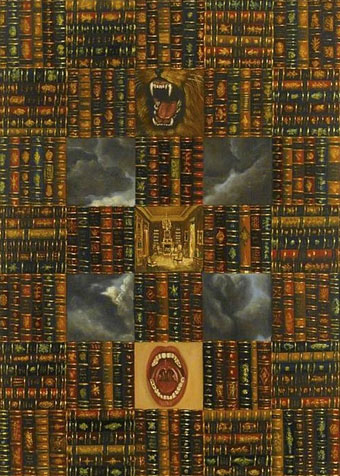
• Your Surrealist literature starter kit by Emily Temple.

John Peel’s Archive Things (1970)

5fathom: Things rich and strange

Hole In The Sky (1975) by Black Sabbath | Thru The Black Hole (1979) by Metabolist | Black Hole (1993) by Total Eclipse