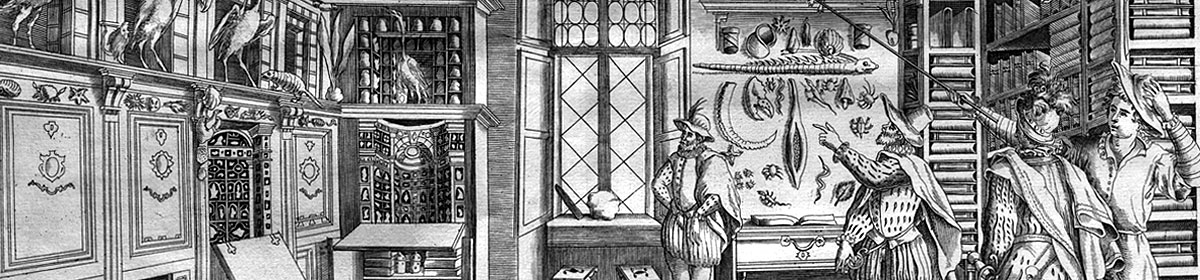
Daunting, dazzling – and doomed
| The Tower of Babel.
Category: {painting}
Painting
The art of Fred Tomaselli
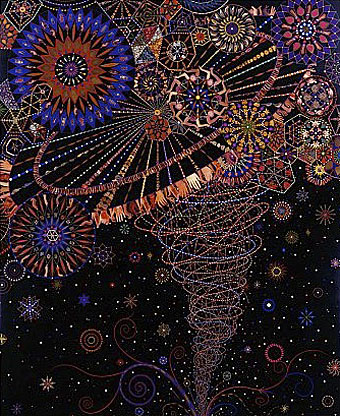
Abductor (2006).
Two examples from this gallery selection. There’s more at White Cube.

Halo of Flies (2006).
Previously on { feuilleton }
• Yoshitaka Amano in Berlin
• Visions and the art of Nick Hyde
• AVAF at Mao Mag
Holman Hunt and the Pre-Raphaelite Vision

The Hireling Shepherd by William Holman Hunt (1851).
Holman Hunt and the Pre-Raphaelite Vision is an exhibition of Victorian paintings at Manchester’s City Art Gallery which they describe as “the first international exhibition in over 40 years dedicated to the life and work of Pre-Raphaelite master William Holman Hunt.” It helps that they own some prime examples of Hunt’s work, including The Hireling Shepherd, a painting I used to look at a great deal when I first moved to Manchester.
This isn’t my favourite Holman Hunt work—that would be The Lady of Shalott—but The Hireling Shepherd has a wealth of the insane detail which was his forte. For anyone who’s tried painting in this hyper-real manner it’s good seeing how he rendered the flowers, grass and fabrics. The picture is laden with typical Victorian morality, of course; the shepherd is distracted so his flock is straying. That never interested me, far more fascinating was looking at the original of the work which Brian Aldiss uses in his experimental science fiction novel, Report on Probability A (1968). In one of Aldiss’s parallel universes Holman Hunt’s painting is exactly the same as the one we know but for the addition of a book entitled Low Point X which can be seen lying incongruously on the grass. Whenever I’ve been in the City Gallery I’m always disappointed that the book is missing from the picture.
Holman Hunt and the Pre-Raphaelite Vision runs to 11 January 2009.
The recurrent pose 20
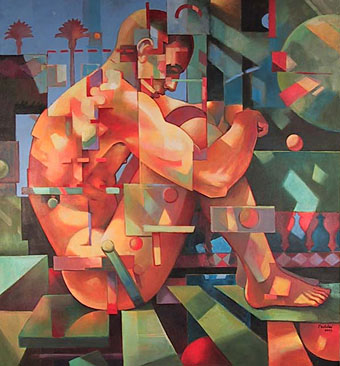
Meditation by Richard Taddei (2003).
Many of Richard Taddei‘s paintings of male figures draw upon Classical and other references so encountering the Flandrin pose in his work isn’t too surprising. I really like the semi-abstract works of which Meditation is an example.
Elsewhere on { feuilleton }
• The gay artists archive
• The recurrent pose archive
Dark horses
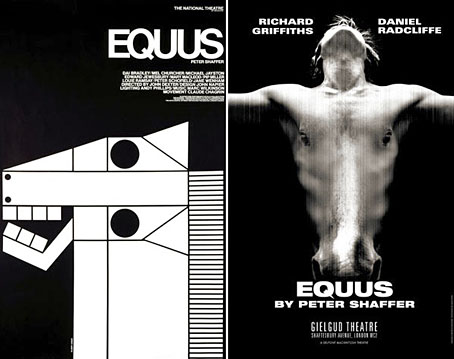
A juxtaposition of old and new theatre posters in the New York Times caught my eye this week, part of a feature about the current Broadway run of Peter Shaffer’s play. The news there, of course, has been Daniel Radcliffe’s on-stage nudity; understandable, perhaps, but celebrity trivia has overshadowed appraisal of Shaffer’s work as a piece of art.
What struck me seeing these was the two very different approaches to the same design problem. Given the subject matter, using an image of a horse is somewhat unavoidable as well as being immediately attractive since horses nearly always look good. The freight of historical and cultural association they carry is also one of the themes of the play. I really like the spare treatment of Gilbert Lesser’s 1976 poster for the National Theatre (left) and much prefer it to the new version used for the London and New York shows. The Lesser poster has the quality of a puzzle, matching the psychological piecing together of the story and Alan Strang’s accusation that Dysart the psychiatrist is always “playing games”. It also has a sinister quality lacking in the contemporary version; Shaffer’s Equus is an unforgiving god and the black eyes could refer to the blinded horses. The Photoshop horse looks altogether too mundane and is it my imagination or is the horse head misshapen slightly in order to fit the torso?