Schütze and Unstable at Maggs Bros

schutze.jpg

Maggs Bros. Ltd, London, hosts two events soon featuring { feuilleton } friends and cohorts. First up is Paul Schütze with Air Into Light, a showing of eighteen of his photo prints with musical and perfume accompaniment. Paul has been making perfume a subject of particular concern recently. The combination of sound and scent is still little explored despite Scriabin’s ambitious plans for his apocalyptic Mysterium. Air Into Light opens on 12th March.

biroco.jpg

Chaos (2001) by Joel Biroco.

Unstable is a Strange Attractor event which will run from 8th May to 8th June, 2012 presenting new and old work by Battle of the Eyes (Chris Long & Edwin Pouncey), Joel Biroco, Julian House and Cathy Ward. Maggs Bros. has a page with exhibition details here including a PDF catalogue.

Previously on { feuilleton }
Strange Attractor Salon

The Piper at the Gates of Dawn

witw1.jpg

Illustration by W. Graham Robertson (19o8).

(No, this doesn’t concern Pink Floyd.)

The chapter – The Piper at the Gates of Dawn – is normally dropped because it jars, seems so strange compared to all the others and, to some, is vaguely homoerotic. [Kenneth] Grahame thought it essential.

Thus Mark Brown discussing the curious seventh chapter of The Wind in the Willows (1908) wherein Mole and Rat have a mystical encounter with the Greek god of nature in the British countryside:

Perhaps he would never have dared to raise his eyes, but that, though the piping was now hushed, the call and the summons seemed still dominant and imperious. He might not refuse, were Death himself waiting to strike him instantly, once he had looked with mortal eye on things rightly kept hidden. Trembling he obeyed, and raised his humble head; and then, in that utter clearness of the imminent dawn, while Nature, flushed with fullness of incredible colour, seemed to hold her breath for the event, he looked in the very eyes of the Friend and Helper; saw the backward sweep of the curved horns, gleaming in the growing daylight; saw the stern, hooked nose between the kindly eyes that were looking down on them humorously, while the bearded mouth broke into a half-smile at the corners; saw the rippling muscles on the arm that lay across the broad chest, the long supple hand still holding the pan-pipes only just fallen away from the parted lips; saw the splendid curves of the shaggy limbs disposed in majestic ease on the sward; saw, last of all, nestling between his very hooves, sleeping soundly in entire peace and contentment, the little, round, podgy, childish form of the baby otter. All this he saw, for one moment breathless and intense, vivid on the morning sky; and still, as he looked, he lived; and still, as he lived, he wondered.

Brown’s article concerns a forthcoming exhibition, Writing Britain: Wastelands to Wonderlands, at the British Library, part of the summer’s Olympic celebrations. Kenneth Grahame’s hand-written text of chapter seven will be on display together with a later Arthur Rackham illustration of the goat god. The Library makes a point of noting that the Pan chapter is sometimes excised from the book although I’m not sure how often this occurs, it’s been present in all the editions I’ve seen including the cheap paperback edition I have somewhere. W. Graham Robertson’s rather fine drawing above (showing Mole and Rat bowing to their presiding deity) embellishes the first UK edition. Paul Bransom’s illustration below is the frontispiece to a 1913 US edition.

witw2.jpg

Illustration by Paul Bransom (1913).

One benefit of this bit of news has been finding Robertson’s illustration which gives Brown’s use of “homoerotic” a slight twist. Robertson was a children’s illustrator and playwright who Neil McKenna in The Secret Life of Oscar Wilde (2003) describes as being a member of the surreptitiously gay art world in London during the 1890s. (If there’s to be any dissent about this let’s note that one of his plays was entitled Pinkie and the Fairies…) Robertson knew Oscar Wilde but fell in with the contra-Wilde fraternity, notably Robert de Montesquiou, so gets left out of many accounts of Wilde’s circle. He was however immortalised by John Singer Sargent in this well-known portrait. I’ll be writing a little more about Robertson and Sargent’s painting at a later date. For more about the surprising recurrence of Pan in Victorian and Edwardian literature, see this earlier post.

Writing Britain: Wastelands to Wonderlands at the British Library opens on May 11th and runs throughout the summer.

Elsewhere on { feuilleton }
The illustrator’s archive

Previously on { feuilleton }
The Great God Pan
Peake’s Pan

Weekend links 94

walpoth.jpg

Mateo (2011), carved wood sculpture by Bruno Walpoth.

“Dennis Potter’s [The Singing Detective] is 25 years old but still feels avant garde,” says Stephen Armstrong. No fucking kidding, I watched the DVDs again last weekend. Potter’s drama featured non-linear flashbacks, song-and-dance hallucination sequences, an intertextual sub-plot, and a central character who was vitriolic, misanthropic, misogynist and covered from head-to-toe in flaking skin. This wasn’t exiled to an arts channel ghetto but was primetime viewing, Sunday evenings on BBC 1. • Related: “Is Dennis Potter’s singalong noir miniseries the all-time pinnacle of television drama? Graham Fuller thinks it is.”

• American band Earth are using Kickstarter to fund their next project, Wonders from the House of Albion, an LP/CD/DVD/book combining their music with “field recordings from various megalithic and other sites of human/fairy encounters across the UK, also the use of ritual and folkloric magical practices”. Dylan Carlson & Adrienne Davies discuss their work here.

…sort of like Nabokov’s objection to Our Lady of the Flowers, which he saw as a masterpiece but thought, “Why isn’t this book about women?” Nabokov hated homosexuality and was very edgy around it, partly because his own brother was homosexual and his uncle. And he believed that it was hereditary, so he was always nervous about it.

Edmund White chooses five favourite gay novels. Related: a dance adaptation by Earthfall of Jamie O’Neill’s At Swim, Two Boys.

• “The Belbury Tales is the kind of record you feel should have come out on Vertigo around ’73, but never actually did.” Belbury Poly‘s Jim Jupp on ploughman’s lunches, prog rock and avoiding “Clarkson/Wakeman territory”.

Morbid Curiosity: The Richard Harris Collection, an exhibition at the Chicago Cultural Center exploring “the iconography of death across cultures and traditions spanning nearly six thousand years”.

Geoff Dyer’s Zona, an exegesis of Andrei Tarkovsky’s Stalker, is officially out at the end of this month. The book is reviewed here and here.

• “Through a blurry electronic prism“: MetaFilter traces a history of analogue video synthesis.

Dylan Ricci‘s wonderful photography of the male body has moved to a new location.

Infinite Forest by Studio a+i, a design for an AIDS memorial in New York City.

Susan Cain discussing “the power of introverts” at Scientific American.

• Strange Flowers on that icon of Middle Eastern music, Umm Kulthum.

Ewan Morrison on “The self-epublishing bubble”.

Winter Sleep (2007) by Valgeir Sigurdsson feat. Dawn McCarthy | Black (2008) by Ben Frost with Valgeir Sigurdsson, Sam Amidon & Sigrídur Sunna Reynisdóttir | Unbreakable Silence (2011) by Ben Frost & Daníel Bjarnason

Weekend links 92

bmc1.jpg

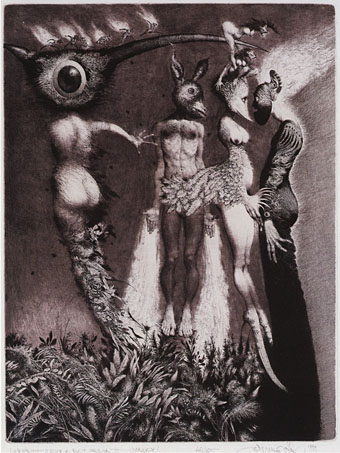
Untitled etching by Briony Morrow-Cribbs.

• An interview with author Paul Russell whose new novel, The Unreal Life of Sergey Nabokov, concerns the gay brother of the celebrated Vladimir.

• Joseph Cornell turns up again in a report at Strange Flowers about Locus Solus, an exhibition in Madrid devoted to the work of Raymond Roussel.

Night of Pan: 42 seconds of occult freakery by Bill Butler featuring Vincent Gallo, Twiggy Ramirez plus (blink and you miss him) Kenneth Anger.

Jan Švankmajer talks (briefly) about his new film Surviving Life. A subtitled trailer is here; the very different Japanese trailer is here.

Cormac McCarthy turns in his first original screenplay. I’d rather he turned in a new novel but any new Cormac is better than none at all.

Barnbrook show off another design for the latest CD from John Foxx & The Maths.

Melanie McDonagh asks “Where have all the book illustrators gone?”

• Congrats to Evan for getting his poetry in the New York Times.

Margaret Atwood on writing The Handmaid’s Tale.

Subliminal Frequencies: An Interview With Pinch.

The (Lucas) Cranach Digital Archive

The M.O.P. Radionic Workshop

• Music promos of the week from the Weird Seventies: All The Years Round (1972) by Amon Düül II, and Supernature (1977) by Cerrone.

Studies in the Horror Film: The Exorcist edited by Danel Olson

exorcist2.jpg

Growing up in the 1970s put cinema-going kids of my generation in a frustrating position: we knew that the censorship of decades past was over but we weren’t old enough to see any of the films benefiting from the relaxed strictures. Consequently some notorious releases grew larger in the imagination than they might have otherwise, especially when their cryptic titles—A Clockwork Orange, Straw Dogs—gave no clue as to their content. Looming larger and darker than all of these was William Friedkin’s The Exorcist whose content was at least clear despite that vague poster design. The film arrived in Britain in March 1974 bearing a ferocious reputation thanks to tabloid reports of a cursed production and hysteria at US screenings. The film’s power has been significantly reduced since its release, not least because of its enormous success which gave us two sequels, a prequel that went through three directors (and ended up as two separate films), a reworked version of the original in 2001, and all the endless parodyings of Linda Blair’s torment.

exorcist3.jpg

Pazuzu and Father Merrin face off in the desert.

The film and its sequels are explored in a new book from Centipede Press which turned up before Christmas but which has taken me a while to get round to since I wanted to re-watch the film first. I hadn’t seen The Exorcist for many years, the last viewing being a shoddy VHS copy so it was good to see it again in a decent DVD print. I still find the film more admirable on a technical level than as a work of cinematic art: the story has always been a piece of Catholic propaganda—something that author William Peter Blatty freely admits—and even if I set aside my lapsed-Catholic prejudices I have a hard time taking seriously Blatty’s religious narrative. Friedkin is a very good thriller director but the tension sags in the first half of the film when the possessed (or is she?) Regan is being hauled around various hospitals while Father Karras frets about his dying mother and his lapsed faith. A sub-plot with police detective Lee J. Cobb—a pared-down thread from the novel—is completely superfluous. On the plus side, the acting is first-class, the almost wordless sequence in Iraq makes a tremendous opening, and the exorcism itself still packs a considerable punch not least because of Dick Smith’s remarkable makeup effects.

exorcist1.jpg

The Centipede volume is a substantial collection (516 pages) of interviews and essays edited by Danel Olson, part of the publisher’s Studies in the Horror Film series. The interviews are especially worthwhile being taken in part from back issues of Cinefantastique magazine: Friedkin and Blatty appear twice, there are talks with Dick Smith and Friedkin’s editor Bud Smith (no relation), and Paul Schrader discusses his troubled prequel, Dominion (2005).

Among the essay highlights Thomas Ligotti juxtaposes Blatty’s moral and theological universe with the amoral pessimism of HP Lovecraft while Blatty recounts the factual origin of his novel in a piece taken from The Exorcist: From Novel to Film (1974). Successful films that spawn sequels often present challenges for critics when the later installments begin to deviate from the premise of the original. Part of the interest in Olson’s collection is seeing how the writers delve into the imperatives of Hollywood sequelitis for moments of value. The critical essays are thought-provoking without wandering into the quicksands of jargon-ridden academicism: Kendall Phillips examines the influence of The Exorcist on The Texas Chainsaw Massacre (1974), there’s a spirited attempt by James Kloda to defend John Boorman’s much-vilified The Exorcist II: The Heretic (1977), and James Marriott points out that horror films are a continuing source (however debased) of metaphysical speculation.

This last notion is an intriguing one: people always take The Exorcist at face value—God and Satan are real; it’s a spiritual battle—yet the demon we see in the film is the Assyro-Babylonian god Pazuzu, a spirit never mentioned by name in the Bible, or in the film for that matter. I’d suggest there’s an argument to be made that it’s only Pazuzu that actually exists as a supernatural force in the film’s world, and that the prayers of the priests confound it but temporarily.

exorcist4.jpg

Pazuzu has entered the building.

The aura of metaphysical threat may have diminished but The Exorcist still wasn’t allowed a UK TV screening until 2001. Something about the idea of people confronting supernatural evil continues to compel, however antiquated the scenario may seem. This isn’t too surprising when we have nominees for the US Presidential elections talking in hyperbolic terms about God and Satan without being widely ridiculed. Then there’s news stories like this recent one in the UK: “Boy ‘tortured and drowned’ over witchcraft claims, court told“. Blatty and Friedkin’s devil child was one of the most influential films of the 1970s, and may well be the most influential despite the continued popularity of the wretched Star Wars cycle. In the past couple of years alone we’ve had The Last Exorcism (2010) and The Rite (2011), with The Devil Inside due to appear on UK cinema screens in March; possessed girls appear in all three films. Danel Olson could easily fill another volume tracing this influence through the decades.

Studies in the Horror Film: The Exorcist isn’t published until March 2012 but can be pre-ordered at Amazon (US) and Barnes & Noble.

Previously on { feuilleton }
A playlist for Halloween: Orchestral and electro-acoustic
Dead on the Dancefloor
The monstrous tome